Mark your diaries! My must-see art for this year.

Steadily, tentatively, light is creeping back. The snowdrops have been sighted at the Botanic Gardens. There are still a few dregs of colour in the sky after the work day is done. Slowly we begin to emerge from hibernation, and what better way to celebrate this than by letting you know about some of the art exhibitions I’m most looking forward to this year.

Over my years of writing about art (Encounters Art is four years old in May this year!) there are a few things I’ve learnt. Unfortunately, you have to be organised. If you see something you like the look of, make sure you go to see it close to the start of the run. Otherwise, you just won’t get round to it. I have learnt this the hard way far too many times. Even with shows that will be on until 2026, it’s better to strike while the iron’s hot. So, let’s all get our diaries out and get these dates marked! Exhibitions are listed in chronological order.
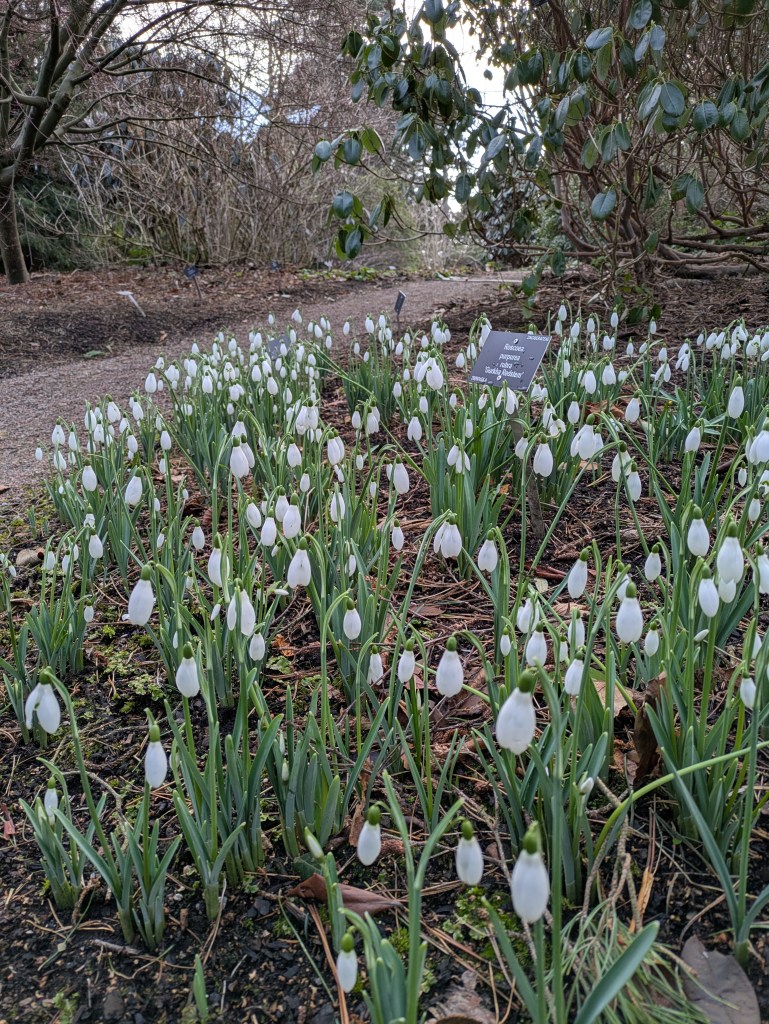
Snowdrops sighted at the Botanics

The Scottish Colourists – Radical Perspectives at Dovecote Studios

Friday 7 February to Saturday 28 June

This looks like a fascinating show, hosted by Dovecot Studios – one of the most underrated places to see art in Edinburgh. The Scottish colourists were a group of four painters around in the early 20th century, who were influenced by the time they spent in France. This exhibition shows their work alongside Matisse and Derain, as well as Vanessa Bell and Duncan Grant from the Bloomsbury Group. I LOVE this era of painting but don’t know much about this much beloved group of Scottish artists, so I’m looking forward to learning more. General Admission tickets are £12.
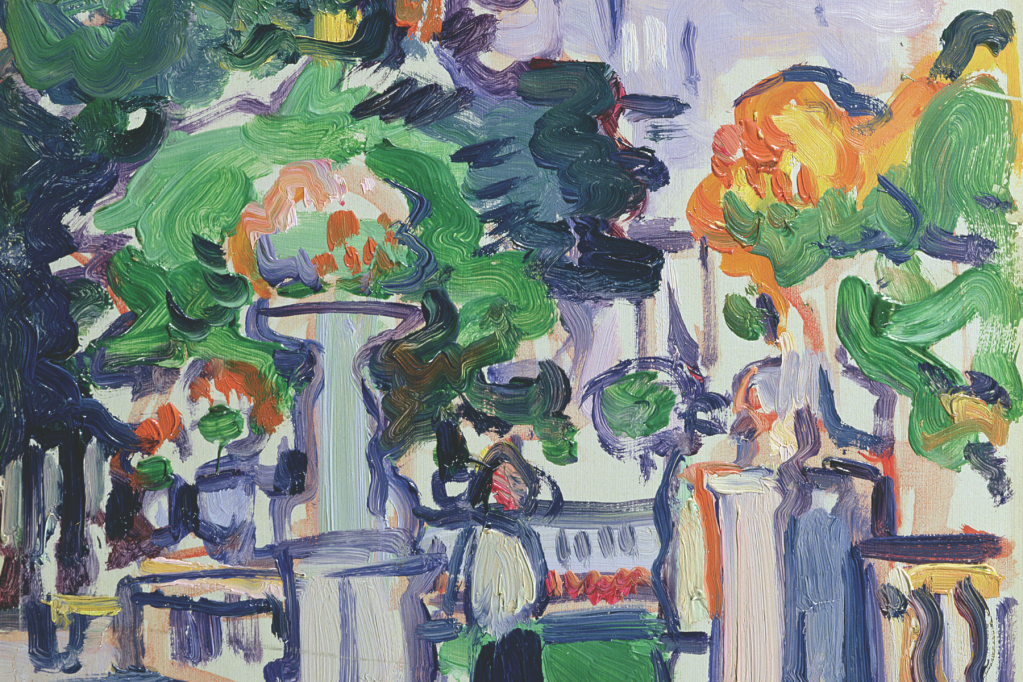
Luxembourg Gardens by SJ Peploe, c.1910 from the Flemming Collection

Jerwood Survey III at Collective

Friday 28 February to Sunday 4 May (Wednesdays – Sundays)

Collective, perched high atop Calton Hill, is an art space I feel I have neglected. I think I’ve seen a few shows there that didn’t quite land with me, which have made me lazy about climbing that hill. However, I intend to rectify that this year. Their first show of the year is the Jerwood Survey III. This initiative brings together ten emerging, early career artists who have been recognised and selected by leading artists for the outstanding work they are creating. Collective is the final stop on this exhibition’s tour, it has been to London, Cardiff and Sheffield. I love the concept of a touring exhibition – several feature in this list. Themes addressed by the artists include colonialism, climate change, healing, gender, sexuality, folklore and spirituality. So this is one to visit when you’ve got brain space and energy for art that can challenge, provoke and make you encounter the big topics. Entry is free, though a £5 donation is suggested. Please donate if you can afford to do so: these are trying times for the arts in Scotland and exhibitions are expensive to run. Collective is open Wednesday-Sunday.

Acts of Creation: On Art and Motherhood at Dundee Contemporary Arts

Saturday 19 April to Sunday 13 July

I love Dundee Contemporary Arts. If I lived in Dundee I’d be there all the time at their cinema which seems to only show interesting movies (I just checked, it’s also showing Mad About the Boy, which is fine with me). The Acts of Creation exhibition has been on my radar for a while. Hettie Judah, the curator, has done an amazing job of advocating for artists who are also mothers. She uses her Instagram as a platform for artist-mothers work and I love the idea of an exhibition that interrogates motherhood in all its complexity. Featuring some pretty big hitters of the art world, including Tracey Emin, Paula Rego and Chantelle Joffe, I’m so glad this is finally coming to Scotland – it began at the Hayward Gallery in London and has also been at the Millenium Gallery in Sheffield. I think tickets are free, can’t see anything to suggest otherwise. The gallery is open Wednesday-Sunday.
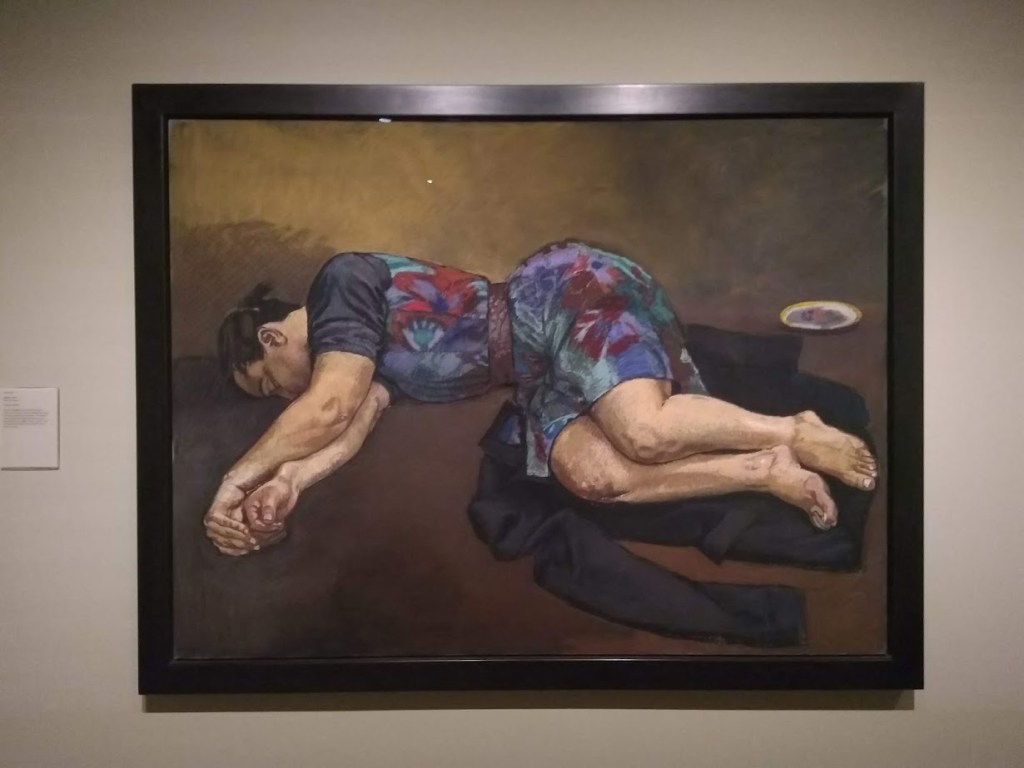
Sleeper by Paula Rego, 1994
Photographed at the ‘Obedience and Defiance’ show at Scottish National Gallery of Modern Art, 2019

The murals at Mansfield Traquair

This is another one on the “I’ve been meaning to go for years but never got round to it” list. The Mansfield Traquair Centre is referred to by some as ‘Edinburgh’s Sistine Chapel’, which is a pretty big claim. Originally it was a Catholic Apolostolic Church, completed in 1895. The building’s most famous feature is its murals, painted by the renowned Phoebe Anna Traquair in the 1890s. The space is currently used for weddings, parties and corporate events, but they host open days and tours usually on the second Sunday afternoon the month, with more dates added during the Fringe. Free – more info on tours and dates here.

Linder: Danger Came Smiling at Inverleith House, Royal Botanical Gardens

Friday 23 May to Sunday 19 October

I was really excited hearing about this show and was trying to figure out when I could get down to London to see it at the Hayward Gallery when, lo and behold I find out it’s coming to Inverleith House! This will be a remarkable show – a retrospective of feminist icon Linder’s work in the year she turns 70. This weekend in the Guardian there was a long and fascinating interview on how she uses trauma and porn to inform her art, and I definitely think she’s going to ruffle a few feathers of people visiting the Botanics! She’s a very cool punk artist who does incredible collages. This one, of a woman seemingly in a picture of domestic bliss, is gouging her eyes out with a fork (I saw it at the Women in Revolt exhibition at the National Galleries of Scotland earlier this year). I can’t wait to see more of her provocative and radical work. Not sure on ticket details and pricing yet – watch this space.
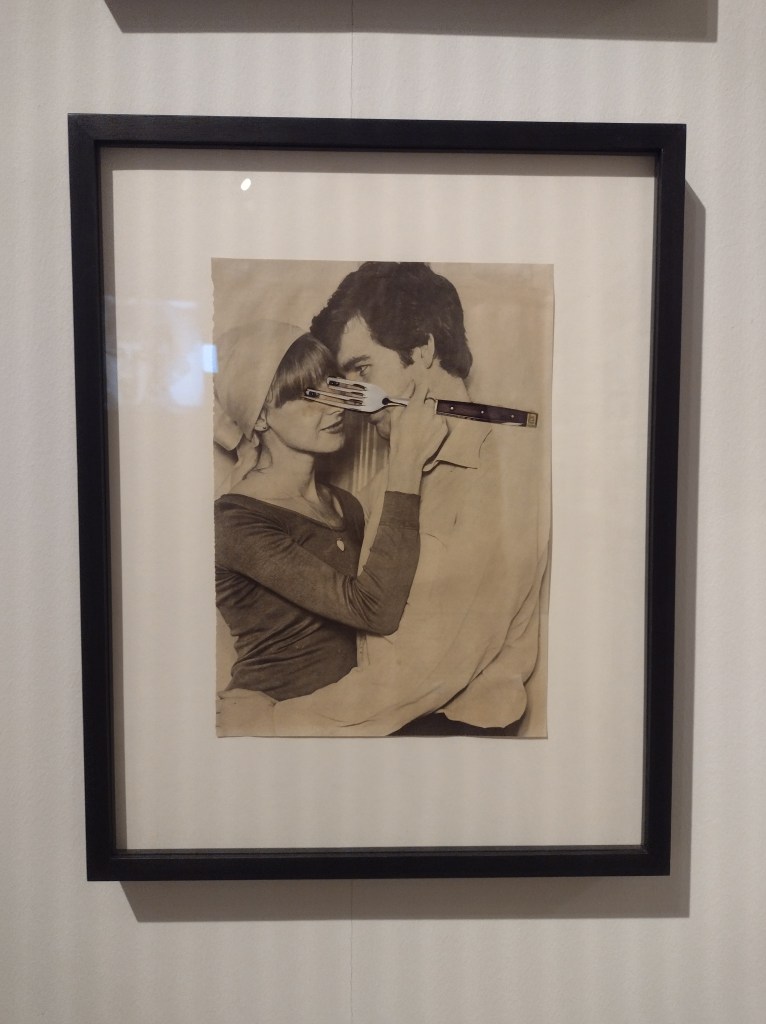
Untitled collage by Linder (1976)

Mike Nelson at Fruitmarket

Friday 20 June to Sunday 28 September

I first came across Mike Nelson’s work at a huge exhibition at Tate Britain in 2019, which art critic Laura Cumming referred to as his ‘all time masterpiece’. I’ll be interested to see where he goes from there. His work features huge installations, often formed from scrap metal and defunct machinery. For this exhibition, Nelson will be using Fruitmarket’s bare Warehouse as a studio in the weeks preceding the exhibition, and I think his work will marry well in that space, where the art has to take on an industrial scale. Fruitmarket exhibitions are free.
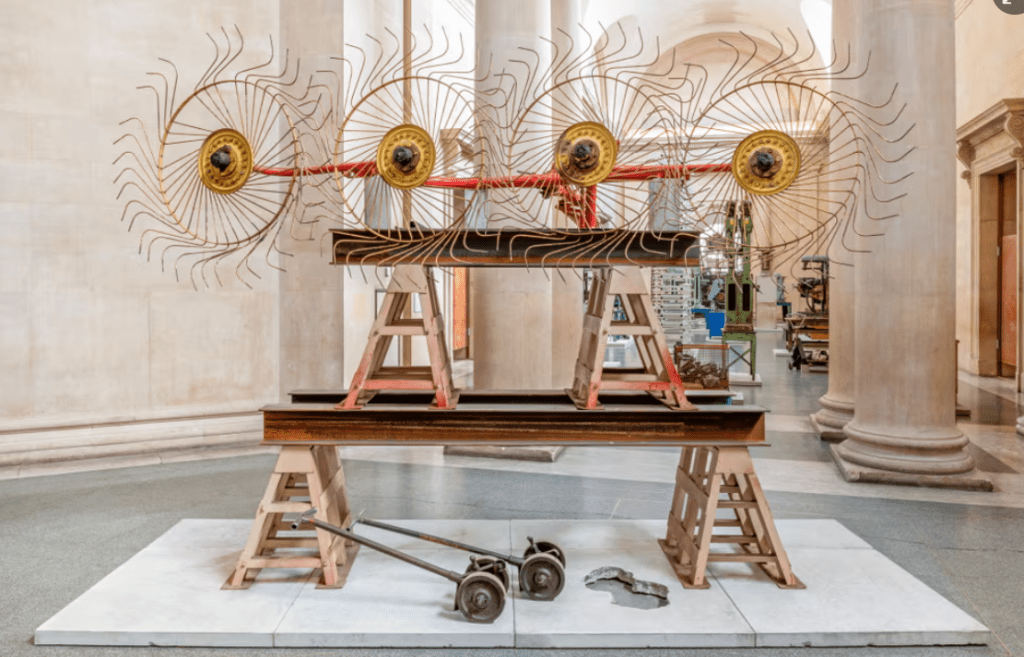
A detail from Mike Nelson’s The Asset Strippers at Tate Britain, 2019

Andy Goldsworthy – Fifty Years at the Royal Scottish Academy

Saturday 26 July – Sunday 2 November

You have probably seen an Andy Goldsworthy artist without having even realised it. Last week at the Botanic Gardens a slate structure that looked like an old cairn caught my eye, and it turned out to be a large sculpture by him. His work, Coppice Wood, at Jupiter Artland is probably my favourite there. He uses nature and the natural elements of our world to craft artwork that is simultaneously vast in scale and understated in tone. The exhibition brings together more than 200 works including photographs, sculptures and expansive new installations built in-situ and specially created for this exhibition. Unlike some of the other shows on this list, it’s only being exhibited in Edinburgh – part of Edinburgh Art Festival – but one to visit before the Fringe crowds arrive, if you can. Full price tickets are £19. Read to the end for my tip on getting cheaper tickets.
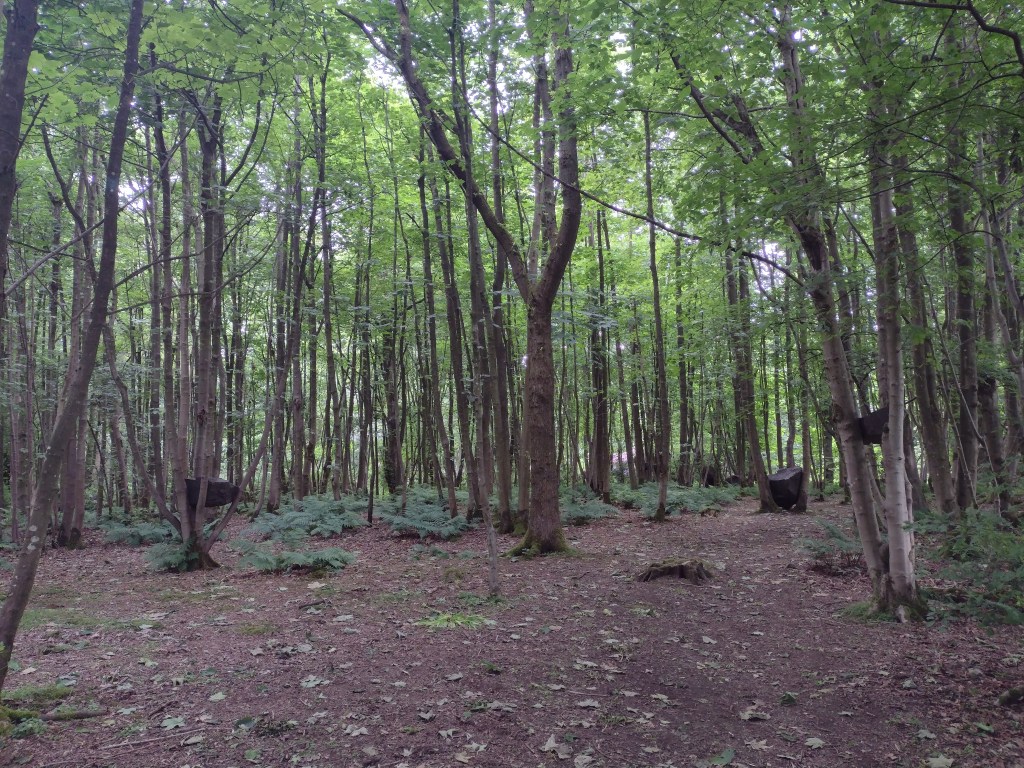
Stone Coppice by Andy Goldsworthy (2009) at Jupiter Artland

Jupiter Rising x EAF

Date TBC

Those of you who’ve been reading the blog for a while know I’m a big fan of both Jupiter Artland and Edinburgh Art Festival. But I’ve never made it to their big collaborative summer party/festival, Jupiter Rising x EAF. This time, I’m determined to be there. It brings together experimental music, performance, poetry and art. Essentially it sounds like a big fun queer art party. Does anyone want to give me a lift?

Pittenweem Arts Festival

Saturday 2 to Saturday 9 August

This is an event I’ve been meaning to go to for a while, and it’s in one of my favourite corners of Scotland. Pittenweem is one of the prettiest coastal villages in the East Neuk of Fife. The annual art festival brings the joy of art to everyday spaces – homes, garages and sheds. I think it sounds like a lovely way to spend a day, wandering along the Fife Coastal Path (hot chocolate at the Cocoa Tree Cafe, lunch at the East Pier Smokehouse) then browsing some art, and chatting to artists, maybe purchasing something new for your home too.
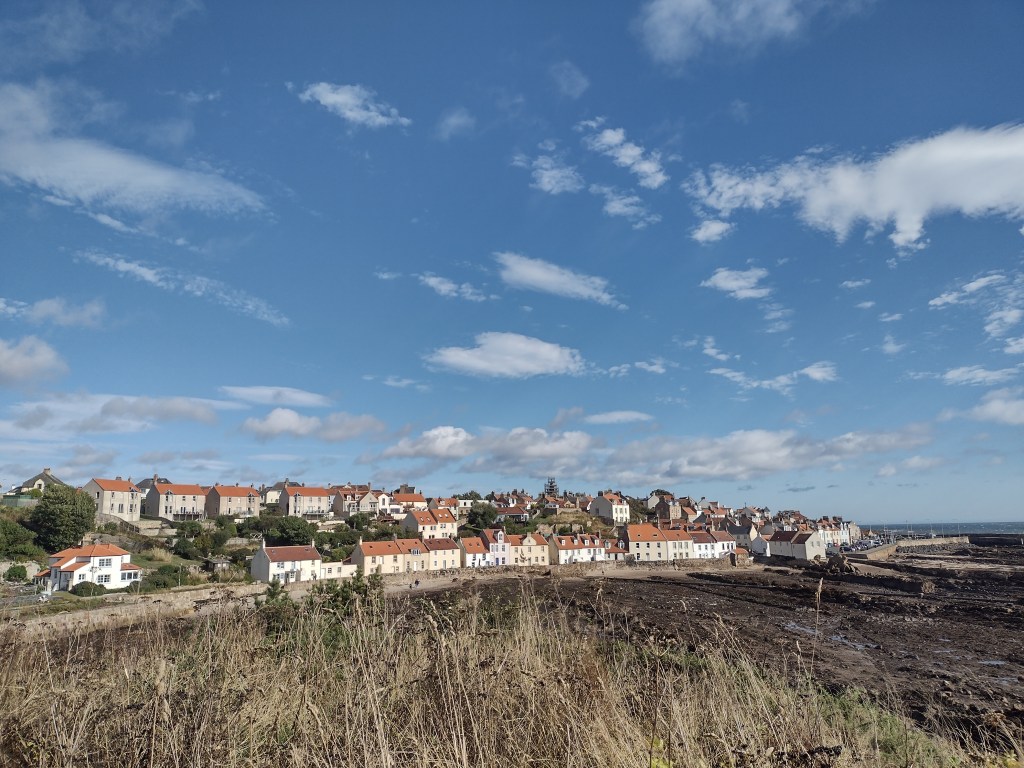
Pittenweem looking pretty

Art Walk Porty

6 to 14 September 2025

OK I am biased with this one as I’m on the Board of the organisation, but Art Walk Porty is always one of the highlights of the art calendar in my year. It brings together artist residencies, with events, workshops, and the art houses, where people open up their homes to exhibit their art. While the programme is yet to be announced, this year marks 10 years since the organisation began, so it’s bound to be a packed and celebratory week. I am always in awe of how much the Art Walk team manage to deliver, and they recently managed to secure multi-year funding from Creative Scotland for the first time. Watch this space as more details of the programme emerge.

Rolled over from last year, I still want to visit Mount Stewart House in Bute and the Italian Chapel, Orkney. You can read more about my 2024 bucket list in last year’s blog post here.

Finally, I feel the list wouldn’t be quite complete without a nod to two exhibitions I am intending to see in London. Firstly, Kiefer/Van Gogh at the Royal Academy London (28 June – 26 October) which is sure to be astounding. My Masters’ Dissertation was on Anselm Kiefer and his retrospective at the Royal Academy in 2014 was one of my favourite shows I’ve ever seen. At Tate Modern, I’m hoping to see Do Ho Suh: Walk the House (1 May – 19 October). This is after encountering his work for the first time at the one of my favourite exhibitions of the 2024 at the National Galleries of Scotland. I’m very keen to see more.
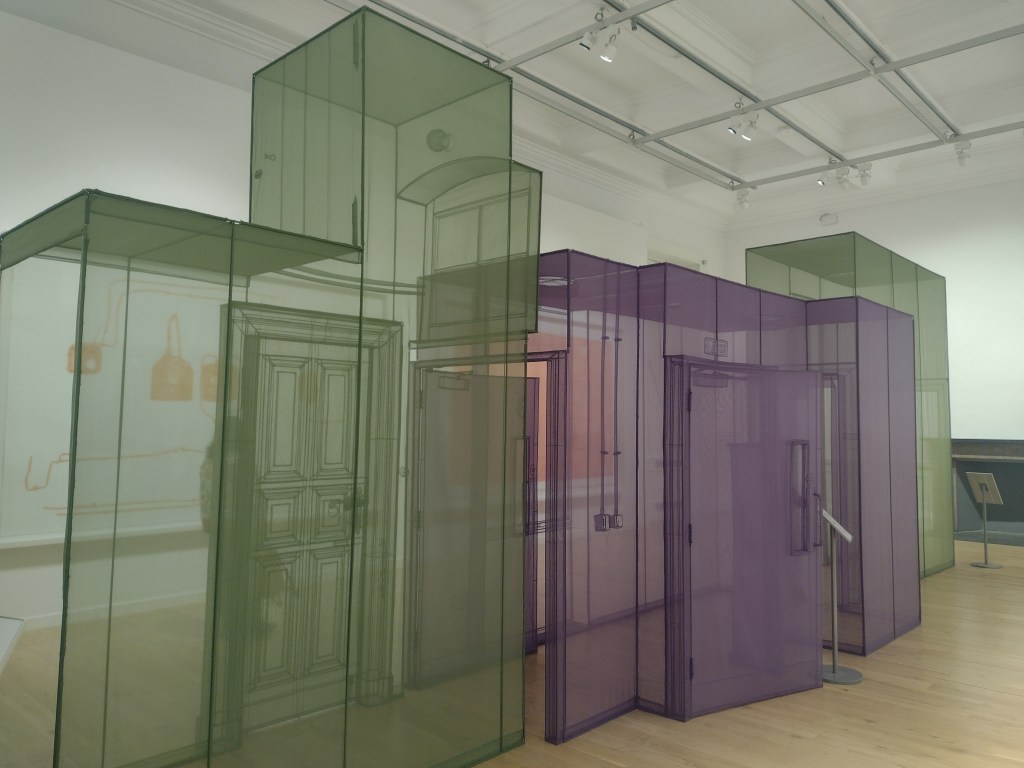
Do Ho Shu installation view at Tracing Time exhibition, National Galleries Scotland

Top tip: if you’re seeing lots of art this year, I’d recommend looking into buying a National Art Pass from the Art Fund, which currently costs £62.35 by direct debit. Almost every charging exhibition gives you a discount if you have the card, you get a cute quarterly magazine with interesting article and art news, and most importantly, you’re supporting the arts.

I’d love to hear what you’re looking forward to, and perhaps any major moments I’ve missed from my list! Feel free to get in touch using the comments, and don’t forget to follow me on Instagram to see if I make good on all these art ambitions for 2025.
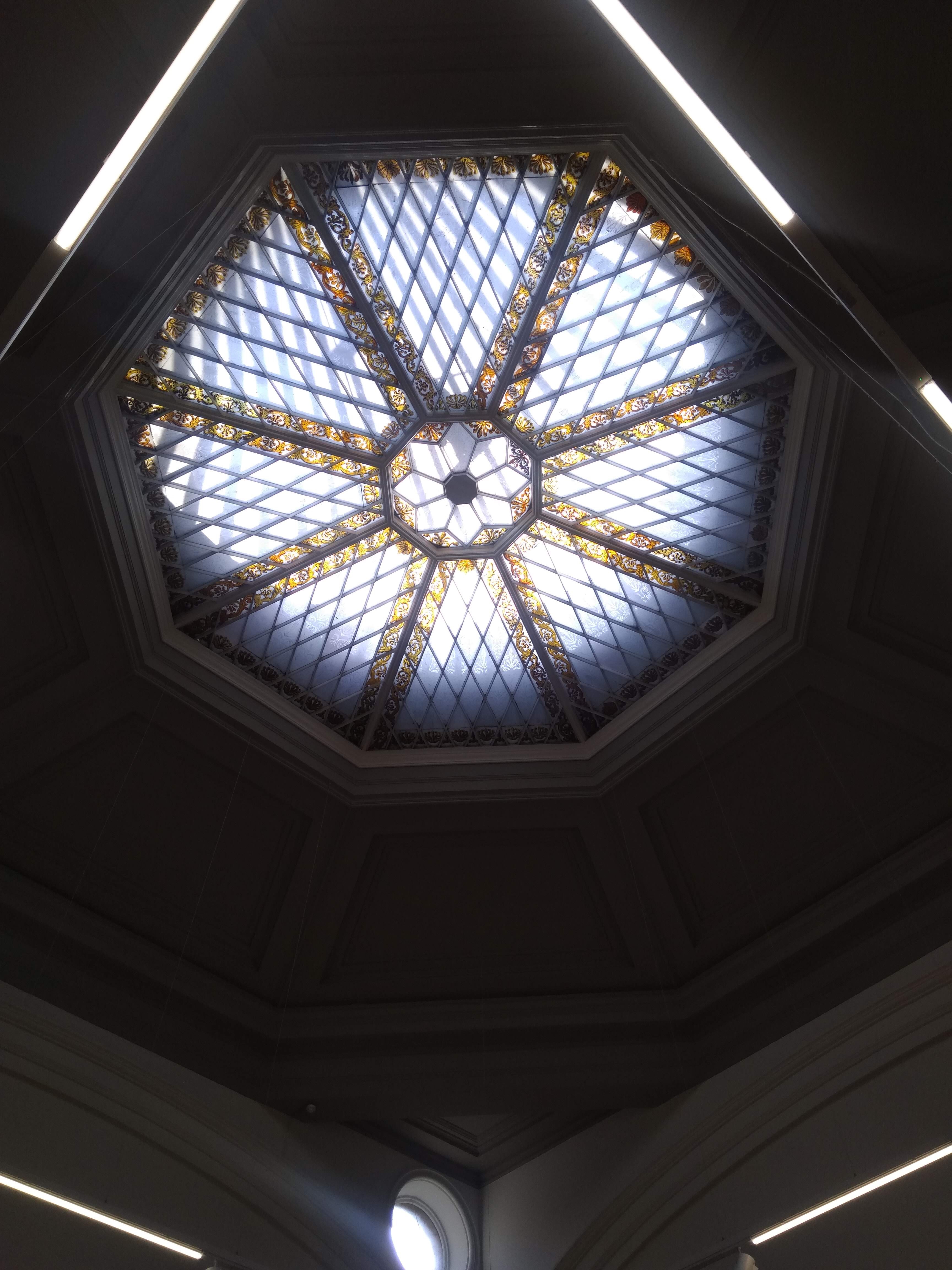
On the roof of National Museum of Scotland

Five to see at Edinburgh Art Festival

It only feels like yesterday that I put together my five to see at 2023’s iteration of Edinburgh Art Festival. And we’re already one week in! The Festival officially finishes on August 25th, but don’t fret. Many of the shows carry on beyond festival season. 

EAF is 20 years old this year and there really is something for everyone. So if you’re searching for something different to do this weekend, with a bit of space from the Fringe crowds, here are my suggestions.

Ibrahim Mahama: Songs about Roses

Fruitmarket Gallery until 6th October

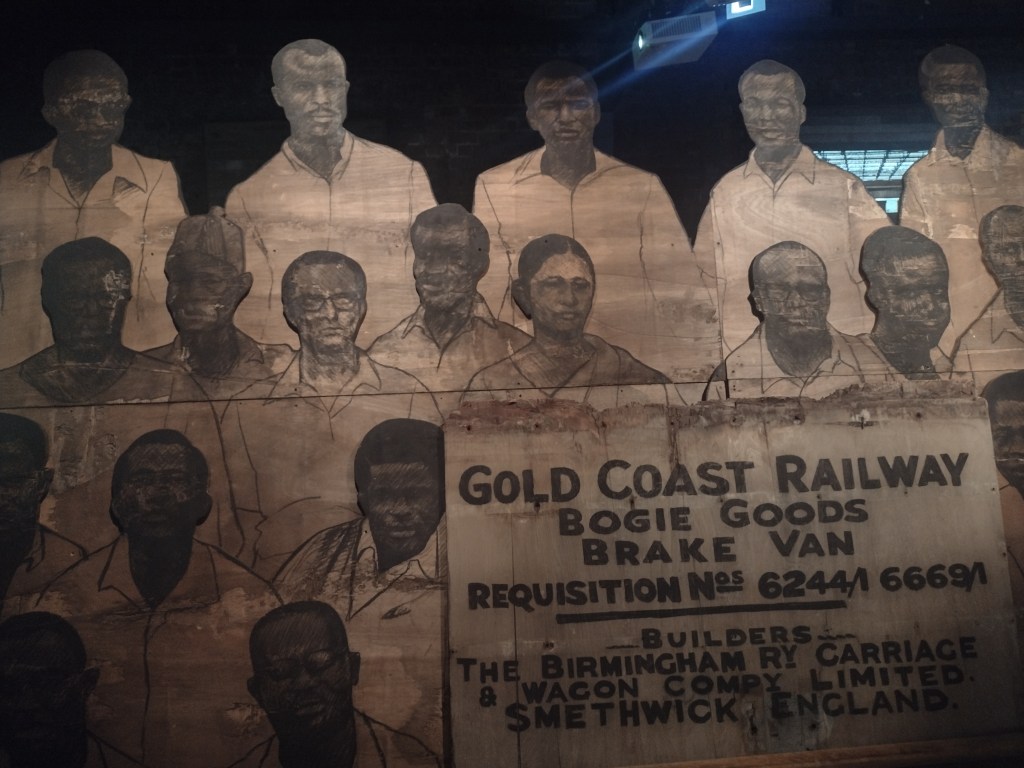
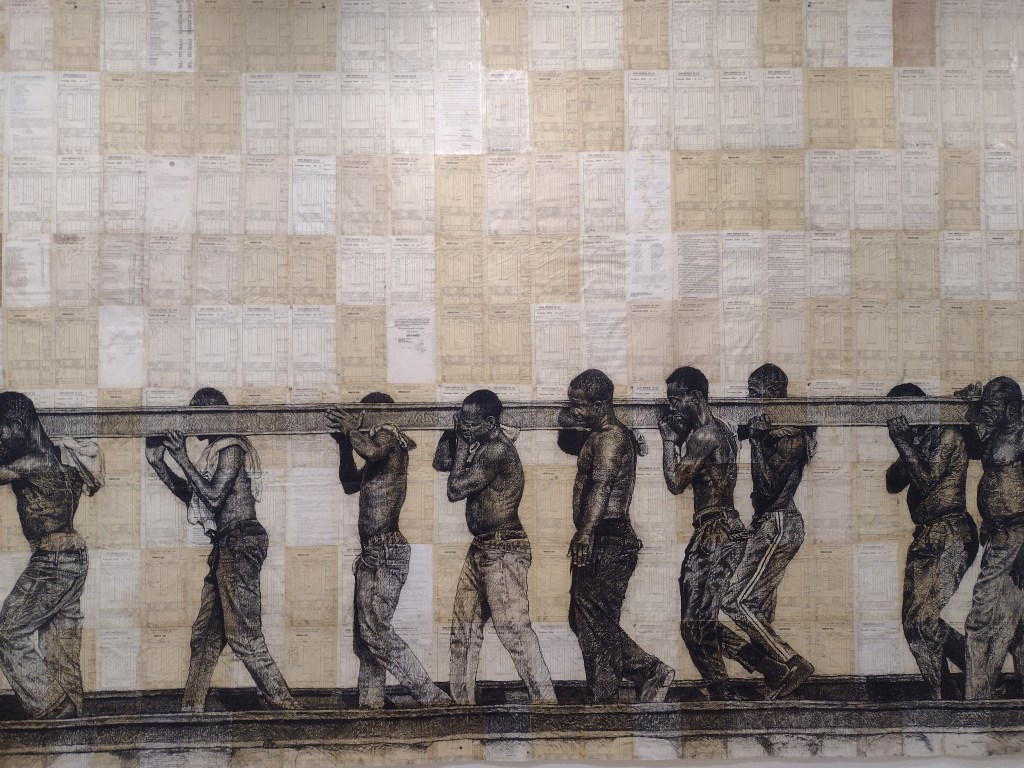
When talking to odious people about colonialism one of the things that might be brought up is how colonisers implemented infrastructure  – roads and railways – to the country that enabled it to advance. Songs about Roses explores the reality: these infrastructures were just a mechanism for extracting goods out of that land to make profit for the colonisers (pillaging). Mahama has collected huge pieces of a now defunct railway that was built by the British in 1923 to transport gold, minerals and cocoa around the area of Ghana that was then known as the Gold Coast. He has subverted and reframed these materials and given them new meaning in the process. In a video played on the ground floor, we see drone footage of these immense, rusted train carriages being transported across the Ghanaian landscape, like a funerary procession. Archival documents show the administrative nuts and bolts of empire building, that have now become the canvas for portraits and line drawings.

Detail of My Dear Comfort (2024) by Ibrahim Mahama

Delving further into archival material, Mahama has gathered group photographs of railway staff, which were taken pre-independence at railway workers’ retirement parties and company events. These are now rendered lifesize in charcoal and mounted on old railway tracks. The ghosts of colonial infrastructure have now returned to the Fruitmarket Gallery warehouse space: the place has become a monument to the railway workers, members of strong unions that played a key role in Ghanian independece and its immediate aftermath. It’s a dark room, thick with dust and the smells of industry. Perched as it is above Waverley station, I couldn’t help but think of Jamaican philosopher and academic Stuart Hall’s words on empires: ‘we are here because you were there’. These legacies are the ghosts of history and they have come home to roost.

Detail of Sekondi Locomotive Workshop (2024) by Ibrahim Mahama

Yet it’s not an exhibition that is about the story of historic exploitation alone. It’s also about Ghana’s future. The collaborative nature of Mahama’s practice is a source of hope: he sells his work in Europe and the USA and funds art and education institutions and projects in Ghana with the profits. Many of the works in the exhibition have links to audio of Muhama discussing the process of creating the works and exploring the ideas that inspired them – definitely worth a listen when you visit.

Renèe Helèna Browne: Sanctus!

City Art Centre until 25th August

I was lucky enough to meet artist Renèe Helèna Browne before seeing this piece, who explained how, though the surface story is about rally car driving, races and culture in Ireland, creating Sanctus! was really a mechanism to get to know their mother better. Browne discussed how, when thinking about their mother’s life, it was dominated by two systems: the catholic church which presided over her childhood, and the system of motherhood and raising children which followed. Both of these are explored in the work, but slowly, tentatively. The main piece is a film, lasting about 15 mins, obscured behind a red leather curtain (the red is a nod to the colour of Browne’s uncle’s rally car). As the viewer sits in the darkness we are confronted with the sounds of cars revving their engines. We see a distorted view of leaves and branches buffeted by the wind – reflections in the shiny paintwork of a vehicle.

What emerges is an intimate but simultaneously distant picture of the artist’s mother. At work at the farm. At home. Snippets of conversation where artist and mother discuss family deaths, the afterlife, faith and meaning. Their conversations seemingly evolve side by side but never quite join together. An intimate portrait of memory surfaces: the teenage child meticulously dyeing the mother’s hair and eyebrows. All the while the film explores the hyper-masculine space of rally driving. A little boy in full rally gear eagerly awaits the cars at the side of the road, poses for family photos with his father, uncles, cousins. Teenage boys drive cars in mesmeric circles like a dance, where they edge ever closer until you feel sure that one of them will collide (I think it’s called adjacent diffing). Meanwhile, we see the artist’s view from the sidelines. It feels as though this rally driving world is a source of nostalgia, a means of connection hovering close but always just out of reach. Fascinating and multilayered: I hope to go again to see the things I missed the first time. I also need to get some photos!

Home: Ukrainian Photography, UK Worlds 

Stills Centre for Photography until 5th October 

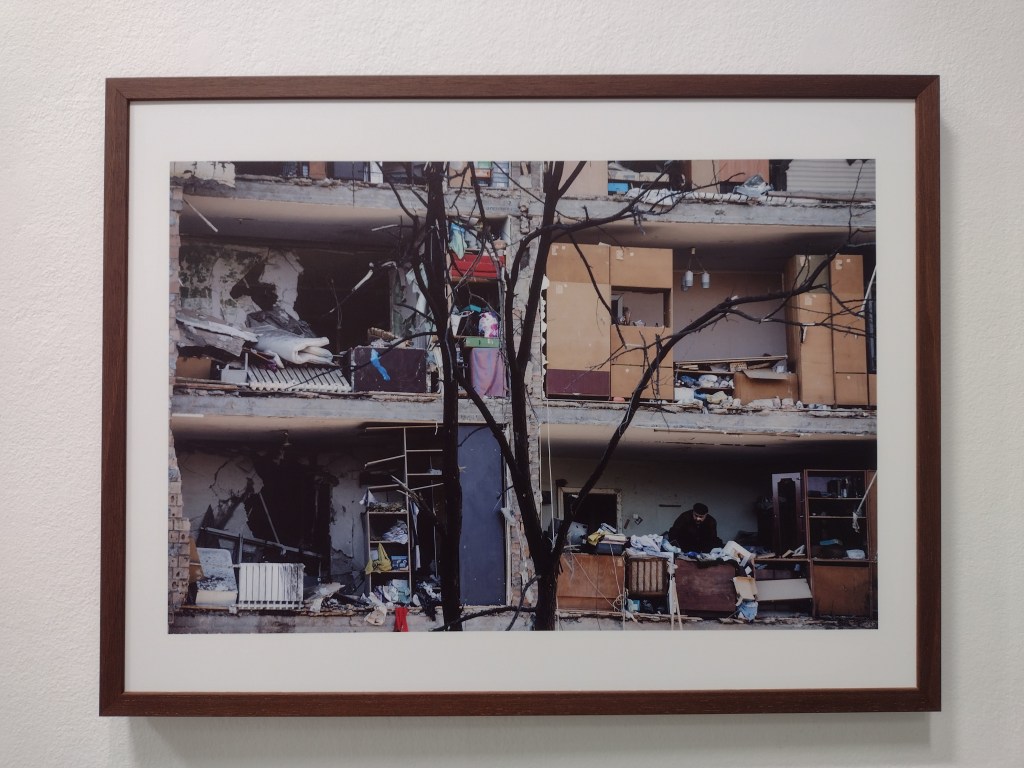
I am always drawn to the shows that Stills puts on and this one is no exception. There’s much talk about how now that everyone has access to good quality cameras via their smartphones, everyone’s a photographer. But when you go into a place like Stills you realise there is a still a difference. During the hype and excitement of the Fringe, it seems like the last thing you might want to do is look at photographs documenting the brutal realities of war. But the way this small but powerful show is put together makes it utterly necessary. We see a snapshots of clothes and possessions that refugees have left behind on a beach. There are insights too from Ukrainian life from the very end of the Soviet Era: in Passport (1995) photographer Alexander Chekmenev visiting the elderly at home to take passport photos and exposing the brutal reality of their living conditions. There’s an apartment block which looks like a doll’s house because the front of it has come clean off.

Damaged buildings in the aftermath of shelling, Podilskyi district, Kyiv (March 2022), Mykhaylo Palinchak

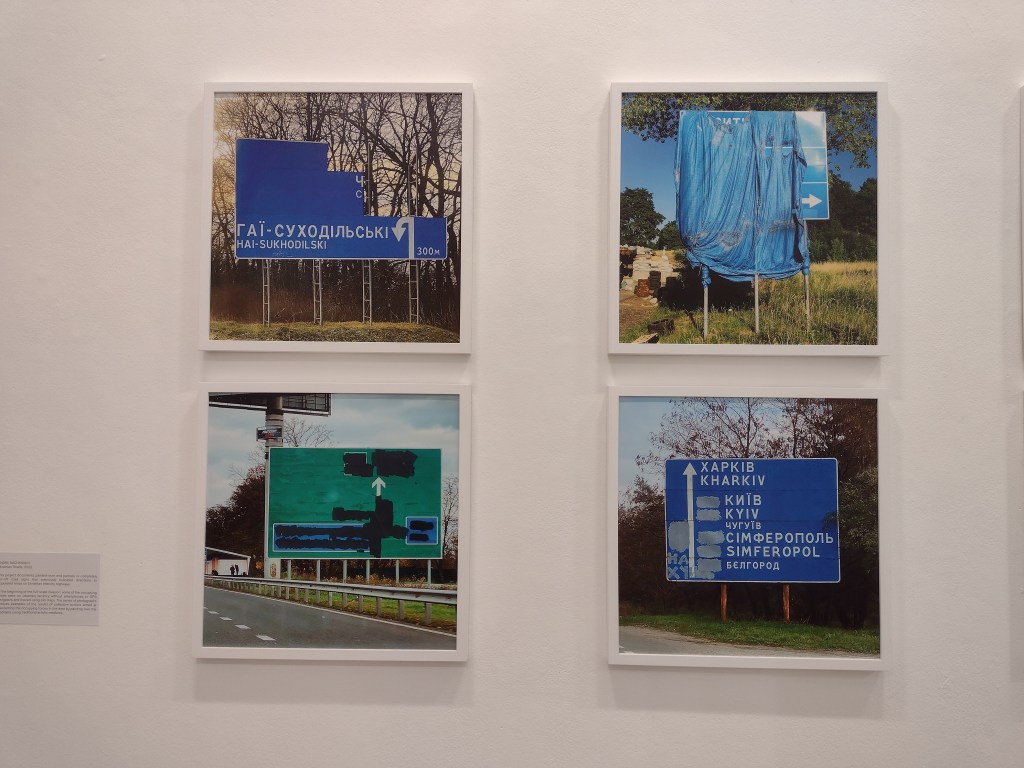
In the series that captured my attention the most, Ukrainian Roads (2022) by Andrii Ravhynskyi, we see roadsigns that have been obscured by bin liners, plastic bags, the mileage between towns and village names daubed with black paint: all attempts by local Ukrainian citizens to confuse and disorientate the Russian army whose GPS was patchy at the beginning of the war. Something so simple as a road sign, that looks so familiar, conflated with what has now become familiar because they are synonyms of war: Kharkiv, Kyiv, Simferopol. These images are deeply unsettling but demand to be seen.

Ukrainian Roads (2022) by Andrii Ravhynskyi

Platform24: Early Career Artist Award

City Art Centre until 25th August

I always enjoy seeing what the EAF Platform artists are up to. Now in its 10th year, the platform programme is a group show for emerging artists, and they have taken over a floor of the City Art Centre with this year’s presentation. The artists are Alaya Ang, Edward Gwyn Jones, Tamara MacArthur and Kialy Tihngang, who were asked to respond directly to the themes of the 2024 programme: intimacy, material memory, protest and persecution. My particular favourite was Gwyn Jones’ multi channel video piece Pillory, Pillocks!, where we see muck, slime, food residue and all manner of unknown substances flying at the face of a person looking back at us. He flinches, we flinch, and each time is saved by the presence of a clear screen. The artist says that it’s a response to historic shaming of people (think the stocks, rotten vegetables), humiliation and entertainment. It reminded me how as children we used to watch “get your own back” willing parents to be covered in slime. While you pity the man in the video, part of you wills for the protective screen to disappear.

I promise I will add some pictures to this section when I revisit!

El Anatsui: Scottish Mission Book Depot Keta 

Talbot Rice Gallery until 29th September

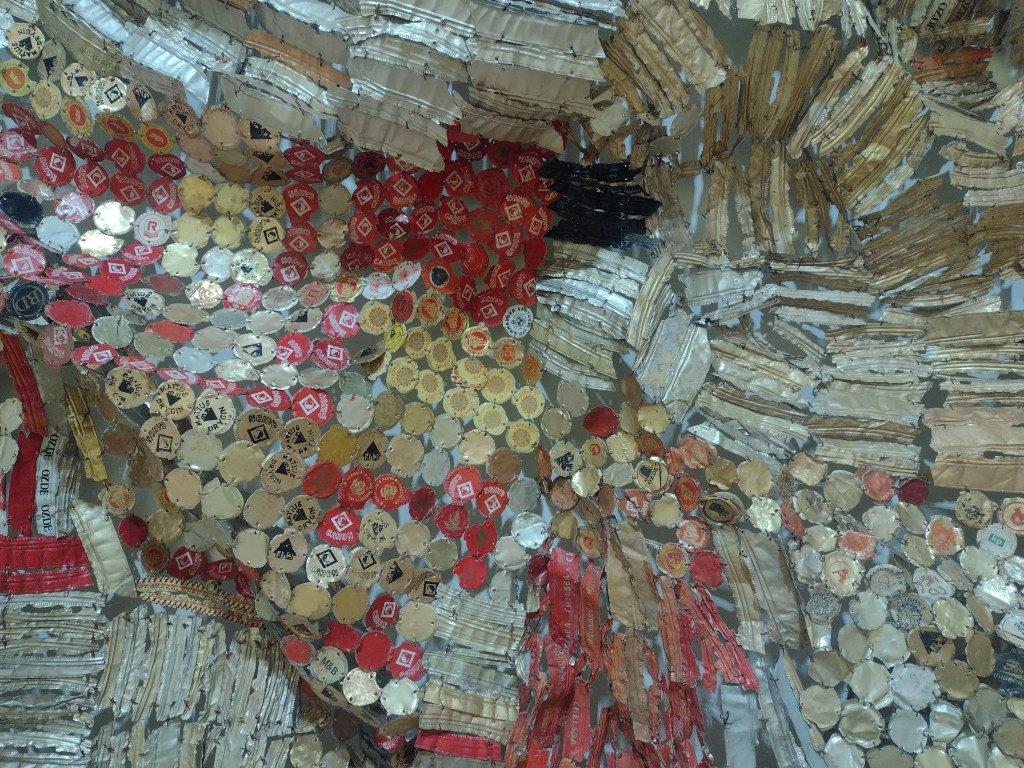
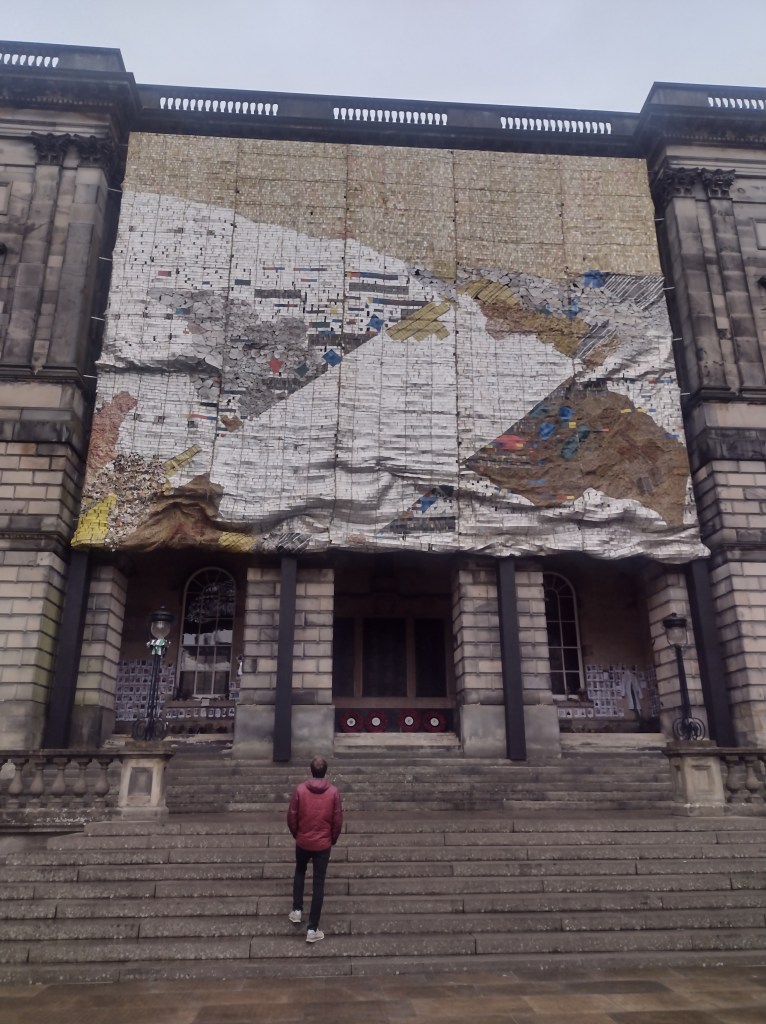
It feels so right that El Anatsui’s exhibition overlaps with Ibrahim Mahama’s at the Fruitmarket. Both artists are concerned with materiality, the legacies of history, colonialism, consumerism and they both work on a vast scale. I love El Anatsui’s work because it can be taken in on so many levels. You begin seeing the work from afar, dwarfed by it (recently, these huge scale works have adorned the side of the Royal Academy and the Turbine Hall in the Tate Modern). As you approach, it’s like zooming in to see the pixels in a photograph, each element emerges as unique and distinctive. These huge ‘tapestries’ may look like woven Kente cloth, but slowly reveal themselves as thousands of pieces of reclaimed aluminium bottle tops, from Ghana and Nigeria’s liquor bottling industries.

El Anatsui, details

This exhibition is the largest examination of El Anatsui’s work staged in the UK, and spans five decades of his career. The crowning glory is the beautiful and huge outdoor installation TSIATSIA – Searching for Connection (2013) which dominates the Old College courtyard, draped over the Georgian architecture like some shining shroud. Yet it’s also a treat to see smaller works which I wasn’t so familiar with: works on paper, and carved wooden reliefs. I would love to see these two giants of Ghanaian art in conversation. Or, at least responding to the other’s exhibitions. Come on Fruitmarket and Talbot Rice, make it happen?

TSIATSIA – Searching for Connection (2013) with Andrew for scale

There are still shows I haven’t managed to see yet, so what I’m looking forward to exploring next are:

I would love to hear what others have been enjoying at EAF this year. Let me know in the comments!

Five to see at Edinburgh Art Festival

As Edinburgh’s festival season approaches, residents and visitors alike become spoilt for choice as to how to spend their free time. While I often wish things were more spread out throughout the year, in truth, I’m a big fan. I love the buzz, the excitement and the chaos energy the festivals bring to an otherwise pretty chilled (some would say sedate) city.

Edinburgh Art Festival is an interesting beast, because it’s not quite as temporary as the Fringe, Book or International festivals. Rather, the art festival takes lots of different exhibitions which are already happening, and groups them under its banner, while adding special events, talks and tours. I guess the aim of this tactic is to raise the profile of the galleries and exhibition spaces across the city, allowing them both to compete with performance venues, and to take advantage of the vastly swelled number of tourists in town. 

As an Edinburgh resident, the best thing about this is that many of the exhibitions aren’t just limited to the month of August. Some have already started, while others will be here until the autumn and beyond. So, whether you’re a festival hater, or just here in Auld Reekie for a few precious August days, here are my five top choices for Edinburgh Art Festival. Picking only five was difficult, there are lots more shows and events to see, so make sure you head to the EAF website for more info.

Leonor Antunes: the apparent length of a floor area

Fruitmarket From now until 8 October

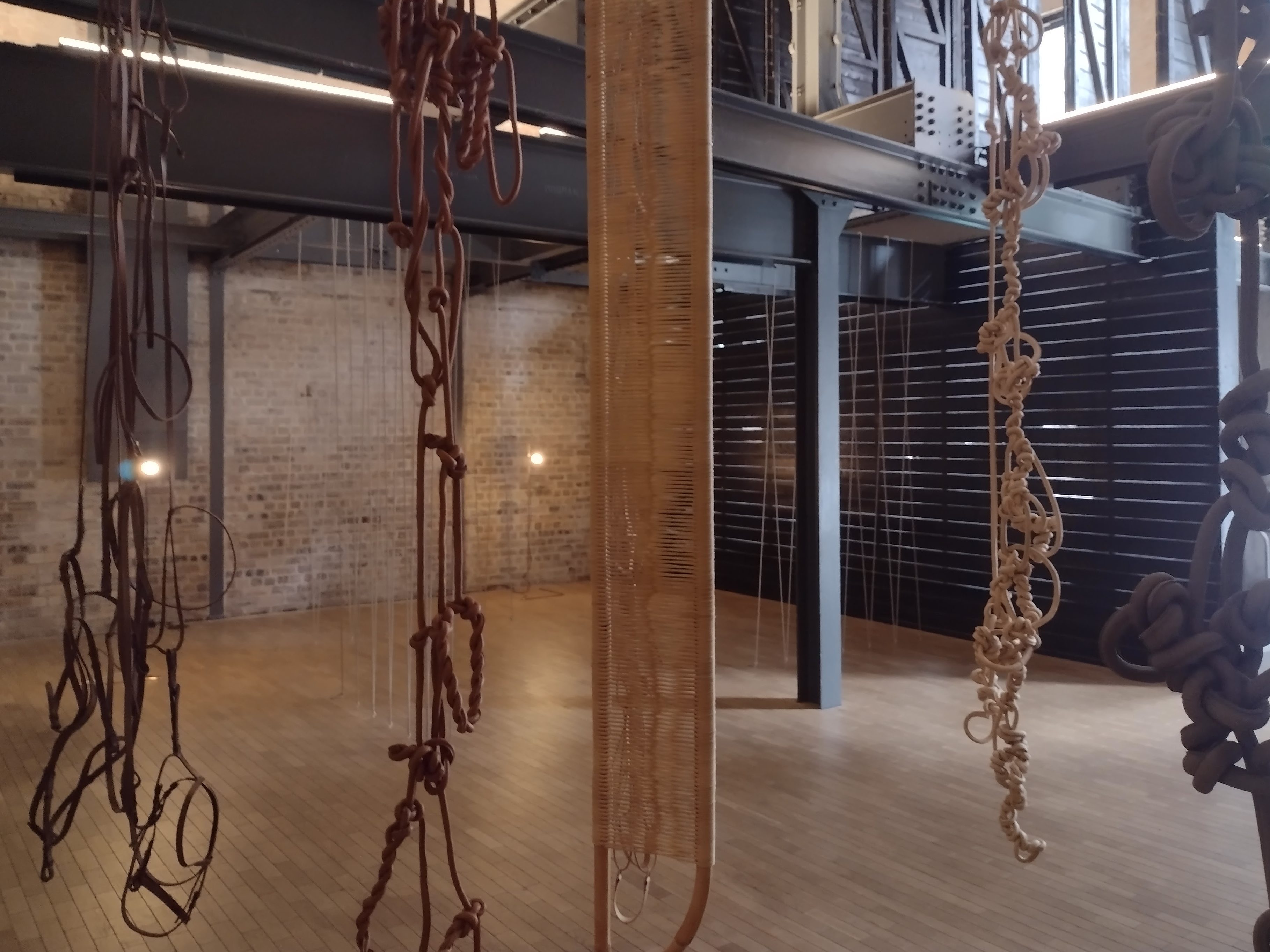
This is the best I’ve seen the Fruitmarket looking in ages, particularly the cavernous warehouse space (walk through the café to get there). Portuguese artist Leonor Antunes has used the dark room to miraculous effect, her woven/knotted/sculpted horse bridles, made from leather, wire and rattan, hanging like vines in clusters from the industrial beams above. As you walk among these tangled pieces, the different lines and fabrics intersect and enliven the empty space. It could be mistaken for some sort of S&M dungeon rather than a gallery, but that makes these weirdly haunted artworks all the more interesting. In the other rooms, the artist has created bespoke cork flooring where blocks of black and brown abstract shapes interlock and create artificial barriers: we must traverse these barriers in order to see this art more clearly. These floors, which smell comfortingly earthy and give the impression the artworks are floating, are based on designs for rugs by British designer Marian Pepler (1904-1997). Here, I’d recommend watching the short exhibition film in the upstairs gallery, which gives the work more context, and explains how Antunes looks to acknowledge overlooked (often female) artists and designers from history. 

Keg De Souza: Shipping Roots

Inverleith House, Royal Botanic Garden from now until 27 August

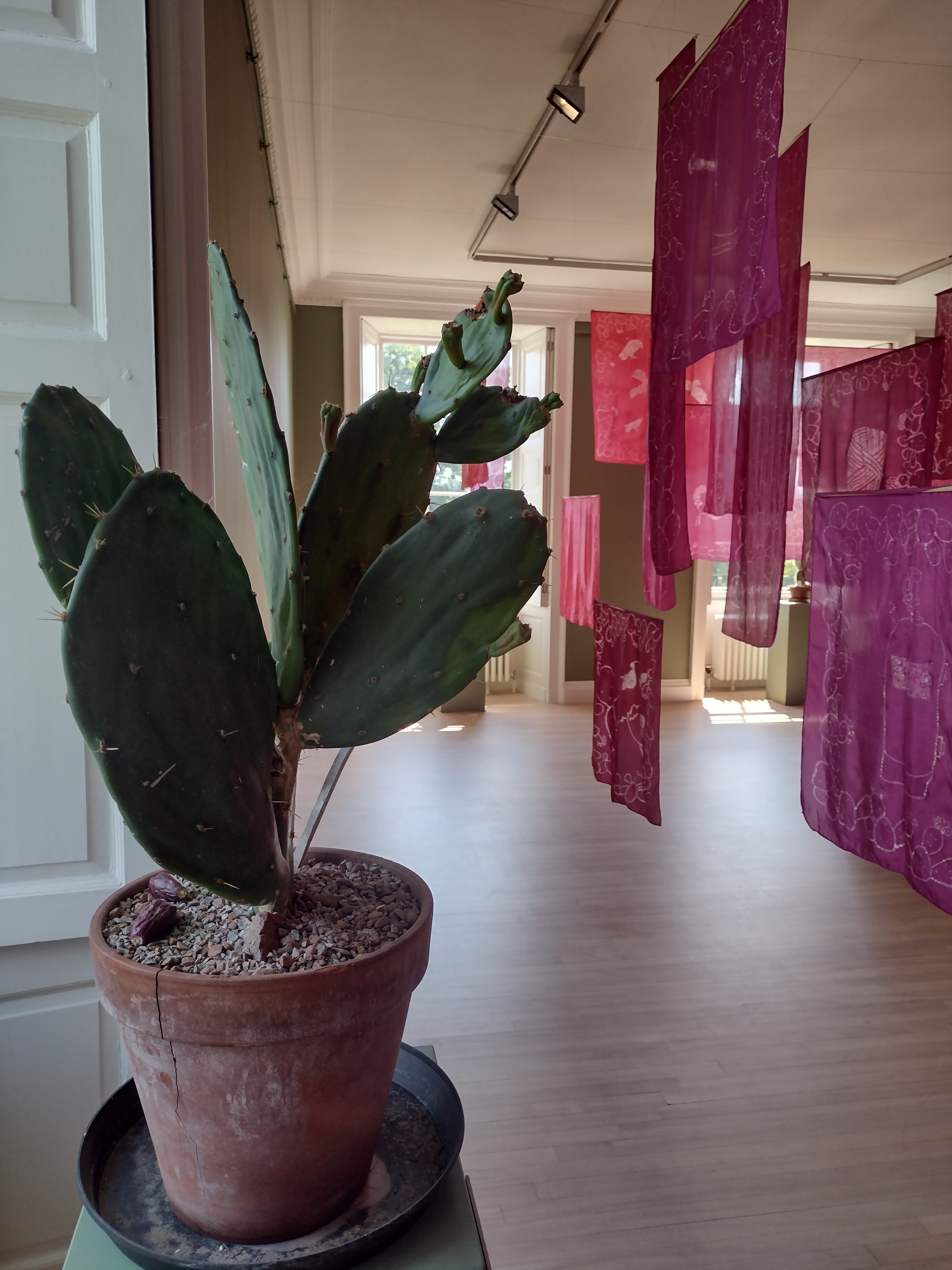
I stumbled upon this exhibition while showing my Australian aunt and uncle around Edinburgh’s Botanics – one of my favourite places to show off the views of the city. At the time, I didn’t really feel in the mood to look at art. I felt like a petulant child. I had already walked quite a bit, it was sunny, bright and breezy, the type of day where you don’t want to be inside and really don’t want to think too hard. My mood changed almost the moment I entered the first room, where the artist has placed branches of eucalyptus alongside floating silks which drape down dreamily. The air was beautifully scented and calming, conjuring the sweet lull of being in a Muji shop with several of their diffusers blasting at once. Yet despite the dreamy feel, the exhibition grapples with problematic histories of Botanical Gardens, through examining certain plant species that were transported across the British Empire. Upstairs, beautiful, ancient prickly pear plants combined with hanging artworks take on a sculptural quality. De Souza has managed to create an exhibition which examines the legacies of colonialism in a beguiling, almost-too-beautiful way. Very clever.

Grayson Perry: Smash Hits

Royal Scottish Academy from now until 12 November (ticketed)

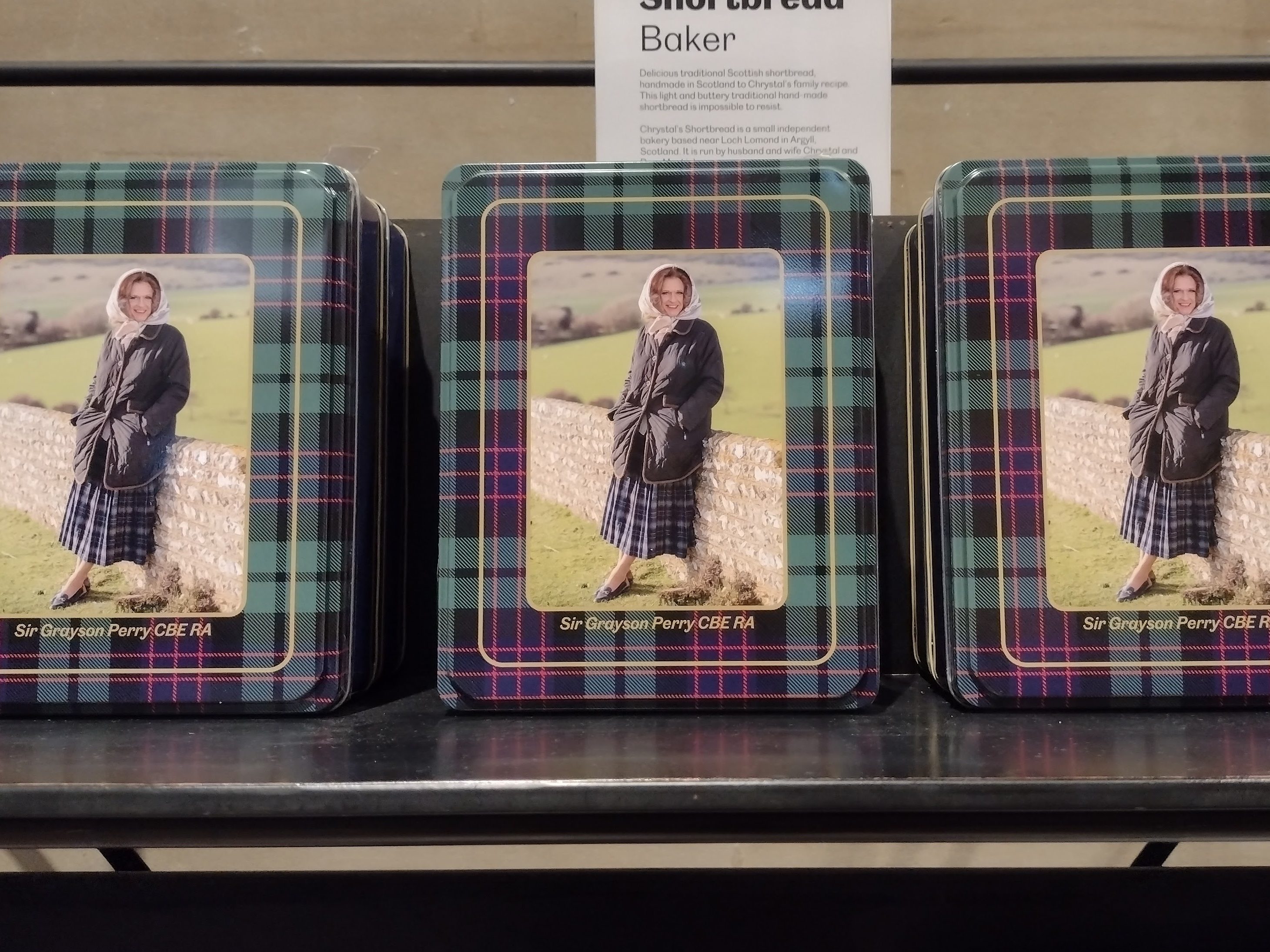
OK so this exhibition got panned in the Guardian (2 stars from JJ!?) but I loved it. I am in the Grayson cult and I pretty much love everything he has done, from TV shows to his Reith Lectures to his actual artwork. The Royal Scottish Academy’s massive walls are the perfect setting for the huge tapestries that adorn them. Whether you like art on a grand scale, or prefer to getting up nice and close to examine the details, then this is for you. If you like bright colours, this is for you. If you like shortbread biscuit tins decorated with Grayson dressed as Queen Elizabeth II on holiday in Balmoral, then this is for you. I think Jonathan Jones is right to question the relevance of placing Grayson’s obsession with Englishness in the Royal Scottish Academy, but maybe he’s forgetting how many English people live in Edinburgh or will be visiting Edinburgh this August. I can confirm that the shortbread is also delicious.

Markéta Luskačová

Stills Centre for Photography from 12 August until 7 October

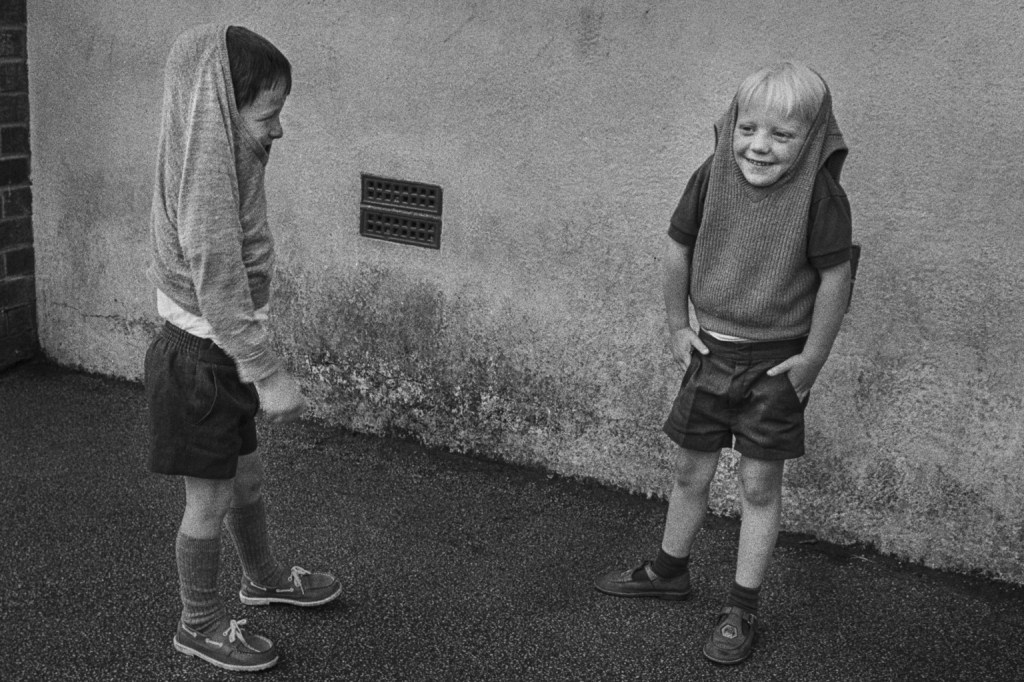
Although I’m not familiar with Markéta Luskačová’s work, I know it will be captivating. Encounters Art began life as an exploration of the magic of everyday ‘encounters’ with art, from graffiti to pleasing patterns in brickwork, so street photography has always had a place in my heart. The exhibition focuses on Luskačová’s photographs of children, and I’m interested in how she plays with the nostalgia that is inherent to photojournalism, and how this contrasts with our current usage of photography, where memories are instantly captured and then lost in the internet’s ether. Stills is consistently one of the best (and perhaps a little underrated) places to see art in Edinburgh. I trust their curating and expect this will be a fascinating show.

Two boys with their jumpers over their heads, Booker Avenue Primary School, Liverpool (1988), Markéta Luskačová

Alberta Whittle: create dangerously

National Galleries of Scotland: Modern One from now until 7 January 2024

I’ve been a fan of Alberta Whittle since I reviewed her film business as usual: hostile environment that was part of Glasgow International’s online edition in 2020. This exhibition is the largest showing of her work to date, and there is a LOT to see here, including sculpture, tapestry, film, photography and installations, all exploring the idea that compassion and collective care can be a powerful means of resisting racism. The major piece in the exhibition is Lagareh – The Last Born, a 43-minute video installation which Whittle presented at the Venice Biennale in 2022. Unfortunately I didn’t have the chance to see the film all the way through (I will be going back) but was deeply moved by the portion I saw, where musician Kumba Kuyateh walks around a sparse wooden courtroom, slamming the stands, the lecterns, the apparatus of ‘justice’ with her fists, whilst singing a lamentation for Sheyku Bayoh, who died in police custody in Scotland in 2015. A personal highlight for me was the final installation, portal for breathing love into the Elders or an Adoration for kith-folk who we long for (2021) which brings together special, significant objects – fabrics, shells, plants – to creates a shrine to lost loved ones, completing what is a deeply moving, and in some parts shocking exhibition with an act of contemplation, showing how anger and grief live alongside one another.

Memorial for ‘The Great Carew’ aka Neville Denis Blackman, (2019), Alberta Whittle

Follow me on Instagram for more updates on art to see in Edinburgh this summer, and let me know what you’re most looking forward to seeing, I would love to hear from you!

‘Cut and paste: 400 years of collage’, National Galleries Scotland

There’s so much packed into this exhibition at the Scottish National Gallery of Modern Art, which connects radically different works of art by artists as diverse as Pietro da Cortona (Italian Baroque painter and architect, 1596-1669) and Linder (British radical feminist artist, b.1954) it’s difficult to know where to begin.

The exhibition is a chronological survey of just about everything connected to the act of cutting one thing and sticking/stitching it on to another, including the digital techniques used today by brilliant artists like Cold War Steve. So there’s a lot to get through.

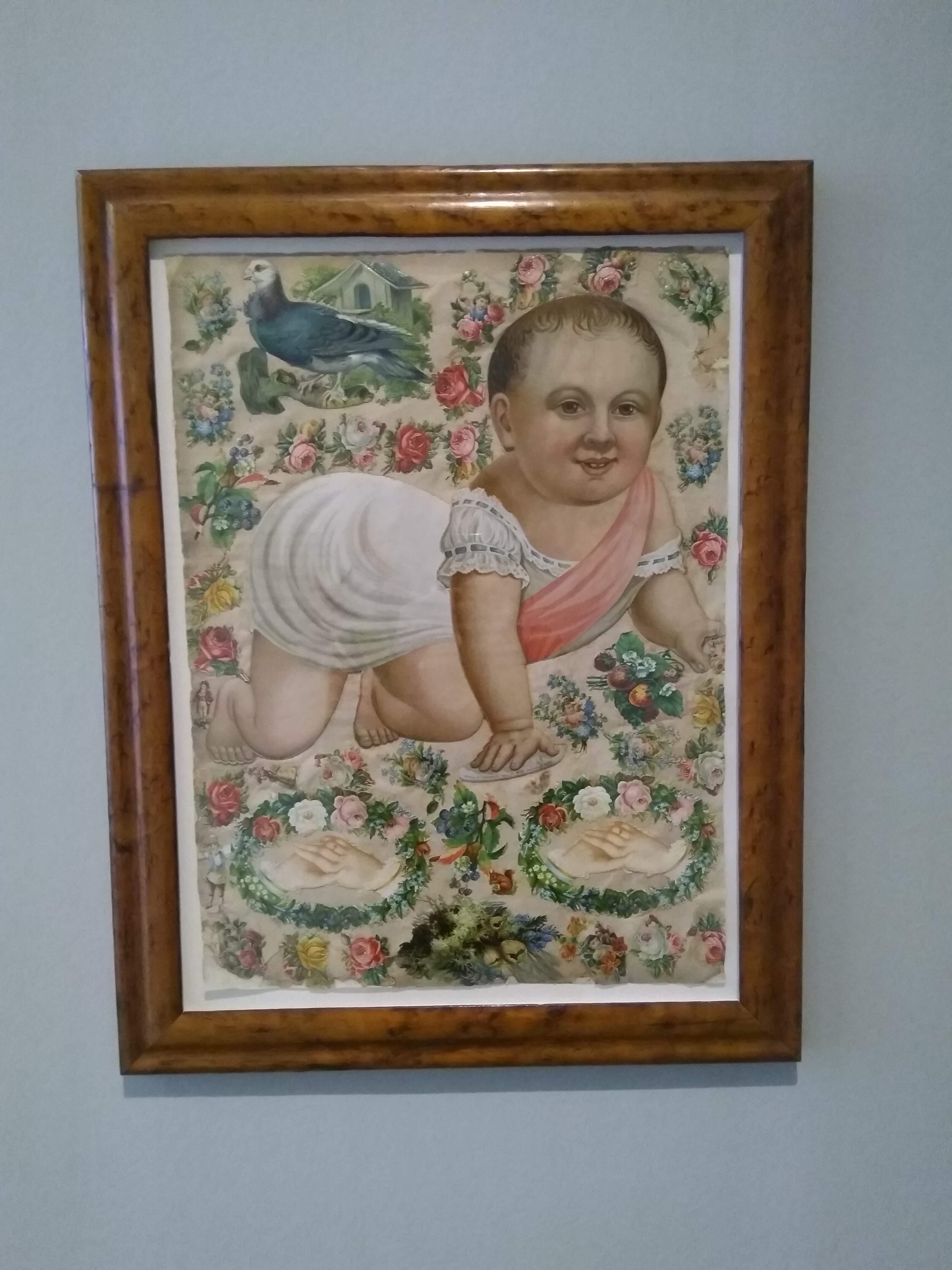
It might sound as a though the whole concept is a bit broad (it’s true that the exhibition has so many works it almost falls into the ‘overwhelming’ category), but in the very act of broadening out the understanding of collage as art, the show opens up the narrative possibilities around the medium. By including works by amateur and anonymous artists, we see the informal side of collage, which became hugely popular in the nineteenth century, particularly among women. I’m glad of that because it exposes some of the many weird and wonderful constructions that resulted from the pastime of sticking one thing to another, one of my favourites being this monstrously ugly baby from 1890.

Anonymous, Baby, (about 1890)

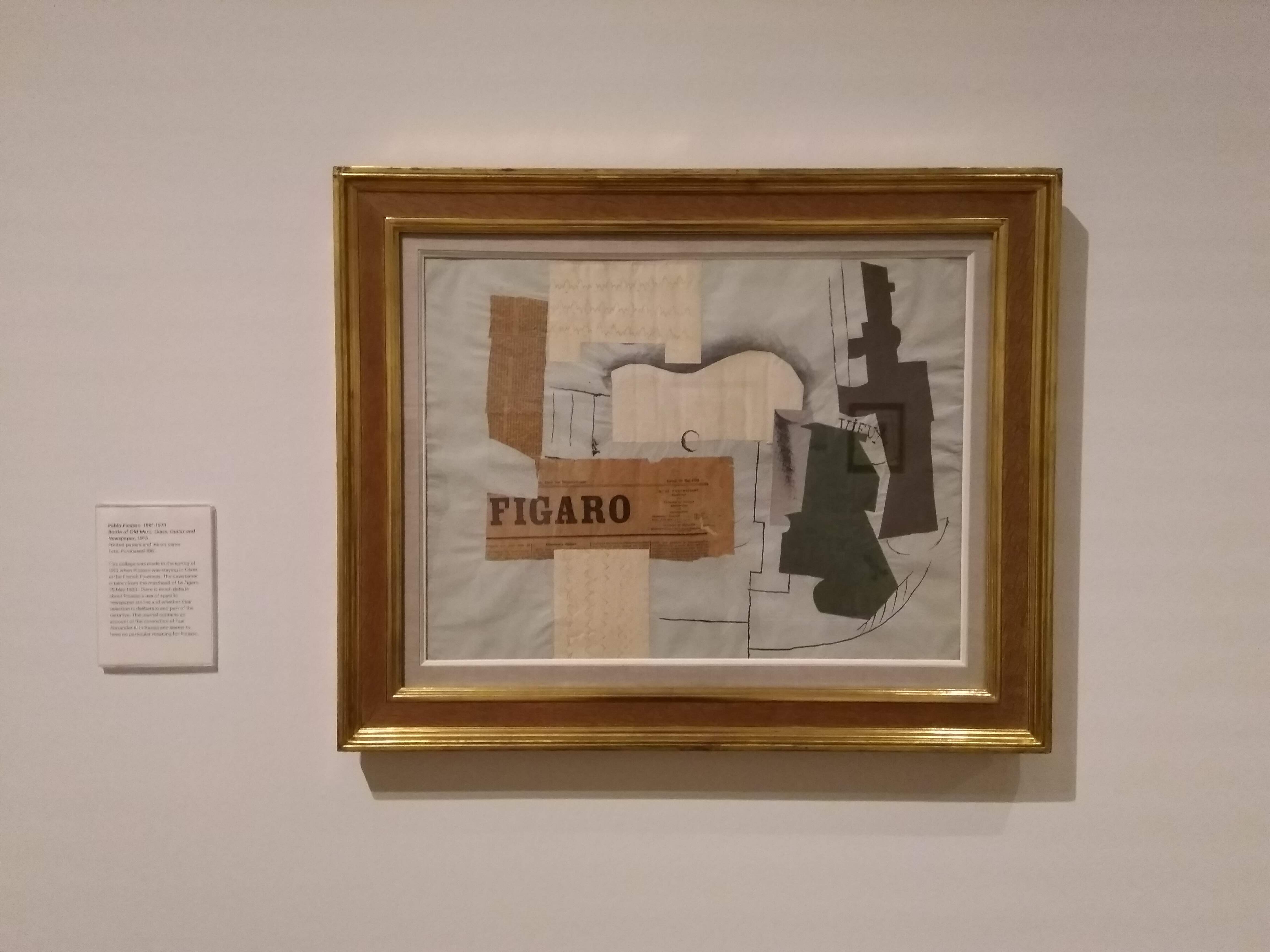
By placing objects like this one alongside Picasso’s Old Marc, Glass, Guitar and Newspaper (1913), the exhibition stressed some of the continuities of collage throughout the centuries. Yet though the wall text explained how the meanings of collage changed in the twentieth century, I still feel that more could have been made of how utterly radical it was when avant garde artists started to incorporate fragments of newspaper and other ephemera on to the canvas. It was a gesture that intended to break the mould and redefine painting altogether, which had huge repercussions on what later constituted art. It was for this reason that collage went on to be one of the go-to visual languages of satire, protest and activism.

Pablo Picasso, Bottle of Old Marc, Glass, Guitar and Newspaper, 1913

For me, the political artworks were some of the best in the show. John Heartfield’s series of satirical photomontages for the left-wing German publication AIZ really fascinated me. One, depicting a Hitler with coins for a skeleton alongside the caption “Adolf the Superman: swallows gold and spouts rubbish” (1932) felt particularly apt to our current political climate. I just wish the series was placed somewhere more prominent, rather than in a walkway. The exhibition has so much to say, but there wasn’t enough space to say it. Better to cut down on the numbers of works and give ones like this the position they deserve.

John Heartfield, rotogravure, published in AIZ 17 July 1932

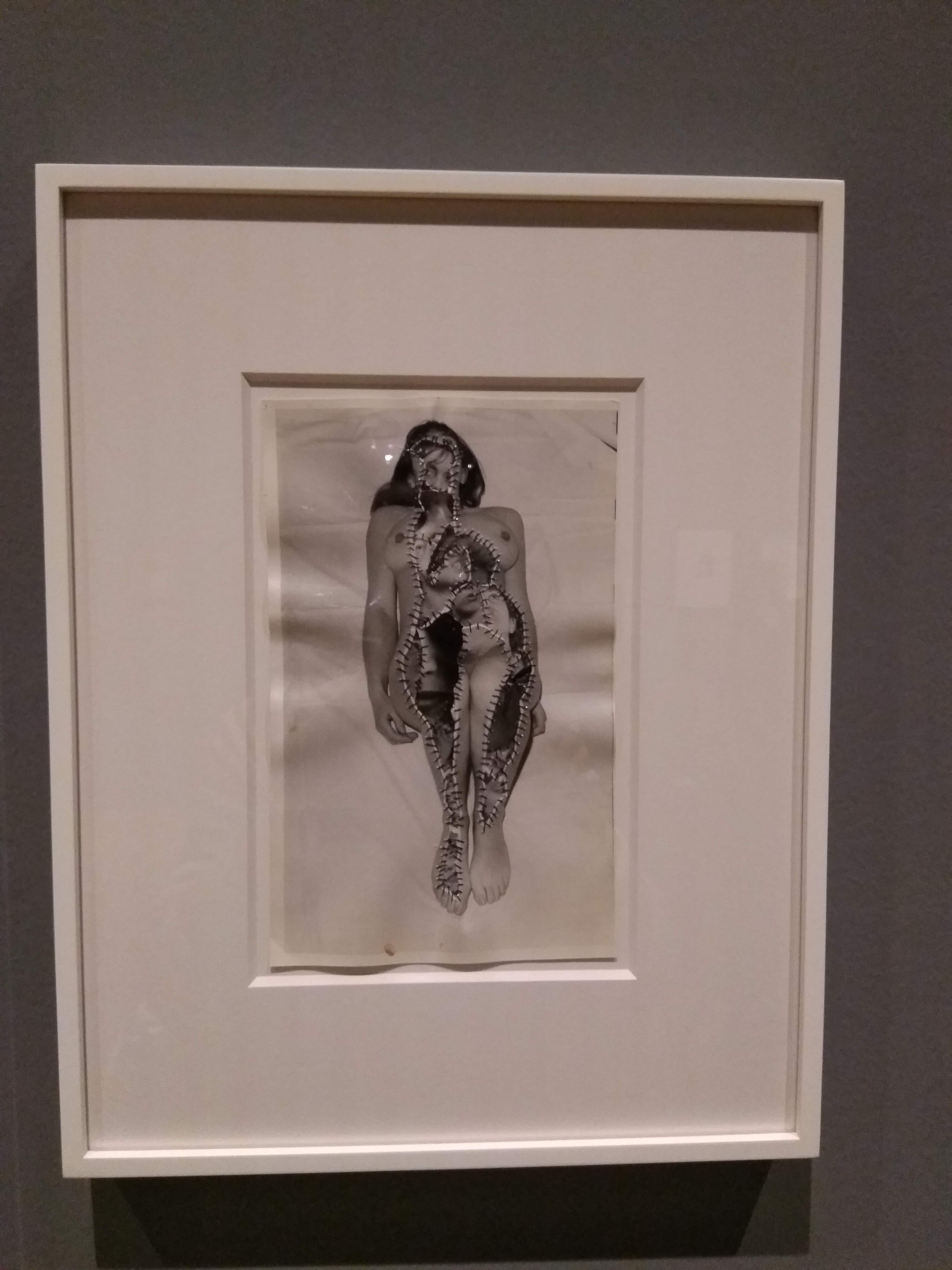
It seems that with works in collage, there’s a strong urge towards the uncanny, things that disturb and make the viewer take a second look. That was true of the works exploring the body by feminist artists of the 1960s and 70s, in one of the best rooms of the exhibition. I hadn’t heard of Annegret Soltau (b.1946) before, and her works made with black thread suturing together different photographs of her naked body were really striking.

Annegret Soltau, Schwanger II (Pregnant II), 1978

There are so many fascinating things to see at this exhibition and it throws a light on some of the challenges of dealing with such a broad theme. It is said too often, Qbut there really is something for everyone here, and I would really recommend you go and see it before it closes on 27 October.

‘My Own Private Bauhaus’, David Batchelor at Ingleby Gallery, Edinburgh

I first encountered David Batchelor’s work about a year ago, and I was so happy when I heard he had a show in Edinburgh, at Ingleby Gallery (free, ending 28 September). It’s not a place I’m familiar with, and being a commercial gallery, I wondered whether the space would feel welcoming. Though I had to ring a bell to be let in, there was no need to fear – I was welcomed by a friendly member of staff who introduced me to the gallery and some of the ideas behind the exhibition.

The building itself dates from 1834 and is settled in the heart of Edinburgh’s austere but beautiful New Town. It was originally built as a religious meeting house for the Glasites, a break-away group of worshippers from the Church of Scotland, who heartily disapproved of embellishment, decoration (or, it seems, joyfulness of any kind) in their places of worship. So it is with a delicious sense of irony that such a space has been transformed into a gallery, a dynamic that I’m sure Batchelor would have revelled in when planning the exhibition.

The ceiling of the main exhibition space

One of my favourite things about Batchelor’s work is that it is characterised by a sense of playfulness. It doesn’t seem to take itself to seriously: art is boiled down to its essentials – colours and shapes – reminding us that all of us begin interacting with the world through these two key sensory building blocks. Through his explorations, Batchelor invites us become children again, to see with fresh eyes and wonderment that art can exist within the banal and the everyday. He’s there to show us where and how to look.

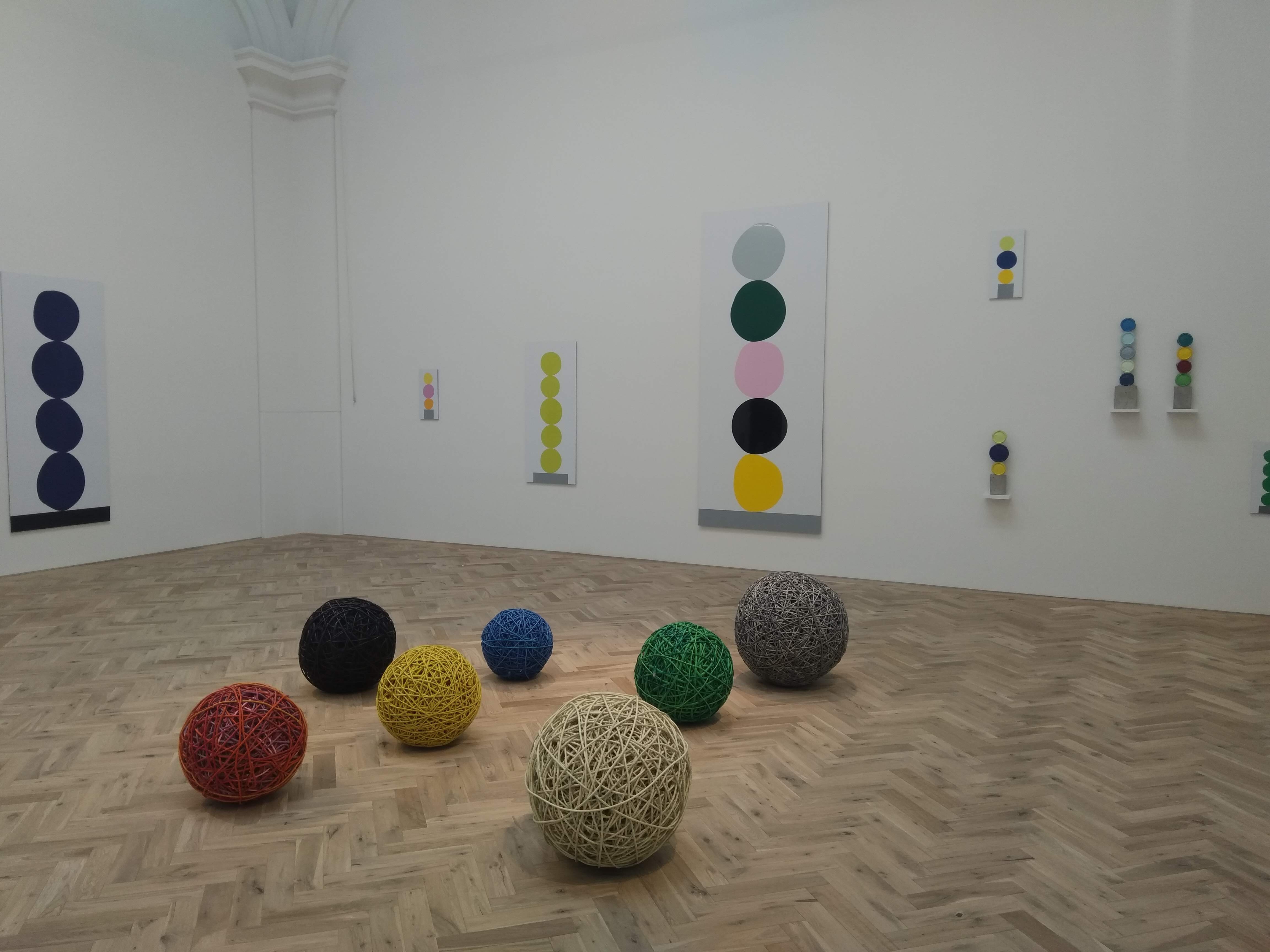
Installation view, the piece on the floor in the centre is Dogdays, 2008-2011

The exhibition is full of all sorts of mundane objects made fascinating, mounted on their concrete plinths and transformed into abstract sculptures. There are tape measures, huge spheres made of electrical wires and cable ties, sheets of intricate mesh, plastic circles that look like bottle tops, all celebrating the vibrancy of artificial colour. There’s not much suggesting the natural world in here, though shards of glass stuck in concrete look remarkably like window boxes. Rather, it’s the things we have invented that take precedence, repurposed and reframed by Batchelor, the magpie-esque collector of all things shiny, bright and saturated.

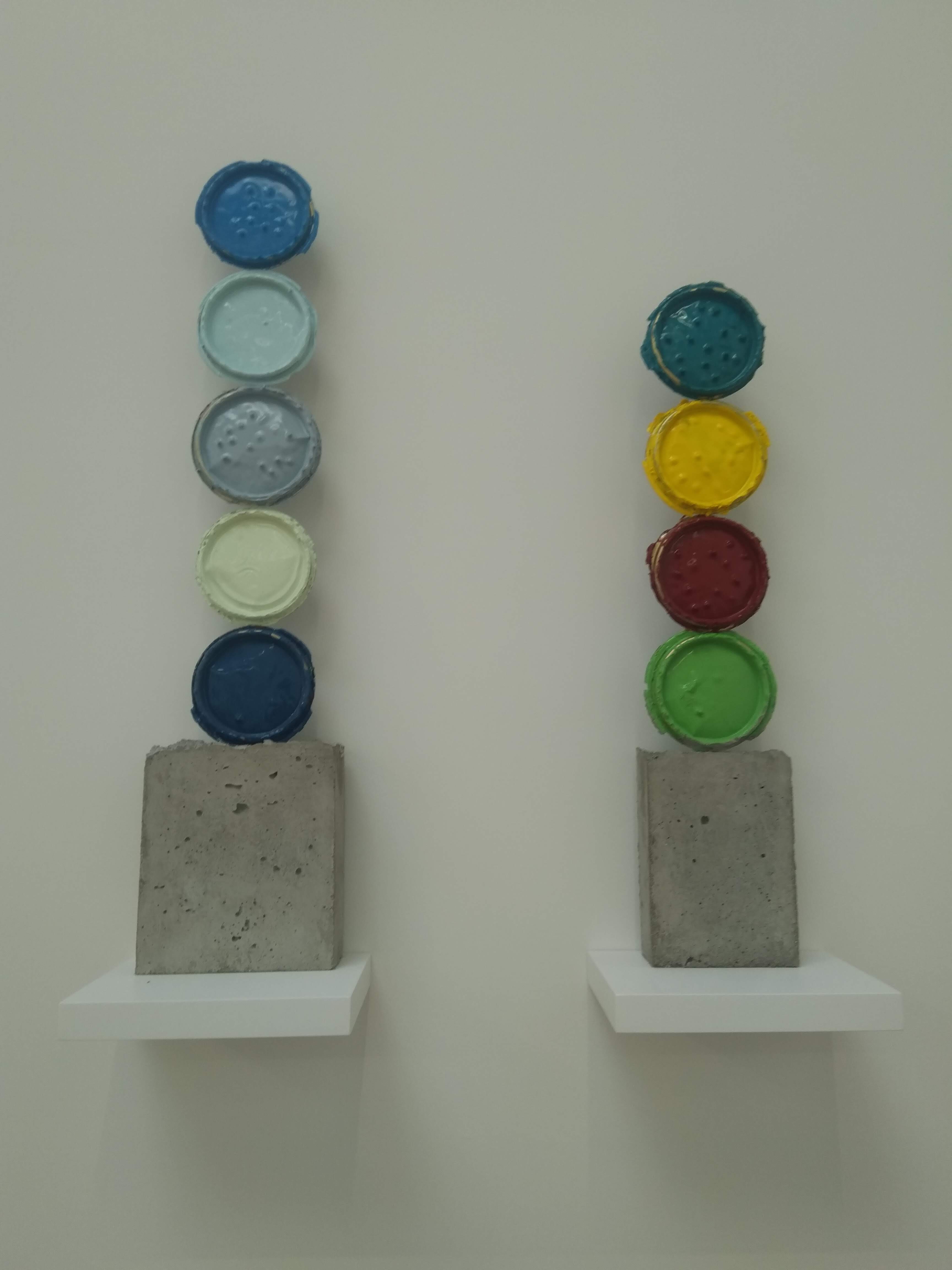
Geo-Concreto 06, 2018 (left) and Geo-Concreto 02, 2018 (right)

Yet for all of their man-made qualities, the show is not about looking at the pristine perfection of these objects, but rather their imperfections. The paintings on the walls are made using spray paint, giving them a mechanical shine that seems totally devoid of the artist’s hand, yet the circles themselves are misshapen and pleasingly wobbly, with the occasional splodge of paint that may not have been intended, but remains present on the canvas nonetheless.

Part of the Concreto 1.0h series

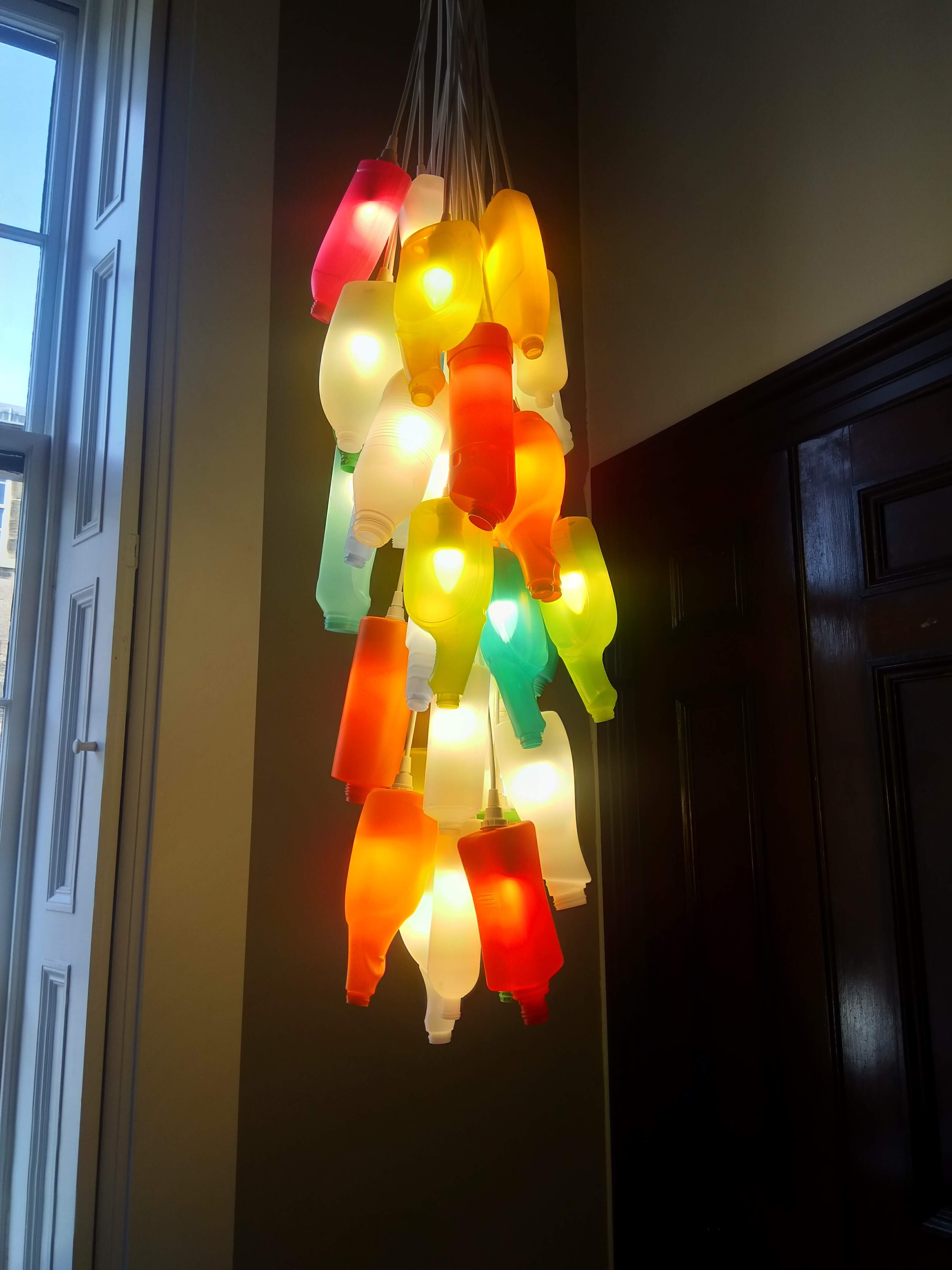
Much more tactile than the paintings, however, are their partner sculptures, made by precariously stacking the lids of paint pots on to of one another, the paint crusty, wrinkled and stippled, crying out to be prodded and poked. Some sculptures are framed by fluorescent fabric backdrops, and the much maligned plastic bottle is transformed the ultimate 21st century chandelier.

It’s art that’s fun, accessible, and shows us the possibility of finding beauty in the most basic of everyday things, a skill we need more than ever at the moment.

Candela, 2016

Bridget Riley, National Galleries Scotland

This week, I finally got round to seeing the Bridget Riley exhibition at the Scottish National Gallery. A couple of friends had been telling me how great the show was, and the critics had been raving about it, so I knew I had to catch it before it closes (Sunday 22nd September), and moves to the Hayward Gallery in London for its second leg.

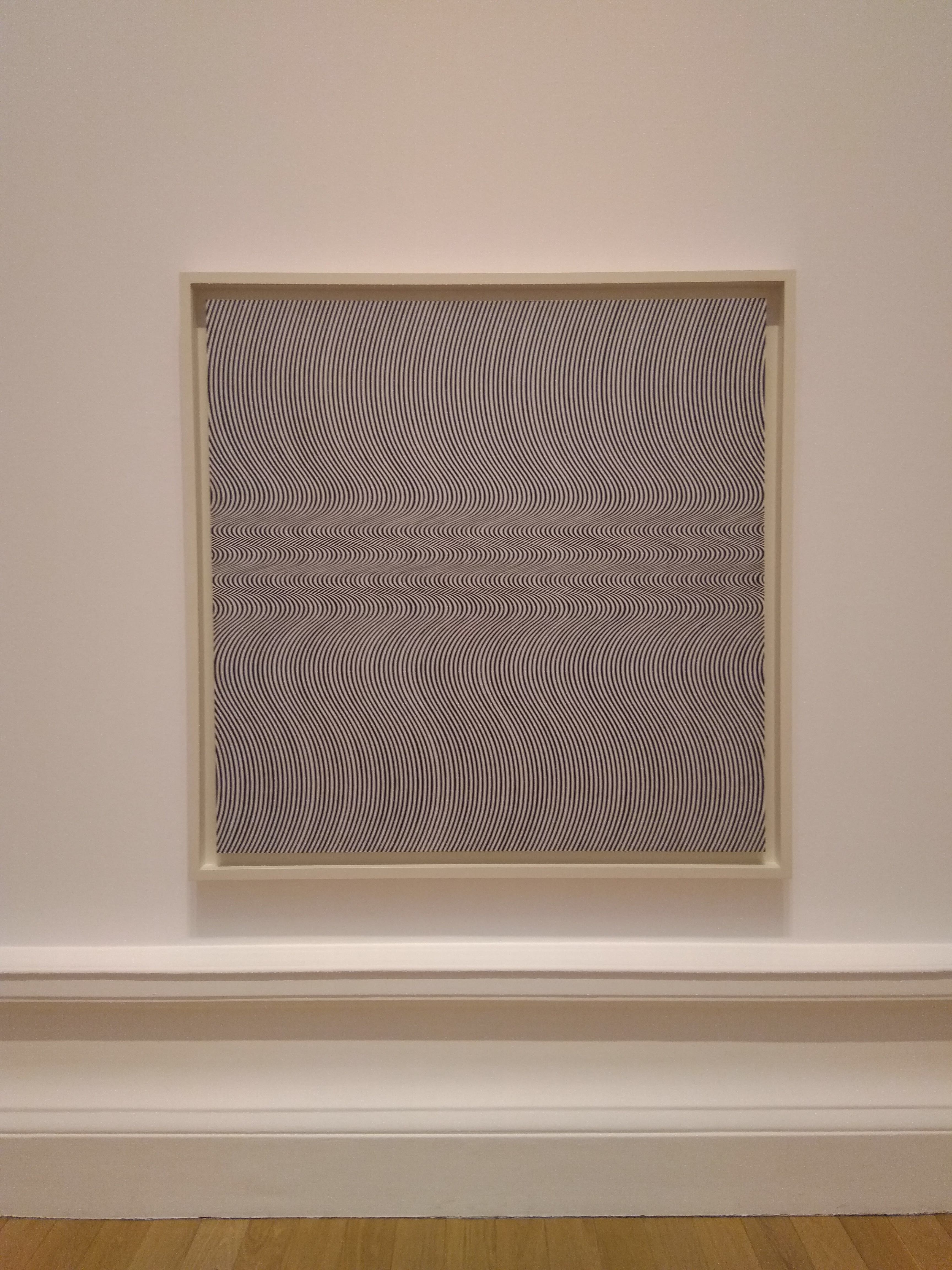
Riley was a key figure in the Op Art movement, which developed in the 1960s and used abstract patterns and geometric shapes to create optical illusions in art. You can see that straight away, with Cataract 3, in Room 1. The whole painting is pulsating and vibrating with energy, in a way that makes you want to reach out and check that the canvas itself isn’t undulating. It’s a dizzying experience and quite a shock to the system.

Detail of Cataract 3 (1967)

Some of Riley’s most famous works are the black and white pieces (Room 2), which seem, paradoxically, to be alive with colour. As your eyes scan the canvas, it flickers with pink and green, like looking at a TV screen when the channel isn’t tuned in, the visual equivalent of white noise.

I was familiar with the concept of Riley’s work and was vaguely interested in seeing it, but hadn’t been prepared for just how convincing it is when experienced in person. As the exhibition continued, I realised I had expected it to be fairly simplistic and one-note, but her work is a much more in-depth exploration of perception and sensation. It shows us how what we see is deeply connected to how we feel, not just emotionally, but physically as well.

Current (1964)

As your body moves closer to and further away from the paintings, or your eyes refocus as they try to figure out the mechanics of the brushstrokes, what you see shifts and morphs. It made me want to take off my glasses and lie down, to let the colours wash over me, the paintings becoming hallucinogenics and bringing a kind of playful blurring to the gallery space. It’s not surprising that Op Art was born in the 1960s.

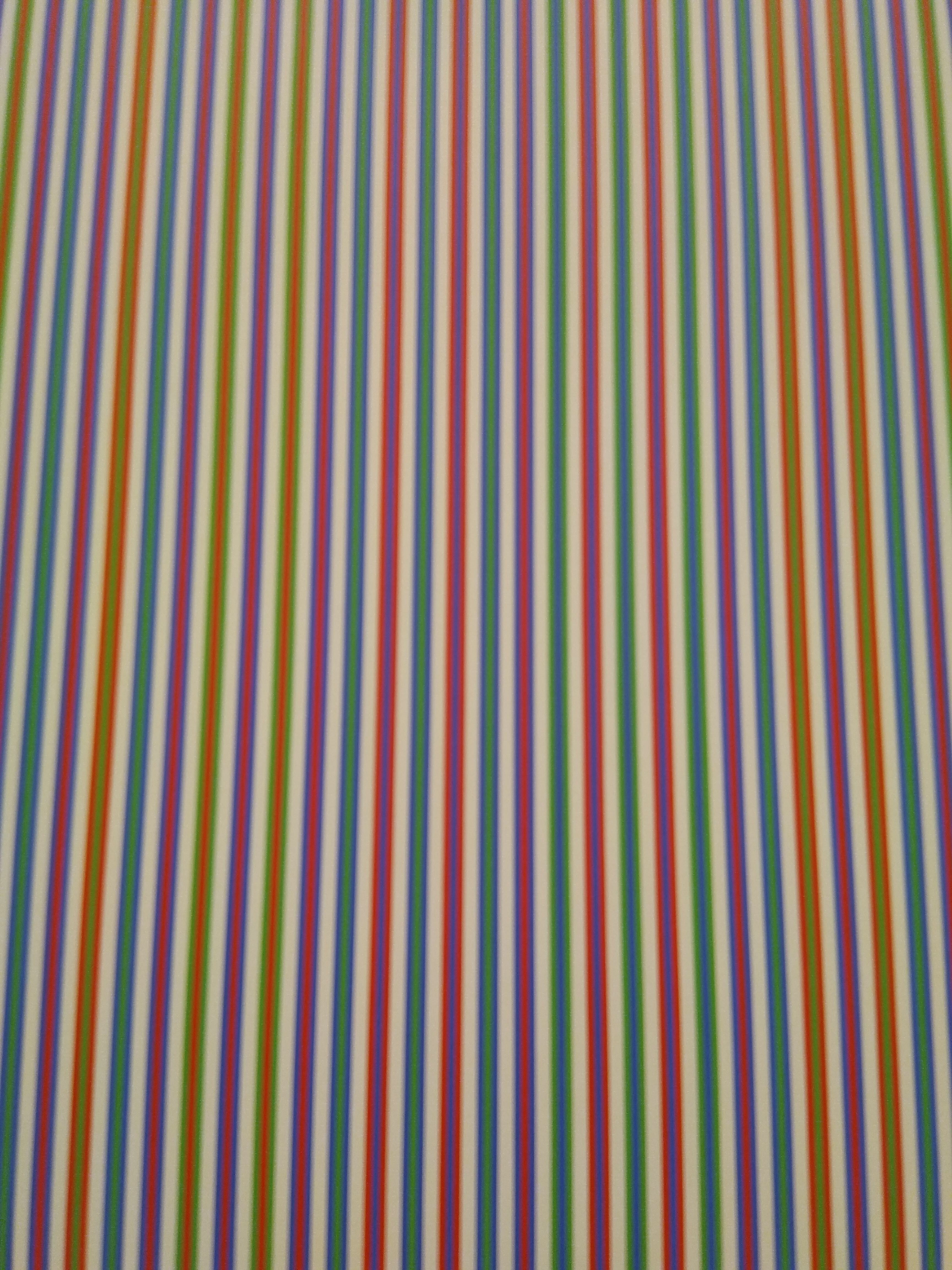
My favourite room was at the heart of the exhibition, and displayed a number of Riley’s brightly-coloured monumental striped canvases. The way the pairings of colours create different effects, and can trick the eye, made me wonder how colour really works. In Paean (1973), stripes of red, white, blue and green seem to create flashes of pink. Riley’s work must be underpinned by a proper understanding of the physics of colour theory, and the fascinating room packed full of her sketches and studies show how meticulously worked out each composition is.

Detail of Paean (1973)

In 2017, Riley said that ‘the movement is created by looking’, which to me, is the key to her work. It suggests that it is the viewer, as a participant, who plays a pivotal role in ‘activating’ the compositions. As we move around the paintings and allow our eyes to drift over them, we help to bring them to life. It’s an experience everyone will react to differently, but one I would recommend trying.

Night Walk for Edinburgh, Janet Cardiff and George Bures Miller

On Sunday night I took part in an art experience that had been intriguing me since I first saw it advertised as part of Edinburgh International Festival several weeks ago. It fell into the category of “must go” because it sounded unique (commissioned especially by the Fruitmarket Gallery), immersive and slightly odd, making the perfect cocktail for someone who likes thinking, writing and talking about art.

Starting at the bottom of Cockburn St near the Royal Mile, the Fruitmarket staff gave me a short briefing (which made me ever more intrigued and slightly trepidatious about what was coming), armed me with a pair of headphones and a small screen, and away I went. What followed was a cross between virtual gaming, crime drama, ghost tour and art piece.

Edinburgh’s Old Town is the stage set for this discombobulating drama

Janet Cardiff’s voice whispers in your ear, half talking to you, half musing to herself. The walk winds through the backstreets, closes and alleys surrounding the Royal Mile, strangely empty, dusty and damp compared to the garish, touristy brightness of the Mile itself. Arrows on the ground sometimes indicate the way, but mostly you are guided by Cardiff’s instructions, enhancing the sense that you are taking part in a game in which your own agency is reduced to zero.

The narrative weaves in and out of fiction and reality, with the film element of the walk emphasising the idea that the city is a canvas or a stage, and we as its residents, its visitors, its participants, are part of the multiple layerings that make up its history, and its identity. Marks on the canvas are left behind by former inhabitants: chewing gum pressed into the crevice of a wall, string delicately tied around a lamppost, pieces of scattered clothing lost, left behind. The work delves into Edinburgh’s macabre history, but is also rooted in the banal fabric of the city itself, drawing attention to air vents, street signs and shop windows.

The walk draws your attention to all sorts of details, making the banal into something noticeable

The sound effects, with snatches of conversations, song, sirens, and the noises of city life unfolding around you make the stories of the walk all the more convincing. I can’t count the number of times I turned around to check whether the footsteps approaching me were part of the fake cinematic narrative I was immersed in, or belonging to life itself. The artists play with the uneasy gesture of looking over one’s shoulder, the sound of footsteps is inherently creepy and unnerving and puts the participant/viewer on edge throughout the walk, in a way that is both thrilling and memorable.

Weaving their way through the city, Cardiff and Bures Miller have made a fascinating and haunting piece that interweaves history, the digital, magic, reality, memory and storytelling. If you’re interested in any of the above, this is something you won’t want to miss.

Grayson Perry, Dovecot Studios

Grayson Perry, with his numerous books, TV documentaries and lectures, is probably one of the few genuinely famous contemporary artists in Britain today. He is perhaps better known for talking about art than for the art he produces, though the bright colours and recurring cast of characters in his ceramics, tapestries and prints, once seen, are not easily forgotten. He is a chronicler, a satirist, a kind of psychedelic William Hogarth of our times, chewing up the world and spitting it back out at us in a way that both gloriously kitsch and raucously ugly.

Hogarth’s Gin Lane, 1751

Perry is fundamentally a storyteller artist. He creates narratives in his artworks which help us to think about the world around us, and our multiple identities as individuals within society. That is what he has done for this show at Dovecot Studios, Julie Cope’s Grand Tour: The Story of a Life by Grayson Perry. The exhibition follows his fictional character Julie through what Perry calls ‘the trails, tribulations, celebrations and mistakes of an average life’, using a series of brightly-coloured Jacquard tapestries.

Don’t be fooled by the bright colours, though. The story behind the works is one that is full of tragedy, examining the mundane reality of life, the pervasive banality even of its most dramatic moments. Alongside the tapestries, The Ballad of Julie Cope, a poem written by Perry bleakly sets the context for Julie’s life. I sometimes find looped audio tracks in exhibition spaces quite distracting, but here, the poem read aloud by Perry in his slight Essex accent gave the tale of Julie Cope, an Essex girl, a kind of timeless authenticity.

Detail from the first tapestry in the series, A Perfect Match

The tapestries themselves are immense and impressive. Packed with details, they are a fascinating maze of signs and symbols, clashing colours and patterns for the viewer to decipher. Clever tricks are used that are barely noticeable at first, but make the images all the more convincing, like the shadows used around the feet in the picture above, giving the work a sense of depth and the cartoon-esque characters more solidity.

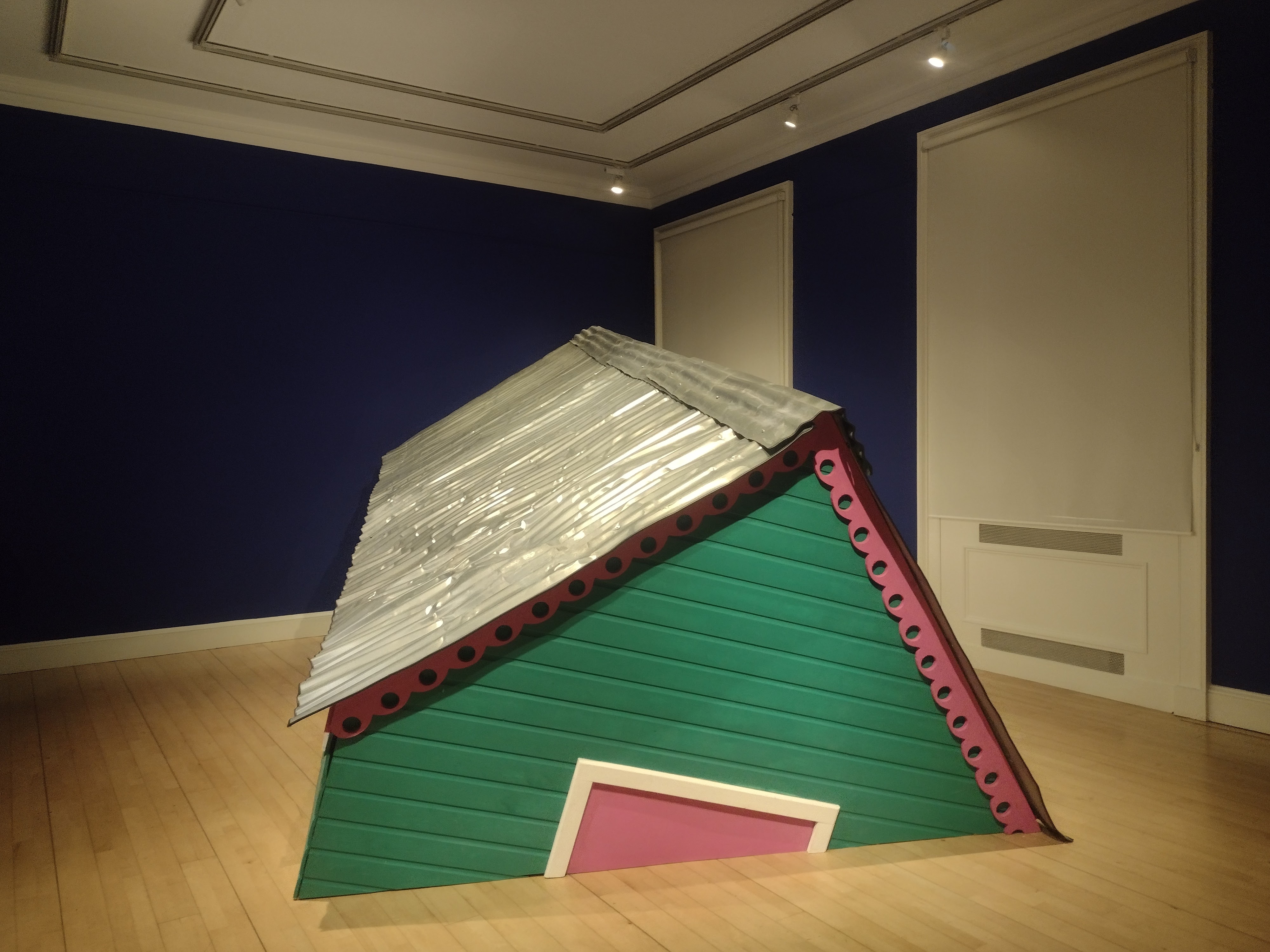
As with much of Grayson Perry’s work, class is the central theme underlying the show, and his observations about life in modern Britain are as bittersweet and tinged with nostalgia as they are acerbic. The tapestries, when they are not on tour, usually decorate another of Perry’s fascinating projects, A House For Essex, a whacky Wendy house construction which is part folly, part shrine, to Julie Cope. Seen divorced from this context, in the exhibition space, I think the works have probably lost some of their whimsical quality, and we are left with a documentation of the sad predictability of life. For me, the overriding feeling of the exhibition was not uplifting, but in that way, Perry, the Bard, creates a perfect mirror of the country in turmoil around us.

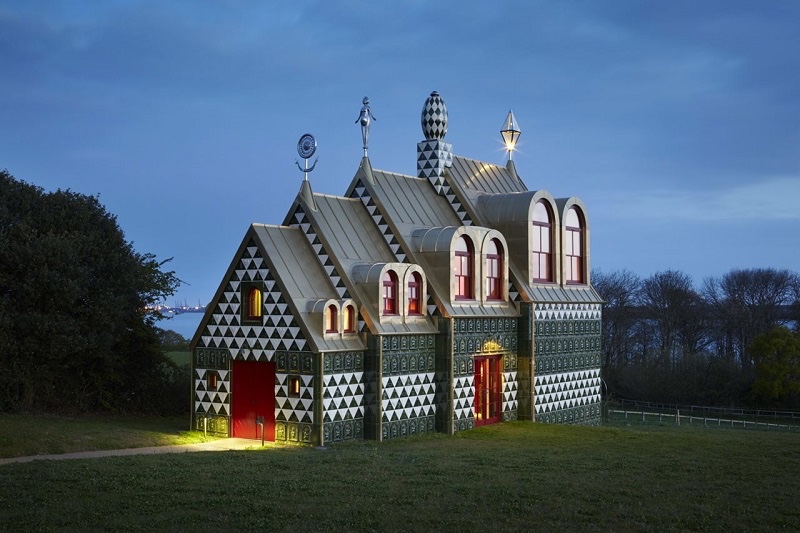
A House For Essex

Edinburgh Art Festival is here

It’s been a bit quiet on the blog recently while I’m trying to knuckle down and get my dissertation done. Apologies! However, Edinburgh Art Festival has just opened and I’m going to try and see as many of the exhibitions as I can and write about them on here over the next couple of weeks, so watch this space.

So far, the only things I’ve booked are both related to the same work, Night Walk for Edinburgh by Janet Cardiff and George Bures Miller. My slot for the walk is next Sunday, and it sounds like an unusual and immersive experience. From what I can gather, the artists have created a site specific work which you carry with you on a walk around the streets of central Edinburgh, using a tablet and headphones. They become your tour guides in an experience which mixes reality and fiction. The artists are delivering the keynote lecture at the National Gallery of Scotland this evening, which will cover what it was like to make the work in Edinburgh, and will touch on their art practices more generally.

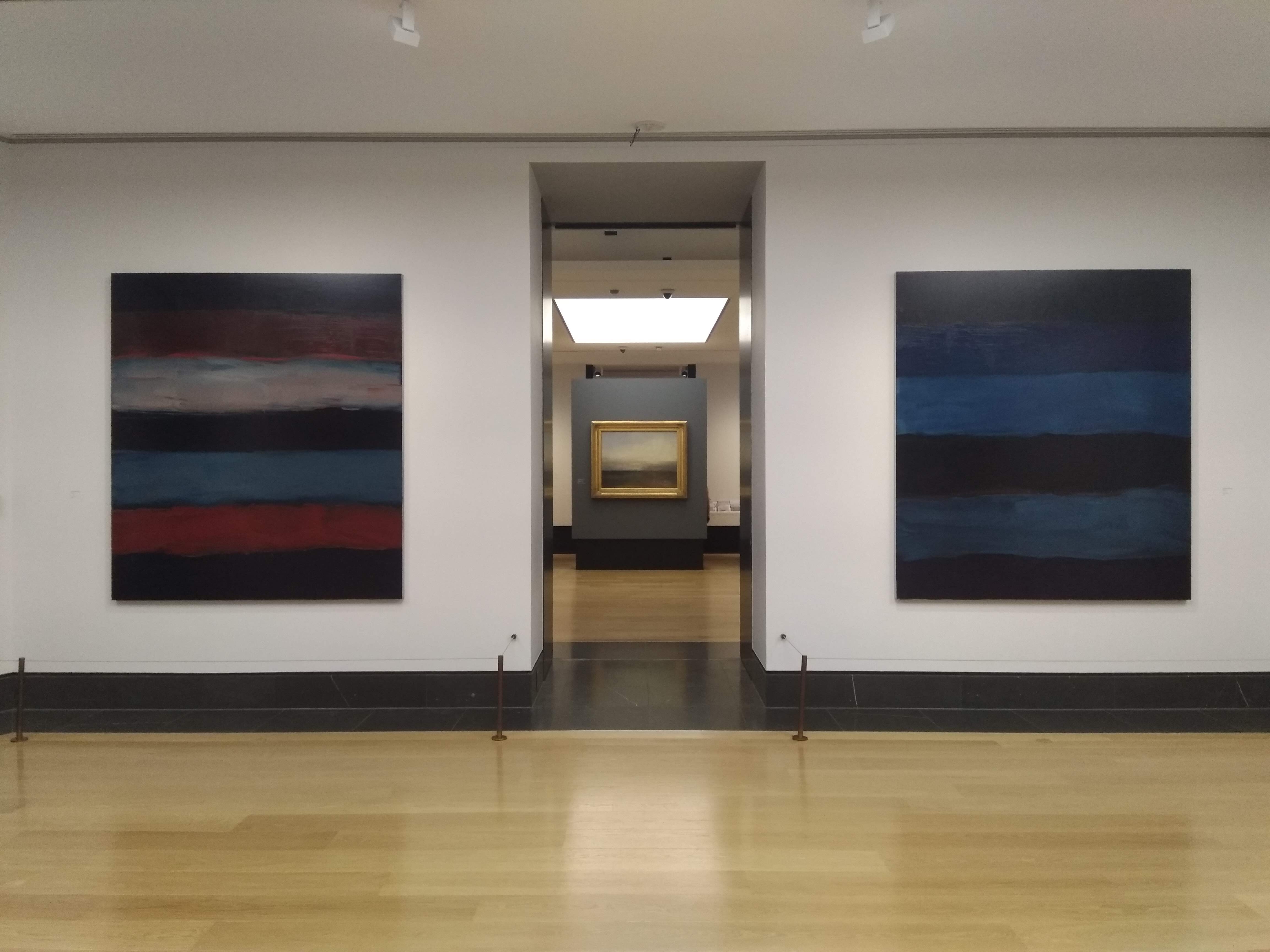
I’ll be back with more updates as and when I get to more Art Festival exhibitions and events. In the meantime, here’s a photo of some excellent curation I noticed recently at the National Gallery in London, pairing two recent works by Sean Scully, Landline Star and Landline Pool (both 2017) with the work that inspired them, The Evening Star (1830) by J. M. W. Turner.