Grayson Perry, Dovecot Studios

Grayson Perry, with his numerous books, TV documentaries and lectures, is probably one of the few genuinely famous contemporary artists in Britain today. He is perhaps better known for talking about art than for the art he produces, though the bright colours and recurring cast of characters in his ceramics, tapestries and prints, once seen, are not easily forgotten. He is a chronicler, a satirist, a kind of psychedelic William Hogarth of our times, chewing up the world and spitting it back out at us in a way that both gloriously kitsch and raucously ugly.
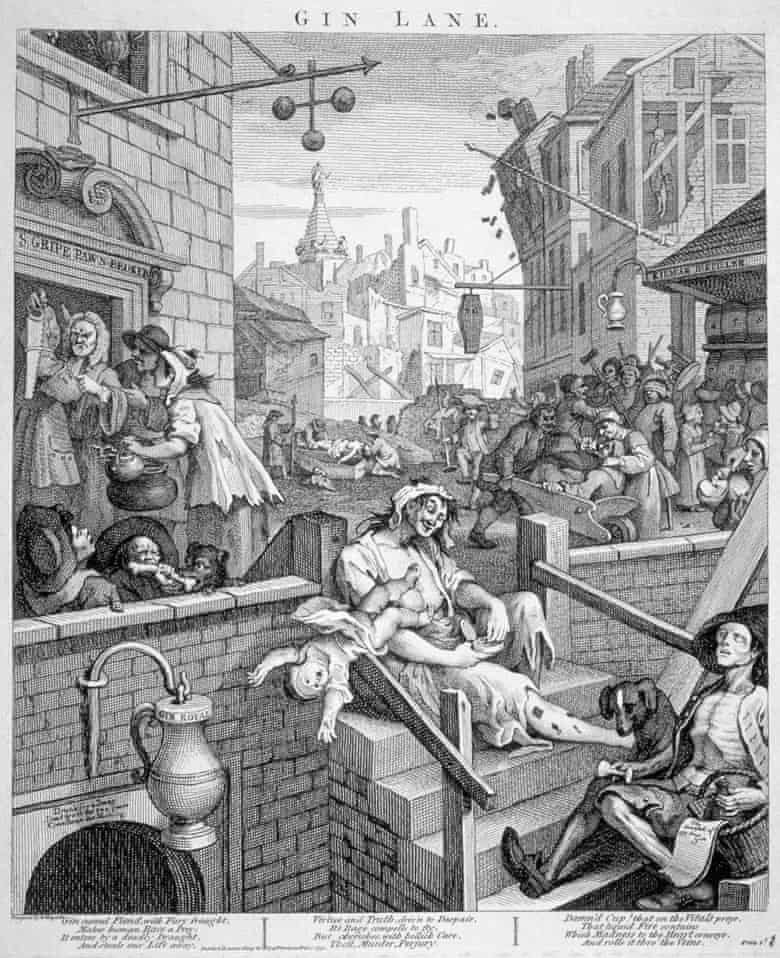
Hogarth’s Gin Lane, 1751

Perry is fundamentally a storyteller artist. He creates narratives in his artworks which help us to think about the world around us, and our multiple identities as individuals within society. That is what he has done for this show at Dovecot Studios, Julie Cope’s Grand Tour: The Story of a Life by Grayson Perry. The exhibition follows his fictional character Julie through what Perry calls ‘the trails, tribulations, celebrations and mistakes of an average life’, using a series of brightly-coloured Jacquard tapestries.

Don’t be fooled by the bright colours, though. The story behind the works is one that is full of tragedy, examining the mundane reality of life, the pervasive banality even of its most dramatic moments. Alongside the tapestries, The Ballad of Julie Cope, a poem written by Perry bleakly sets the context for Julie’s life. I sometimes find looped audio tracks in exhibition spaces quite distracting, but here, the poem read aloud by Perry in his slight Essex accent gave the tale of Julie Cope, an Essex girl, a kind of timeless authenticity.
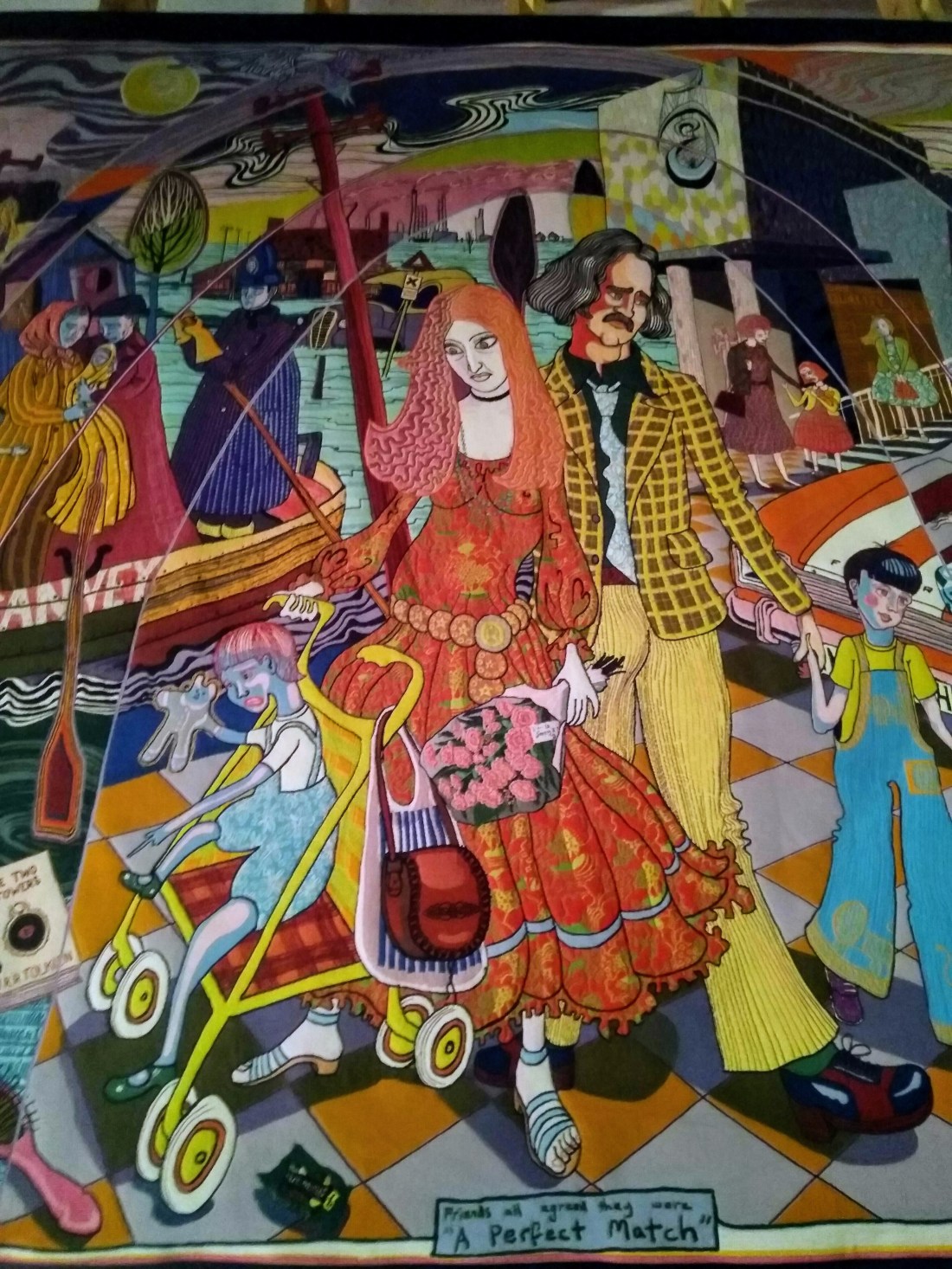
Detail from the first tapestry in the series, A Perfect Match

The tapestries themselves are immense and impressive. Packed with details, they are a fascinating maze of signs and symbols, clashing colours and patterns for the viewer to decipher. Clever tricks are used that are barely noticeable at first, but make the images all the more convincing, like the shadows used around the feet in the picture above, giving the work a sense of depth and the cartoon-esque characters more solidity.

As with much of Grayson Perry’s work, class is the central theme underlying the show, and his observations about life in modern Britain are as bittersweet and tinged with nostalgia as they are acerbic. The tapestries, when they are not on tour, usually decorate another of Perry’s fascinating projects, A House For Essex, a whacky Wendy house construction which is part folly, part shrine, to Julie Cope. Seen divorced from this context, in the exhibition space, I think the works have probably lost some of their whimsical quality, and we are left with a documentation of the sad predictability of life. For me, the overriding feeling of the exhibition was not uplifting, but in that way, Perry, the Bard, creates a perfect mirror of the country in turmoil around us.
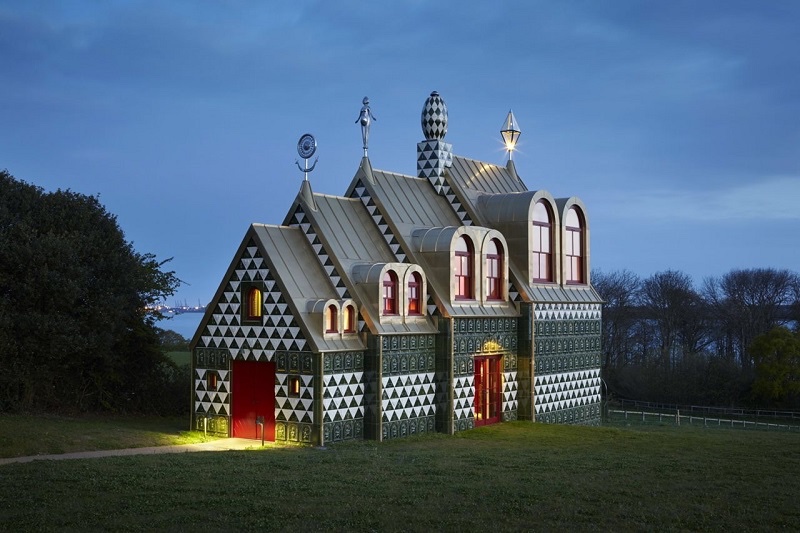
A House For Essex

The Long Look, Scottish National Portrait Gallery

The Long Look at the Scottish National Portrait Gallery is a small but focused show that turns portraiture on its head in a conceptually intriguing and visually satisfying way. The exhibition is the result of a two-year project in which Norman McBeath (photographer, printmaker) sat for painter Audrey Grant as she created two portraits of him in charcoal.

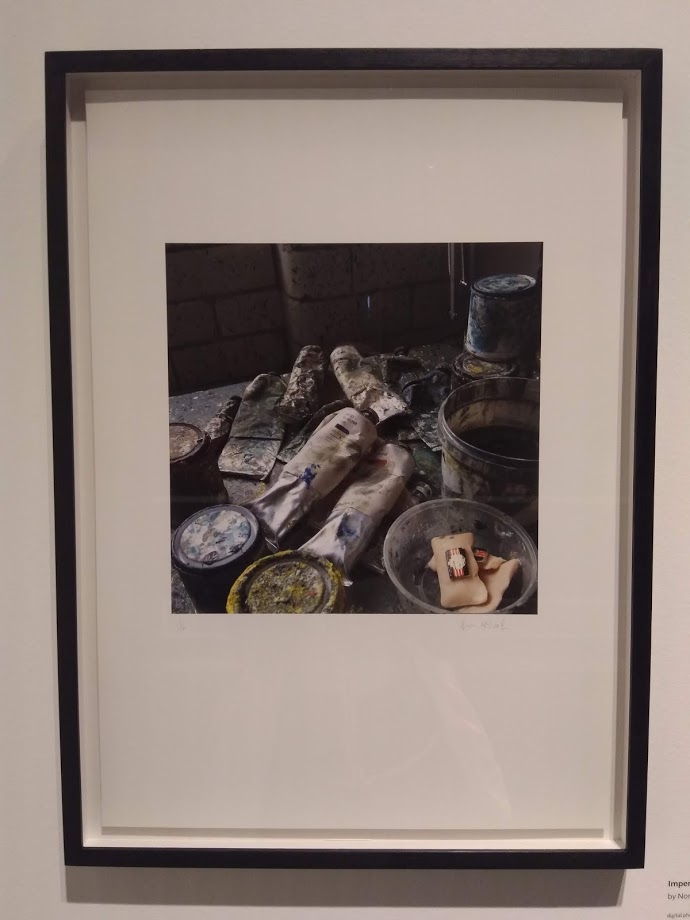
The portraits of McBeath do feature, but they are really only a side story to this show. The main body of work is by McBeath: his photographic impressions of Grant’s studio, documenting her presence by the trails of creative detritus she leaves in her wake. These ‘portraits’ show the traces of Grant everywhere: fingerprints in the paint that has dried on the back on her easel; highly detailed close-ups of her charcoal-blackened apron that seem transformed into vast monochrome sand dunes; the bars of soap on the counter, misshapen by the hands they help to clean after every session.

Hands series, a sequence of close up and super-high-definition photographs is at the centre of the display. Each minute detail is made more striking by the charcoal dust embedded in the creases of Grant’s skin. We rarely get much of a glimpse of the artist in standard portraiture, a genre that can feel fairly prosaic and transactional. Here, the photographs by McBeath document her creative space, the studio, and present its contents as a lens through which we ‘see’ the artist.

Imperial Leather by Norman McBeath

It seems that the sense of fascination with the artist’s studio now seems more prevalent than ever. The most unique and (the more I reflect on it) bizarre example I encountered was at Dublin City Gallery, The Hugh Lane. There, in the centre of the gallery, is Francis Bacon’s studio. Its contents – even the dust – painstakingly reassembled having been documented and meticulously transferred from London to Dublin in 1998. Though it is undeniably a fascinating sight, and totally worth visiting, there is something voyeuristic about the practice of preserving and reassembling the artist’s studio within the Gallery space (closer to home, Paolozzi’s studio is on display at the Scottish National Gallery of Modern Art until next year). These kind of displays continue to assert the narratives of the ‘artist genius’, elevating and shrouding his or her workplace in magic and mystique, ways of thinking that contemporary art history has sought to move away from.

The Long Look, though it has elements of this tendency to give the artist’s studio too much auratic power (including the unnecessary inclusion of the chair that McBeath sat in while his portrait was created) for the most part manages to circumvent these more troubling tendencies of artist/studio worship. Particularly when presented in the context of a national collection of portraiture, where wall labels normally the list the sitter’s name and details of their life far more prominently than the artist’s, this reversal of the gaze subverts the traditions of portraiture in a refreshing way.

Hands series by Norman McBeath

For me, the examination of the psychological intensity of two people observing one another over time, and the resulting sense of intimacy between McBeath and Grant was one of the other most successful outcomes of the show. For this reason, I would argue that the inclusion of two portraits of Val McDermind were a kind of ‘third wheel’, an unnecessary curatorial appendage to an otherwise tightly-focused exhibition.

Through the simple switch between observer/observed, The Long Look empowers the usually passive sitter with the gift of re-observation, and extends this to the observer in a way that offers a fresh perspective. When encountering subsequent portraits, we might ask ourselves: how did it look from the other side?