Year 3, Steve McQueen

Yesterday ArtAngel ran a live Q&A with artist and director Steve McQueen, following their most recent collaboration for his vast work, Year 3. For this artwork, McQueen arranged for 76,146 kids, from 3,128 Year 3 classes (ages 7–8) to be photographed in the timeless, traditional, and I would even say iconic format of the class photo. It’s something most of us can relate to. Bodies arranged in rows, taller kids standing, some sitting on plastic chairs or old wooden gym benches, and others cross-legged on the floor. What has emerged is a rich tapestry, a beautiful, huge patchwork quilt of thousands of photographs that document the present and, as McQueen emphasised in the talk, the future of London. What an incredible concept for a piece of art. I’ve heard it described as a giant portrait. But it feels far more dynamic, participatory and meaningful than that word implies.

I knew that the work was being exhibited at Tate Britain (I was due to visit in April, and am gutted that now I’m unlikely to see it at all), but from photos the installation looks impressive. The messy brightness of 1,504 schools packed into the grandiose space of the Duveen Galleries would always create a delicious juxtaposition. I hadn’t realised that for the ArtAngel side of the work, some 600 of the photos were created into billboards, situated across all 33 London boroughs, in November 2019. An ephemeral facet of a monumental artwork. It’s the stuff Encounters Art was made to write about – my only regret is to not have seen and documented them myself. In some ways that’s the beauty of these pop up artworks though. They aren’t supposed to be sought out, they mix and mingle with the everyday and you don’t know it’s there until you stumble upon it. If you did see a billboard in London back in November then I would love to hear your thoughts – leave a comment or DM me @encounters_art.

Installation view on Camden Road

Subverting a space that is usually used for adverts by filling it with a school photograph which is simultaneously strange (because we don’t know these children) and familiar (because we’ve all been children) is such a strong, engaging idea. One of the best moments I’ve come across by searching online for #year3project is a BT advert on Camden Road announcing “Technology will save us”. It is a timelapse video of BT’s billboard being surmounted with a photo of smiling kids in bright red cardigans and summer dresses in an old school hall. Here the children aren’t being prepped and presented as the consumers of the future. They are the future. They will save us. (Though I suppose ironically I owe my thanks to technology for preserving this moment for me to find months later.)

I love seeing these images interwoven into the London landscape. In tube stations, framed by carriage windows, this array of smiling young faces must have cheered up and intrigued countless commuters. Even in the gallery display, away from the urban fabric, it feels like a very London-based artwork, because it celebrates the city’s amazing diversity. McQueen chose Year 3 because for him, that is the moment we start to gain perception of our identities. Our classroom becomes a window on society and a crucible of the nuances of race, class, privilege and opportunity, all of which are explored in the work.
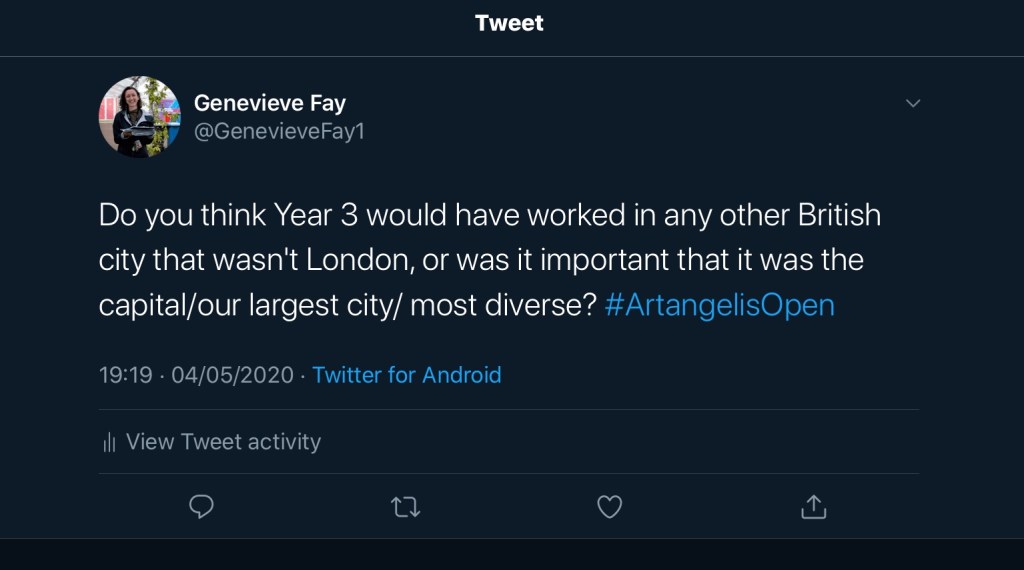
I found the London aspect particularly intriguing so I decided to ask a question using the hashtag #artangelisopen and I couldn’t believe it when it was picked for McQueen to answer. I was so excited, cheering and jumping up and down that I almost forgot to listen to his response. He said that for him, London was the clear choice, but it didn’t have to be limited to that – it could be carried out anywhere – and he seemed to be encouraging people to take up the project and move it on elsewhere. I would love to see that, particularly somewhere like Nottinghamshire (where I grew up) where there are rural and urban childhoods playing out. I wonder if it would click in the same way the original project does.

Installation view at Tate Britain Duveen Galleries

Listening to McQueen, the work was also understandably rooted in London because that was his experience – despite its scale, there is a highly personal context to the artwork which draws on his own boyhood engagement with art: a primary school outing to Tate Britain was the start of his journey. But it’s also about visibility. According to TIME magazine, Steve McQueen is one of the 100 most influential people in the world. For Twelve Years A Slave he won an Academy Award for Best Picture, and became the first black filmmaker to do so.

By creating this work, displayed in the gallery he visited as a child, he has come full circle. What an amazing thing, to provide an opportunity for the children in Year 3 be able to visit that same space, and see themselves, and others who look like them, on the walls. It fills me with hope that the project will be the spark that ignites countless artistic explorations and adventures. I can’t wait to see what they create when they’re fully grown.
Performance Live: The Way Out review

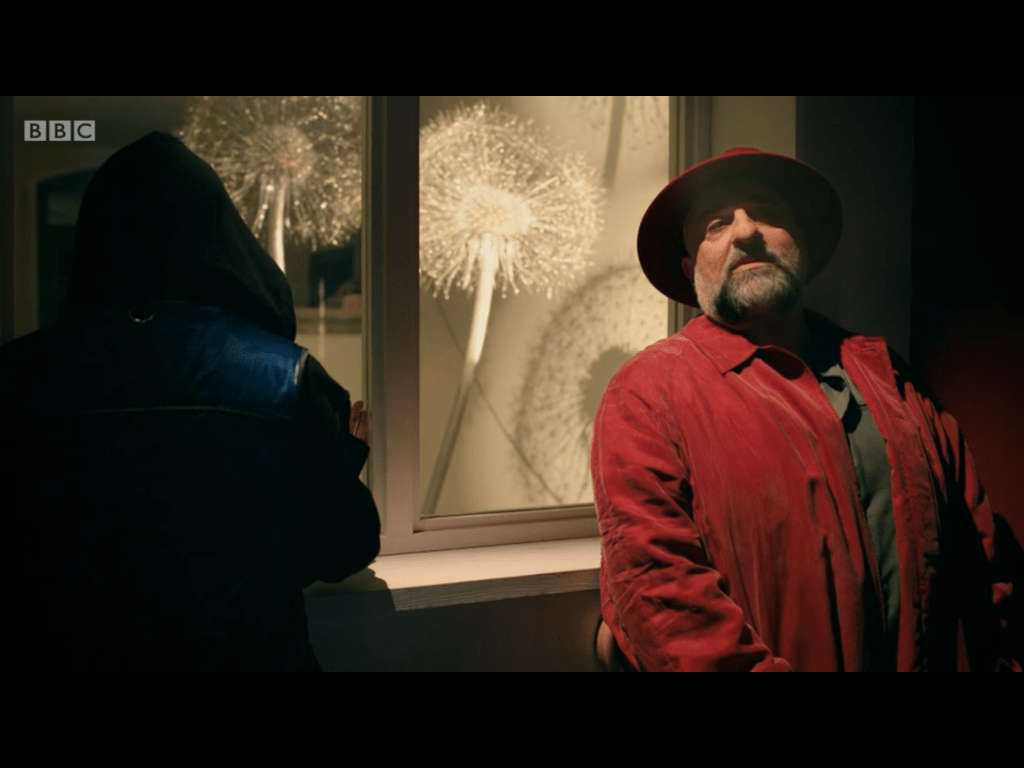
It’s raining heavily outside, and a soaked through, frightened, hooded figure stumbles upon a grand pair of wooden doors. They open automatically, and seem to offer an alternative to the storm, and whatever else is lurking outside that troubles our protagonist. This is how The Way Out, Battersea Arts Centre’s offering for BBC Culture in Quarantine, begins. I promise you that if you like imaginative, surreal adventures and need an escape from this covid-consumed world (as I did yesterday) you will fall down this creative rabbit hole and not look back.

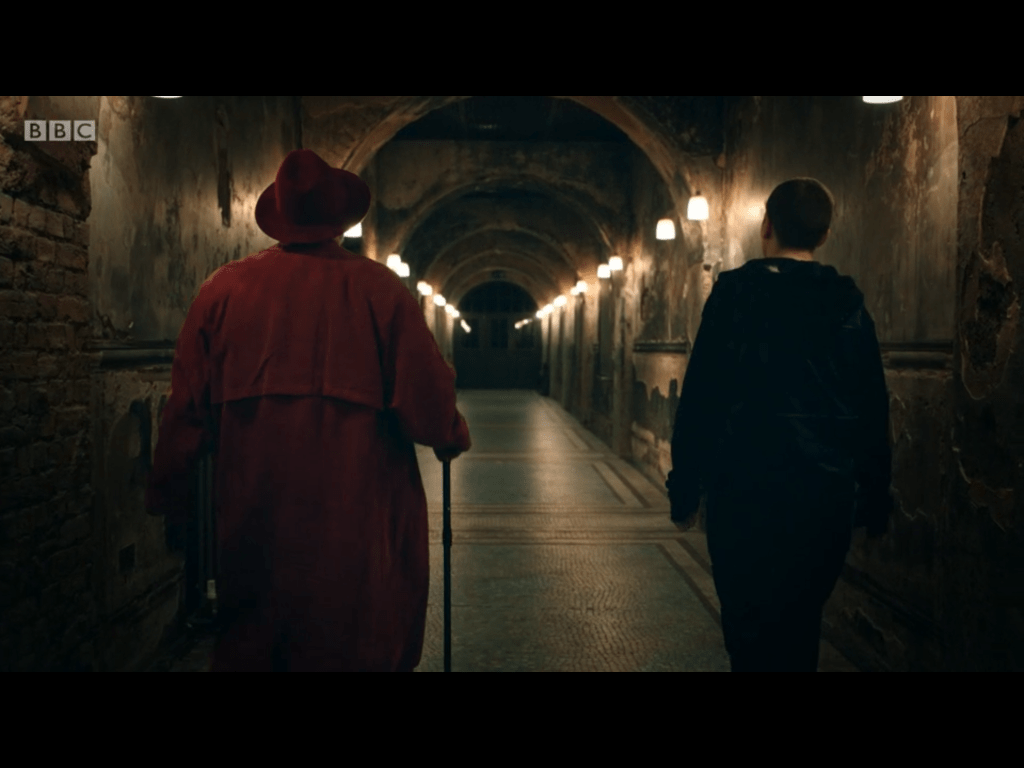
There are a number of references to Lewis Carroll’s Alice’s Adventures in Wonderland, and in many ways this is a modern retelling, one that celebrates the talent that Battersea Arts Centre has to offer as well as the transformative power of creativity. But before we make our way to experience the performances, we first encounter the enigmatic Omid Djalili, our guide and master of ceremonies. His existential musings on pathways, growth, entrances and exits hover between philosophy and riddle. As our journey through this old town hall with crumbling walls and labyrinthine corridors continues, he is increasingly likeable and intriguing.

The work incorporates some of BAC’s art installations, such as Hope, by Caroline Russell (2019)

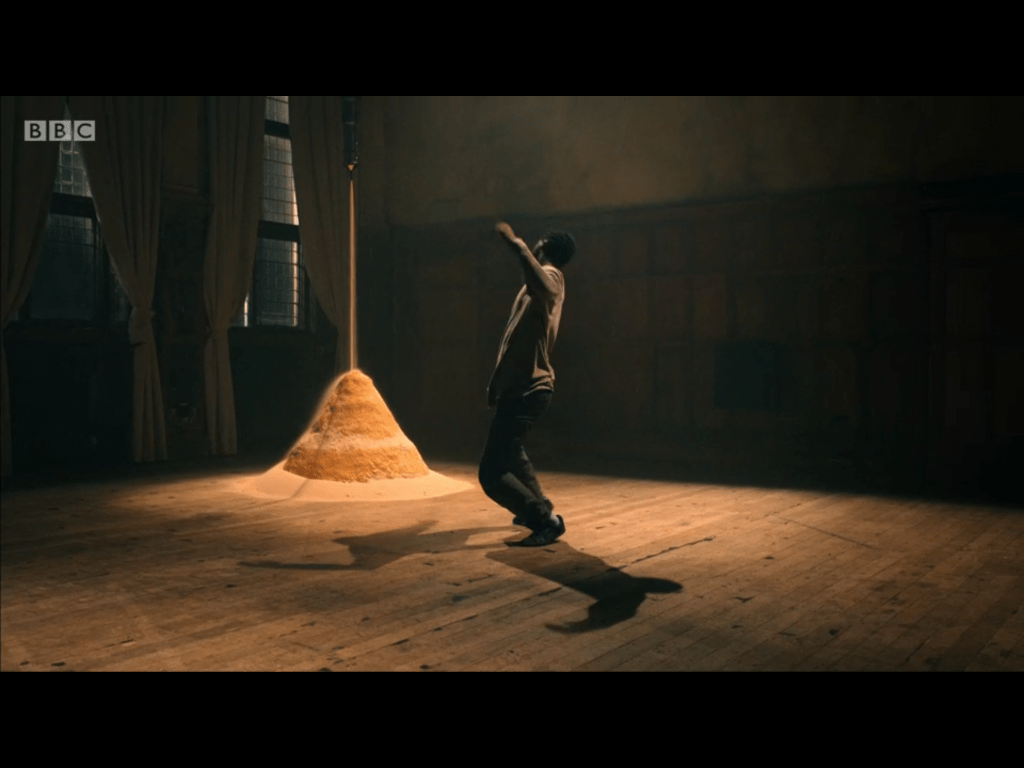
We begin as curious but detached observers, audience members, pondering how it is possible for a body to become fluid in the way that Botis Seva’s does in his performance of Quick Sand, performed alongside what seems to be a broken hourglass, its sediments hardened to the floor. As we venture further into the warren, we enter different worlds, a deep sea chamber where drag artist and opera performer Le Gateau Chocolat reigns supreme, singing a lonely siren song to the luscious, pulsating backdrop of a string trio. As the journey continues, its sinister edge, probably imagined by our own suspicions and scepticism, slowly gives way lightness and joy. We enter the cabaret world of the Cocoa Butter Club and we realise we are now participants in the show. There’s a performance of “Young Hearts Run Free”, one of my favourite disco classics which is poignant and joyful in equal measure. It’s a party and a crazy one at that, the kind of night when time warps and you don’t realise how late or early it is, or how it got to be light outside?

Botis Seva working magic with his movements in Quick Sand

The building is in many ways my favourite part of the show. It transported me, kindling memories of similar places I’ve been or known – art venues like Summerhall in Edinburgh (which is currently crowdfunding), nightclubs, the backstages of theatres, the burlesque house from The Simpsons, Shangri-la at Glastonbury, and even certain dark, decrepit corridors of my Midlands secondary school. The film is about 40 minutes long and is taken in a single shot from around head height, making it as close to immersive theatre as TV can get. You are the one journeying through the maze. And wow, it feels good to be traveling through and exploring a hive of creativity and weirdness. While watching I vow to myself not to take these experiences for granted again.

Come As You Are is a heartfelt poem written and performed by Sanah Ahsan, resplendent in a bright yellow suit and standing in centre of what seems to be a yellow brick road. It’s a nod to another memorable, psychedelic adventure into another land – except it is made from flowers and not bricks. A road made of flowers sums up the paradoxes of this wonderful piece of theatre, this story. It’s bizarre, fun and seems impossible and yet it works because of all the paradoxes woven into it. It is a beautiful escape, so perfect and so utterly needed for these times that it’s hard to believe that it wasn’t planned for a quarantined world (it was filmed in January). 

This flight of fantasy took me out of myself for a moment. Hopefully, on the other side of this stationary journey we are all undergoing, we can emerge, like the character from The Way Out, with our hoods thrown back, ready to embrace the world, each other and ourselves.

Through the labyrinth

Myriam Lefkowitz / Walk, Hands, Eyes (Edinburgh)

I have been wanting to write a piece about this for a long time. I regret I’ve been behind on my blog posts lately, but February is the month I’m going to write regularly. As my friend Kate put it, ‘perfectionism is taking a hit’. She is drawing every day, and I’m trying to do the written equivalent, whether on here, in my journal or on Instagram (@encounters_art).

What does it mean to meet a stranger, and within minutes, be expected to rely upon them for everything? To trust them to be your eyes, to guide you through the complex labyrinths of city streets, buildings, traffic, and other people? This is the question that lies at the heart of Myriam Lefkowitz’s extraordinary work ‘Walk, Hands, Eyes (Edinburgh)’, which was organised and performed by Talbot Rice Gallery, one of the city’s best places for engaging with contemporary art (art that is being made now, or has been very recently).

The work is a 45-minute 1-1 walk where the performer takes you by the hand and leads you through the city, with your eyes closed throughout. It is a silent experience, except for the occasional, whispered command by your performer “one step down… and another”. It was as intense as it sounds, and most people I have discussed the piece with have recoiled in horror, and asked me why anyone would voluntarily put themselves through that kind of thing. Was it even “art” if there wasn’t a object or thing you could look at as part of it?

Yet, I would go so far as to say it was one of the best art pieces I’ve experienced. Yes, it was intense, but in all the best ways. The childlike, gentle way the performer took my hand, and the way my body responded with utter trust (even though my mind fluctuated between embarrassment, confusion and hilarity) was a fascinating experience. It’s a simple concept when you boil it down, but for me as participant, it was and emotional and sensory rollercoaster.

People have always told me that when a person loses one sense, the others become sharper, super-senses. Temporarily ‘losing’ my sight for around an hour (I just about managed without peeking) demonstrated how accurate this is. I became aware of so much more in a way that was genuinely exhilarating: the frosty blades of grass crunching under my feet, the snippets of conversations, and even the atmosphere or feeling that you sense when entering a place. I did the walk on 12 December, and certain rooms we passed through vibrated with intense festiveness. In other moments I could sense we were in the deserted crevices of Edinburgh: alleys and corners where the sun barely ever reaches, the very quality of the air a telltale sign of pervasive damp.

There was an almost embarrassing sense of intimacy to it. As a rule, we only ever hold hands with people we know really well, who we feel affection for, who we know will not judge us if our hands are clammy or our skin rough. I found myself thinking about the performer (who was fast becoming my spirit guide through this new sensory world). I worried that her hand was cold: that prolonged connection with a stranger, though artificially created through an artistic concept, became a strong bond through a shared surreal experience. I had to trust her, because I had no choice otherwise. I also had to trust the other people we encountered in the streets not to hurt me, to take advantage of my vulnerability, my acute sense of which was counteracted with relief when nothing did go wrong. (On a side note, I have new respect for those who navigate landscapes with limited sight, by using a white stick or a guide dog. It really brought home the element of trust and bravery involved in that).

Experiential art, or art that functions through making us interact or participate with it in some way, is a big business. In our free time more and more we seek “experiences”, moments we can document on social media that boost our social capital in the process. Unfortunately, this can often lead to art experiences that are packed with gimmicks, but art vacuous at their core. By contrast, this simple action of two people walking together, with the city as their backdrop, felt minimalist and radical. Lefkowitz’s ‘Walk, Hands, Eyes (Edinburgh)’ reminded me that to make this kind of art successfully, you don’t need lights, big budget shows, music, bells and whistles.

For me, the best art can makes us as viewers/listeners/participants feel, perceive, experience and enjoy both reality and artifice in a way we hadn’t before, that stays with us. You can tell from the lack of images on this post that there were no visual tokens or takeaways from the experience, nothing to prove I was there. That’s because the best part of the work came from something intangible, from what I experienced within.

Gormley and Eliasson: perception and perspective

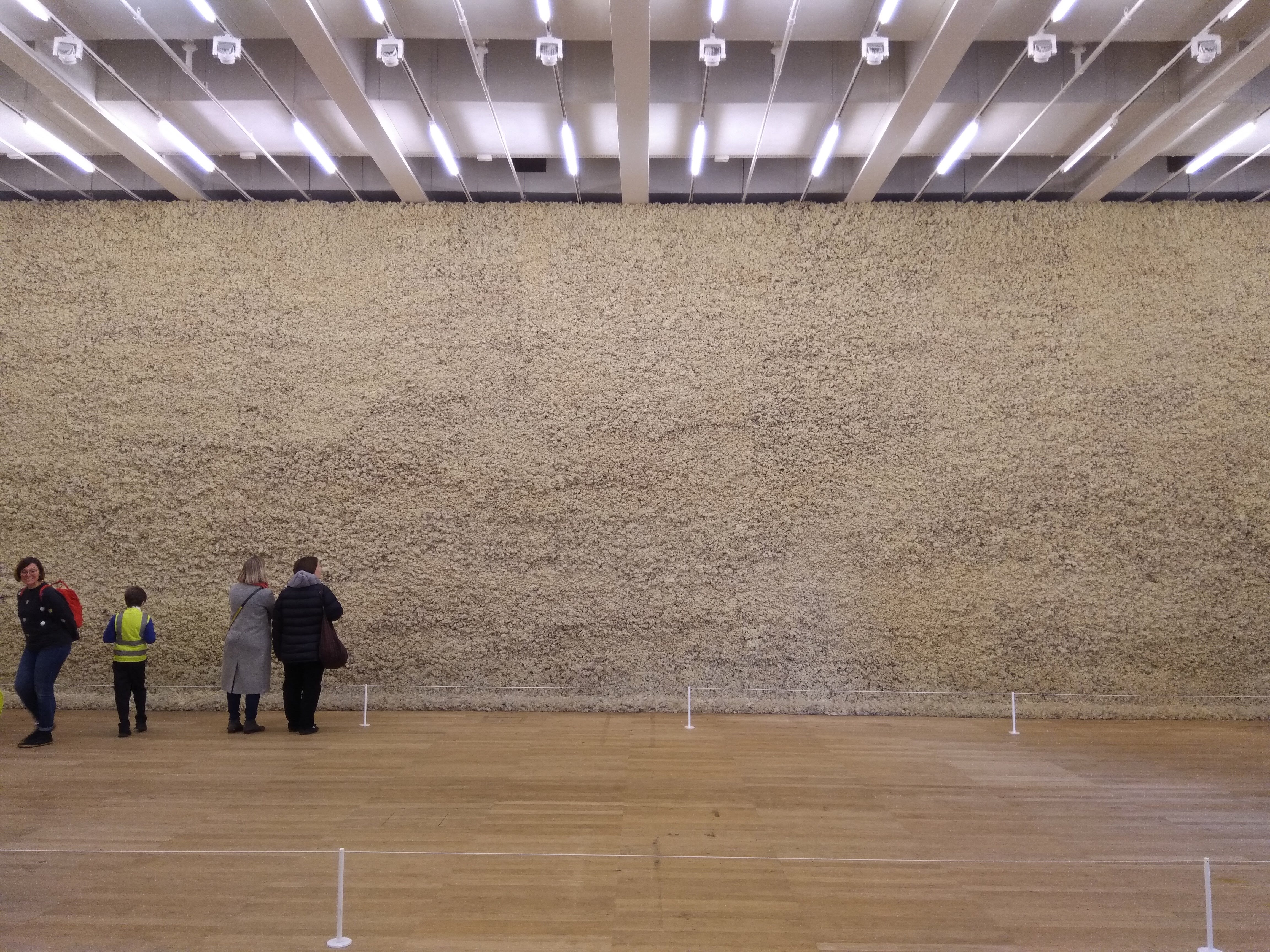
At first glance, it might not seem that there is much that connects the art of Anthony Gormley and Olafur Eliasson. Two weeks ago I would have summarised Gormley’s work as largely figurative, heavy, often made using metal and other industrial materials, and sombre in tone, while I tended to think of Eliasson’s as abstract, colourful and using a range of substances, natural and artificial, to playful effect.

Eliasson’s Moss Wall (1994)

Before visiting their recent exhibitions in London two weeks ago, the only thing that connected them in my mind was the fact that both shows were exceedingly busy and popular. This was based on the huge volume of posts I’d seen on Instagram, combined with an article in the Guardian in which gallery-goers expressed their chagrin that other people were getting in their way of enjoying art (more on that later).

Both exhibitions surprised me, starting with the Gormley. Although I’ve always enjoyed his work when I’ve come across it, I’ve often thought of it as fairly repetitive (frequently based on his own body) and ubiquitous. His sculptures are scattered across the country, in high-profile installations from Gateshead to Merseyside. In Edinburgh there are six Gormleys standing in a short stretch of the Water of Leith. But the Royal Academy show demonstrated how his artwork is much broader and more varied than the ‘universal’ self portraits we are frequently exposed to in his public art. His best works challenge how we perceive space, and how we perceive ourselves and each other through art.

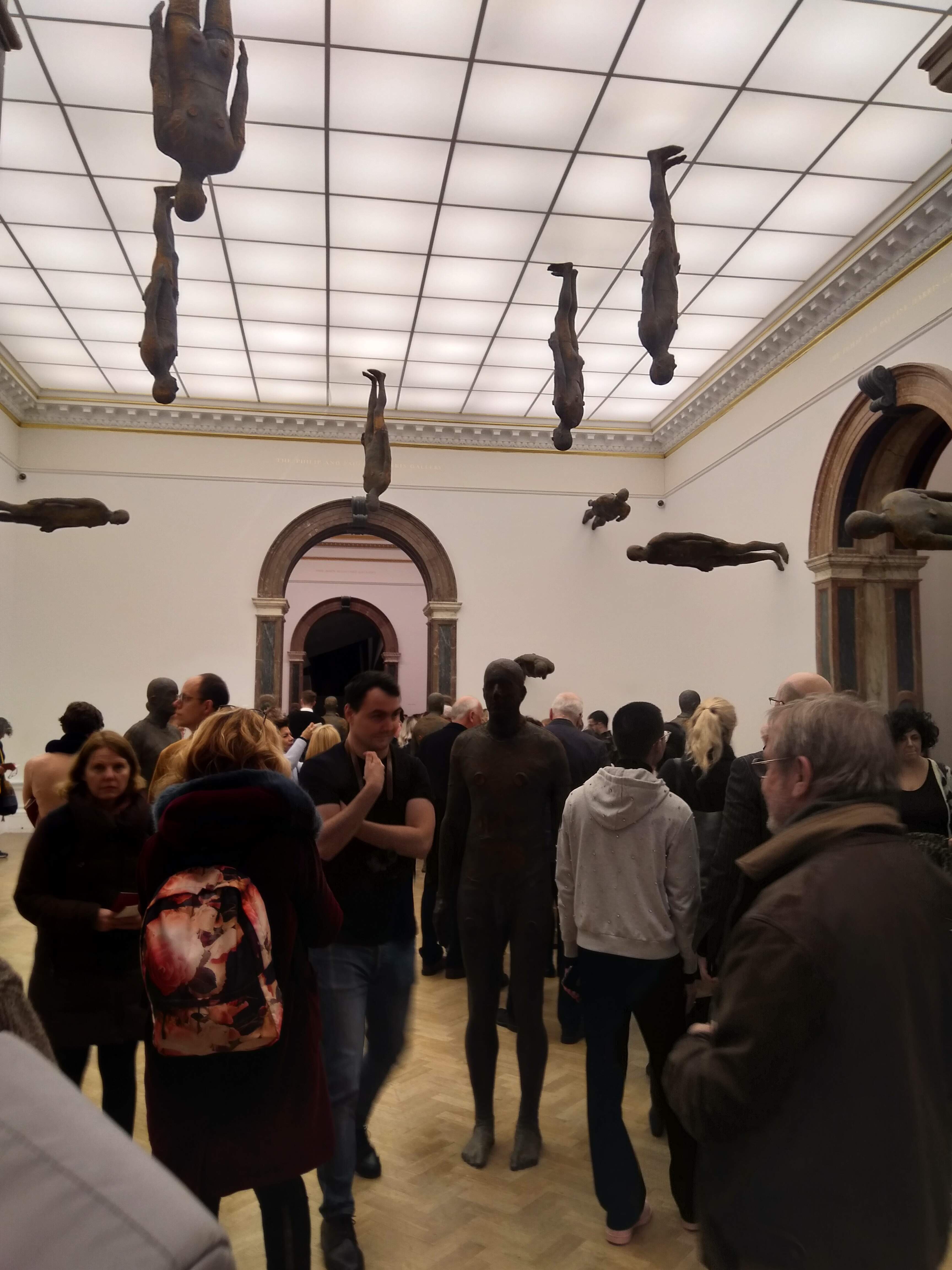
For instance, his Lost Horizon (2008), presents us with a familiar sight, multiple forms of Gormley’s body in cast iron, but in a different way. Bodies jut out at all angles and surround us, defying gravity and playing with our senses. The work isn’t ponderous, it’s fun. Seeing the exhibition on the last day meant that the room was packed with people, making it difficult to tell the sculptures from the live bodies that surrounded them.

Art and life intermingle in Lost Horizon I (2008)

Some of you might look at that photo and recoil at the number of people in the room. Yes, both exhibitions were busy. But part of experiencing art is noticing how others experience it: seeing other people react to and interact with art is one of the things I find most interesting about it. This aspect was what really made me see the connections between the two artists’ work. Humans play a major part in activating these artworks and making them resonate.

Visiting the Eliasson exhibition mid-week and during the day, I experienced it alongside a large school group of teenagers. Their interactions with Your Uncertain Shadow (colour) (2010), brought the work to life for me: they danced, flicked their hair, and had fun with it. One criticism that has been levelled at the show is that it’s a little gimmicky, but it is indisputable that this very quality makes it a good entry point for young people. And in turn, they remind us that we don’t have to be so serious all the time when it comes to art.

My fellow guests brought Your Uncertain Shadow (colour) to life

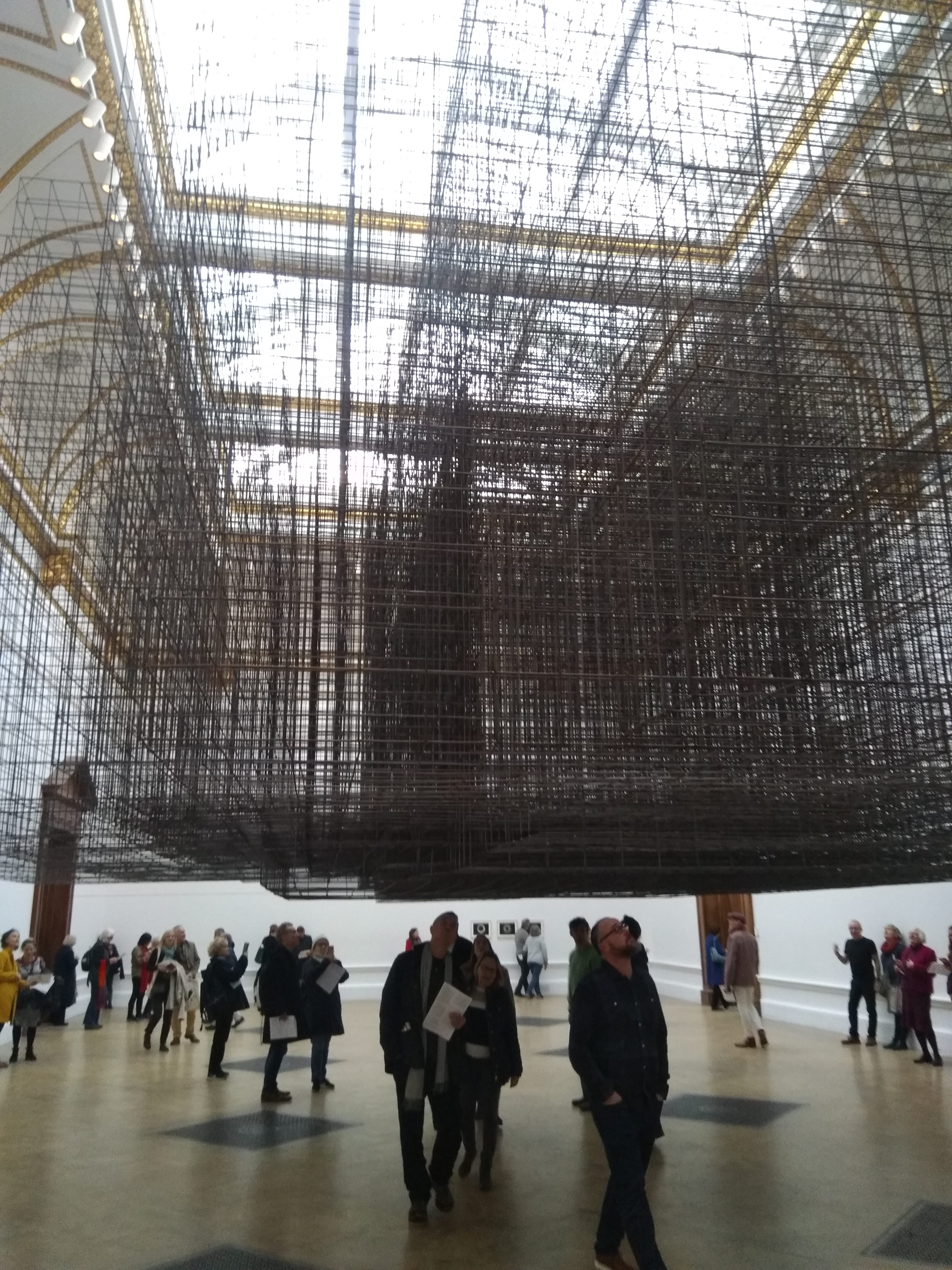
As well as having moments of levity and playfulness though, both exhibitions experimented with their visitors’ senses of fear and disorientation. Walking, sitting and lying beneath the Gormley’s colossal Matrix III (2019), 21 intersecting weighty steel mesh cages that contrasted satisfyingly with the Academy’s gilt cornices, felt genuinely daring. Cautiously making my way through the 39-metre fog tunnel of Eliasson’s Din blinde Passager (Your blind passenger) (2010), I wondered whether this immersive journey through colour and light would ever end (is this what they speak about when they say you see a white light when you die?!) Both were enormous, immersive, visceral and tinged with danger.

Walking underneath Matrix III – not for the faint-hearted

Alongside the colossal, statement-making art of these two big budget shows, there is also an exploration of vulnerability which makes them more than a bombastic celebration of these highly successful artists’ achievements.

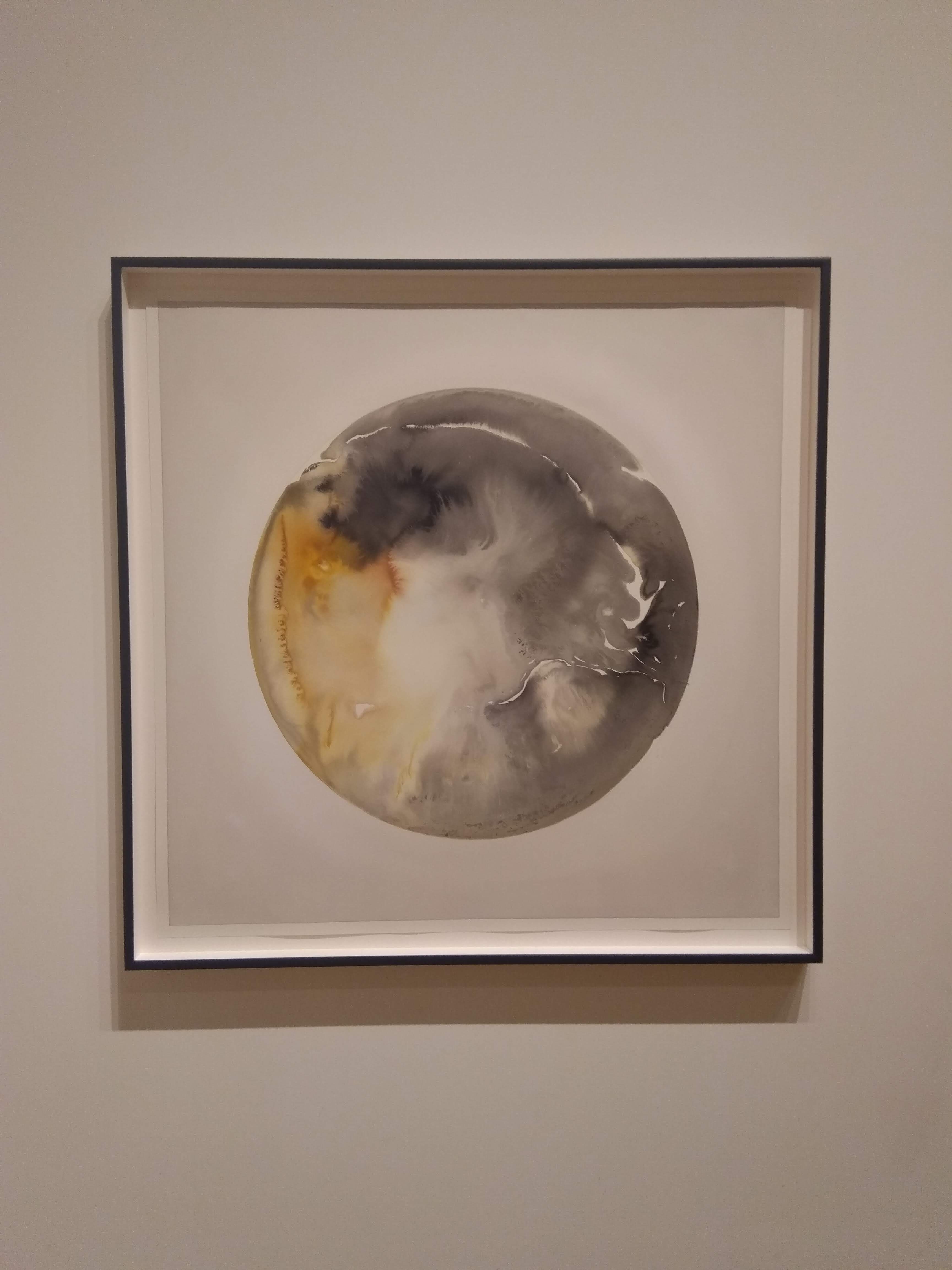
Eliasson’s work is centred around the environment, focusing on absence as well as presence, and soberly examines the loss of elements of our natural world in an era of climate crisis. Installations remind the viewer of the magic of the everyday: rain trickling down a window in Regenfenster (1999), the different effects that occur when light and water meet are made manifest in Beauty (1993) and Big Bang Fountain (2014). The ghostly imprints left by glacial ice melting into thin washes of colour in the Glacial currents series (2018) were almost haunting.

Glacial currents (yellow, sienna), 2018

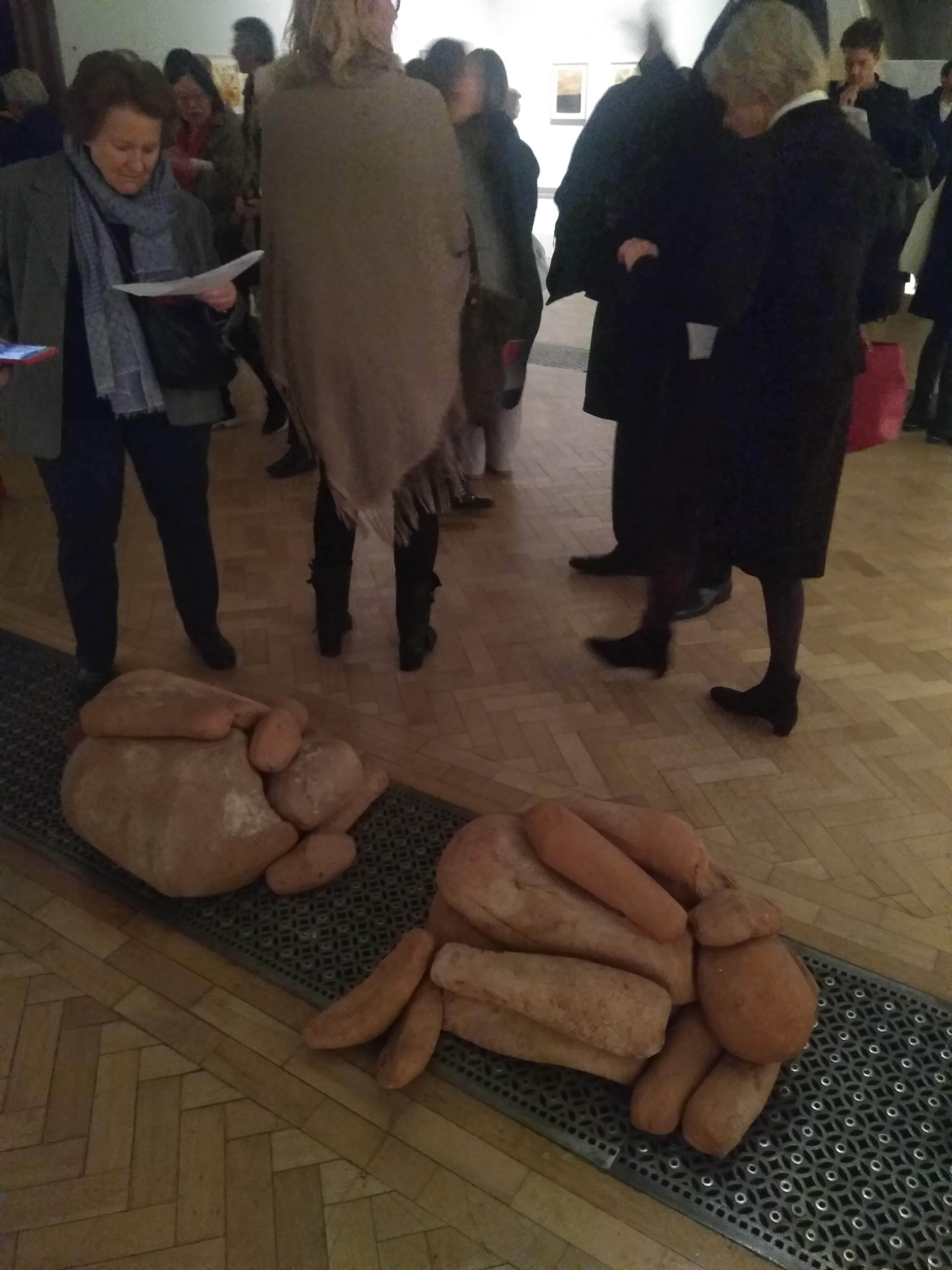
While Eliasson’s work focusses on the vulnerability of the planet, Gormley takes us back to ourselves once again. Starting the journey in the courtyard with Iron Baby (1999), at the end of the show we encounter ourselves once more, in Pile I (2017) and Pile II (2018). Stacks of simple, earth-coloured clay, huddled on the floor and without a plinth to protect them from the metal grates beneath, these small works are the hardest hitting of all in their unassuming fragility. We contemplate ourselves, our earthliness and our mortality.

Full circle: we encounter ourselves again as huddled lumps of clay

In very different ways, both artists are helping us to make sense of ourselves, our present, and heightening our awareness of our surroundings. That kind of lesson is worth braving a crowded exhibition for – and who knows – you might even feel inspired by those you have been thrown together with on your journey of discovery.

Nicky Bird & Art Walk Projects, Portobello

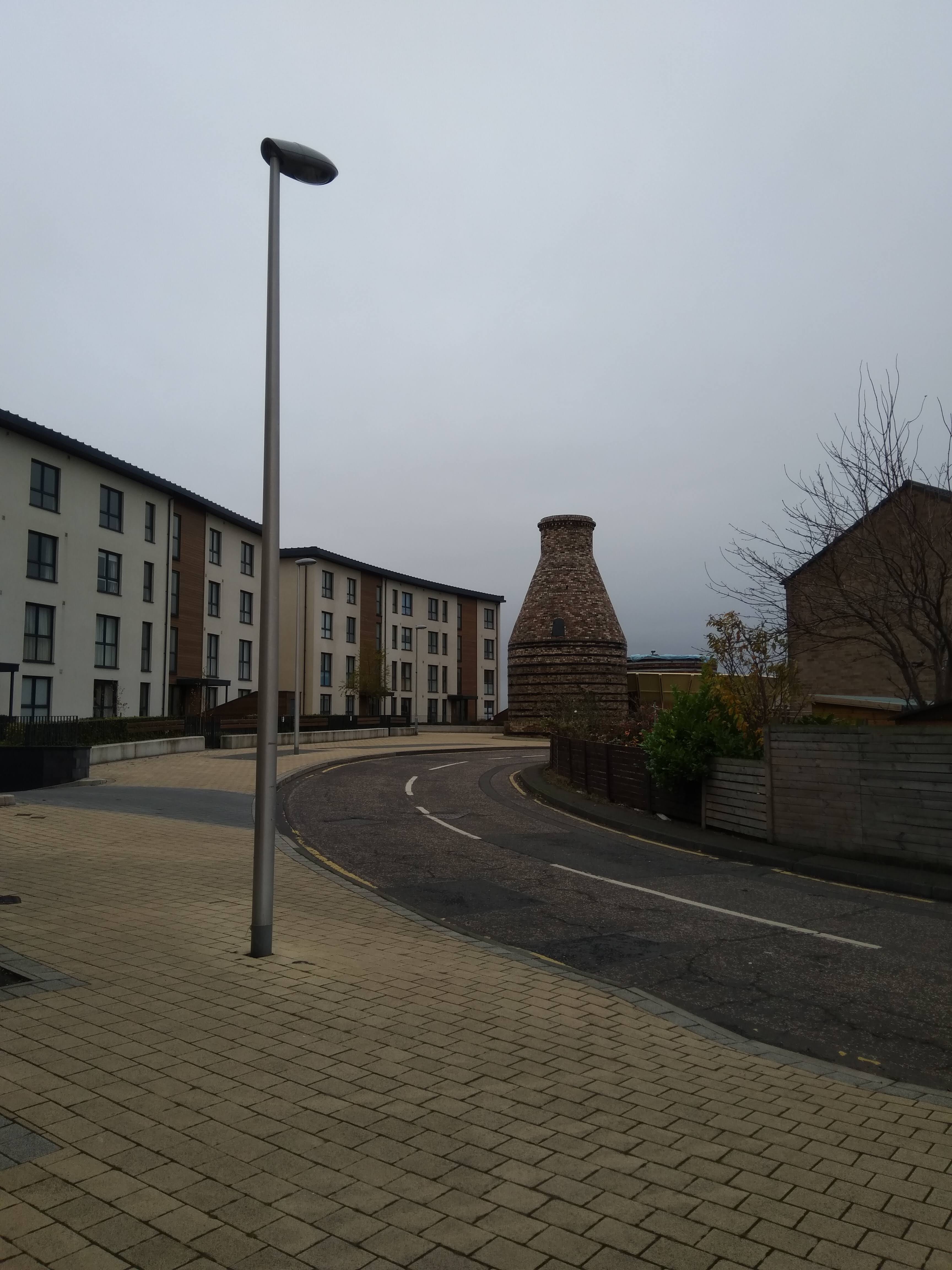
How much do we really know about our surroundings? Living in towns and cities, there are fragments of past lives and clues to how the environment has changed scattered all around us, if we look carefully. That careful looking, backed up by detailed research is how artist Nicky Bird is spending her LAND MARK residency with Art Walk Projects, based in Portobello. The starting points for her project are the two bottle kilns close to the shore (dated 1906 and 1909), the only fragments left of the large Buchan Pottery complex, which dominated the area close to the shore, but closed in the early 1970s.

One of the bottle kilns, an alien industrial fragment adrift in a sea of new builds

Portobello is a seaside town between Leith and Musselburgh, east of Edinburgh city centre. It’s a beautiful walk along the promenade, more a place of leisure than of work, but until relatively recently it was an important industrial hub – there was a paper mill and a chocolate factory all within easy reach of the Pottery.

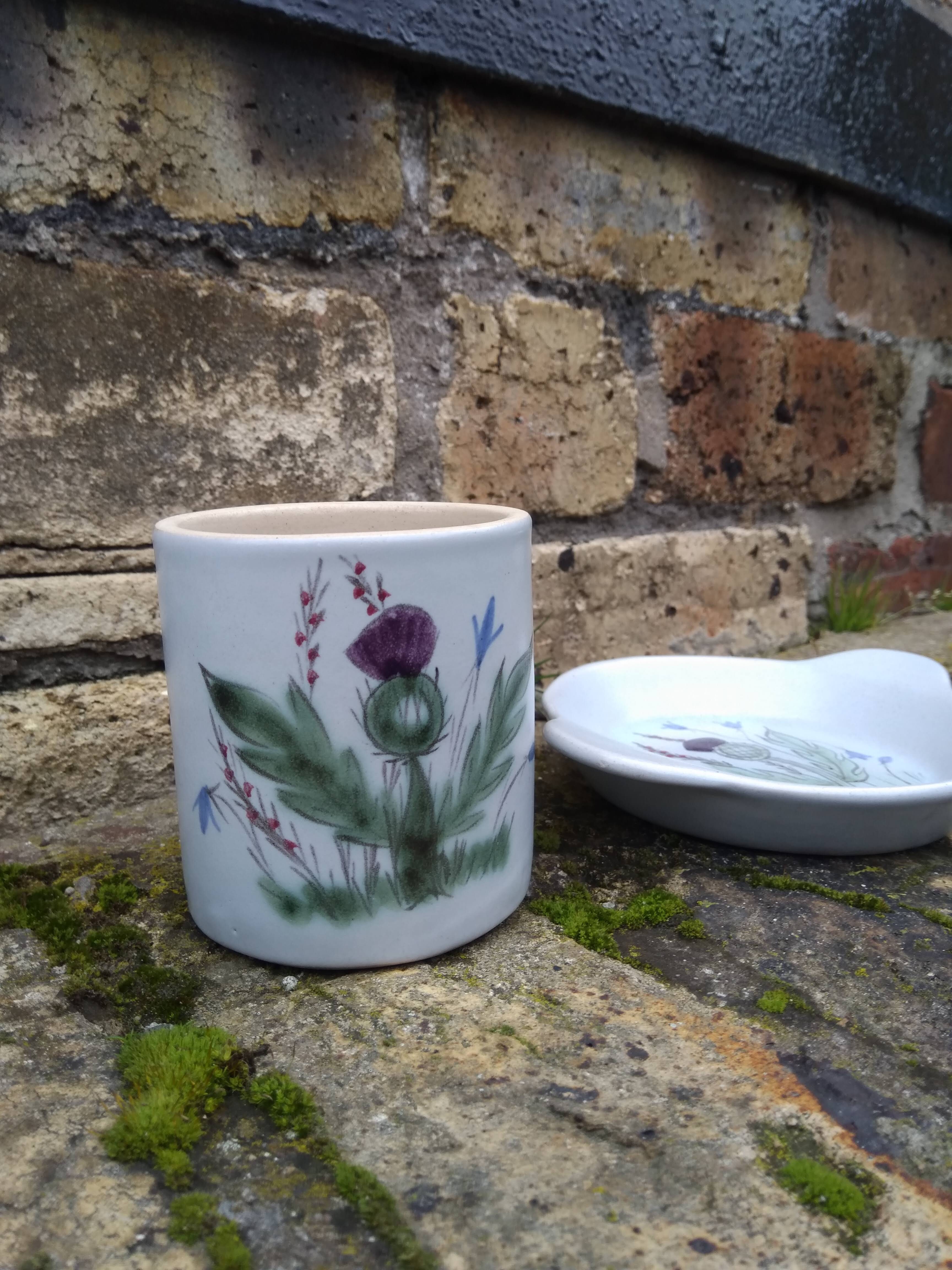
Today a small group, led by Bird, helped to revive a memory of that recent industrial past, through a walk event which told the decorators’ stories. These were the women who painted the ceramics before they were fired in they kiln, who occasionally raked through the spoils to try out their own designs and have them fired on the sly. Like a band of investigators searching for clues we walked around the area and examined maps from different phases of the area’s history.

Classic Buchan Portobello pottery, set against the backdrop of the beautiful kiln bricks

We also looked at examples of the pottery the women had decorated, and two fellow participants told me they recognised the design – it used to be sold in all the tourist shops in the 1970s, but they had never realised it had been made in Portobello itself. It felt good to participate in reviving that part of the town’s story, and I’ll be keeping an eye out for pieces of Buchan pottery in Edinburgh’s shops from now on. Even the most everyday objects can be brought to life through giving a voice to their past, which is why art projects like this one, which evoke memories that have been lost, are so important, especially for communities that have changed as much as Portobello.

Nicky Bird’s residency with Art Walk Projects is culminating with an event in February, so this walk was really a launch for her project. The completed work promises to be one that shakes off the dust that has settled on Portobello’s recent history, and I’ll look forward to seeing what else is revealed.

‘Cut and paste: 400 years of collage’, National Galleries Scotland

There’s so much packed into this exhibition at the Scottish National Gallery of Modern Art, which connects radically different works of art by artists as diverse as Pietro da Cortona (Italian Baroque painter and architect, 1596-1669) and Linder (British radical feminist artist, b.1954) it’s difficult to know where to begin.

The exhibition is a chronological survey of just about everything connected to the act of cutting one thing and sticking/stitching it on to another, including the digital techniques used today by brilliant artists like Cold War Steve. So there’s a lot to get through.

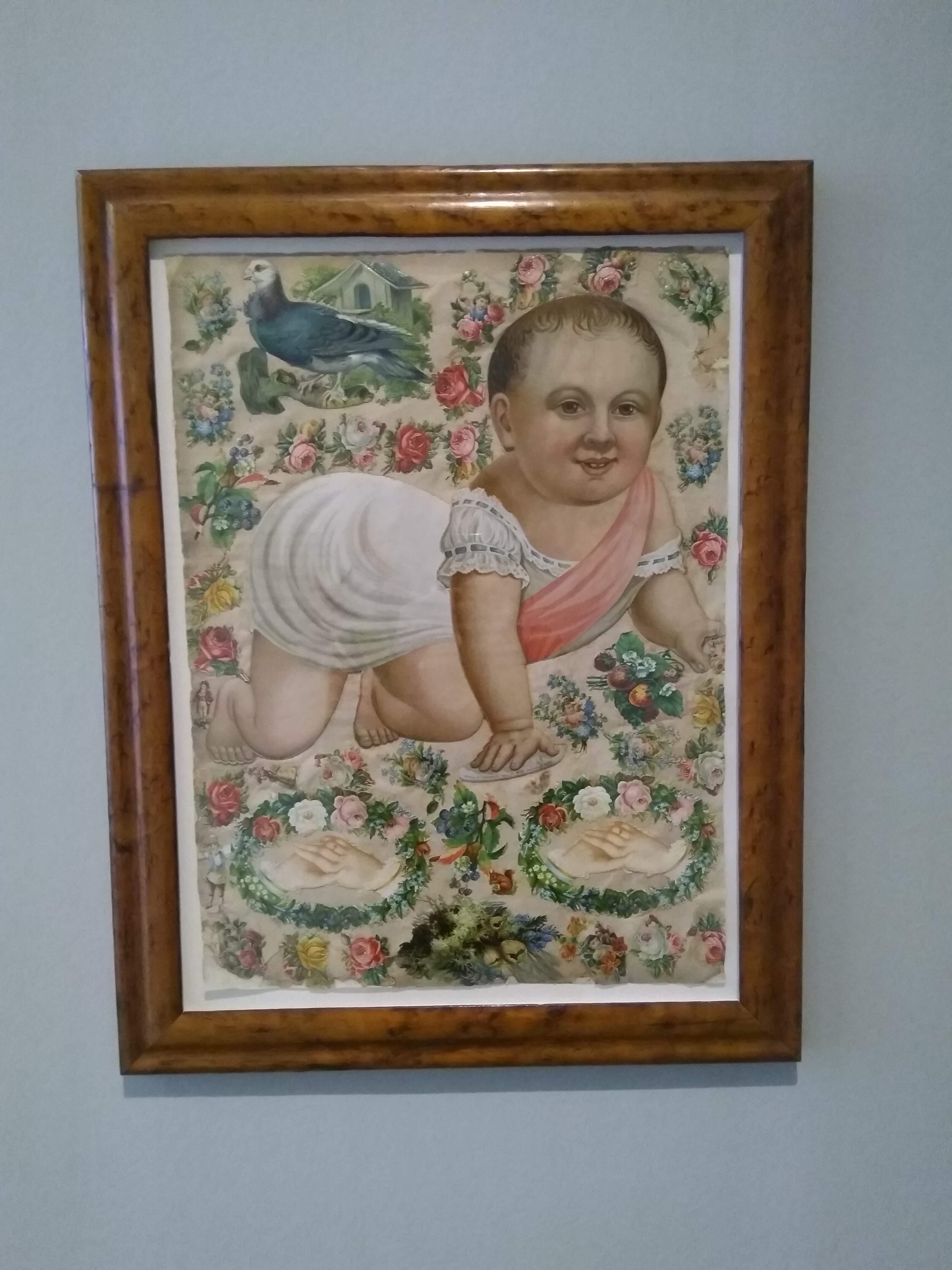
It might sound as a though the whole concept is a bit broad (it’s true that the exhibition has so many works it almost falls into the ‘overwhelming’ category), but in the very act of broadening out the understanding of collage as art, the show opens up the narrative possibilities around the medium. By including works by amateur and anonymous artists, we see the informal side of collage, which became hugely popular in the nineteenth century, particularly among women. I’m glad of that because it exposes some of the many weird and wonderful constructions that resulted from the pastime of sticking one thing to another, one of my favourites being this monstrously ugly baby from 1890.

Anonymous, Baby, (about 1890)

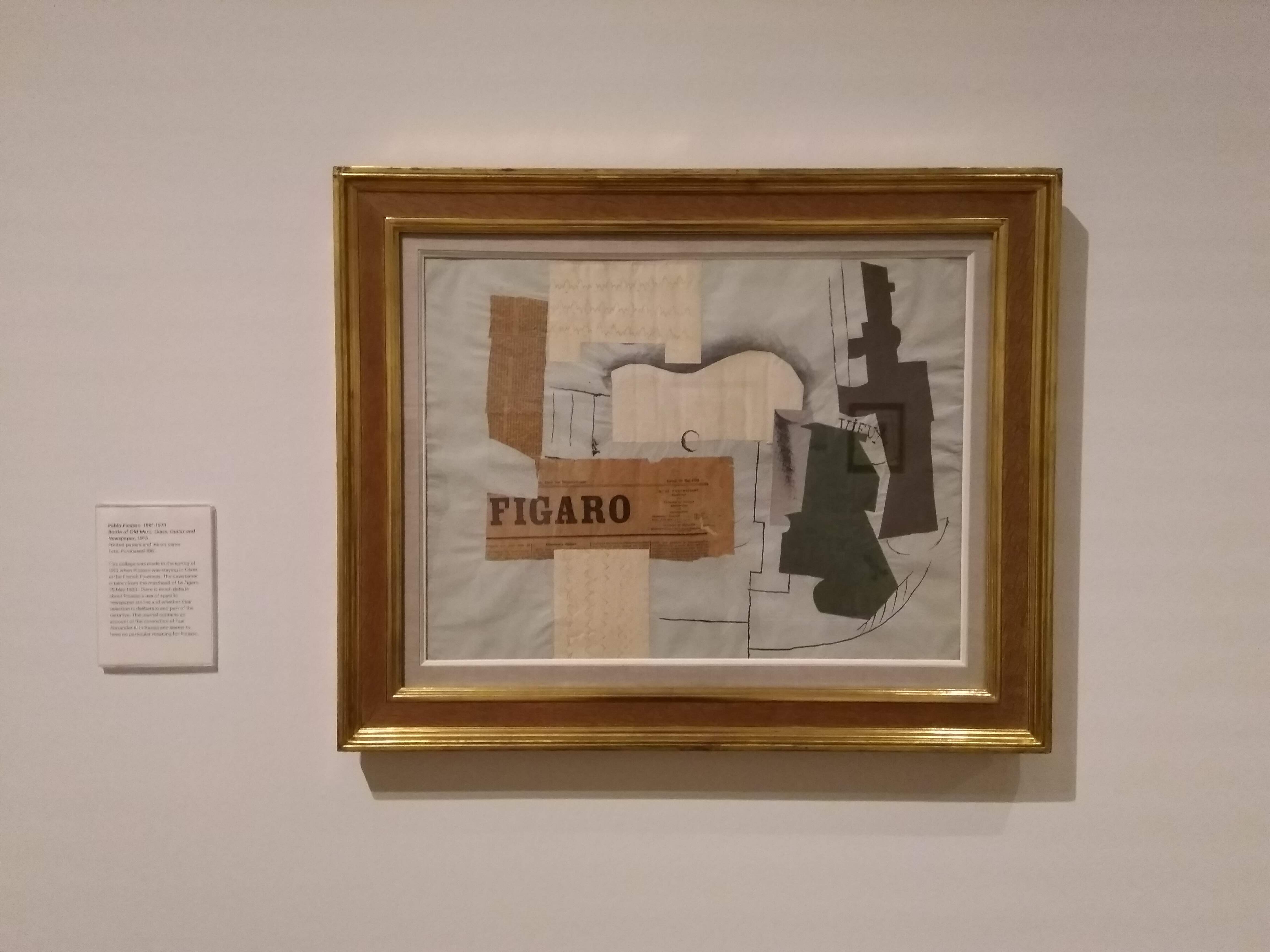
By placing objects like this one alongside Picasso’s Old Marc, Glass, Guitar and Newspaper (1913), the exhibition stressed some of the continuities of collage throughout the centuries. Yet though the wall text explained how the meanings of collage changed in the twentieth century, I still feel that more could have been made of how utterly radical it was when avant garde artists started to incorporate fragments of newspaper and other ephemera on to the canvas. It was a gesture that intended to break the mould and redefine painting altogether, which had huge repercussions on what later constituted art. It was for this reason that collage went on to be one of the go-to visual languages of satire, protest and activism.

Pablo Picasso, Bottle of Old Marc, Glass, Guitar and Newspaper, 1913

For me, the political artworks were some of the best in the show. John Heartfield’s series of satirical photomontages for the left-wing German publication AIZ really fascinated me. One, depicting a Hitler with coins for a skeleton alongside the caption “Adolf the Superman: swallows gold and spouts rubbish” (1932) felt particularly apt to our current political climate. I just wish the series was placed somewhere more prominent, rather than in a walkway. The exhibition has so much to say, but there wasn’t enough space to say it. Better to cut down on the numbers of works and give ones like this the position they deserve.

John Heartfield, rotogravure, published in AIZ 17 July 1932

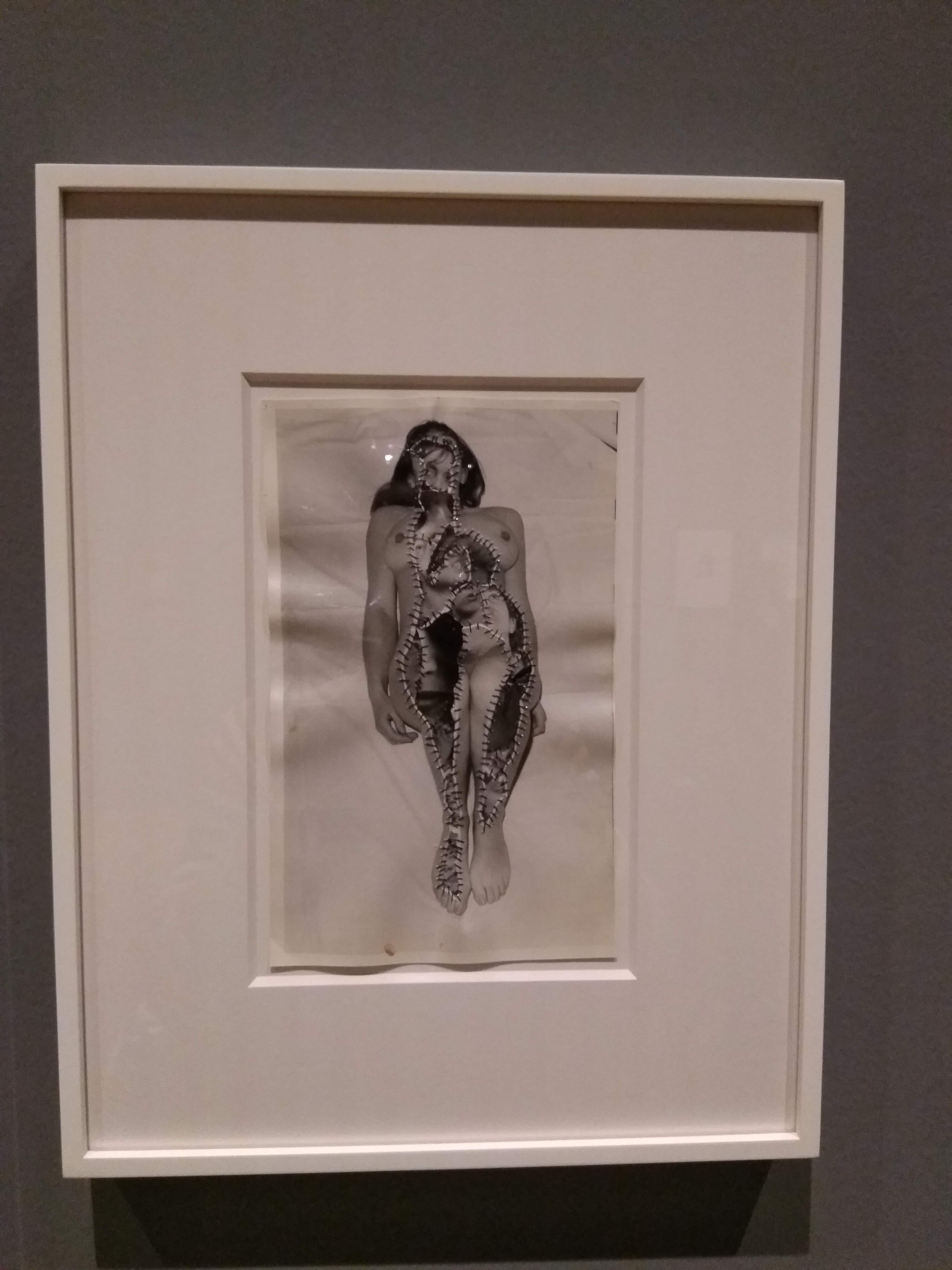
It seems that with works in collage, there’s a strong urge towards the uncanny, things that disturb and make the viewer take a second look. That was true of the works exploring the body by feminist artists of the 1960s and 70s, in one of the best rooms of the exhibition. I hadn’t heard of Annegret Soltau (b.1946) before, and her works made with black thread suturing together different photographs of her naked body were really striking.

Annegret Soltau, Schwanger II (Pregnant II), 1978

There are so many fascinating things to see at this exhibition and it throws a light on some of the challenges of dealing with such a broad theme. It is said too often, Qbut there really is something for everyone here, and I would really recommend you go and see it before it closes on 27 October.

‘My Own Private Bauhaus’, David Batchelor at Ingleby Gallery, Edinburgh

I first encountered David Batchelor’s work about a year ago, and I was so happy when I heard he had a show in Edinburgh, at Ingleby Gallery (free, ending 28 September). It’s not a place I’m familiar with, and being a commercial gallery, I wondered whether the space would feel welcoming. Though I had to ring a bell to be let in, there was no need to fear – I was welcomed by a friendly member of staff who introduced me to the gallery and some of the ideas behind the exhibition.

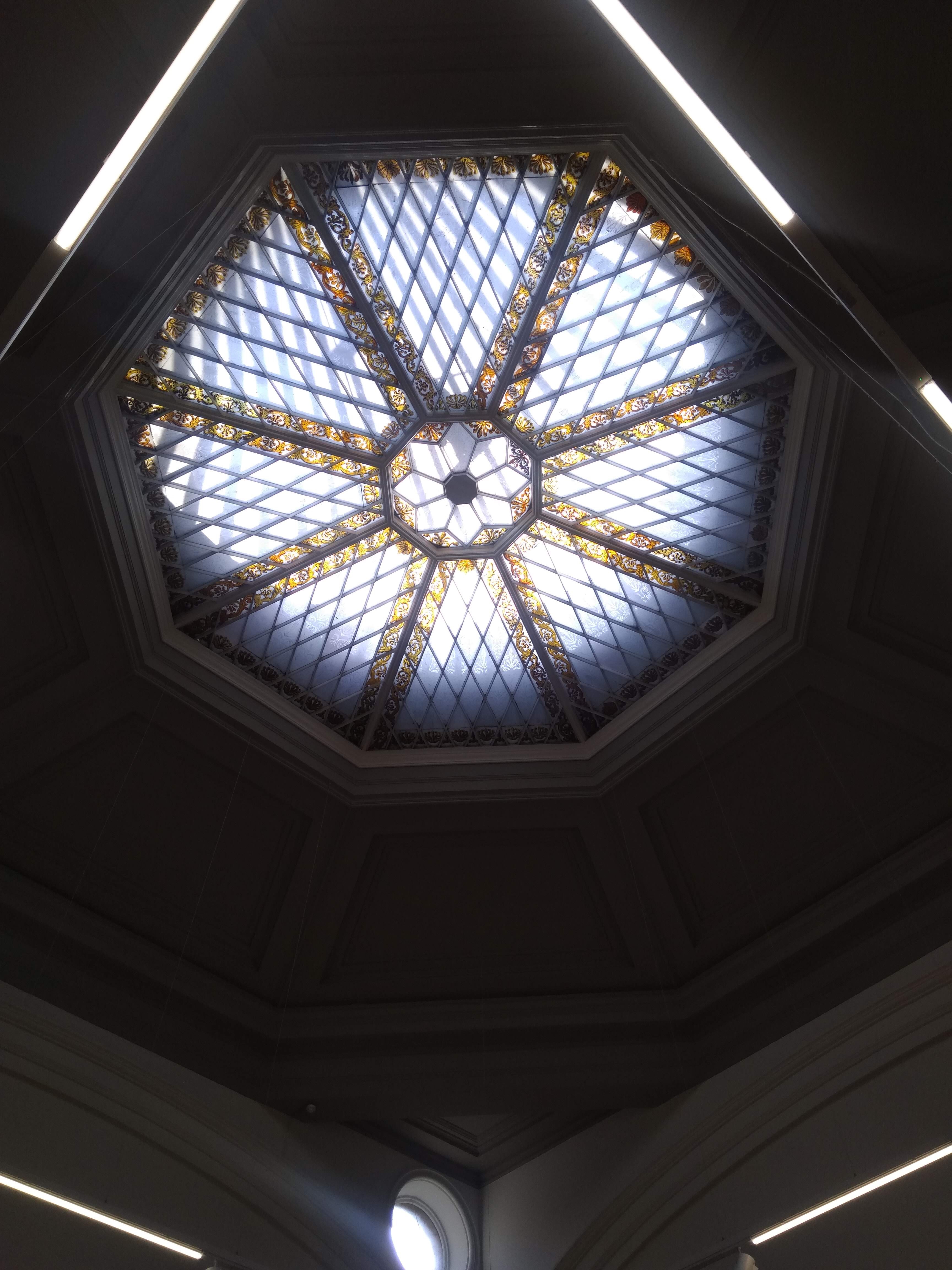
The building itself dates from 1834 and is settled in the heart of Edinburgh’s austere but beautiful New Town. It was originally built as a religious meeting house for the Glasites, a break-away group of worshippers from the Church of Scotland, who heartily disapproved of embellishment, decoration (or, it seems, joyfulness of any kind) in their places of worship. So it is with a delicious sense of irony that such a space has been transformed into a gallery, a dynamic that I’m sure Batchelor would have revelled in when planning the exhibition.

The ceiling of the main exhibition space

One of my favourite things about Batchelor’s work is that it is characterised by a sense of playfulness. It doesn’t seem to take itself to seriously: art is boiled down to its essentials – colours and shapes – reminding us that all of us begin interacting with the world through these two key sensory building blocks. Through his explorations, Batchelor invites us become children again, to see with fresh eyes and wonderment that art can exist within the banal and the everyday. He’s there to show us where and how to look.

Installation view, the piece on the floor in the centre is Dogdays, 2008-2011

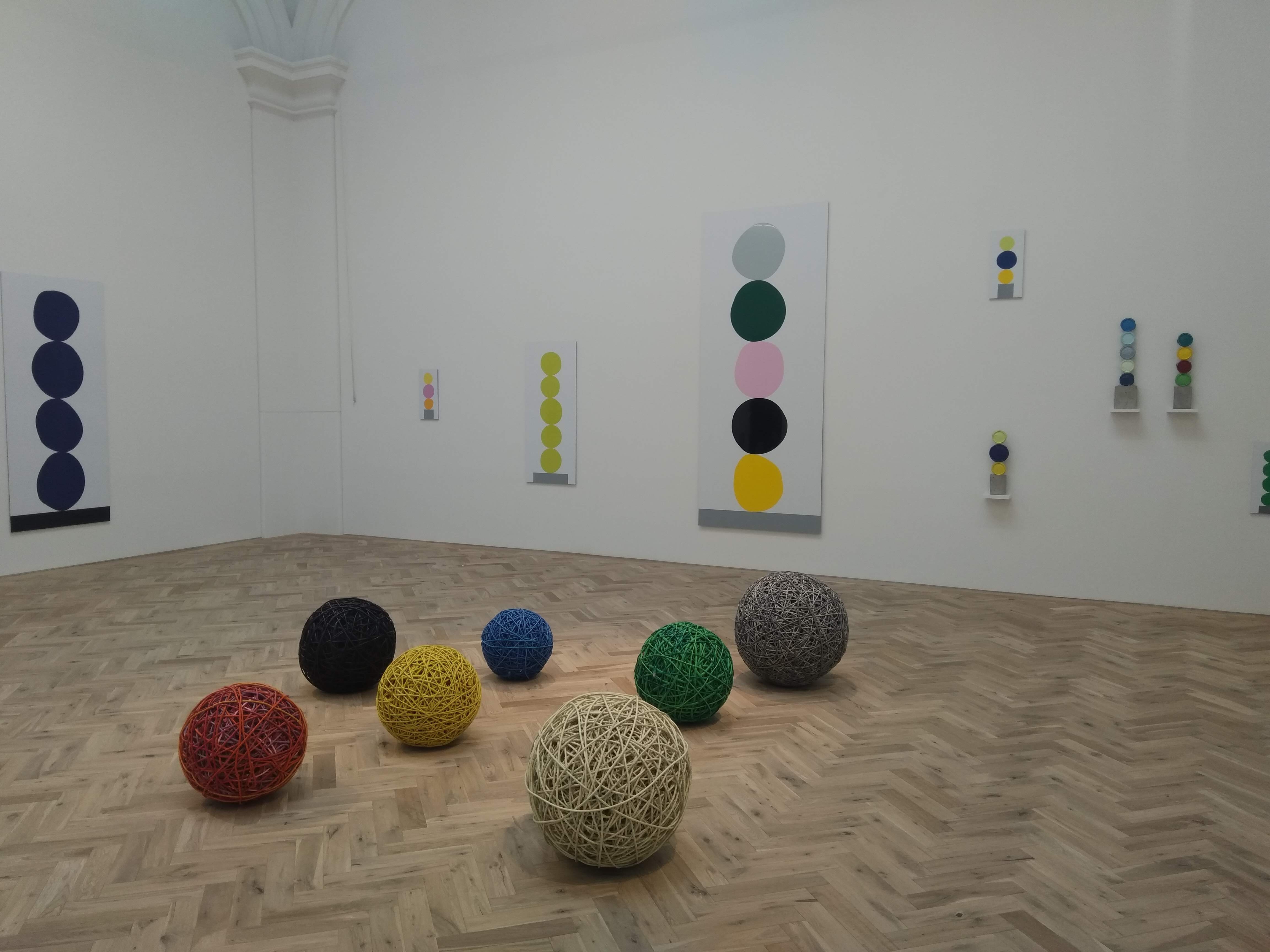
The exhibition is full of all sorts of mundane objects made fascinating, mounted on their concrete plinths and transformed into abstract sculptures. There are tape measures, huge spheres made of electrical wires and cable ties, sheets of intricate mesh, plastic circles that look like bottle tops, all celebrating the vibrancy of artificial colour. There’s not much suggesting the natural world in here, though shards of glass stuck in concrete look remarkably like window boxes. Rather, it’s the things we have invented that take precedence, repurposed and reframed by Batchelor, the magpie-esque collector of all things shiny, bright and saturated.

Geo-Concreto 06, 2018 (left) and Geo-Concreto 02, 2018 (right)

Yet for all of their man-made qualities, the show is not about looking at the pristine perfection of these objects, but rather their imperfections. The paintings on the walls are made using spray paint, giving them a mechanical shine that seems totally devoid of the artist’s hand, yet the circles themselves are misshapen and pleasingly wobbly, with the occasional splodge of paint that may not have been intended, but remains present on the canvas nonetheless.

Part of the Concreto 1.0h series

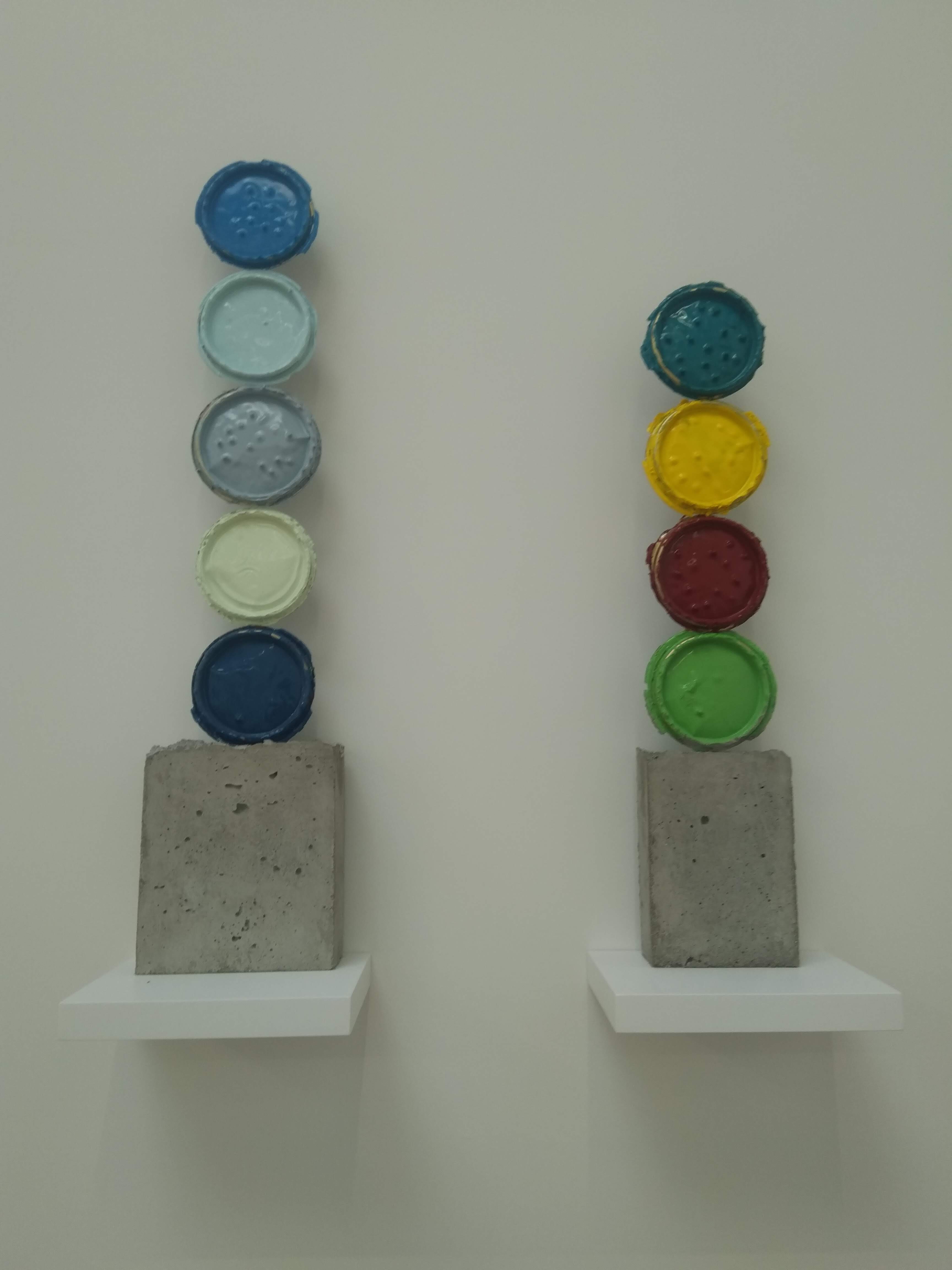
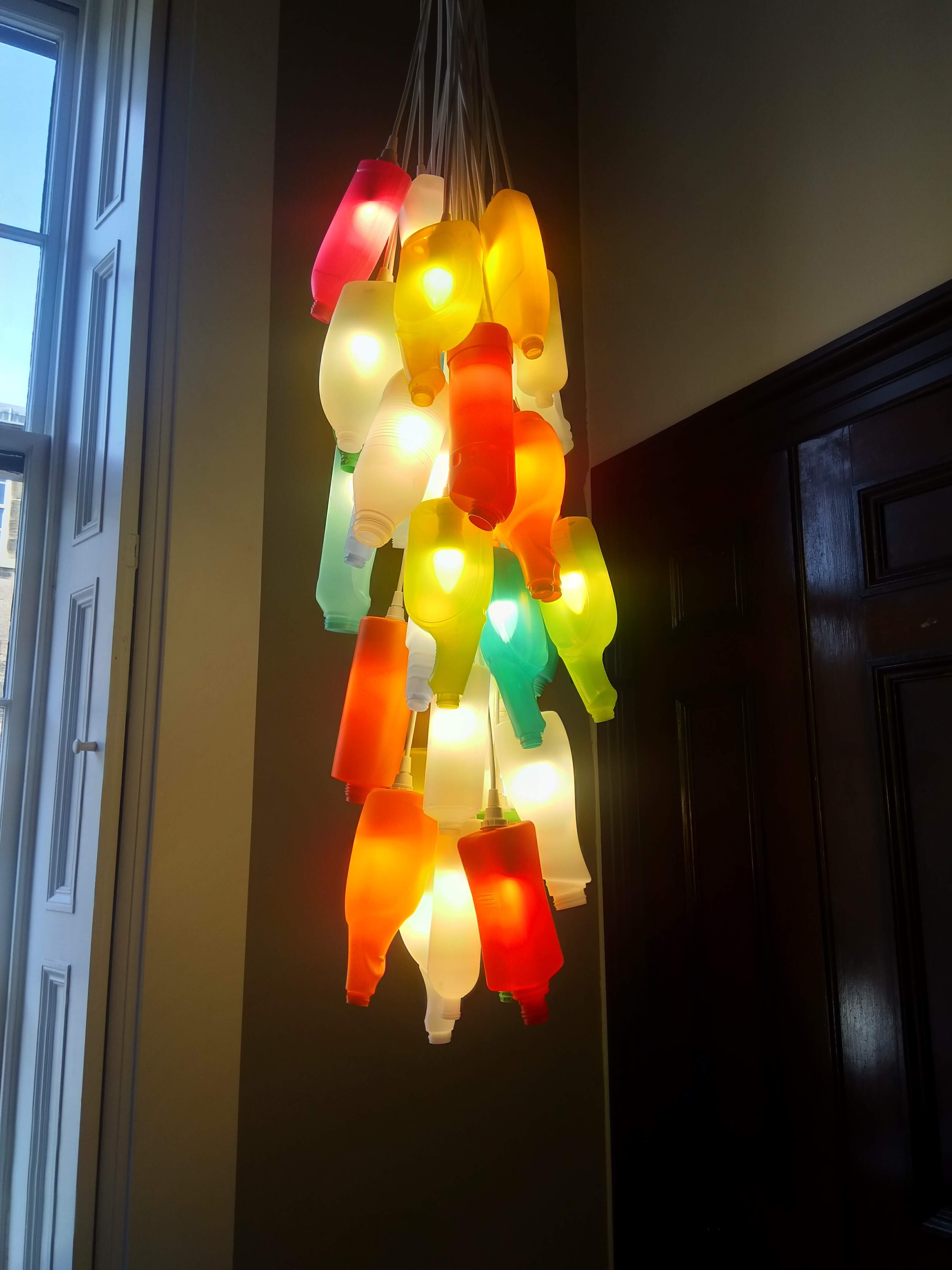
Much more tactile than the paintings, however, are their partner sculptures, made by precariously stacking the lids of paint pots on to of one another, the paint crusty, wrinkled and stippled, crying out to be prodded and poked. Some sculptures are framed by fluorescent fabric backdrops, and the much maligned plastic bottle is transformed the ultimate 21st century chandelier.

It’s art that’s fun, accessible, and shows us the possibility of finding beauty in the most basic of everyday things, a skill we need more than ever at the moment.

Candela, 2016

Bridget Riley, National Galleries Scotland

This week, I finally got round to seeing the Bridget Riley exhibition at the Scottish National Gallery. A couple of friends had been telling me how great the show was, and the critics had been raving about it, so I knew I had to catch it before it closes (Sunday 22nd September), and moves to the Hayward Gallery in London for its second leg.

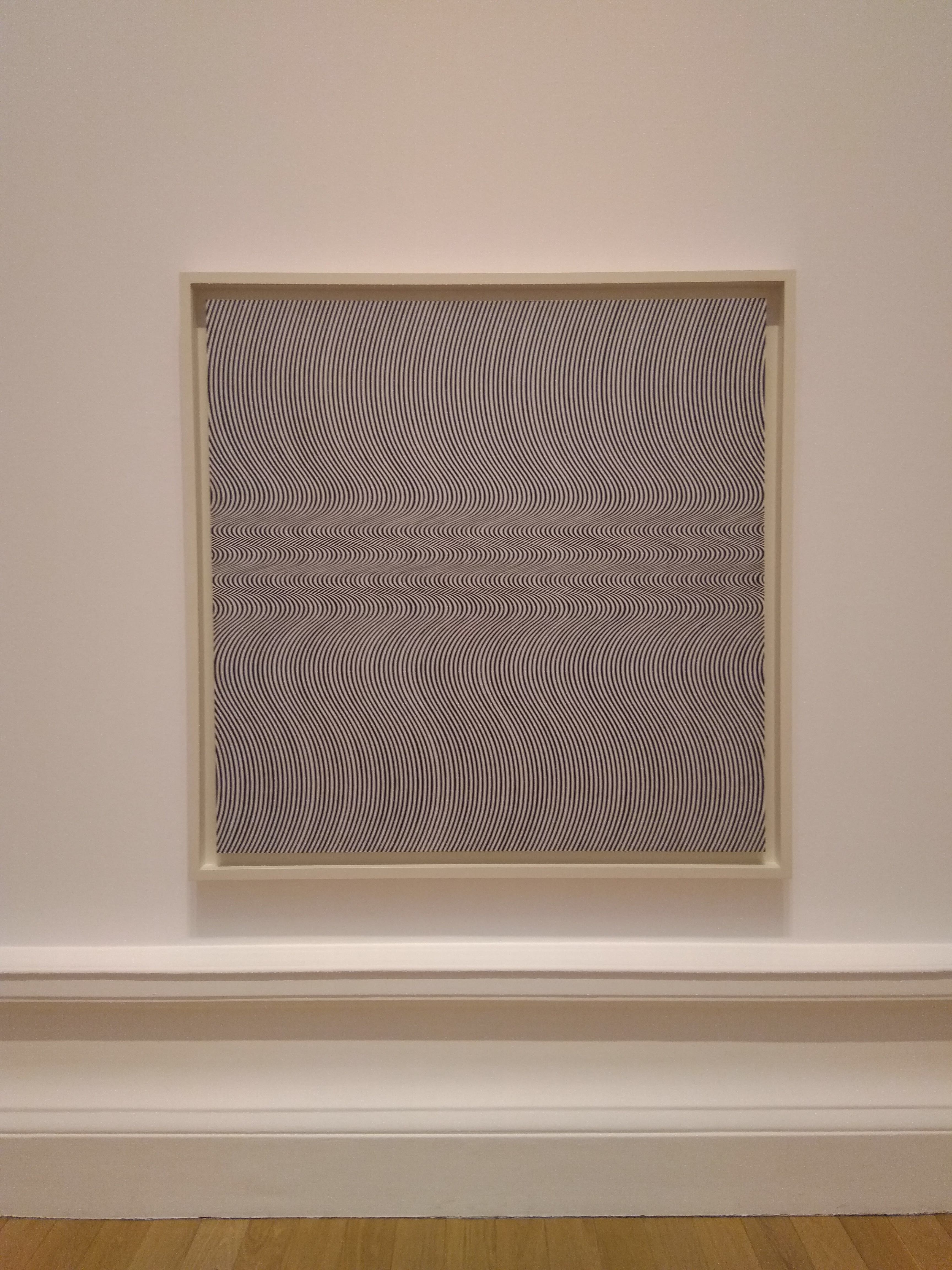
Riley was a key figure in the Op Art movement, which developed in the 1960s and used abstract patterns and geometric shapes to create optical illusions in art. You can see that straight away, with Cataract 3, in Room 1. The whole painting is pulsating and vibrating with energy, in a way that makes you want to reach out and check that the canvas itself isn’t undulating. It’s a dizzying experience and quite a shock to the system.

Detail of Cataract 3 (1967)

Some of Riley’s most famous works are the black and white pieces (Room 2), which seem, paradoxically, to be alive with colour. As your eyes scan the canvas, it flickers with pink and green, like looking at a TV screen when the channel isn’t tuned in, the visual equivalent of white noise.

I was familiar with the concept of Riley’s work and was vaguely interested in seeing it, but hadn’t been prepared for just how convincing it is when experienced in person. As the exhibition continued, I realised I had expected it to be fairly simplistic and one-note, but her work is a much more in-depth exploration of perception and sensation. It shows us how what we see is deeply connected to how we feel, not just emotionally, but physically as well.

Current (1964)

As your body moves closer to and further away from the paintings, or your eyes refocus as they try to figure out the mechanics of the brushstrokes, what you see shifts and morphs. It made me want to take off my glasses and lie down, to let the colours wash over me, the paintings becoming hallucinogenics and bringing a kind of playful blurring to the gallery space. It’s not surprising that Op Art was born in the 1960s.

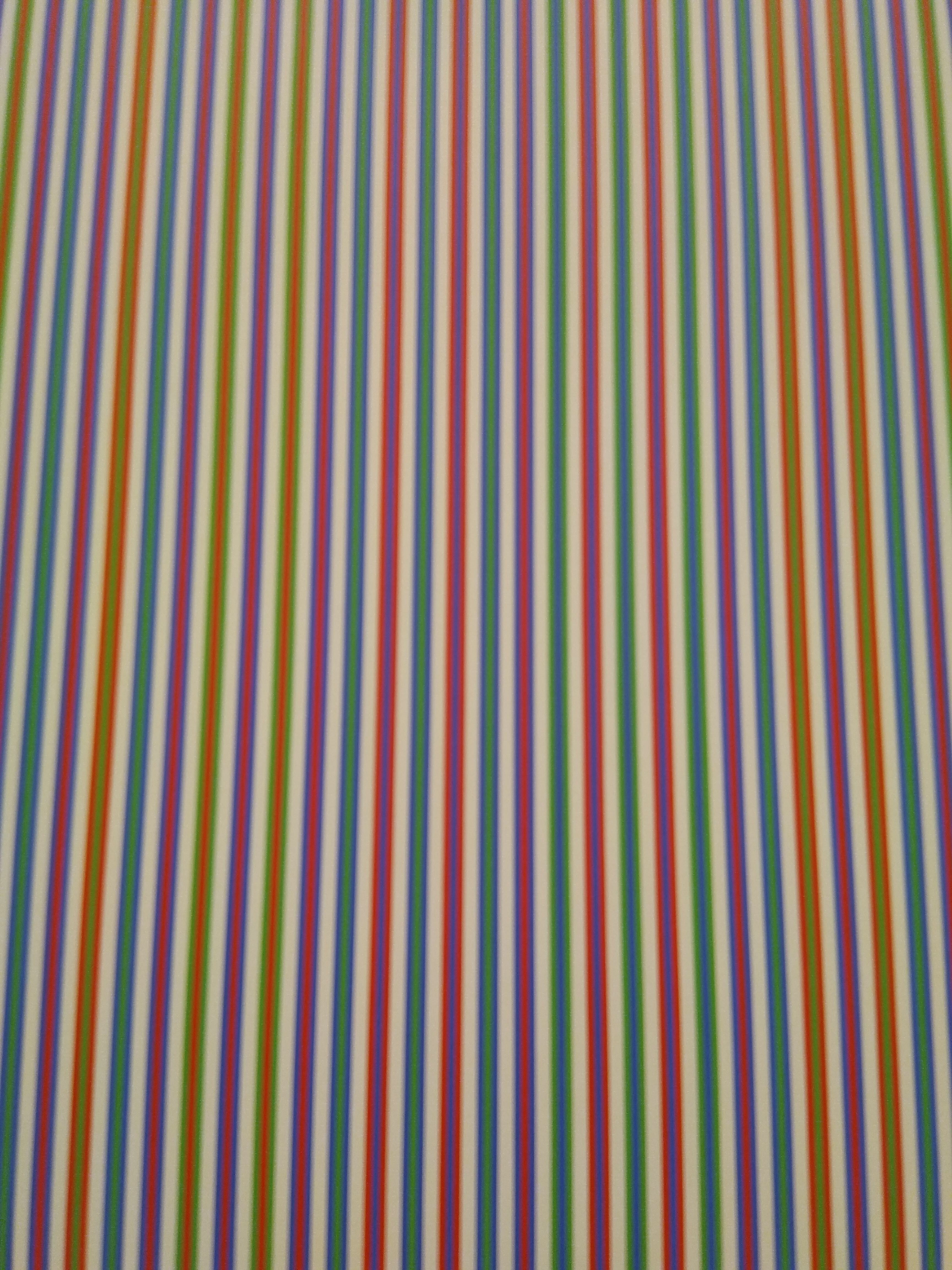
My favourite room was at the heart of the exhibition, and displayed a number of Riley’s brightly-coloured monumental striped canvases. The way the pairings of colours create different effects, and can trick the eye, made me wonder how colour really works. In Paean (1973), stripes of red, white, blue and green seem to create flashes of pink. Riley’s work must be underpinned by a proper understanding of the physics of colour theory, and the fascinating room packed full of her sketches and studies show how meticulously worked out each composition is.

Detail of Paean (1973)

In 2017, Riley said that ‘the movement is created by looking’, which to me, is the key to her work. It suggests that it is the viewer, as a participant, who plays a pivotal role in ‘activating’ the compositions. As we move around the paintings and allow our eyes to drift over them, we help to bring them to life. It’s an experience everyone will react to differently, but one I would recommend trying.

Ivon Hitchens, Pallant House Gallery, Chichester

I’ve been meaning for a while now to write about a lovely, focused exhibition I saw at the Pallant House Gallery in Chichester last week. I’d never been to the gallery before, and unfortunately I didn’t have enough time to explore its permanent collection, which is based around modern and contemporary British art – I’m looking forward to exploring that the next time I go.

So many important creative people of the twentieth century, including members of the Bloomsbury Group, the poet Edward Thomas and visual artists like Eric Ravilious, seem to have been drawn to spend time in Sussex at some point in their lives, so it makes sense that this Sussex gallery represents some of the most important artistic developments of the last century. While Ivon Hitchens (who I hadn’t heard of before seeing the show) isn’t someone who rewrote the rulebook of modern art, his work shows a talent for noticing and capturing the remarkable detail within the big picture, the abstract patterns he experimented with in his early career continuing playing a major part in the landscapes he is primarily known for today.

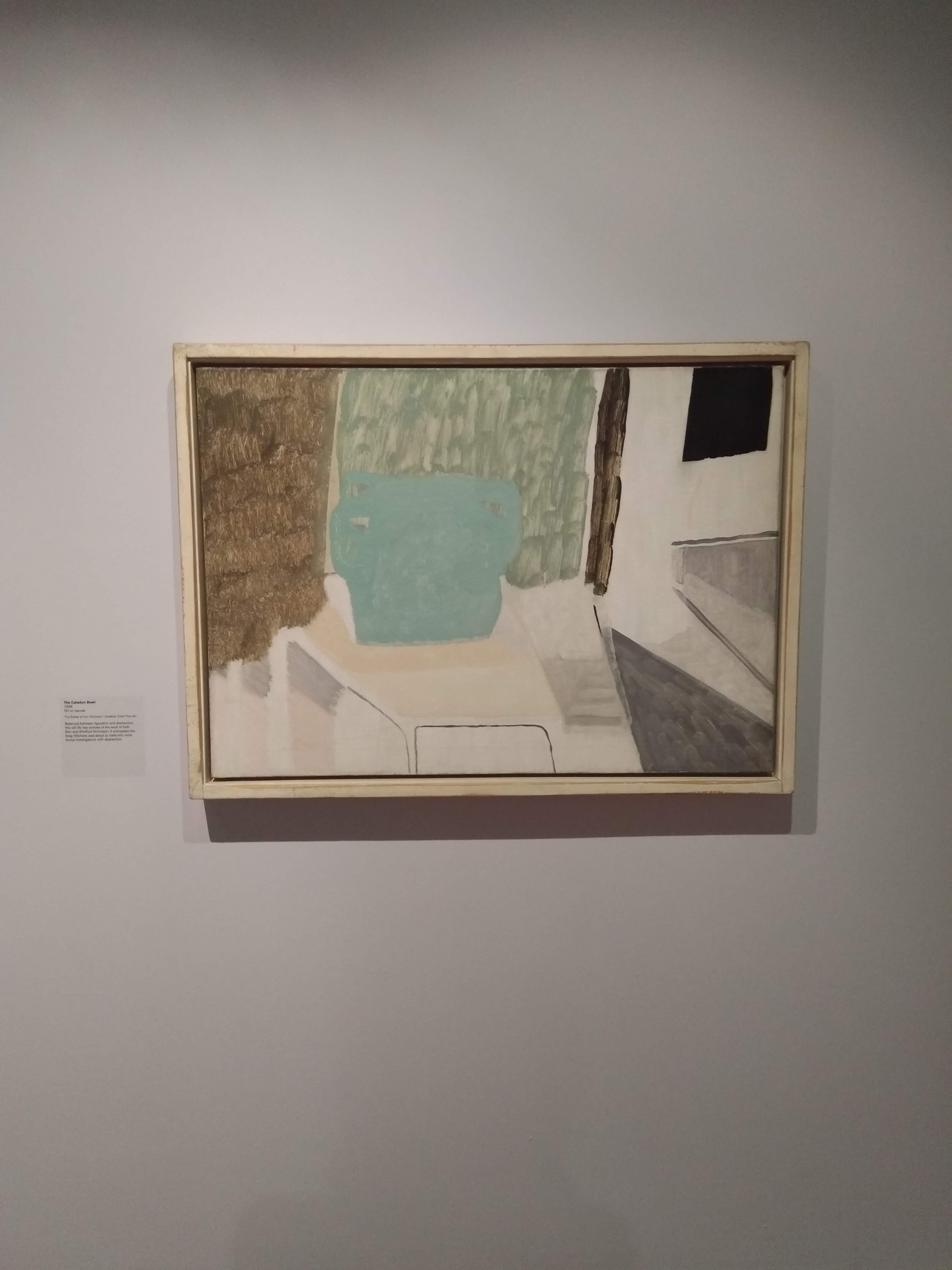
The Celadon Bowl (1936)

Some of my favourite of his works were early ones like The Celadon Bowl (1936), in the way that it delicately treads the line between abstraction and figuration, the scrubby brushstrokes of the teal and khaki squares in the backdrop adding texture to the plain white canvas. In a sketchbook annotation, he wrote “don’t try to find a picture. Find a place you like and discover the picture in that”, which is true of every setting he painted, interior and exterior.

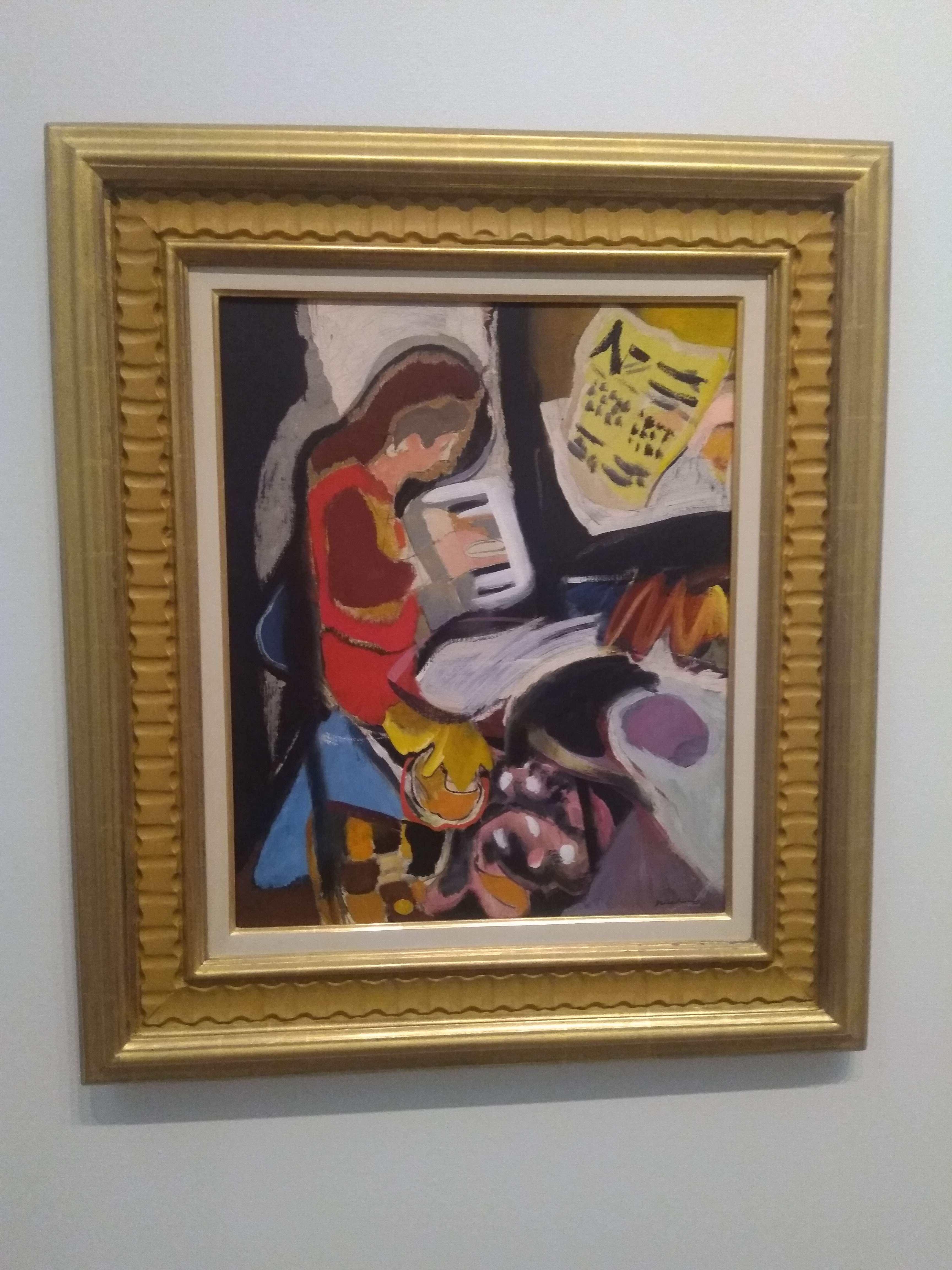
Woman playing the piano, c.(1942)

He left London during the war, and lived in a caravan called Greenleaves with his wife and their baby, set in a forest clearing. Living in the heart of the countryside clearly gave Hitchens more than enough subject matter for his art, and he set about painting the landscape, not focusing on grand vistas, but on his favourite spots that he visited repeatedly, capturing the view in different seasons and at times of day.

I love the Sussex countryside and have enjoyed walking on the South Downs, in the woods and by the rivers that Hitchens lived alongside, and so I may be biased, but I found his landscapes very evocative and able to capture the magic of the place. Perhaps there’s something in the water that makes it special.

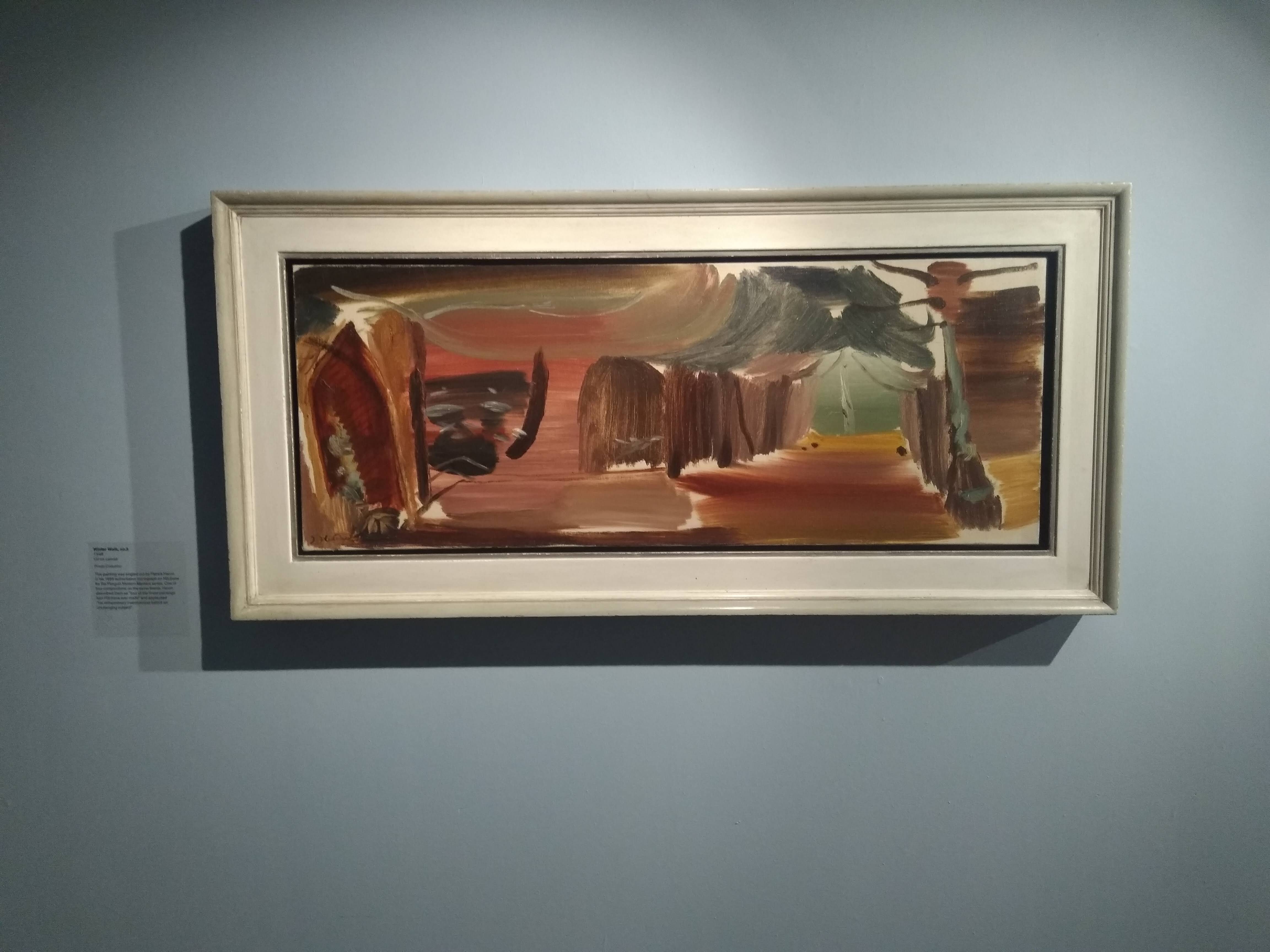
Winter Walk, no.3 (1948)

Winter Walk no.3 (1948), really captured me. The earthy brown and scratchy red tones, mixed with the evergreen of the avenue of pine trees towards the right of the picture perfectly sum up the colours of winter which are beautiful too, in their muted way.

The theme of the exhibition, how artists use their works as an exploration of their surroundings and of place more generally, was underpinned by the audio element of Simon Roberts’ Inscapes exhibition, which were dotted throughout Hitchens show. Roberts is an artist-photographer whose work focuses on identity and people’s connections with the landscape around them, and as part of the exhibition was invited to revisit the settings that so fascinated Hitchens. His soundscapes of the countryside (cattle lowing, brooks babbling, branches creaking in the wind) brought Hitchens’ landscapes to life in new ways, and the pairing of the two artists’ work brought out the best in both of them.

Night Walk for Edinburgh, Janet Cardiff and George Bures Miller

On Sunday night I took part in an art experience that had been intriguing me since I first saw it advertised as part of Edinburgh International Festival several weeks ago. It fell into the category of “must go” because it sounded unique (commissioned especially by the Fruitmarket Gallery), immersive and slightly odd, making the perfect cocktail for someone who likes thinking, writing and talking about art.

Starting at the bottom of Cockburn St near the Royal Mile, the Fruitmarket staff gave me a short briefing (which made me ever more intrigued and slightly trepidatious about what was coming), armed me with a pair of headphones and a small screen, and away I went. What followed was a cross between virtual gaming, crime drama, ghost tour and art piece.

Edinburgh’s Old Town is the stage set for this discombobulating drama

Janet Cardiff’s voice whispers in your ear, half talking to you, half musing to herself. The walk winds through the backstreets, closes and alleys surrounding the Royal Mile, strangely empty, dusty and damp compared to the garish, touristy brightness of the Mile itself. Arrows on the ground sometimes indicate the way, but mostly you are guided by Cardiff’s instructions, enhancing the sense that you are taking part in a game in which your own agency is reduced to zero.

The narrative weaves in and out of fiction and reality, with the film element of the walk emphasising the idea that the city is a canvas or a stage, and we as its residents, its visitors, its participants, are part of the multiple layerings that make up its history, and its identity. Marks on the canvas are left behind by former inhabitants: chewing gum pressed into the crevice of a wall, string delicately tied around a lamppost, pieces of scattered clothing lost, left behind. The work delves into Edinburgh’s macabre history, but is also rooted in the banal fabric of the city itself, drawing attention to air vents, street signs and shop windows.

The walk draws your attention to all sorts of details, making the banal into something noticeable

The sound effects, with snatches of conversations, song, sirens, and the noises of city life unfolding around you make the stories of the walk all the more convincing. I can’t count the number of times I turned around to check whether the footsteps approaching me were part of the fake cinematic narrative I was immersed in, or belonging to life itself. The artists play with the uneasy gesture of looking over one’s shoulder, the sound of footsteps is inherently creepy and unnerving and puts the participant/viewer on edge throughout the walk, in a way that is both thrilling and memorable.

Weaving their way through the city, Cardiff and Bures Miller have made a fascinating and haunting piece that interweaves history, the digital, magic, reality, memory and storytelling. If you’re interested in any of the above, this is something you won’t want to miss.