Some exhibitions have an unofficial soundtrack in my mind. Francis Alÿs’ Ricochets at the Barbican, which closed a couple of weeks ago, has had Whitney Houston’s The Greatest Love of All bouncing around in my head. The song starts with a gentle falling scale on the synth, and then Whitney comes in with the words: “I believe that children are our future/ teach them well and let them lead the way… let the children’s laughter remind us how we used to be.”
I’m a woman and I’m 32. That means that I am almost daily drawn into discussions of children. People ask me why I don’t have them, or if I’m wanting to have them. I’m an auntie and a guideparent. Some of my closest friends have babies, toddlers, kids in primary school. Some are wanting babies and it isn’t happening for them at the moment, some have had miscarriages and lost unborn children. I kind of knew the phase would come, when this would be the main topic of conversation dominating my life, but I had never expected an art exhibition to bring me back to it once again.
I’m with Whitney, I do believe children are our future. I think that artist Francis Alÿs does too, which is why he has spent years and travelled the globe collecting and documenting children’s games, which have been compiled together in beautiful, moving, sensory-overload-inducing multi-screen installations for his exhibition at the Barbican. The photos I took weren’t great, but the most wonderful thing about the project is that all of the Children’s Games videos are available online. You can explore the whole roster here and I’ve linked to specific ones in this post.
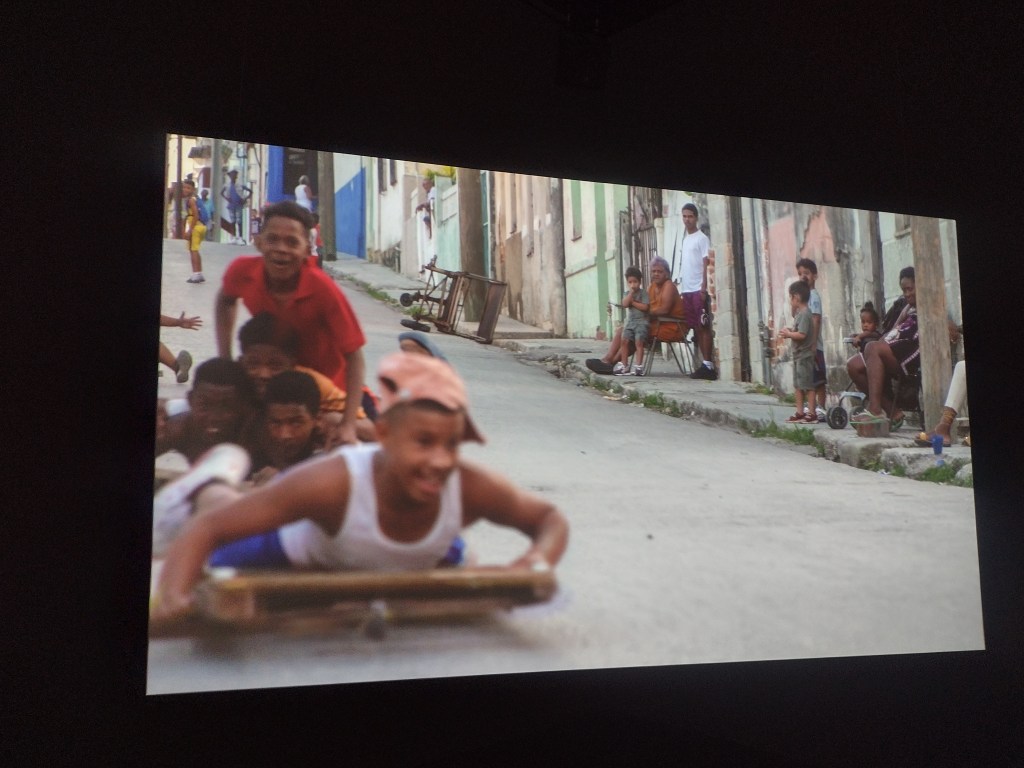
I loved immersing myself in the worlds of these children, as they raced perilously down hilly streets on makeshift go-carts, as they played “Doctor Doctor!” in a yard by a cold-looking lake, as they raced snails on concrete or flew kites, skipped and skimmed stones. They enliven and brighten and spark joy wherever these games take place. Even in war zones, places decimated by wars now over, in refugee camps, their flame and zest for life burns so brightly. The sensitive curation at the Barbican brought this home: when children play in barren wastelands, they are no longer barren. It kindles a moment of hope.
Children’s Game #40: Chivichanas La Habana, Cuba, 2023
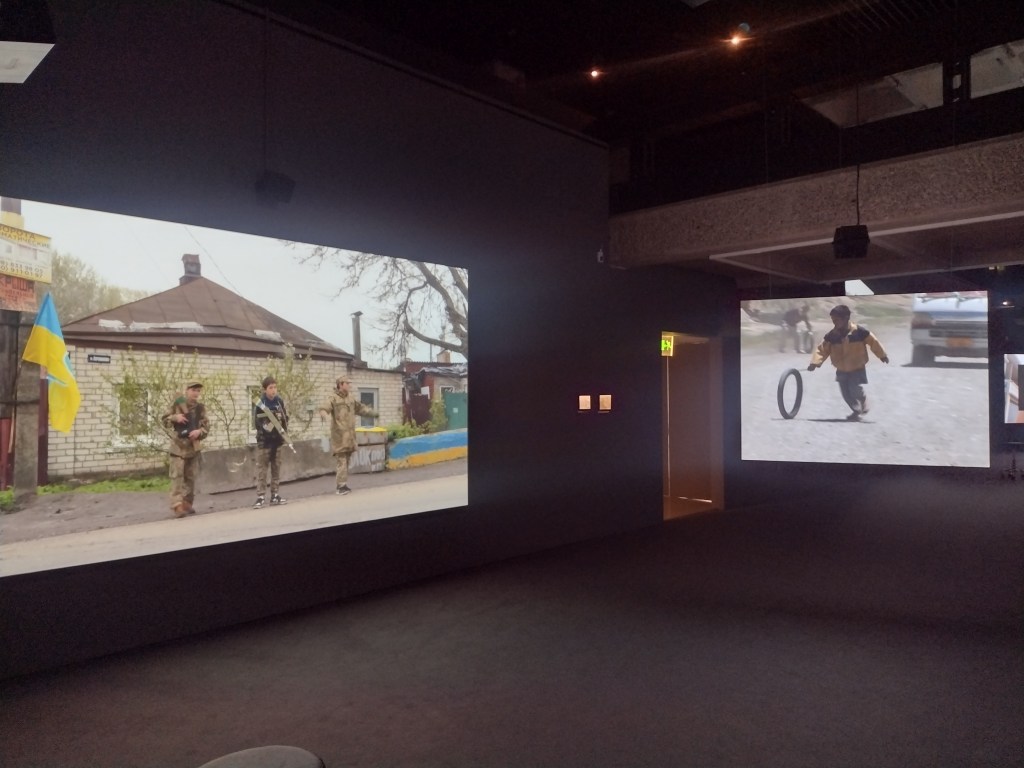
In one of the exhibition’s longer videos, Parol, three Ukranian pre-teen boys are dressed in khaki and have wooden rifles, daubed in yellow and blue, slung over their shoulders. As the accompanying text explains (beautifully written for each game by Lorna Scott Fox), the boys “act out a grown-up duty: to uncover Russian spies… Cars are flagged down, IDs requested, trunks inspected. A password is demanded: “Palyanitsya”, the name of a traditional Ukrainian bread, and a word that Russians can’t pronounce right.” While the drivers of the passing cars appear to be cheered by their interactions with the children, it’s a perilously pertinent reminder that in a few years, these boys won’t be playing anymore. They’ll be on the front line. The existence of innocence always implies the loss of it.
Children’s Game #39: Parol Kharkiv, Ukraine, 2023
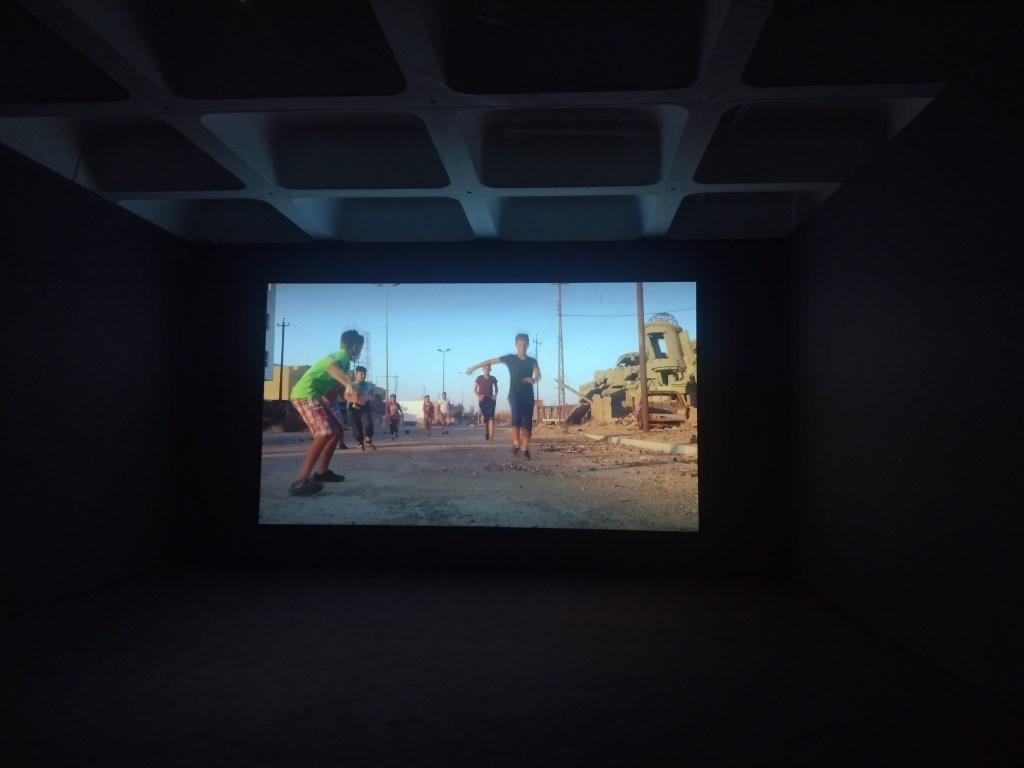
In Haram Football, a group of lads between 8-15 years old gather in the streets of Mosul, Iraq, to play a game of collective imagining inspired by ‘the beautiful game’. Haram means ‘forbidden’, and football was forbidden under the rule of Islamic State. In the shadow of that regime, these boys perfected their craft of playing football without a ball, a collective pretending, all in agreement where the ball bounces, rolls and flies through the air. They shake hands and once the game starts, they jostle, dribble and leap for headers. All around them there’s rubble and collapsing buildings, the sun is setting. At one point, a tank drives straight over their makeshift goalpost, the boys just rebuild it and carry on. They disperse into the rubble and the shadows at the sound of an explosion or gunfire, but return at the end under the cover of darkness, to announce their names paired with their favourite clubs.
Children’s Game #19: Haram Football Mosul, Iraq, 2017
It is utterly impossible not to think of Gaza. Back in May, Unicef estimated that 14,000 children had been killed in Gaza, with 17,000 of them unaccompanied or separated. Obviously that number just keeps on going up. While I’m sure that Alÿs will be visiting Gaza to document children creating games and hope from within whatever rubble is left, it is brutal and sickening to know that the children who do survive there will inherit decades of trauma, no matter how strong their resilience is, no matter how skilled they are at continuing to create joy even among the horror. I’m reminded of Greta Thunberg’s speech to the UN in 2019: “you come to us young people for hope? How dare you.” Yet we keep on turning back to children to kindle hope in the despair and darkness, to create something better than we have. They have so much resting on their small shoulders.
If hoping is a radical act, then having children surely must be the most radical act of hope. For me, in my head, I’m still the girl in the blue summer dress weaving through the cityscape and avoiding stepping on the lines, not one of the earthbound, onlooking adults. That is the magic of Alÿs’ project. It reminds us of the beauty and fragility of youth but also presents the language of play as the universal one, the one that connects us all, if we can only hear their laughter, to ‘remind us how we used to be’.
Children’s Game #23: Step on a Crack Hong Kong, 2020
A few of my friends, who know I’m interested in public space, memorials, statues and public art (because I’m constantly banging on about it) have asked me what I think about the debate raging over statues in Britain. In order to try and express this, I’m going to draw on something I wrote during my MSc at Edinburgh College of Art last year, which takes two case studies from the USA as its main examples.
I want to show that public art, including performative rituals such as protests, can usefully inform debates around our identity, and that a frank discussion of visual culture in public spaces remains vital for understanding the public sphere we operate in today.
The essay was written for a class called Art in the Creative City, run by Harry Weeks (now at Newcastle University ). I’ve taken out large chunks, removed the footnotes and edited it fairly heavily in the interest of making it more accessible. If you want to see my reading list or access the original essay, send me a note in the comments, or DM me on Instagram. Events are changing so fast. ‘Statue defenders’ are holding protests at London’s Cenotaph as I write this. I’ll try and keep up with the momentum. Asterisks mark the start and end of the essay section, before sharing some of my thoughts on the situation in Britain.
***
The question of who is commemorated and who is erased in public space is one that is charged with different interpretations of history, politics and the concept of identity. Historically, public art has reflected the power of the dominant forces in society, because having a presence in public space, being deemed worthy of representation, is a signal of power, status and money.
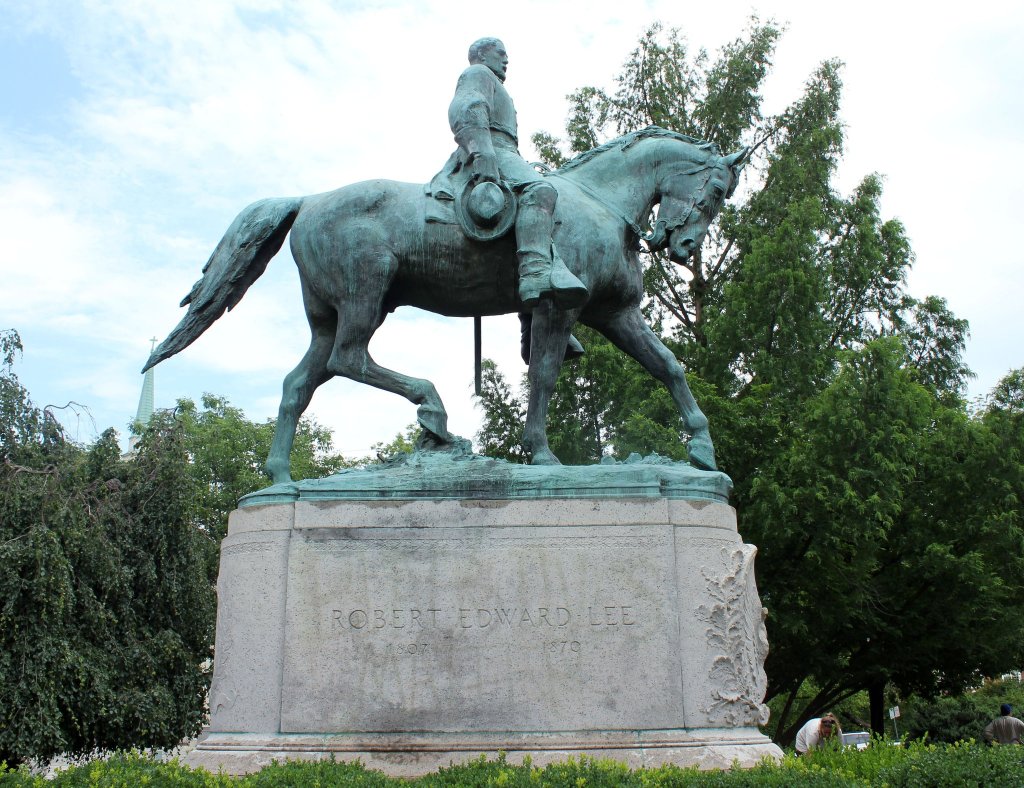
Statue of Robert E. Lee, Charlottesville, VA., (1924), bronze and granite, (7.9m × 3.7m × 2.4m including plinth)
The turbulent history surrounding the equestrian statue of Confederate General Robert E. Lee in Charlottesville, Virginia, is indicated by the renaming of its location three times over the past three years. Formerly Lee Park, it was briefly to become Emancipation Park, and now is known as Market Street Park; the difficulty of finding the right name for the space directly connects with the controversy around the statue of Lee. The monument was erected in 1924 as part of the wider movement known as the ‘Lost Cause’, which intended to frame the participation of the Southern States in a Civil War narrative of heroism and gallantry, with similar monuments erected in nearby Richmond, Virginia and further afield. In Charlottesville, city councillors took the decision to remove the monument in the spring of 2017, though its removal was delayed pending a legal challenge. During the delay between March and August of that year, the statue became a rallying point for far right groups, who protested against its proposed removal. Over the summer, a number of protests and counter-protests for and against the removal of the statue culminated in August, when violence at a rally for ‘Unite the Right’ resulted in the death of Heather Heyer, a peaceful protestor. The event was reported widely on national and international news.
As a piece of public sculpture, this statue and its interpretation as a symbol of either hateful racism or historic pride by different sides of the debate, is at the centre of these political events. The visual symbolism of the statue and the differing aesthetics that emerged around it, are therefore highly relevant. As embodied rituals, protests, marches and vigils can be read as forms of performance, which use visual tools to enhance their legibility and potency. The rallies both for and against the Robert E. Lee’s removal were no exception.
During a rally in May 2017 protesting against the removal of the sculpture, the leader Richard Spencer was heavily criticised for promoting the use of torches, which were interpreted as an symbolic visual invocation of Ku Klux Klan gatherings. Spencer’s response was to deny that the torches had any reference to the KKK, but justified their use on the basis of their ‘beautiful aesthetic’. This argument, highly doubtful given Spencer’s overtly white nationalist views, attempts to justify the use of a controversial symbol of terror on the basis of an aesthetic effect. It shows the extent to which aesthetic and political strategies are interlinked, and highlights the ways in which public art and aesthetic gestures can be (mis)used as tools for political agitation, whether progressive or regressive.
Scholar David Harvey has convincingly argued that cities as public spaces are constantly in a symbiotic relationship of shaping and being shaped by their inhabitants, through their political, intellectual and economic engagement. It is therefore no surprise that public art is persistently at the centre of debates about identity, collective memory, history and politics, and a whole range of different ideas about right and wrong, who is represented, and who is erased. The case of the Charlottesville statue of Robert E. Lee shows this in action. So far, the statue has been analysed as a magnet for far-right politics, but there are other tactics at work too, interventions that successfully question its validity as a supposedly heroic symbol.
On a purely formal level, the equestrian statue of Robert E. Lee, raised up on its stone plinth, works within the visual language of dominance and power: gazing up from below, we see nothing but galloping hooves. In 2015, prior to the council’s vote to remove the statue, the words ‘Black Lives Matter’ were sprayed on its plinth, and although removed soon afterwards, the outline remains vaguely visible. While many might categorise graffiti as anti-social behaviour and vandalism, Lucy Lippard has framed these kinds of gestures as ‘wake-up art’, and assigns them a significant role within the field of public art, with the capacity to call attention to problematic places and to galvanise communities into action. The political resonance of the graffiti gesture in this context, proven by the groundswell of support for the campaign to remove the Charlottesville statue, is indisputable. In February 2019, further graffiti covered the statue’s plinth, and it is likely that these gestures will continue to be enacted on the statue until its fate has been decided in the legal courts. In this context then, the graffiti acts as a kind of reframing mechanism, reminding passers-by and the media that the debate has not gone away. Statues and monuments commemorating military leaders who fought to defend slavery remain unacceptable to swaths of American society, and especially painful to the African-American community. The debate will continue in public life as long as these contentious symbols remain standing in shared, supposedly equal-access public spaces.
By existing in public spaces, public artworks and their interpretation are fundamentally unpredictable, just as people themselves can be unpredictable. Instead of being confined to the space of a gallery or museum, where artworks are constantly under surveillance and accessible only to a minority of people, public art is out in the open. It is exposed to all passers-by and, while this means it may exist completely unnoticed, equally it can also function as a site of intervention, either in the form of graffiti, or by being used as rallying points within performative gatherings, such as protests and vigils. It is through this very unpredictability and spontaneity that these public works can attain their meaning, and spark debate about what kind of society we wish to construct. Public art in all its forms can help to inform our debates about who is visible, who is represented in our public spaces, and can help us to articulate our equal responsibility in building our shared ownership of them.
Though the graffiti intervention on Robert E. Lee’s plinth effectively brings the sculpture back into the discursive realm and questions its validity, ‘wake up art’ is not the only option for diversifying public spaces. The right to be officially recognised in public sculpture and represented within the ‘symbolic public landscape’, to use Magdalena Dembinska’s term, is also important for the assertion of minorities’ identities.
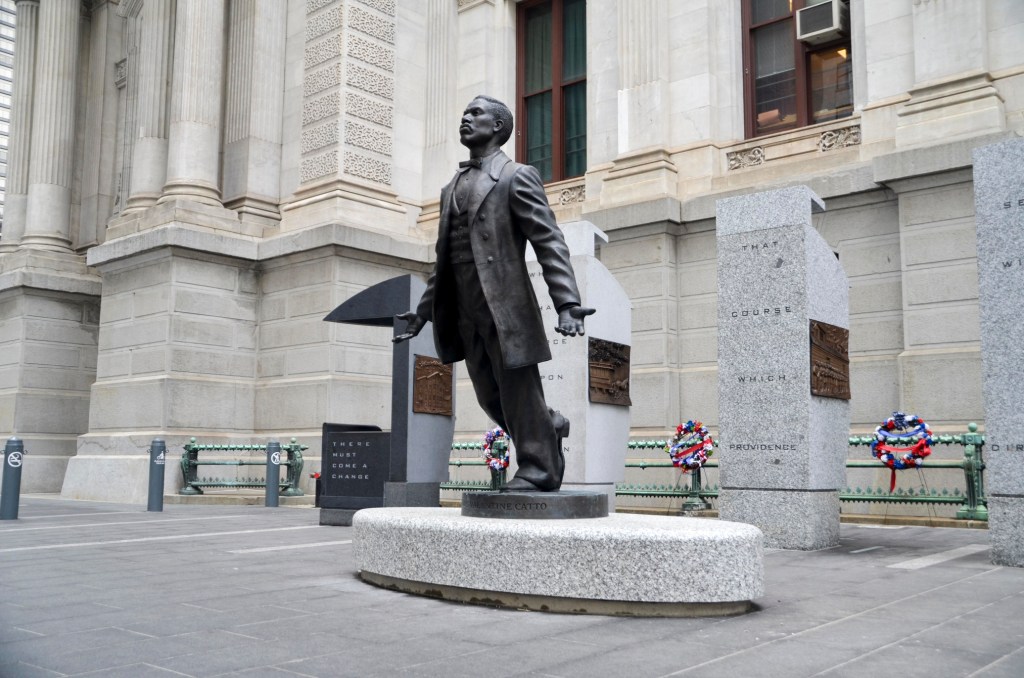
Branly Cadet, A Quest for Parity: The Octavius V. Catto Memorial, (2017), bronze, granite, and stainless steel, statue height 3.6m
Branly Cadet’s 2017 monument A Quest for Parity: The Octavius V. Catto Memorial, which is situated on the southwest corner of Philadelphia’s City Hall, is a useful example. The memorial is comprised of multiple elements which together form an impressive monument to an extraordinary figure – a Civil War-era activist who campaigned for the rights of African-American citizens – who is clearly deserving of recognition in the public sphere.
The monument operates strictly within the confines of the traditional aesthetic of monumental public art, through its figurative use of bronze, and its position outside City Hall. From a formal perspective therefore, it does not push the boundaries or challenge its viewers aesthetically – it is clearly designed to avoid provoking controversy. Yet this is perhaps the very purpose of the Catto monument: it allows African-Americans to assert their presence and validity within the mainstream tradition of monumental forms. The sculpture’s title, A Quest for Parity, specifically refers to Catto’s campaigns for equality. Yet the monument itself is also a reassertion of that quest for parity within public art and representation in the public arena more broadly. The monument therefore is an example of how traditional forms can also help to raise visibility of minority communities, and that their presence in the public arena need not only be represented by avant-garde artistic strategies or counter-monumental interventions.
Public art is embedded in a political landscape. In whatever form it takes, in both its inception and its interpretation, it is informed by differing ideological positions and political beliefs: what remains standing and what is removed from our parks, squares, and the façades of government buildings reflects the societies in which we live. Artworks can be deeply divisive, and can expose latent divisions within societies in ways that can be traumatic and will require healing. Art has the power to spark and intervene in public debate.
What was revered, relevant and what was commemorated in the past may not always be admirable and appropriate in the present and future, which is why those who manage public spaces need to enter into dialogues with the communities and individuals who use them. Artworks that evolve and change help us to question the notions of one fixed ‘public’, and can encourage us to embrace flexible visions of the public sphere, and recognise multiple viewpoints, helping to make those who had been invisible and unheard part of the many voices that make up public life.
***
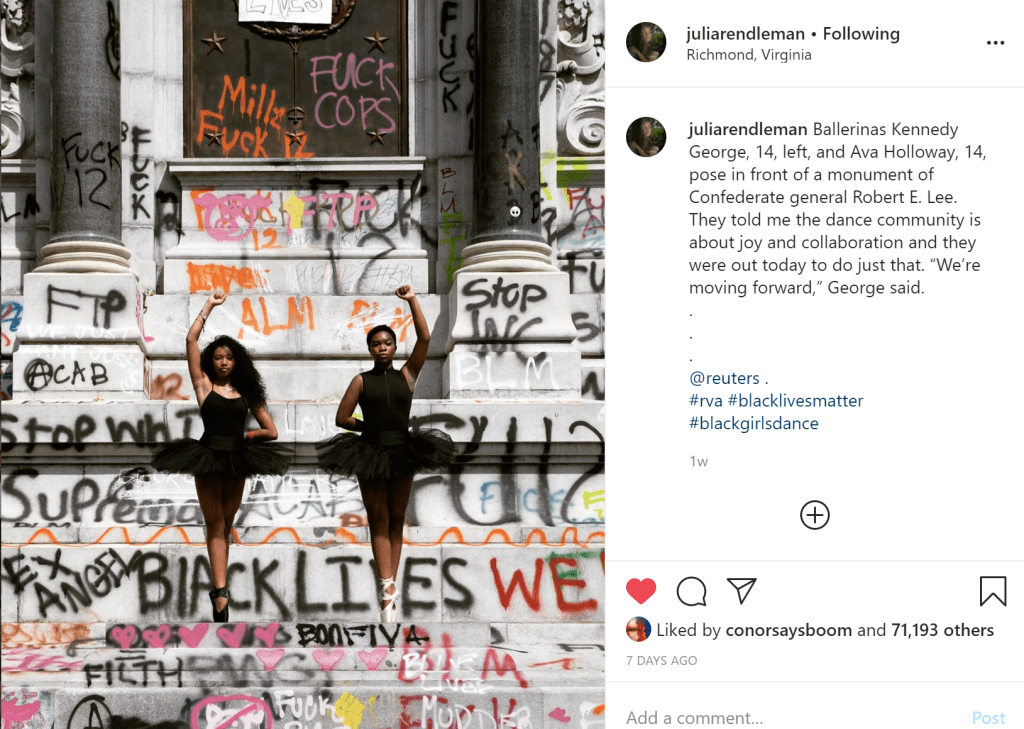
Fast forward a year and after the murder of George Floyd by a police officer, a wave of social activism has swept the US and Britain. In Richmond, Virginia, the government has pledged to remove a statue of Robert E. Lee on Monument Avenue. Images on Instagram of black ballerinas posing below the monument, now covered in graffiti, depict a significant historic moment and show the power of activism. Neighbouring Charlottesville campaigners are relieved that their state authorities are finally acknowledging the hurt these monuments have caused, and hope it will hasten the removal of Lee’s statue from Market Street Park.
In Britain, the argument over who is permitted representation in public space seems to be right at the heart of the nation’s identity crisis. There are a few thoughts I have to add to this debate, which is constantly evolving. Firstly, it is a good thing our public monuments are under scrutiny. They have remained invisible in plain sight for far too long.
The statue of Edward Colston that was forcibly removed by anti-racist protestors and symbolically dumped into the River Avon, where his ships that carried slaves across the Atlantic would have docked, was a momentous and powerful act. The act of its removal has done more to educate people about Britain than the passive existence of the statue itself ever has. As historian David Olusoga has said, rather than the erasure of history, this was the writing of it. Removed in this way is actually far better than had it been quietly taken down by the city’s authorities. It was a moment of activism, a kindling of hope that change could be possible.
For this reason, I don’t believe the statue should have been retrieved from the water so hastily, and I don’t believe it belongs in a museum. As stated above, museums are accessed by a small proportion of the populace, whereas the public space, city squares and streets, are used by us all. (Or were, until coronavirus forced us back to the private sphere, an act which though necessary and in the interest of public health, will serve to entrench the inequalities already prevalent in British society). Rather, Bristol City Council could commission an art piece which works in dialogue with the local community and their city to respond to Colston’s removal: an artwork which shows the journey of the statue from its plinth to the waterfront. Leave the plinth standing empty – the equivalent of an empty chair at a political debate. Leave up the graffiti. Use the landscape and the statue’s journey within it to teach people about Colston, about the legacies of the slave trade upon which Bristol and Britain’s wealth was built.
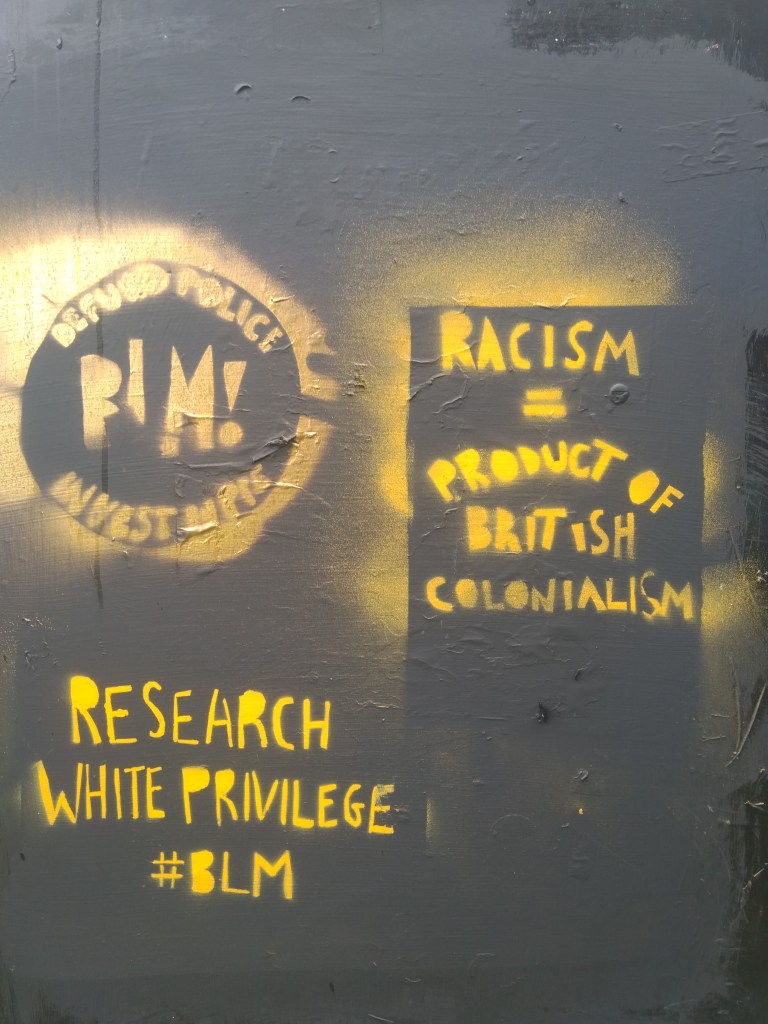
Graffiti on the Meadows, Edinburgh, 13 June 2020
For far too long have the British seen themselves as the “goodies” of history, an idea that has been perpetuated by an education system that doesn’t include the British Empire or colonial rule. I had to do a history degree before I was really exposed to these aspects of our past. If we need inspiration, our European neighbours have examples of public art that helps passers-by work through the traumas of the history. The Berlin wall is commemorated by a copper line which traces the footprint of where the barrier once stood, an artwork woven into the urban fabric which educates but doesn’t erase. Britain could learn a lot from Germany when it comes to acknowledging the past through the use of public space and visual culture.
Understandably, the movement to reassess our statues and monuments has now gathered significant momentum, and other historical figures have come into focus, which has exposed some uncomfortable truths that many would rather sweep under the rug. I think, or would hope, that the vast majority of people agree that slave traders like Colston should have removed long ago. Meanwhile, figures like Winston Churchill and Robert Baden-Powell attract both support and denouncement. Many see these men as heroes, while others reject them for their support of ideologies which, while perhaps common in their day, are not to be celebrated in 2020.
I personally know that the Second World War was not won by one man, and believe that it is possible (and more constructive) to celebrate the now inclusive and welcoming Scout movement without glorifying its founder. However, when I ‘read the room’, and see who is in power in the UK, I think we may have to concede the impossibility of removing all contentious historic figures from view in this current climate. If that is the case, then we need to level the playing field by following the example of Brandy Cadet’s Octavius V. CattoMemorial: let’s commission artists to create monuments to those who have been forgotten, the historically powerless and marginalised. Edinburgh infamously has more statues of animals than of women. If we can’t topple the statue of Henry Dundas in St Andrew’s Square, let’s set up a sculpture that counteracts the ridiculous, phallic intrusion of his monument on our city’s skyline. Let’s insert the narratives of the witches who were publicly executed, the Windrush generation, the LGBT+ community, working class voices, immigrant communities and all who have built our cities into the diverse and interesting places they are today.
Public art can help to articulate and inform our very understanding of who we are, and how we operate in the public sphere, as both individuals and within the groups to which we identify ourselves as belonging. Britain is a deeply divided society, so a proper exploration of our art, which acts like a mirror, can be a way of working through and understanding these divisions. It’s not going to be an easy task. It’s not going to be pretty. There will be lots of feathers ruffled, tears shed, arguments and fights in the process, but asserting our public spaces as sites for activism and debate will be a necessary catharsis, and will enable us to ‘build back better’ in the imminent future.
‘Wake up’ art at a bus stop in Edinburgh, seen 13 June 2020
It is often said that the two prime events that modern Britain’s identity is founded upon are victory in the Second World War in 1945, and the founding of the National Health Service in 1948. With the 75th anniversary of VE day on Friday, and the ongoing coronavirus pandemic, I’ve been thinking these things through lately in the context of British identity.
I’ve been helped on with these thoughts by a film by Alberta Whittle, presented as part of Glasgow International’s Digital Programme. The film is called business as usual: hostile environment (2020), and it was made especially by Whittle for the Digital Programme, adapted from a longer commission she had been working on.
Firstly I need to tell you, that if you want to watch the film you have to do so now, because today is the last day of Gi’s Digital Programme (though hopefully Whittle’s work will be added to her website soon afterwards). I wrote about two other Gi works in the previous blog post, but I needed to sit with this one for longer, because it’s more political, and therefore by nature it is harder to write about.
This is art as activism. It encompasses huge issues, from the treatment of immigrants and the hostile environment, to the Windrush scandal, to the lack of PPE available for frontline staff because of the government’s sluggish reaction and mismanagement of the unfolding COVID-19 crisis. I’ve read it as a reflection on British identity, and the holes in the narrative of that identity. That’s a lot to fit into one artwork, a 16-minute film which pieces together archival footage, news reports, computer generated images and home-movie style footage of a family’s day out on a boat.
Despite the difficult issues broached, its juxtapositions are delicately balanced, so the imagery is not overtly violent or traumatising to watch. Painful subjects are contrasted with some beautiful footage of couples dancing from the archives of an early 1950s Britain, which then sit side by side with brief snapshots of racists marching, and National Front graffiti covering a bridge. Whittle makes use of the split screen to heighten these contrasts: a very grey-looking Britain is paired with what we assume is the clear, beautiful Caribbean sea. Towards the end, a long duet with vocals and drums raises the tension and serves to make the viewer feel uncomfortable. That’s ok though: art doesn’t exist for pleasure alone.
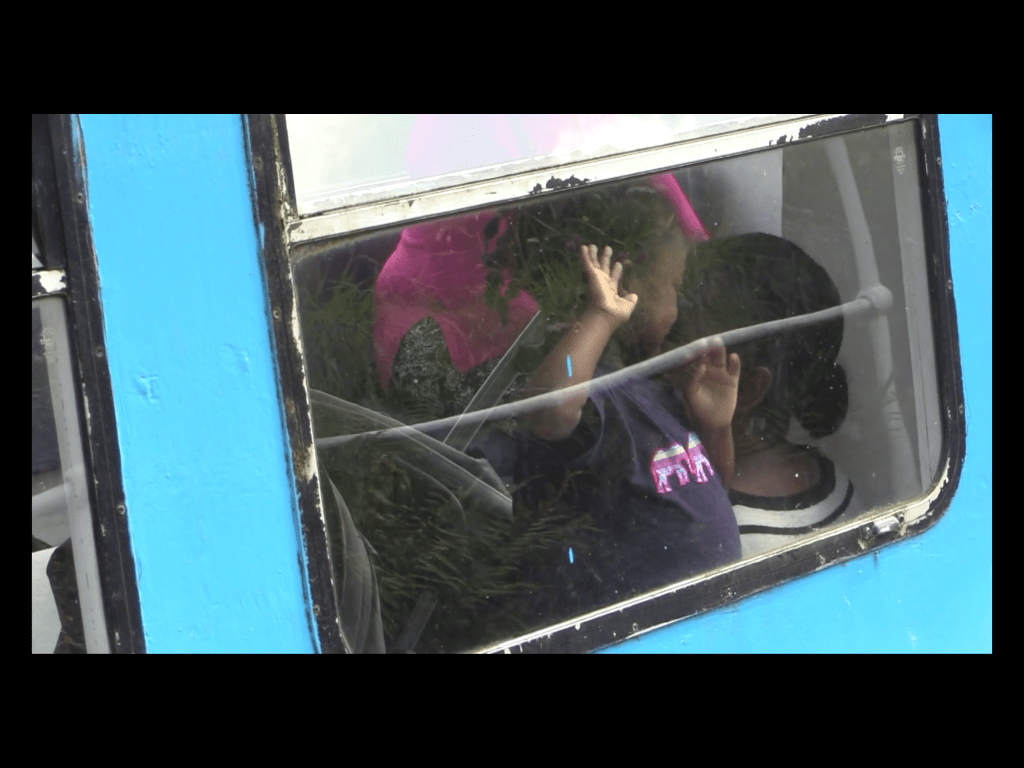
The film persistently subverts the romantic ideas around the images presented. It is partly a response to Visit Scotland’s theme for 2020, Coasts and Waters. What we (and Visit Scotland) might expect from that theme are artworks that respond to and promote Scotland’s amazing coastlines, images of peaceful landscapes with lochs reflecting mountainous scenery. In contrast, Whittle’s work looks at the role water, specifically the Glasgow Forth and the Clyde Canal, have played in the movement of people. There is one image that captures the cleverness and poignance of the film for me. A young black girl is having fun on a canal boat, smiling and knocking on the window, but a passing reflection makes it look for a moment like the window is barred, that she is imprisoned. That sent chills down my spine because of the other images I know of black people incarcerated on ships. It is the unsaid aspect which hovers over the film, including the hopeful images documenting the arrival of Empire Windrush in 1948.
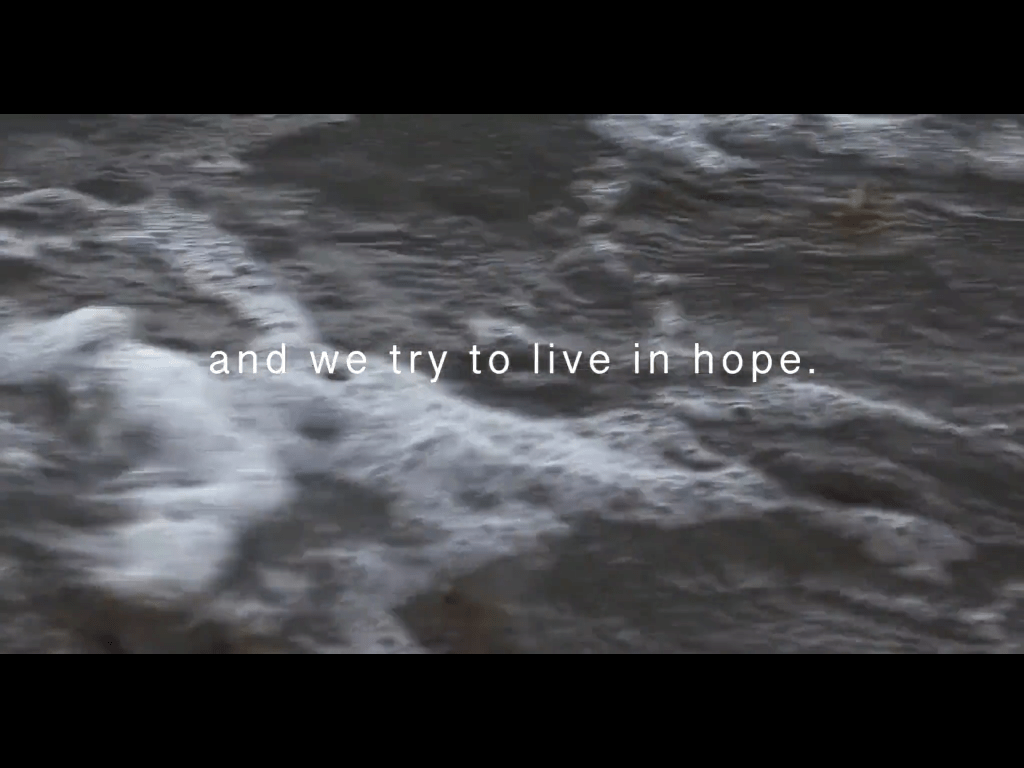
A still from Alberta Whittle’s ‘business as usual: hostile environment’ (2020)
There’s a lot that can be achieved by subverting, questioning and exploring the ideas that nationhood is based upon. Frankie Boyle’s Tour of Scotland, broadcast on the BBC earlier this year, is another example of digging beneath the surface of ideas of who we are. It’s no longer available on iPlayer but clips are online. The section where he talks to Councillor Graham Campbell about Glasgow’s ties to the slave trade was fascinating and, like Alberta Whittle’s business as usual: the hostile environment, works toward educating us about aspects of our past that are often swept under the rug – an ignorance that has allowed for the hostile environment to develop and the Windrush scandal to happen.
Multiple commentators have pointed out that the British government have tried to tie modern Britain’s founding ideas together with its approach to this crisis. Coronavirus has been likened to an enemy, using the language of combat, which isn’t always appropriate, effective or clear when it comes to responding to a medical emergency. The semantics of sacrifice and loyalty are invoked to try and bring us together – though clearly the extent of lives lost could have been limited, had the situation been better handled. Whittle’s film is a reminder that no amount of metaphor should be allowed to submerge that truth.
This work made me think again about how grateful I am to the artists, writers, comedians and journalists who encourage us to look deeper. The ones who question the myths, probe the difficult areas, who remind us to ‘stay alert’ to the situation unfolding around us, to the ideas and the language used to mobilise us. This has been a time of reflection and introspection for many of us, and there are some beautiful, human stories of solidarity that we can take pride in. But after it’s all over, we need a new consciousness to emerge and I want art to be at the forefront of imagining that to be possible as, to quote Whittle, “we try to live in hope” for a better future.
A still from Alberta Whittle’s ‘business as usual: hostile environment’ (2020)
Last weekend was my first visit to Belfast, and I spent some time looking at the city’s famous murals. I wasn’t there for nearly long enough – there are hundreds of murals scattered throughout the city and I only managed to walk around the Falls Road and Shankill Road areas for a short while. But what little I saw I know will stay with me for a long time.
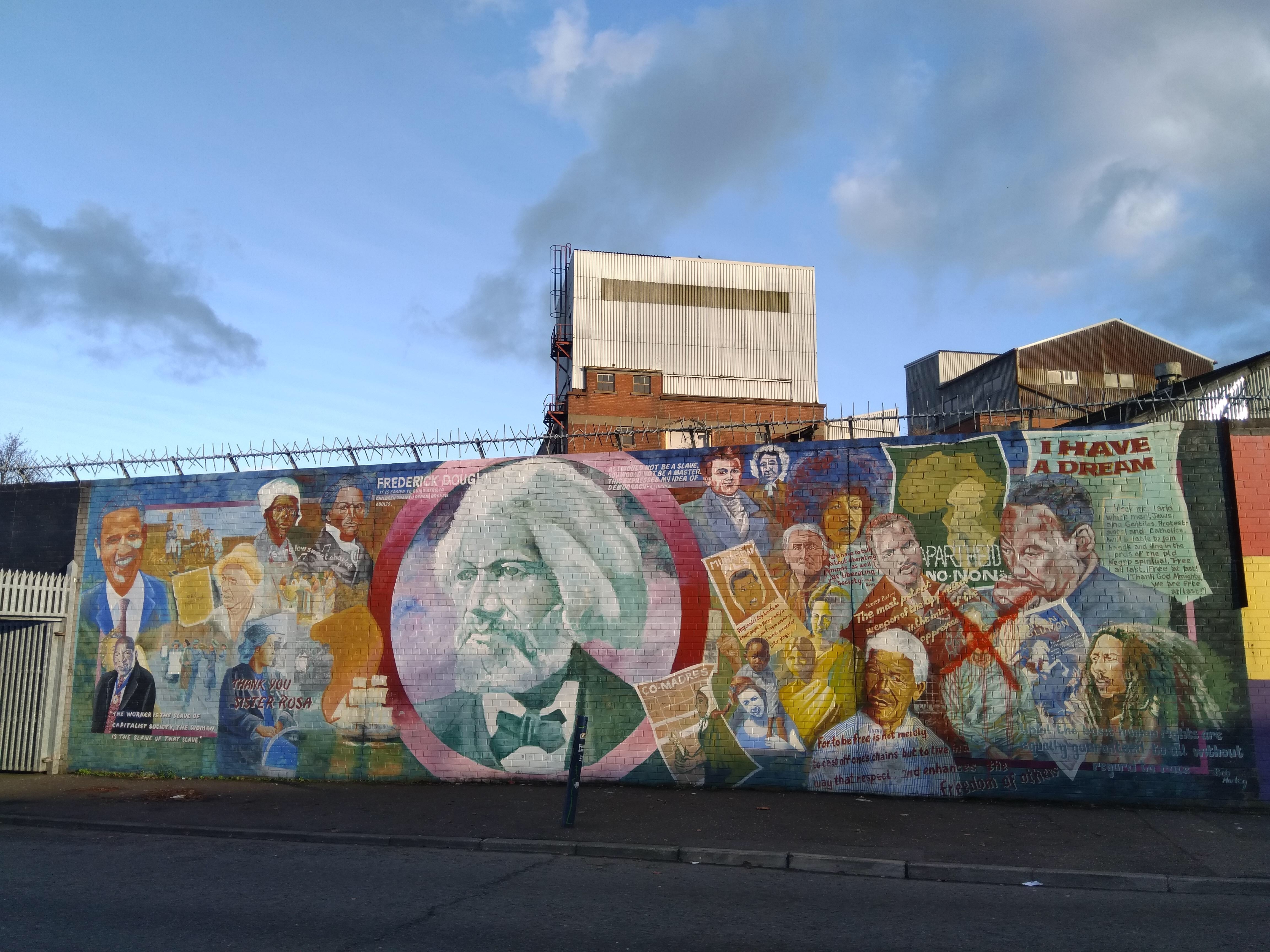
A section of the International Wall, which addresses global struggles
I wouldn’t presume to even try and talk in detail about the context here, but the murals are deeply embedded in years of complicated and violent political history. Public art is always a reflection of power struggles: who is represented and who is left out is a political issue. This is even more true in the case of the murals, which have sprung up over decades, and are for the most part created by people who live in these communities, rather than by artists brought in from outside and commissioned to make work.
The subjects of the murals vary hugely, but many of them commemorate the victims of The Troubles. In a conflict fought at such close quarters, even the smallest of exposed façades becomes a canvas for stating the allegiances of the area.
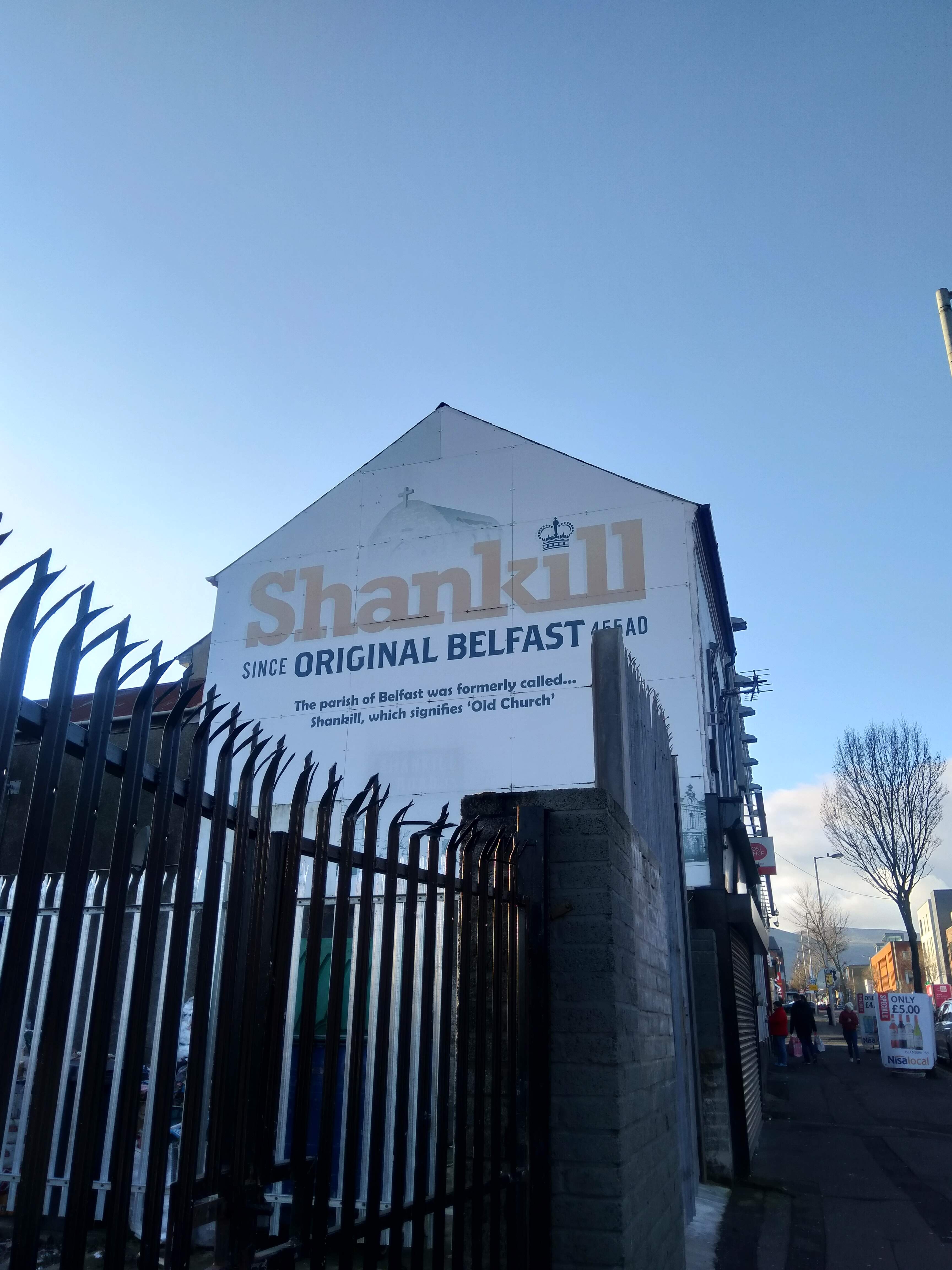
Signs and symbols: the crown dotting the ‘i’ of Shankill denotes the area’s allegiances
I was shocked to learn that thousands of lives were lost in the violence, and perhaps just as surprising was that neither me, nor any of the people I was with (Scottish and English) had learned anything about the conflict in school, even though it is very much in living memory and an important part of both British and Irish history.
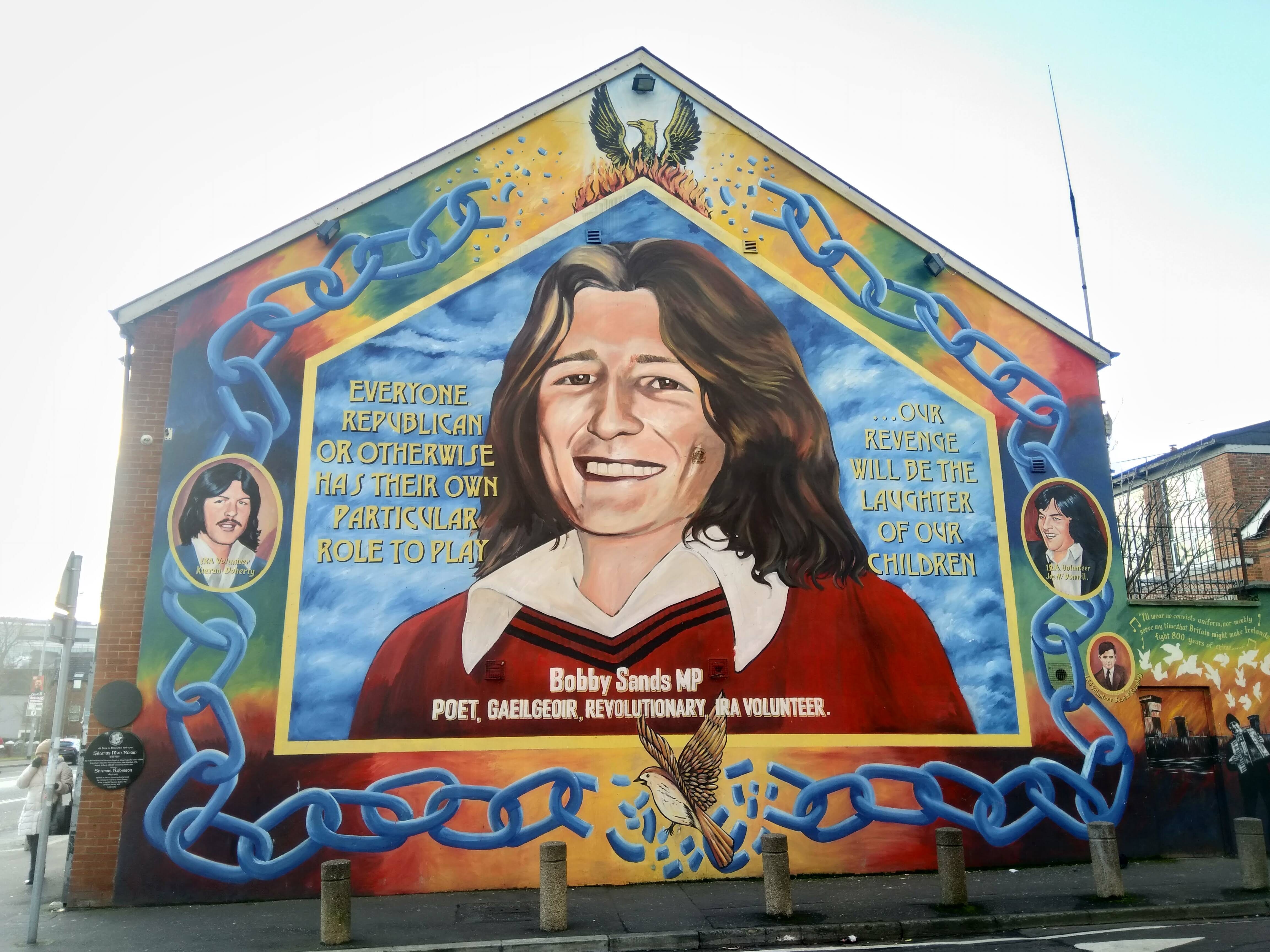
The Bobby Sands mural is the most photographed in Belfast.
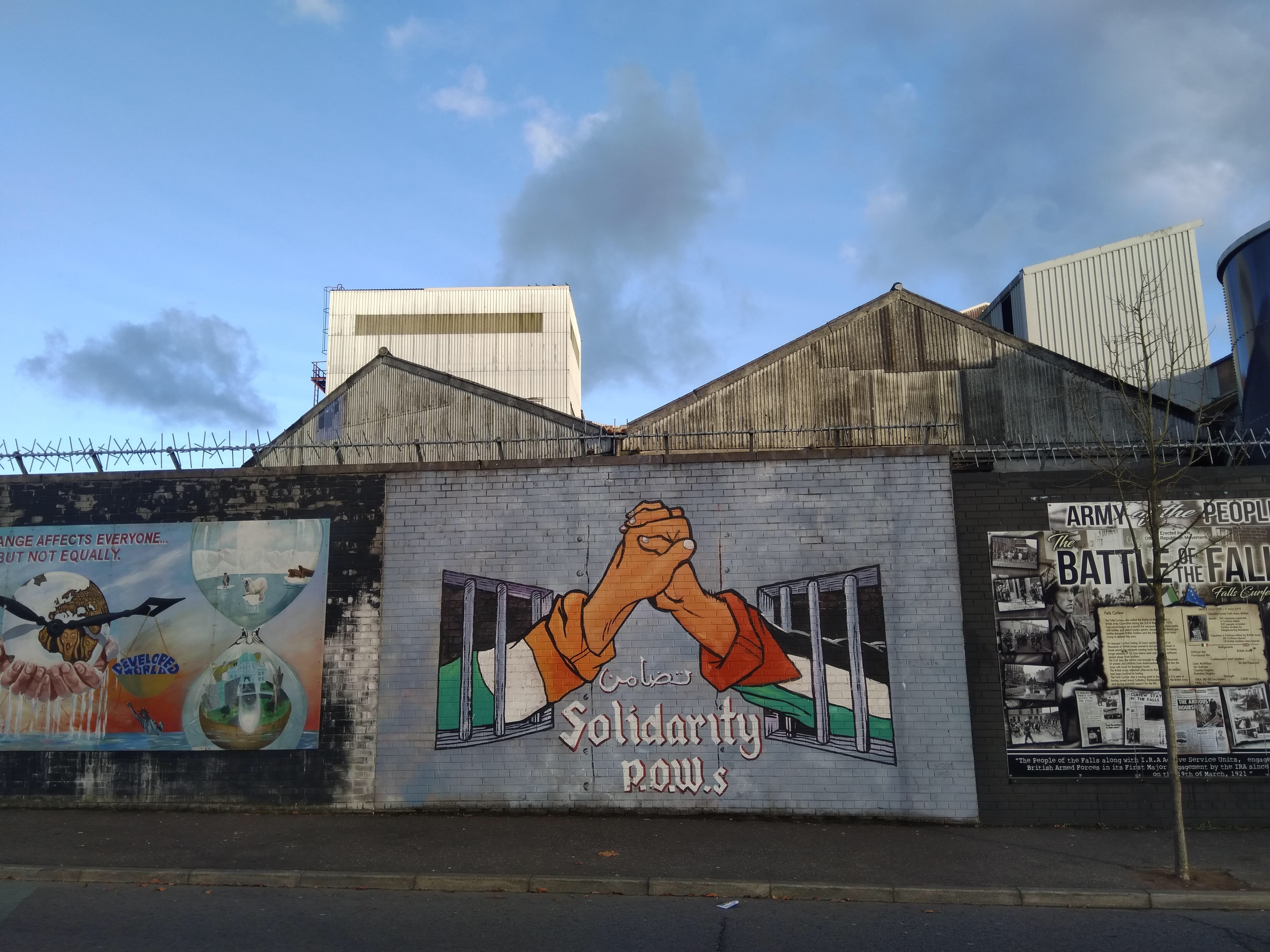
It’s a moving and hard-hitting experience, but walking the streets and engaging with the murals as a tourist is one of the ways we can learn about the city’s difficult past in an accessible way. It’s also an important reminder that images, signs and symbols are always laced with countless different meanings, and it is worth taking some time to try and decipher them.
Images of solidarity using the colours of the Irish and Palestinian flags, situated on the International Wall
There’s so much packed into this exhibition at the Scottish National Gallery of Modern Art, which connects radically different works of art by artists as diverse as Pietro da Cortona (Italian Baroque painter and architect, 1596-1669) and Linder (British radical feminist artist, b.1954) it’s difficult to know where to begin.
The exhibition is a chronological survey of just about everything connected to the act of cutting one thing and sticking/stitching it on to another, including the digital techniques used today by brilliant artists like Cold War Steve. So there’s a lot to get through.
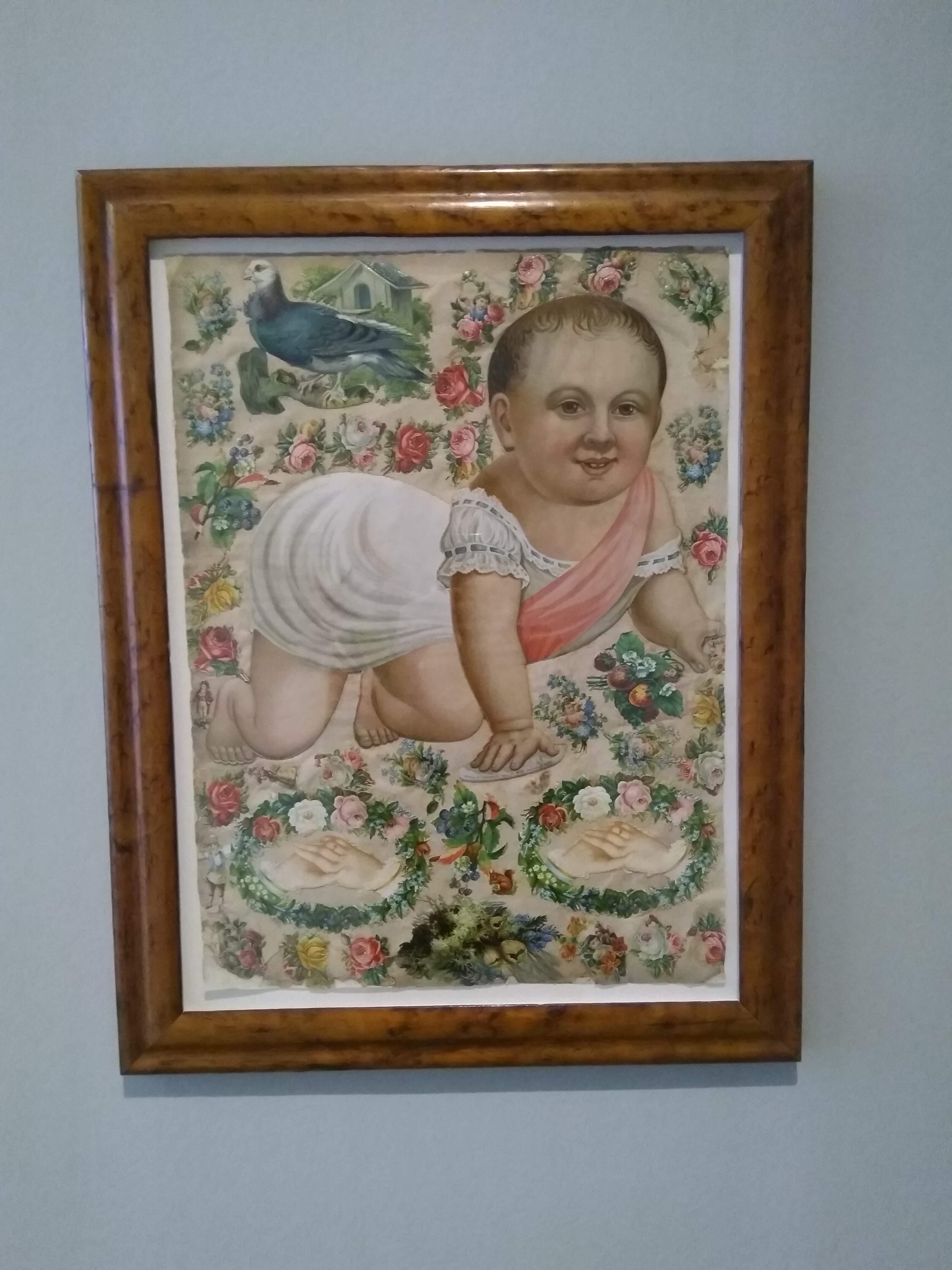
It might sound as a though the whole concept is a bit broad (it’s true that the exhibition has so many works it almost falls into the ‘overwhelming’ category), but in the very act of broadening out the understanding of collage as art, the show opens up the narrative possibilities around the medium. By including works by amateur and anonymous artists, we see the informal side of collage, which became hugely popular in the nineteenth century, particularly among women. I’m glad of that because it exposes some of the many weird and wonderful constructions that resulted from the pastime of sticking one thing to another, one of my favourites being this monstrously ugly baby from 1890.
Anonymous, Baby, (about 1890)
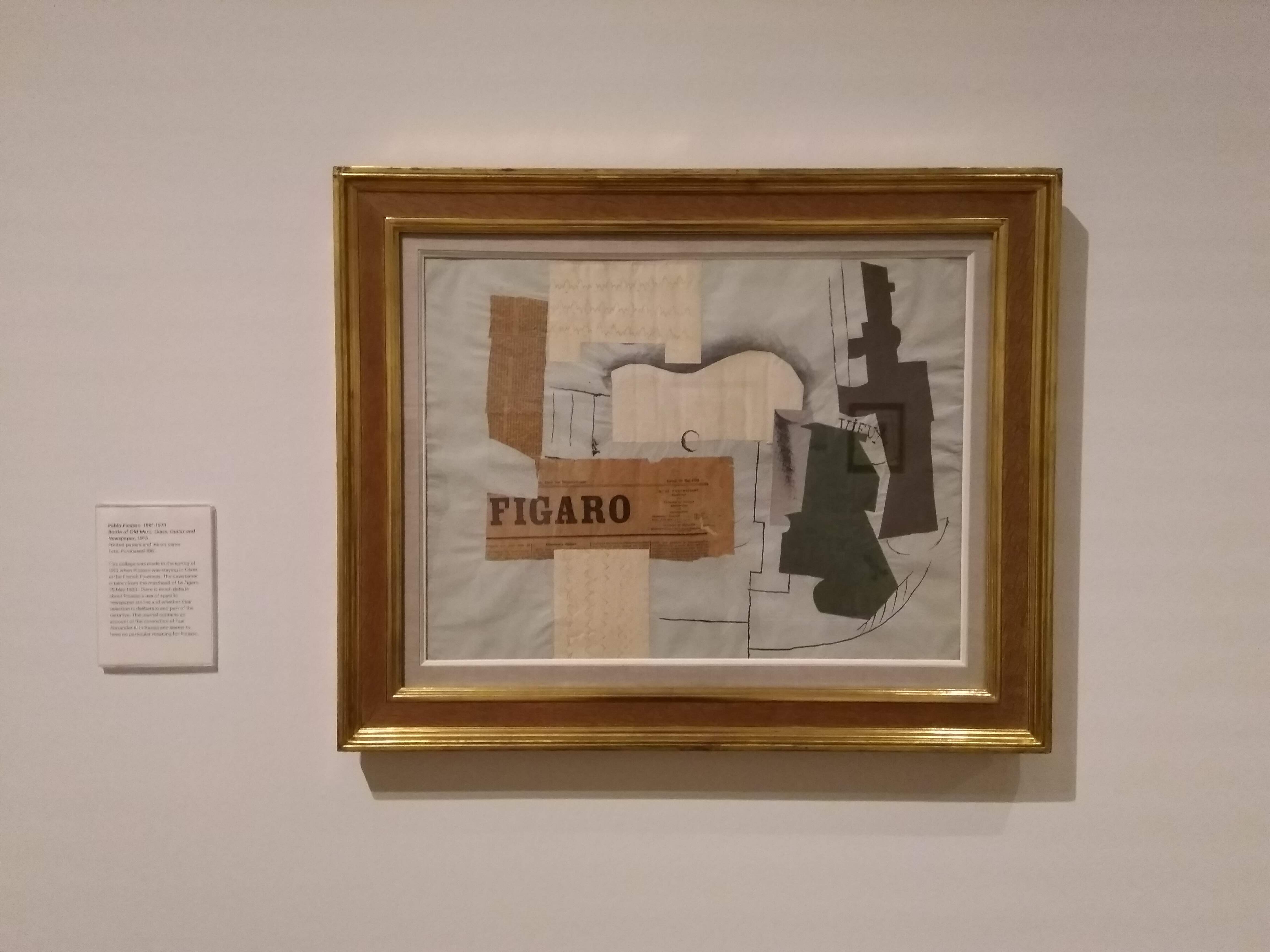
By placing objects like this one alongside Picasso’s Old Marc, Glass, Guitar and Newspaper (1913), the exhibition stressed some of the continuities of collage throughout the centuries. Yet though the wall text explained how the meanings of collage changed in the twentieth century, I still feel that more could have been made of how utterly radical it was when avant garde artists started to incorporate fragments of newspaper and other ephemera on to the canvas. It was a gesture that intended to break the mould and redefine painting altogether, which had huge repercussions on what later constituted art. It was for this reason that collage went on to be one of the go-to visual languages of satire, protest and activism.
Pablo Picasso, Bottle of Old Marc, Glass, Guitar and Newspaper, 1913
For me, the political artworks were some of the best in the show. John Heartfield’s series of satirical photomontages for the left-wing German publication AIZ really fascinated me. One, depicting a Hitler with coins for a skeleton alongside the caption “Adolf the Superman: swallows gold and spouts rubbish” (1932) felt particularly apt to our current political climate. I just wish the series was placed somewhere more prominent, rather than in a walkway. The exhibition has so much to say, but there wasn’t enough space to say it. Better to cut down on the numbers of works and give ones like this the position they deserve.
John Heartfield, rotogravure, published in AIZ 17 July 1932
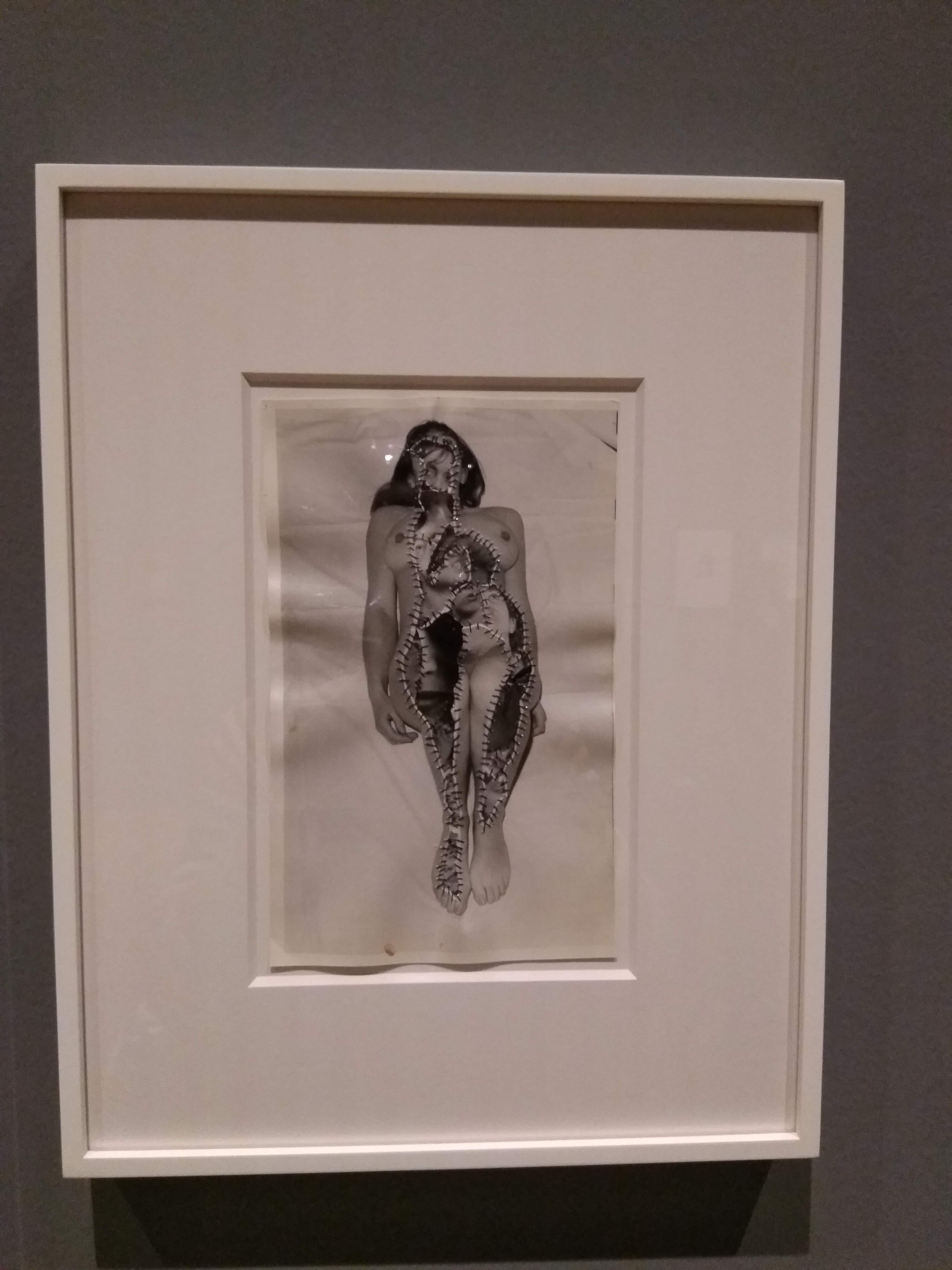
It seems that with works in collage, there’s a strong urge towards the uncanny, things that disturb and make the viewer take a second look. That was true of the works exploring the body by feminist artists of the 1960s and 70s, in one of the best rooms of the exhibition. I hadn’t heard of Annegret Soltau (b.1946) before, and her works made with black thread suturing together different photographs of her naked body were really striking.
Annegret Soltau, Schwanger II (Pregnant II), 1978
There are so many fascinating things to see at this exhibition and it throws a light on some of the challenges of dealing with such a broad theme. It is said too often, Qbut there really is something for everyone here, and I would really recommend you go and see it before it closes on 27 October.
Grayson Perry, with his numerous books, TV documentaries and lectures, is probably one of the few genuinely famous contemporary artists in Britain today. He is perhaps better known for talking about art than for the art he produces, though the bright colours and recurring cast of characters in his ceramics, tapestries and prints, once seen, are not easily forgotten. He is a chronicler, a satirist, a kind of psychedelic William Hogarth of our times, chewing up the world and spitting it back out at us in a way that both gloriously kitsch and raucously ugly.
Hogarth’s Gin Lane, 1751
Perry is fundamentally a storyteller artist. He creates narratives in his artworks which help us to think about the world around us, and our multiple identities as individuals within society. That is what he has done for this show at Dovecot Studios, Julie Cope’s Grand Tour: The Story of a Life by Grayson Perry. The exhibition follows his fictional character Julie through what Perry calls ‘the trails, tribulations, celebrations and mistakes of an average life’, using a series of brightly-coloured Jacquard tapestries.
Don’t be fooled by the bright colours, though. The story behind the works is one that is full of tragedy, examining the mundane reality of life, the pervasive banality even of its most dramatic moments. Alongside the tapestries, The Ballad of Julie Cope, a poem written by Perry bleakly sets the context for Julie’s life. I sometimes find looped audio tracks in exhibition spaces quite distracting, but here, the poem read aloud by Perry in his slight Essex accent gave the tale of Julie Cope, an Essex girl, a kind of timeless authenticity.
Detail from the first tapestry in the series, A Perfect Match
The tapestries themselves are immense and impressive. Packed with details, they are a fascinating maze of signs and symbols, clashing colours and patterns for the viewer to decipher. Clever tricks are used that are barely noticeable at first, but make the images all the more convincing, like the shadows used around the feet in the picture above, giving the work a sense of depth and the cartoon-esque characters more solidity.
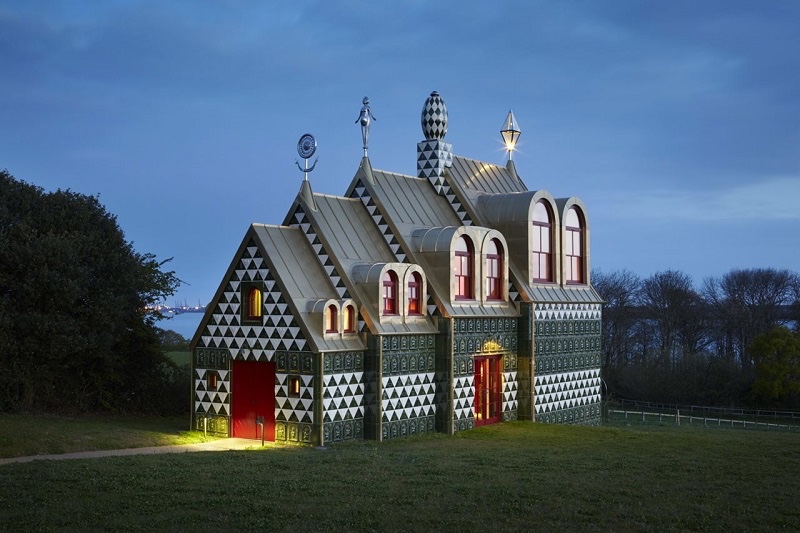
As with much of Grayson Perry’s work, class is the central theme underlying the show, and his observations about life in modern Britain are as bittersweet and tinged with nostalgia as they are acerbic. The tapestries, when they are not on tour, usually decorate another of Perry’s fascinating projects, A House For Essex, a whacky Wendy house construction which is part folly, part shrine, to Julie Cope. Seen divorced from this context, in the exhibition space, I think the works have probably lost some of their whimsical quality, and we are left with a documentation of the sad predictability of life. For me, the overriding feeling of the exhibition was not uplifting, but in that way, Perry, the Bard, creates a perfect mirror of the country in turmoil around us.




 encounters_art