‘Cut and paste: 400 years of collage’, National Galleries Scotland

There’s so much packed into this exhibition at the Scottish National Gallery of Modern Art, which connects radically different works of art by artists as diverse as Pietro da Cortona (Italian Baroque painter and architect, 1596-1669) and Linder (British radical feminist artist, b.1954) it’s difficult to know where to begin.

The exhibition is a chronological survey of just about everything connected to the act of cutting one thing and sticking/stitching it on to another, including the digital techniques used today by brilliant artists like Cold War Steve. So there’s a lot to get through.

It might sound as a though the whole concept is a bit broad (it’s true that the exhibition has so many works it almost falls into the ‘overwhelming’ category), but in the very act of broadening out the understanding of collage as art, the show opens up the narrative possibilities around the medium. By including works by amateur and anonymous artists, we see the informal side of collage, which became hugely popular in the nineteenth century, particularly among women. I’m glad of that because it exposes some of the many weird and wonderful constructions that resulted from the pastime of sticking one thing to another, one of my favourites being this monstrously ugly baby from 1890.
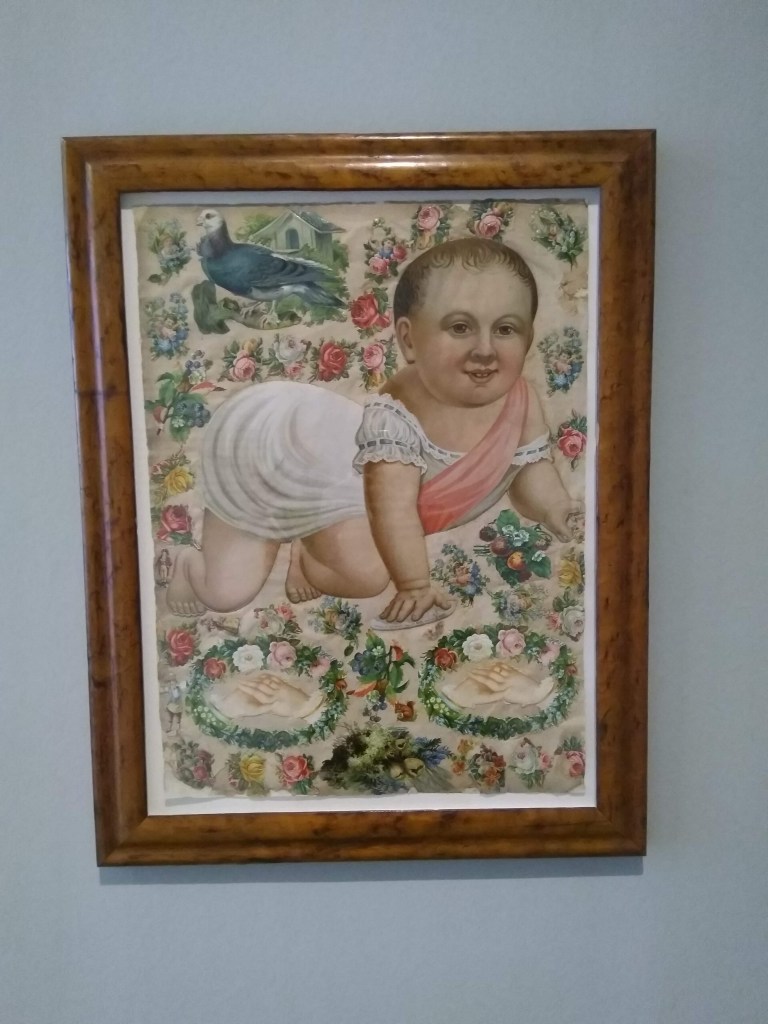
Anonymous, Baby, (about 1890)

By placing objects like this one alongside Picasso’s Old Marc, Glass, Guitar and Newspaper (1913), the exhibition stressed some of the continuities of collage throughout the centuries. Yet though the wall text explained how the meanings of collage changed in the twentieth century, I still feel that more could have been made of how utterly radical it was when avant garde artists started to incorporate fragments of newspaper and other ephemera on to the canvas. It was a gesture that intended to break the mould and redefine painting altogether, which had huge repercussions on what later constituted art. It was for this reason that collage went on to be one of the go-to visual languages of satire, protest and activism.
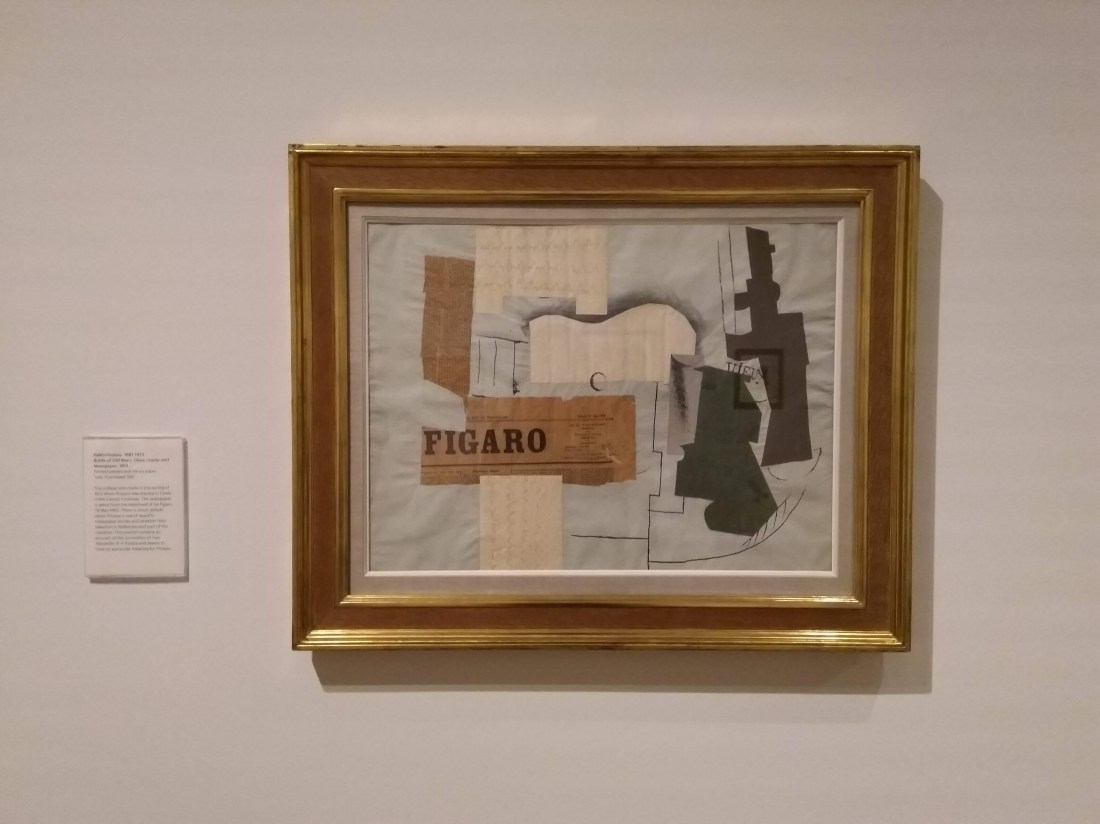
Pablo Picasso, Bottle of Old Marc, Glass, Guitar and Newspaper, 1913

For me, the political artworks were some of the best in the show. John Heartfield’s series of satirical photomontages for the left-wing German publication AIZ really fascinated me. One, depicting a Hitler with coins for a skeleton alongside the caption “Adolf the Superman: swallows gold and spouts rubbish” (1932) felt particularly apt to our current political climate. I just wish the series was placed somewhere more prominent, rather than in a walkway. The exhibition has so much to say, but there wasn’t enough space to say it. Better to cut down on the numbers of works and give ones like this the position they deserve.
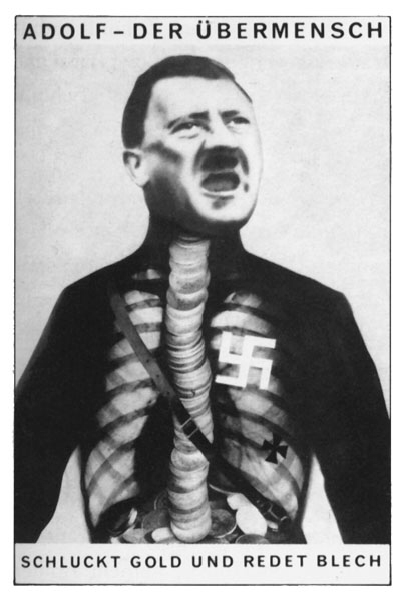
John Heartfield, rotogravure, published in AIZ 17 July 1932

It seems that with works in collage, there’s a strong urge towards the uncanny, things that disturb and make the viewer take a second look. That was true of the works exploring the body by feminist artists of the 1960s and 70s, in one of the best rooms of the exhibition. I hadn’t heard of Annegret Soltau (b.1946) before, and her works made with black thread suturing together different photographs of her naked body were really striking.
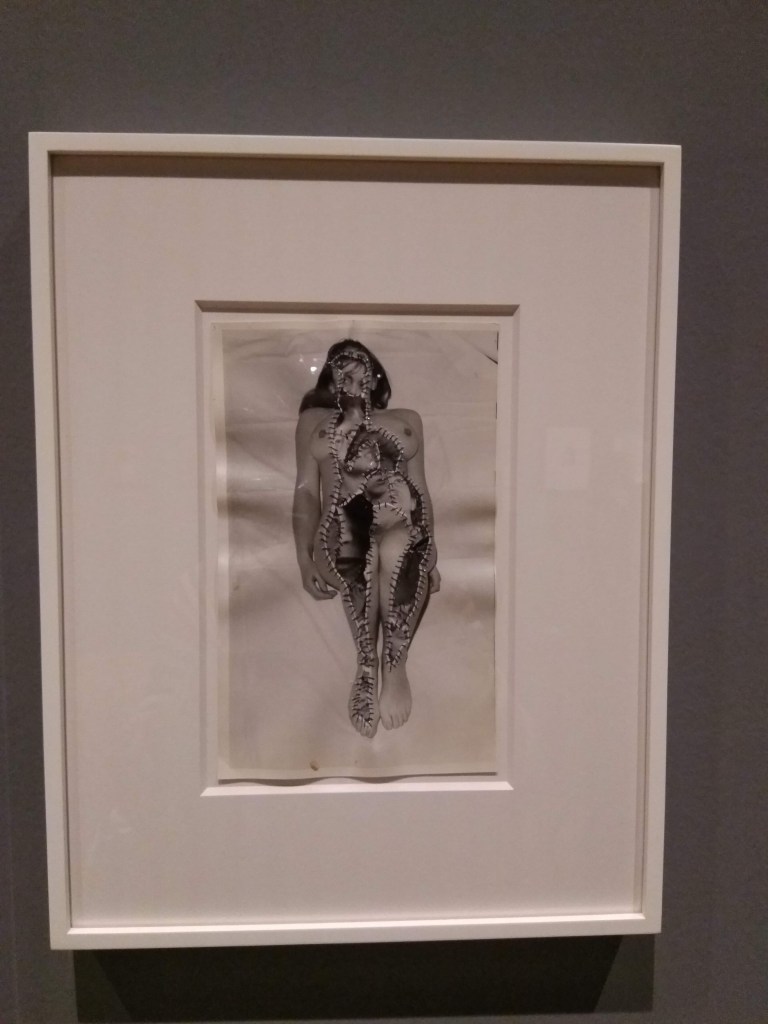
Annegret Soltau, Schwanger II (Pregnant II), 1978

There are so many fascinating things to see at this exhibition and it throws a light on some of the challenges of dealing with such a broad theme. It is said too often, Qbut there really is something for everyone here, and I would really recommend you go and see it before it closes on 27 October.
The Long Look, Scottish National Portrait Gallery

The Long Look at the Scottish National Portrait Gallery is a small but focused show that turns portraiture on its head in a conceptually intriguing and visually satisfying way. The exhibition is the result of a two-year project in which Norman McBeath (photographer, printmaker) sat for painter Audrey Grant as she created two portraits of him in charcoal.

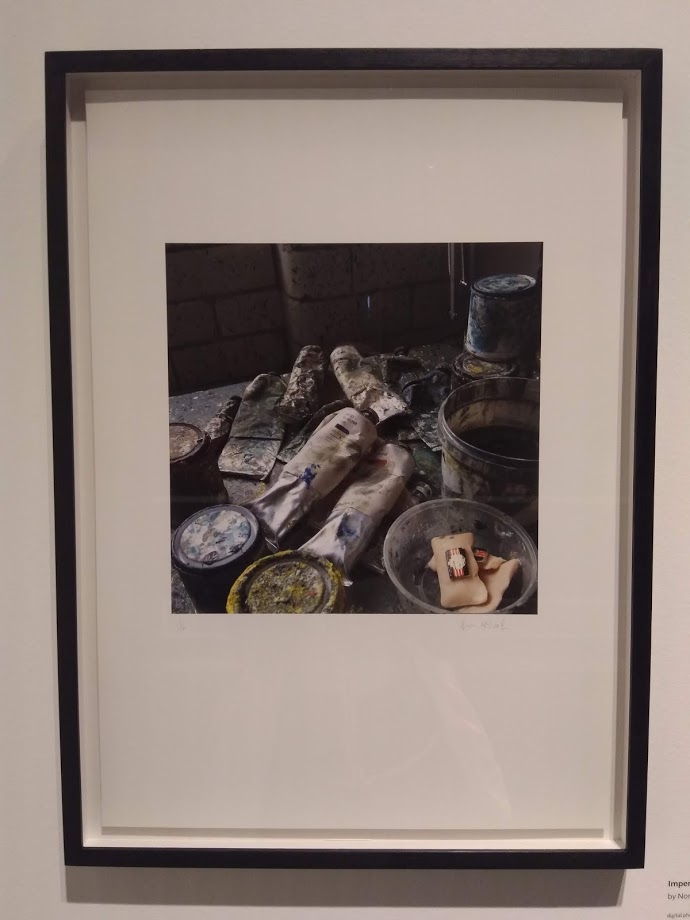
The portraits of McBeath do feature, but they are really only a side story to this show. The main body of work is by McBeath: his photographic impressions of Grant’s studio, documenting her presence by the trails of creative detritus she leaves in her wake. These ‘portraits’ show the traces of Grant everywhere: fingerprints in the paint that has dried on the back on her easel; highly detailed close-ups of her charcoal-blackened apron that seem transformed into vast monochrome sand dunes; the bars of soap on the counter, misshapen by the hands they help to clean after every session.

Hands series, a sequence of close up and super-high-definition photographs is at the centre of the display. Each minute detail is made more striking by the charcoal dust embedded in the creases of Grant’s skin. We rarely get much of a glimpse of the artist in standard portraiture, a genre that can feel fairly prosaic and transactional. Here, the photographs by McBeath document her creative space, the studio, and present its contents as a lens through which we ‘see’ the artist.

Imperial Leather by Norman McBeath

It seems that the sense of fascination with the artist’s studio now seems more prevalent than ever. The most unique and (the more I reflect on it) bizarre example I encountered was at Dublin City Gallery, The Hugh Lane. There, in the centre of the gallery, is Francis Bacon’s studio. Its contents – even the dust – painstakingly reassembled having been documented and meticulously transferred from London to Dublin in 1998. Though it is undeniably a fascinating sight, and totally worth visiting, there is something voyeuristic about the practice of preserving and reassembling the artist’s studio within the Gallery space (closer to home, Paolozzi’s studio is on display at the Scottish National Gallery of Modern Art until next year). These kind of displays continue to assert the narratives of the ‘artist genius’, elevating and shrouding his or her workplace in magic and mystique, ways of thinking that contemporary art history has sought to move away from.

The Long Look, though it has elements of this tendency to give the artist’s studio too much auratic power (including the unnecessary inclusion of the chair that McBeath sat in while his portrait was created) for the most part manages to circumvent these more troubling tendencies of artist/studio worship. Particularly when presented in the context of a national collection of portraiture, where wall labels normally the list the sitter’s name and details of their life far more prominently than the artist’s, this reversal of the gaze subverts the traditions of portraiture in a refreshing way.

Hands series by Norman McBeath

For me, the examination of the psychological intensity of two people observing one another over time, and the resulting sense of intimacy between McBeath and Grant was one of the other most successful outcomes of the show. For this reason, I would argue that the inclusion of two portraits of Val McDermind were a kind of ‘third wheel’, an unnecessary curatorial appendage to an otherwise tightly-focused exhibition.

Through the simple switch between observer/observed, The Long Look empowers the usually passive sitter with the gift of re-observation, and extends this to the observer in a way that offers a fresh perspective. When encountering subsequent portraits, we might ask ourselves: how did it look from the other side?