Glasgow International part 2: Alberta Whittle

It is often said that the two prime events that modern Britain’s identity is founded upon are victory in the Second World War in 1945, and the founding of the National Health Service in 1948. With the 75th anniversary of VE day on Friday, and the ongoing coronavirus pandemic, I’ve been thinking these things through lately in the context of British identity. 

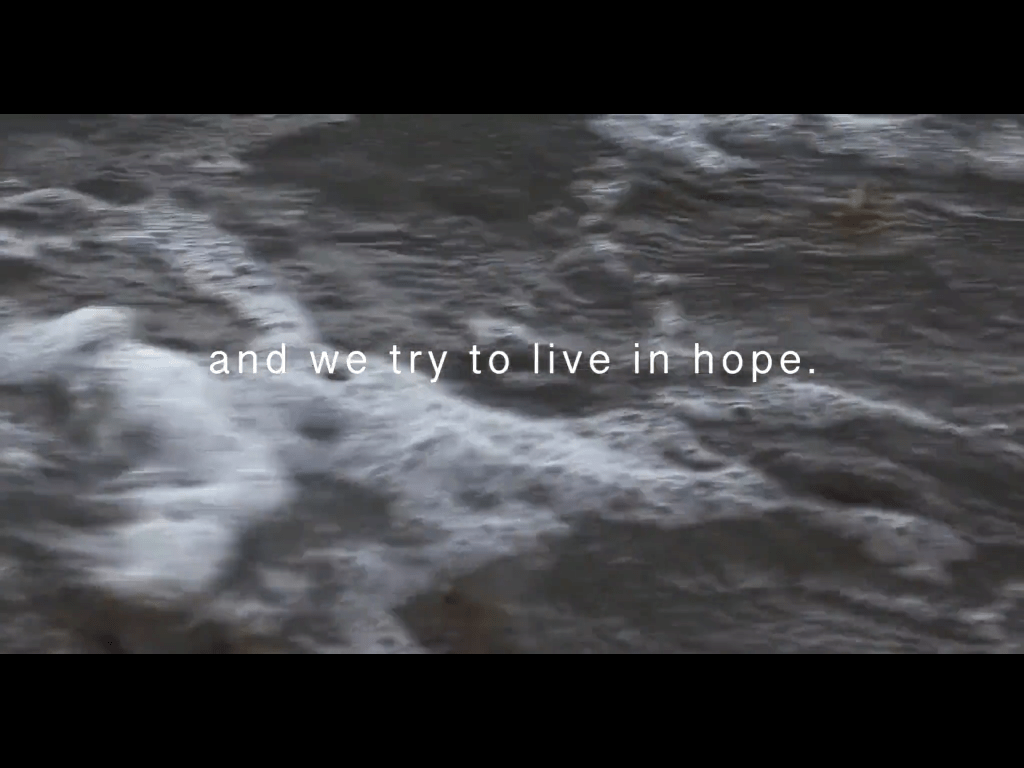
I’ve been helped on with these thoughts by a film by Alberta Whittle, presented as part of Glasgow International’s Digital Programme. The film is called business as usual: hostile environment (2020), and it was made especially by Whittle for the Digital Programme, adapted from a longer commission she had been working on.

Firstly I need to tell you, that if you want to watch the film you have to do so now, because today is the last day of Gi’s Digital Programme (though hopefully Whittle’s work will be added to her website soon afterwards). I wrote about two other Gi works in the previous blog post, but I needed to sit with this one for longer, because it’s more political, and therefore by nature it is harder to write about.

This is art as activism. It encompasses huge issues, from the treatment of immigrants and the hostile environment, to the Windrush scandal, to the lack of PPE available for frontline staff because of the government’s sluggish reaction and mismanagement of the unfolding COVID-19 crisis. I’ve read it as a reflection on British identity, and the holes in the narrative of that identity. That’s a lot to fit into one artwork, a 16-minute film which pieces together archival footage, news reports, computer generated images and home-movie style footage of a family’s day out on a boat. 

Despite the difficult issues broached, its juxtapositions are delicately balanced, so the imagery is not overtly violent or traumatising to watch. Painful subjects are contrasted with some beautiful footage of couples dancing from the archives of an early 1950s Britain, which then sit side by side with brief snapshots of racists marching, and National Front graffiti covering a bridge. Whittle makes use of the split screen to heighten these contrasts: a very grey-looking Britain is paired with what we assume is the clear, beautiful Caribbean sea. Towards the end, a long duet with vocals and drums raises the tension and serves to make the viewer feel uncomfortable. That’s ok though: art doesn’t exist for pleasure alone.

The film persistently subverts the romantic ideas around the images presented. It is partly a response to Visit Scotland’s theme for 2020, Coasts and Waters. What we (and Visit Scotland) might expect from that theme are artworks that respond to and promote Scotland’s amazing coastlines, images of peaceful landscapes with lochs reflecting mountainous scenery. In contrast, Whittle’s work looks at the role water, specifically the Glasgow Forth and the Clyde Canal, have played in the movement of people. There is one image that captures the cleverness and poignance of the film for me. A young black girl is having fun on a canal boat, smiling and knocking on the window, but a passing reflection makes it look for a moment like the window is barred, that she is imprisoned. That sent chills down my spine because of the other images I know of black people incarcerated on ships. It is the unsaid aspect which hovers over the film, including the hopeful images documenting the arrival of Empire Windrush in 1948.
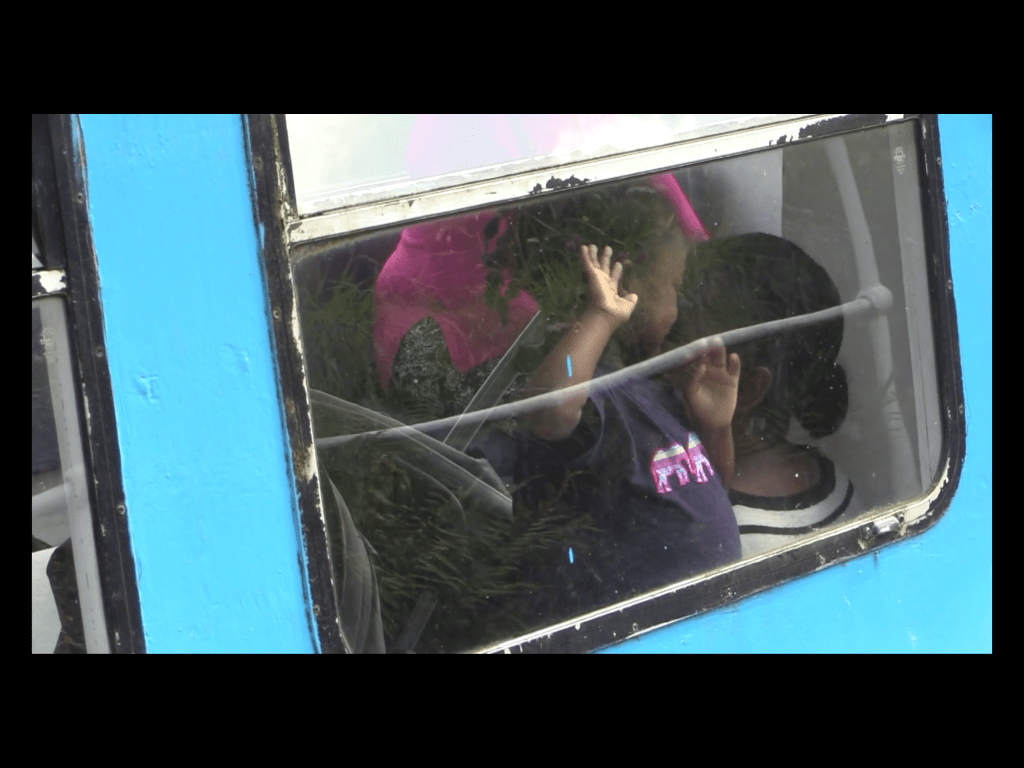
A still from Alberta Whittle’s ‘business as usual: hostile environment’ (2020)

There’s a lot that can be achieved by subverting, questioning and exploring the ideas that nationhood is based upon. Frankie Boyle’s Tour of Scotland, broadcast on the BBC earlier this year, is another example of digging beneath the surface of ideas of who we are. It’s no longer available on iPlayer but clips are online. The section where he talks to Councillor Graham Campbell about Glasgow’s ties to the slave trade was fascinating and, like Alberta Whittle’s business as usual: the hostile environment, works toward educating us about aspects of our past that are often swept under the rug – an ignorance that has allowed for the hostile environment to develop and the Windrush scandal to happen.

Multiple commentators have pointed out that the British government have tried to tie modern Britain’s founding ideas together with its approach to this crisis. Coronavirus has been likened to an enemy, using the language of combat, which isn’t always appropriate, effective or clear when it comes to responding to a medical emergency. The semantics of sacrifice and loyalty are invoked to try and bring us together – though clearly the extent of lives lost could have been limited, had the situation been better handled. Whittle’s film is a reminder that no amount of metaphor should be allowed to submerge that truth.

This work made me think again about how grateful I am to the artists, writers, comedians and journalists who encourage us to look deeper. The ones who question the myths, probe the difficult areas, who remind us to ‘stay alert’ to the situation unfolding around us, to the ideas and the language used to mobilise us. This has been a time of reflection and introspection for many of us, and there are some beautiful, human stories of solidarity that we can take pride in. But after it’s all over, we need a new consciousness to emerge and I want art to be at the forefront of imagining that to be possible as, to quote Whittle, “we try to live in hope” for a better future.
A still from Alberta Whittle’s ‘business as usual: hostile environment’ (2020)

Glasgow International is happening online, right now

The art festival Glasgow International (Gi) had to cancel and has curated a set of seven different artworks available online for the duration of the festival (until 10th May). Some are special commissions, some works were made long before the pandemic hit, but all artists would have been taking part in the festival itself, and the works represent a taster of what would have been available to see. While I understand that Gi want to mark the period when the festival would have taken place, it feels needlessly restrictive to have made this very interesting set of works available only to take them down after two and a half weeks. Time seems arbitrary now. I barely know what day it is, let alone the date. Why not leave them up until the end of lockdown or the end of May at least?

I was a bit late to the party but I’ve just finished watching/listening to them all and wanted to highlight two that resonated with me.

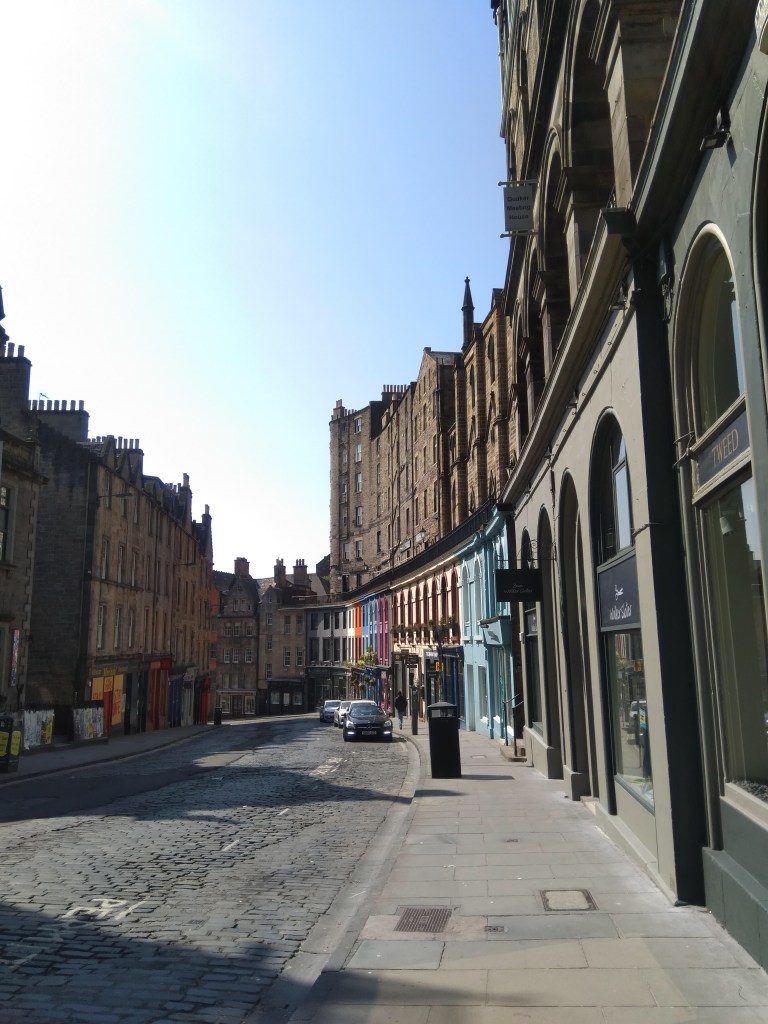
The first is Yuko Mohri’s Everything Flows – distance, 2020. Mohri has taken Yasujirō Ozu’s 1953 silent film Tokyo Story (which I haven’t seen), and has spliced together scenes devoid of human presence. What we are left with is a ghostly compilation of images which suggest humans through their absence. The city continues to function, ships move through water with purpose, but seem to be operated by remote control. Robotic railway station signs indicate platforms and train times to no one. Clothes on washing lines blow in the breeze and shadows on the walls of cramped interiors hint at human life, but each time, the film cuts out just before the figure comes into frame. It’s a tantalising series of almost-moments, which chimes well with having experienced a quiet, deserted central Edinburgh over the last month or so. There’s a strong sense of people watching the goings on from the high viewpoints over the city. Lanterns look like eyes. A moth bashes against a light, a fragile reflection on the futility of existence in this silent world.

Victoria St, Edinburgh looking empty on 25 April 2020

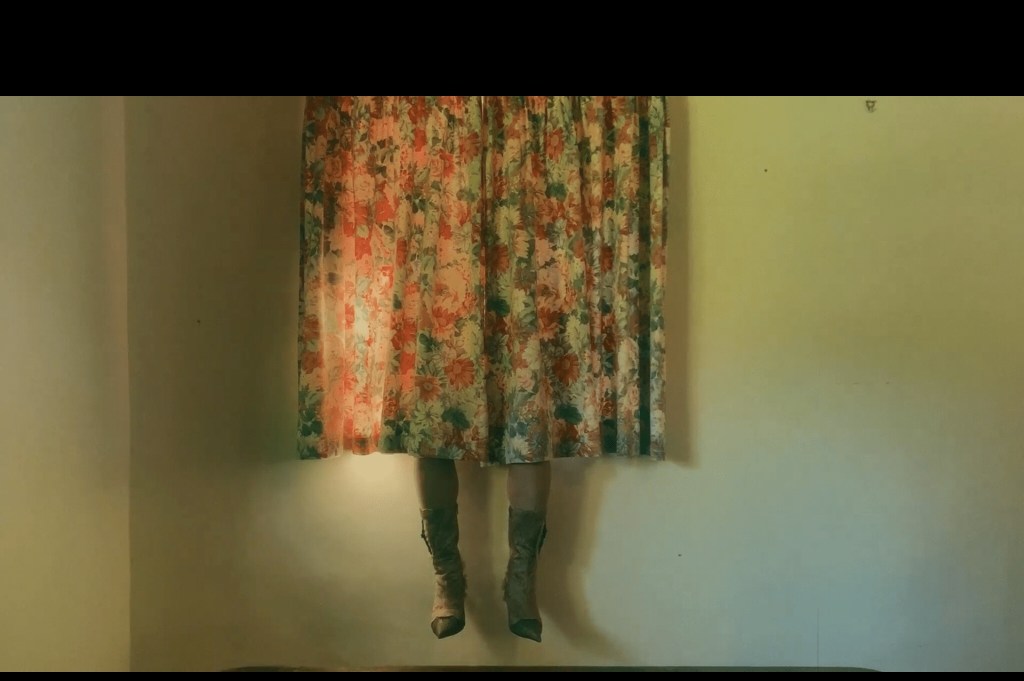
Urara Tsuchiya’s Give us a Meow, 2019, is my other pick of the bunch. This one surprised me – from the cover image and the title I didn’t think I would like it. But the 9 minute film is captivating. It tells a fragmented story, set in the rural idyll of a cottage and the countryside around it. We follow the escapades of a glamorous Asian woman who dons an impressive range of sexy outfits including animal print catsuits, fluffy negligee, powder blue and baby pink fur coats. The costumes are all made by Tsuchiya and are highly influenced by drag, adding to the fascinating confusion around the identity of our protagonist. She dances, applies makeup, takes selfies and does the ironing. It’s a surreal and humorous mash-up of the extremes of femininity, typified by one excellent shot which briefly flashes up, showing a pair of legs clad in high-heeled boots, sticking out from behind twee floral curtains. I took a screenshot which is probably not allowed, but who knows the rules of a digital art festival. Maybe this is part of a process of the democratisation of image-making, taken to a new level.

Still from Urara Tsuchiya’s ‘Give us a Meow’, 2019

For me, in a time of lockdown, it seems as though the character in Give us a Meow is attempting to recreate the experience of being in a nightclub within a completely incompatible setting of ‘home’. She dances like no one’s watching. She even has a little cry in the bathroom, picks herself back up and heads out again, an experience I’m sure we can all relate to. Seeing her vulnerability when navigating a cattle grid in heels is beautiful and moving and funny.

There’s also a fascinating, sinister aspect reflecting on the voyeurism of the film. She appears to be alone, but is not – she breaks the fourth wall repeatedly to interact with us, casting glances directly at the camera, creepily/seductively waving at us from the toilet seat. In the moments filmed outside, with her dancing by the side of the road, the film is shot from the perspective of someone watching from a car window. We are there, but it feels like someone else is there too. This also resonates particularly now – we rely on our cameras more than ever for interaction and attention, but constant rumours circulating about hackers in Zoom calls and sessions on Houseparty make us paranoid about who else might be watching. Tsuchiya created the work last year, but it feels more relevant than ever now.

So, that’s my take. I know there’s so much content out there at the moment, it can be overwhelming. I know that digital art events don’t appeal in the same way as the ones in ‘real life’, which can take you to different corners of your city and have a physicality to them that can’t be recreated on screen. But these artists have created something really interesting. What worked for me may not work for you – see what you think and let me know in the comments, or DM me on Instagram @encounters_art. I’m always here for a conversation about art!

Art and life at home (in the age of Coronavirus)

This is my first post since the Coronavirus outbreak hit Europe. Not for a lack of time – like all of us, I’ve had more time at home than ever before in my adult life. It’s not even for a lack of having things to write about. Rather, it’s because I haven’t had the will, or the inclination to sit down and focus. I often have vague waves of guilt around this – but then I remind myself that this is a pandemic, not a sabbatical. Having free time doesn’t automatically make this an opportune moment to hone my art writing, and that’s ok.

There are a million and one distractions (some would say excuses) that have prevented me from writing, or doing other productive things. The same is also true of engaging with art, the activity I love most. Galleries and museums have been closed for weeks, and they have scrabbled, been inventive and tried their best not to let years of work bringing exhibitions together go to waste. Switching projects to the digital realm successfully is not easy, and I would be interested to see the stats on reach and engagement for online content. I would hazard a guess that for the majority of us, while digital outputs are appreciated, quantity is overwhelming and we still don’t really want to go online to “visit” an exhibition. Even the idea of it brings to mind my least favourite gallery online content of all – photographs of exhibition previews where influential art people drink champagne and look thoughtful. No matter the quality of the exhibition, the virtual tour doesn’t sound appealing. It is more screen time that could be spent looking at things that are created for screens in the first place: telly, films, games. Even “doom-scrolling” through reams of information about the virus, though stress-including, is addictive and sometimes even mentally easier than engaging with something that doesn’t concern the virus at all. 

Art can be engaged with online. Some of the artworks I have studied in depth I have only ever seen via a screen. But there is a social and physical element to visiting exhibitions that is a necessary side-effect of the experience. Why else would the National Gallery have worked through years of negotiations to bring Titian’s poesie together into the same room? We could have googled them individually and seen them together that way if we wanted. But it’s not the same. The best exhibitions have a strength of narrative that enables us to enter a state of meditative curiosity which really absorbs us. That is simply not possible at this moment, and especially on a device, where we are accustomed to enjoying art in Instagram-sized chunks. There are too many other distractions, including our own boredom, to compete with. I doubt that a physical exhibition transported online could recreate that effect – though maybe I will be pleasantly surprised. My sister and I are going to tour the Royal Academy’s Picasso and Paper virtually later this week – will report back…

Despite the circumstances, against all the odds, people have been creative and productive. Far more relevant and fun than an online exhibition, is seeing the results of people making and imitating art themselves. The hashtag #tussenkunstenquarantaine reminds us that with a bit of inventiveness and improvisation, some of the best-loved artworks can be recreated at home. I am biased, but my former colleagues have done a fantastic Twitter thread recreating some of their favourite works in the collection. The results are totally heartwarming, and that’s what we need now. 

Projects like the weekly creative challenge run by OG Education (the learning branch of the October Gallery) provide a bit more freedom than creating an exact copy of an artwork – taking their artists’ work as a starting point for inspiration. Defying gravity, the theme inspired by artist Benji Reid, produced some daft and wonderful homemade results. 

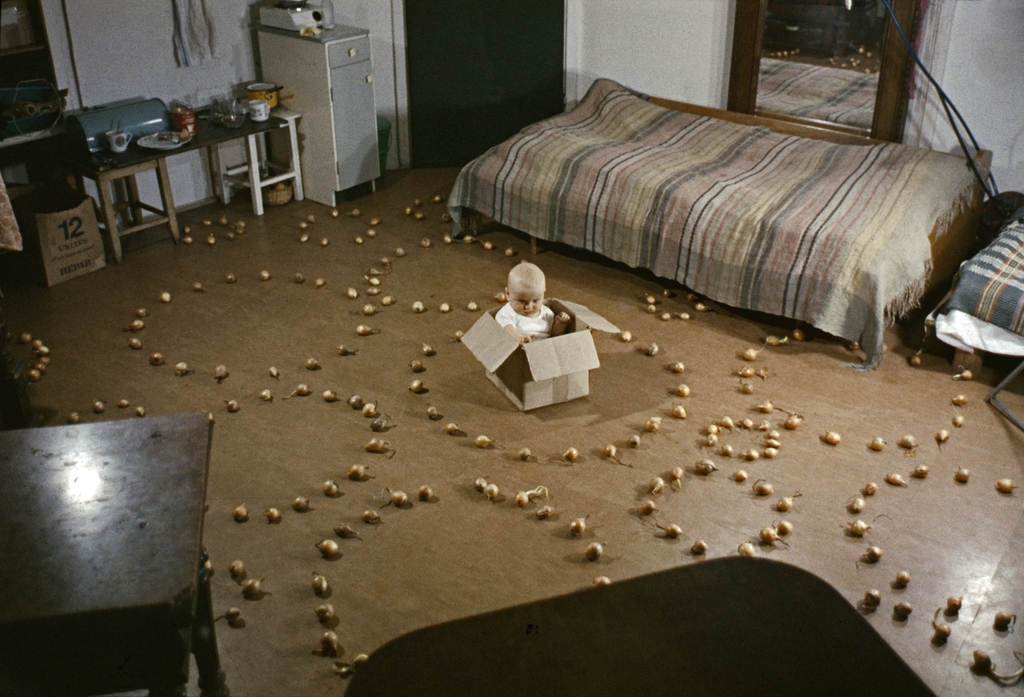
The idea of creating artworks at home is of course, not especially new. The foremost example I can think of is Activities with Dobromierz, created by the Polish artist duo KwieKulik in the early 1970s. Having experienced issues with publicly showing their work, they made the decision to produce and exhibit art in their flat, working with objects they found. Their home, which they renamed Studio of Activities, Documentation and Propagation (PDDiU) became the site for art that blurred the boundaries of the personal and political. 

KwieKulik, Activities with Dobromierz, (1972-74)

We see the couple’s baby, Dobromierz, arranged in multiple surreal scenarios, surrounded by the miscellanea of domestic life. At the centre of a circle of onions, he is a cherub surrounded by stars, or a sacrificial offering in the midst of an occult ceremony. You can see more examples of this fascinating artwork here. There’s an absurdist symmetry and playfulness to these images which I find enchanting – if you can overlook the slightly dubious ethics around it (is it ok to make art by making your child the subject and placing him in a toilet? – I’ll leave that one to the psychoanalysts.) 

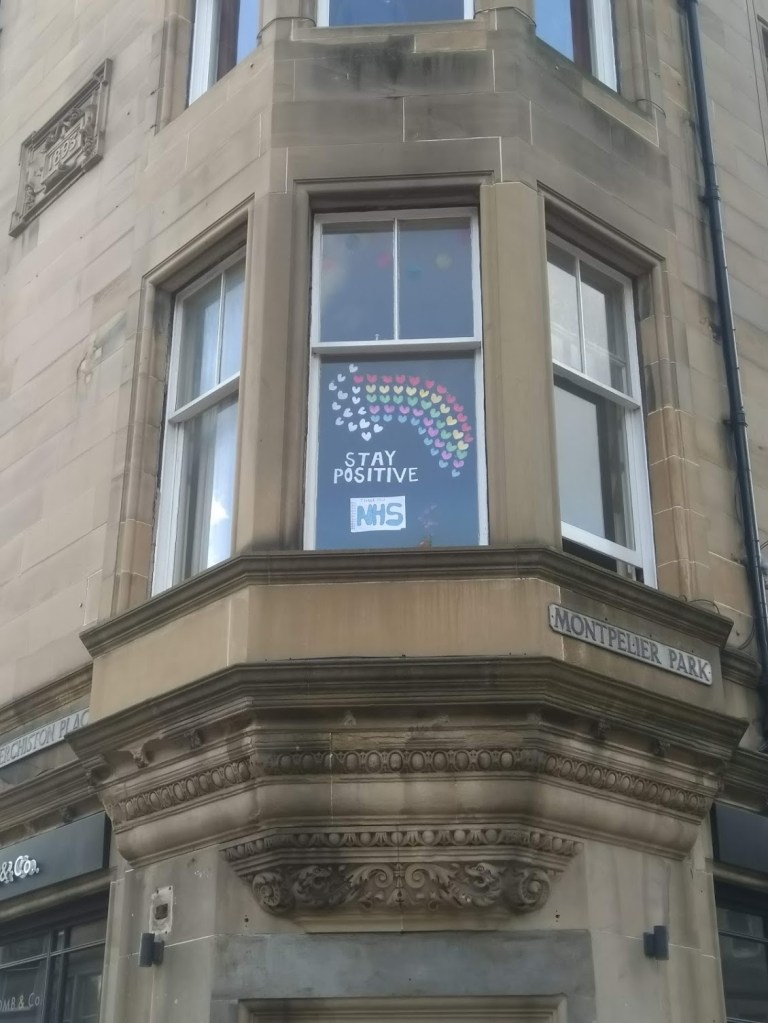
On my daily walks I am reminded of how much inspiration we really can derive from visual symbols and art marks left by other people. The name of this blog is inspired by my belief that art can (and must) be encountered in the everyday. Graffiti is, as always, the site for debate, discussion and seat-of-the-pants creativity. Seeing rainbows stuck against windows does give me hope. People are amazing, creative and inventive, and in the case of an iconic image of a sign spotted in Glasgow which reads “this is shite”, they are astutely acerbic. It is shite. There is as much truth and validity in that as there is in a rainbow.

Rainbows of all shapes and sizes adorn our streets now

We are all dealing with this situation differently: some things that appeal to you as a way to spend your time might not be fathomable to others. Some will create art, others will chuckle at their creations. There will be time to do life admin, and time to sit on the sofa. All are ok.

As we enter another week of lockdown, I miss the outside world. From the privileged perspective of someone who likes to write about art, I miss the solace of visiting exhibitions, learning new things, seeing weird and wonderful objects “in the flesh” and of course, sharing those experiences with others. But the restrictions on our movement have shown us that the democratisation of artwork is possible. Celebrating the joy of art is necessary. Humour and a spirit of accessible creativity are two tools with which we can counter the cultural shock of this pandemic. The challenge now is to bottle that spirit and carry it with us into the post-COVID 19 art world. We are going to need it.