Looking back on Louisiana

We visited on a cold, bright day fringed with snow. Humlebæk is an unassuming town a short train ride away from Copenhagen, and I imagine it’s mainly home to commuters. Yet it also boasts one of the great collections of art from 1945 onwards, Louisiana Museum of Modern Art.

Louisiana is one of those museums that just feels well done. It’s clearly immensely popular. It’s classy, sophisticated, cared for, and it feels rich. Turns out it is a private, state-recognised museum, which means around 15% of its revenue is from the Danish public sector, with the rest made up by commercial activity and sponsorships. Louisiana was founded in 1958 by Knud W. Jensen, who wanted more Danes to access contemporary art. Think the Peggy Guggenheim Collection meets Jupiter Artland. Like a smaller, more accessible Tate Modern.

The place buzzed with dynamic energy. Perhaps this is because, although the collection is large, you will not find a decade by decade chronological survey of art from 1945 to 2025 here. The display policy is centred around a programme of rotating, thematic exhibitions, interspersed with a few of their collection highlights which are on near-permanent display. For our visit, the main exhibition was OCEAN (October 2024 – April 2025), exploring humanity’s complex and fraught relationship with the sea.
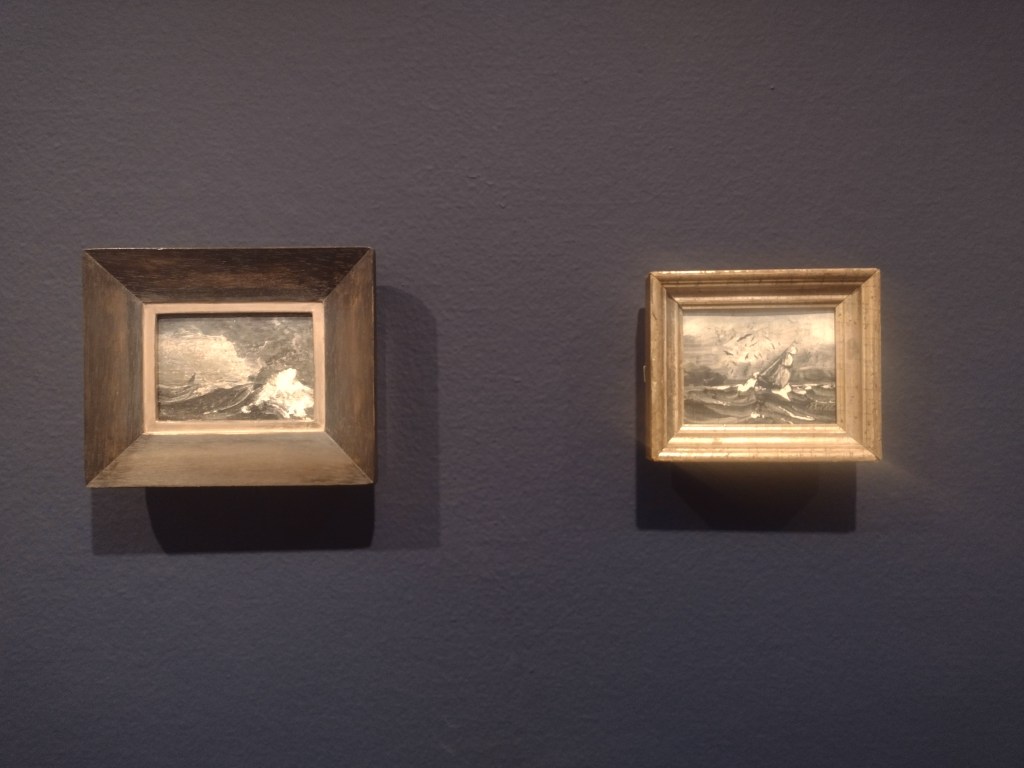
Peder Balke’s tiny seascapes

It’s apt, because Louisiana sits right on the edge of the Øresund, the strait between Denmark and Sweden which is one of the busiest waterways in the world. On 2nd January however, it was an empty deep blue canvas. Some of the works that resonated the most with me in the exhibition weren’t contemporary at all: there were beautiful antique sculptures which showed the sea as both protector and destroyer. The parts that had been submerged in the sand were uncannily smooth, while the exposed sections had been eaten away by sea creatures, and eroded by the water itself. 
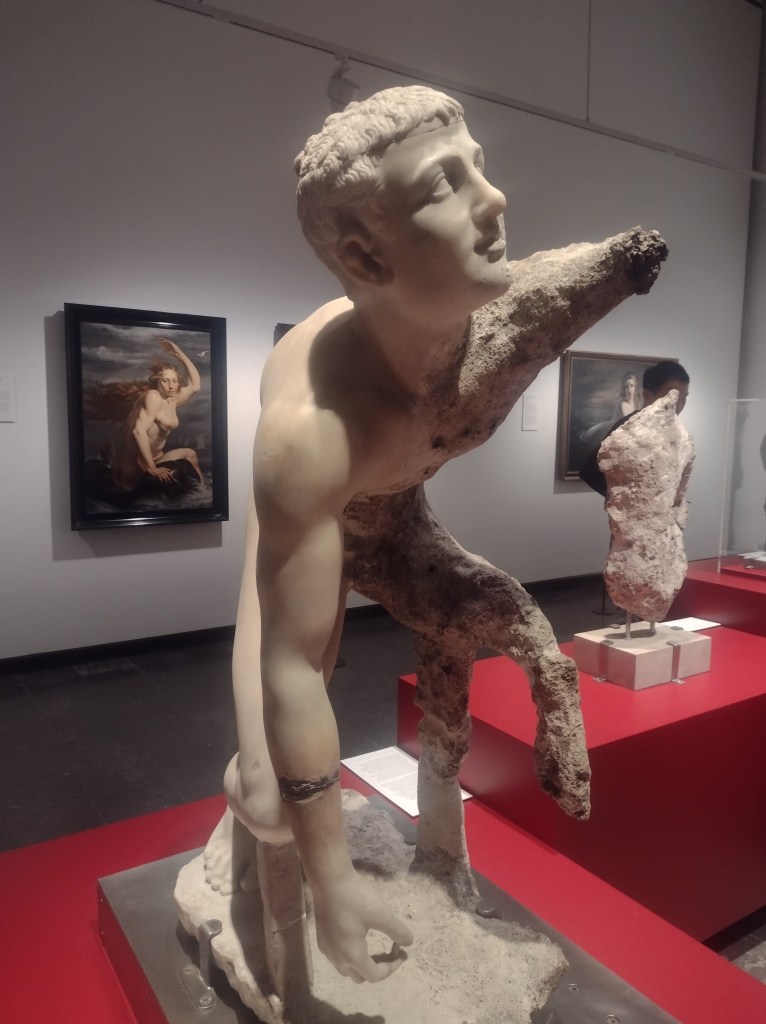
Ancient sculpture found in the Aegean Sea in 1900

Close by, El Anatsui’s Akua’s Surviving Children (1996) was formed of pieces of driftwood and iron found 20 kms north of Louisiana when the artist was visiting Denmark. It represents a group of enslaved people returning from the sea, and was initially assembled at a local arms factory that had provided weapons utilised in the Danish slave trade in Ghana, in the 18th and 19th centuries. Positioned directly behind it was Kara Walker’s The Rift of the Medusa (2017), (after Géricault’s The Raft of the Medusa, 1819), bringing the violence of both the sea and of humans into sharp relief.
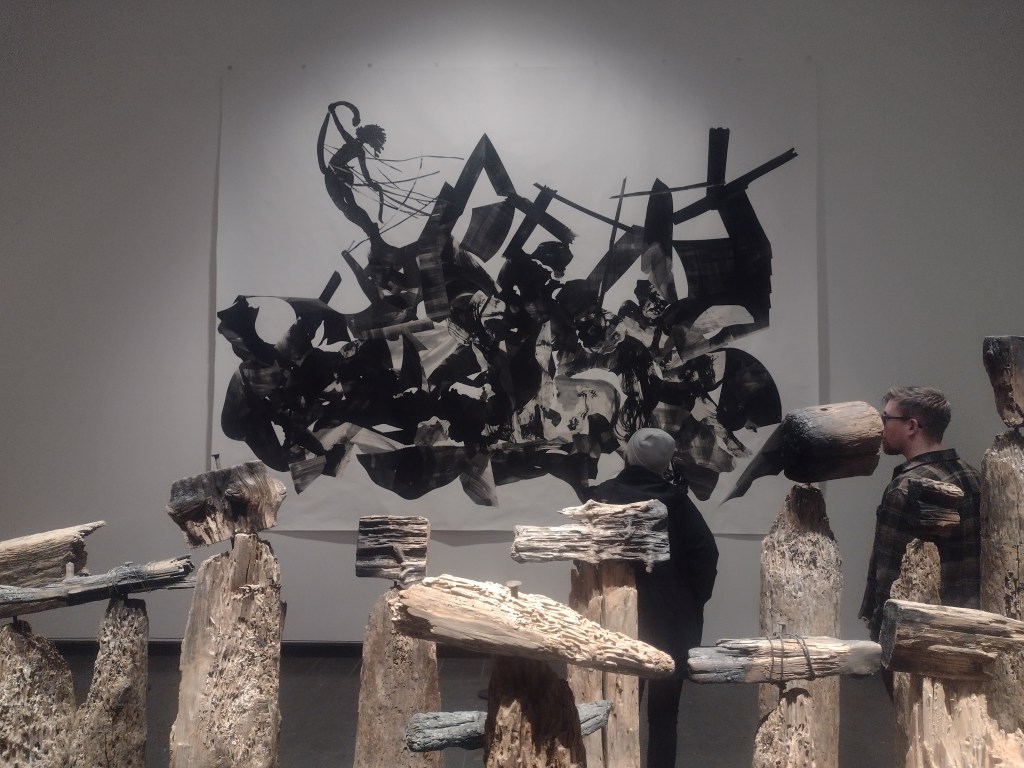
El Anatsui meets Kara Walker

There were paintings, Japanese woodcuts, video art, sculptures. Tiny paintings of the wild sea by Peder Balke met large scale canvases by Anselm Kiefer. I was briefly transported back to Britain via Susan Hiller’s Rough Seas series, where the artist has collected hundreds of vintage postcards of the sea crashing into picturesque towns around Britain’s shorelines: each one depicting the sublime power of the sea in miniature. Sensitive, thoughtful curation meant this vast range of works were able to function in dialogue, opening up new ways of thinking, seeing and even feeling about the sea in all its complexity.
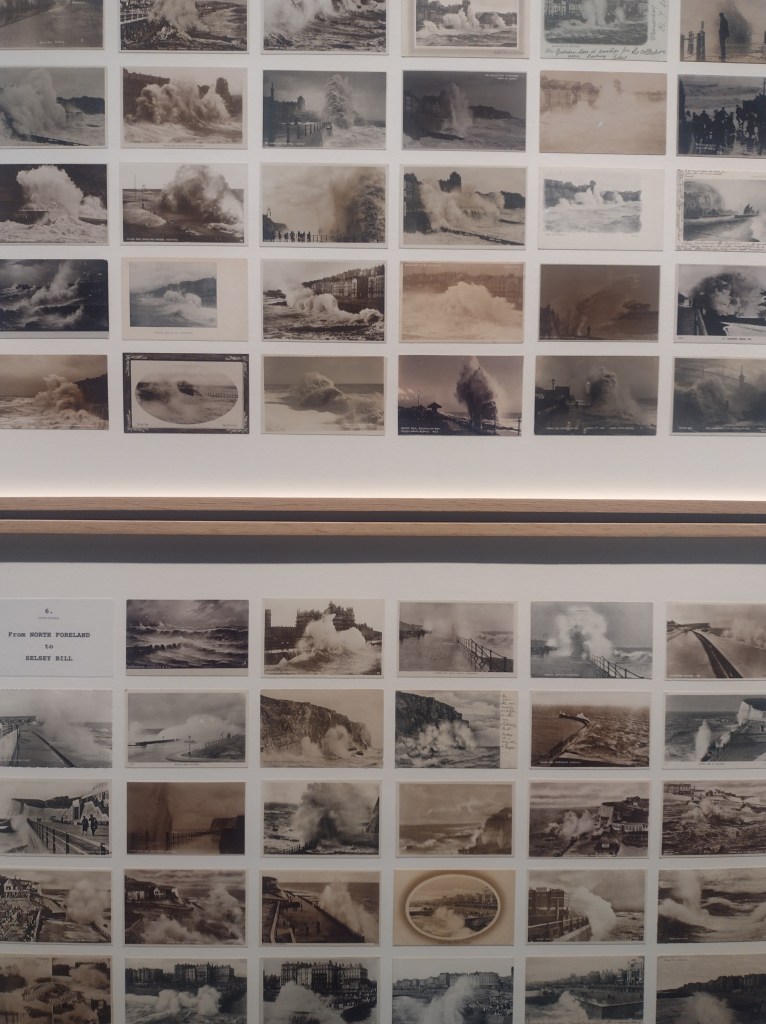
Susan Hiller’s series of Rough Seas postcards

The quality of the Louisiana collection is extraordinary. If you pick any famous artist you can think of from the past 80 years, they probably own one of their works. When we arrived, we made a beeline for one of the few year-round installation artworks, Gleaming Lights of the Souls (2008) by Yayoi Kusama. Having failed miserably to get to the Yayoi Kusama Infinity Rooms that were installed for three years at Tate Modern, it was amazing to have only a short queue to see this mesmerising work. Surrounded by mirrors and water, it is easy to see why Kusama’s work is so popular in this era which prizes immersive experiences more highly than any other mode of interaction with art. Other highlights elsewhere in the museum included seeing Louise Bourgeois’ gigantic Spider Couple (2003) installed by a giant floor-to-ceiling window, their spindly legs echoing the tangle of branches outside.
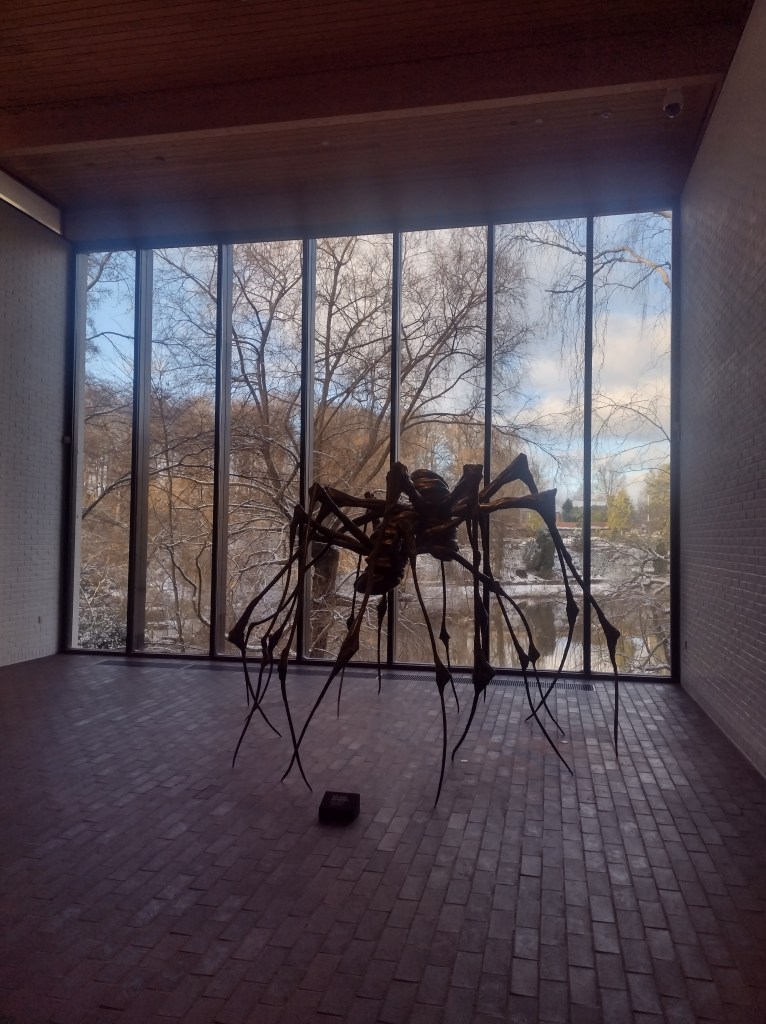
Spider Couple (2003) by Louise Bourgeois

What changes a ‘good’ museum or gallery to a ‘great’ one? Much though I love Scotland’s museums, it is clear to me that even though Denmark and Scotland have a similar size of population, I can’t currently see a way that a museum of Louisiana’s scope, scale or calibre could ever be supported here. It has entire wing for kids, a sculpture park, runs an annual literature festival, hosts its own broadcasting channel which creates new educational content every week, and is open as a music and events space every Thursday and Friday until 10pm. This is one of my chief frustrations with galleries in the UK. You have to be freelance, retired or a student to go there during the week – places open at 10am and close at 5pm so if you’re working, sorry, you have to go at the weekend with everyone else. This seems to be such a missed opportunity to me.

Starting the year visiting such a wonderful museum has given me renewed ambition to try and see more art this year and write about it. For my next post, I’m planning on focusing on 2025’s must-see events and exhibitions much closer to home. Watch this space!
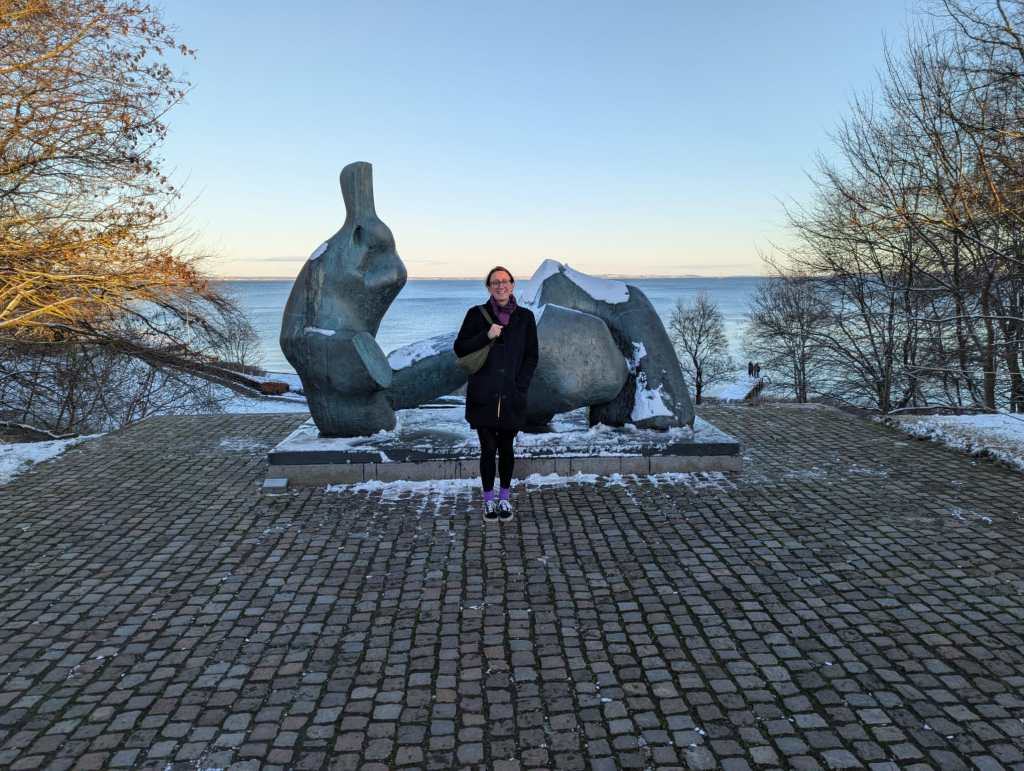
Me with Henry Moore’s Two Piece Reclining Figure No. 5 (1963-64)

My two-year-old nephew taught me how to look at art after lockdown

Last week I spent a really nice chunk of time hanging out with the youngest member of my family. My nephew is two and he’s great company. He’s how I want to be: curious, reflective, eager for fun and a sponge for new information. With his wide-eyed wonderment, he has taught me how to look at art again after a long, enforced break (otherwise known as lockdown).

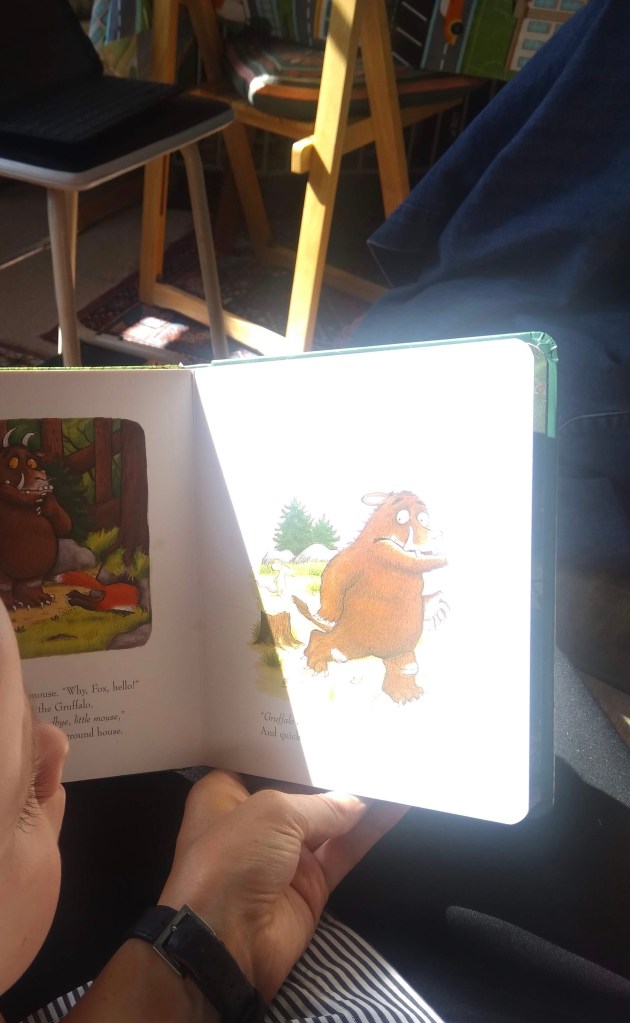
We read books together and looked at the pictures (me reading, both of us looking). Illustration is amazing, and I think a severely underrated form of art. I’m extremely lucky that in my day job, I interact with children’s books on a regular basis. Children’s books are some of the most accessible, universally loved and widely appreciated ways we experience art. The stories fascinate us, but the images are what portray and communicate the joy and terror of the narratives to young minds who cannot yet read or form sentences themselves. Fearfully gazing at the Gruffalo’s long black tongue and terrible teeth, or admiring the crisp and clear (read Scandi) aesthetic in Jon Klassen’s I Want My Hat Back, we carry the pictures with us long after the words have faded from memory.

Some of the most memorable books from my childhood were about looking at details. I was raised on books by Janet and Allan Ahlberg, searching for the characters and minuscule, meticulously written lost letters in The Jolly Postman was my delight. Later, The Most Amazing Night Book by Robert Crowther was my favourite. My nephew is also seemingly enthralled by the details. His favourite thing to do is to ask “Who’s dat?”, pointing excitedly at tiny ladybirds, trees, rocks, main characters, random piles of hay, clothes and anything else that catches his eye. Anyone who has interacted with children regularly will tell you they are incredibly perceptive and observant. Sometimes surprisingly so. They can see and sense things adults can’t.

A household favourite: The Gruffalo by Julia Donaldson, illustrated by Axel Scheffler

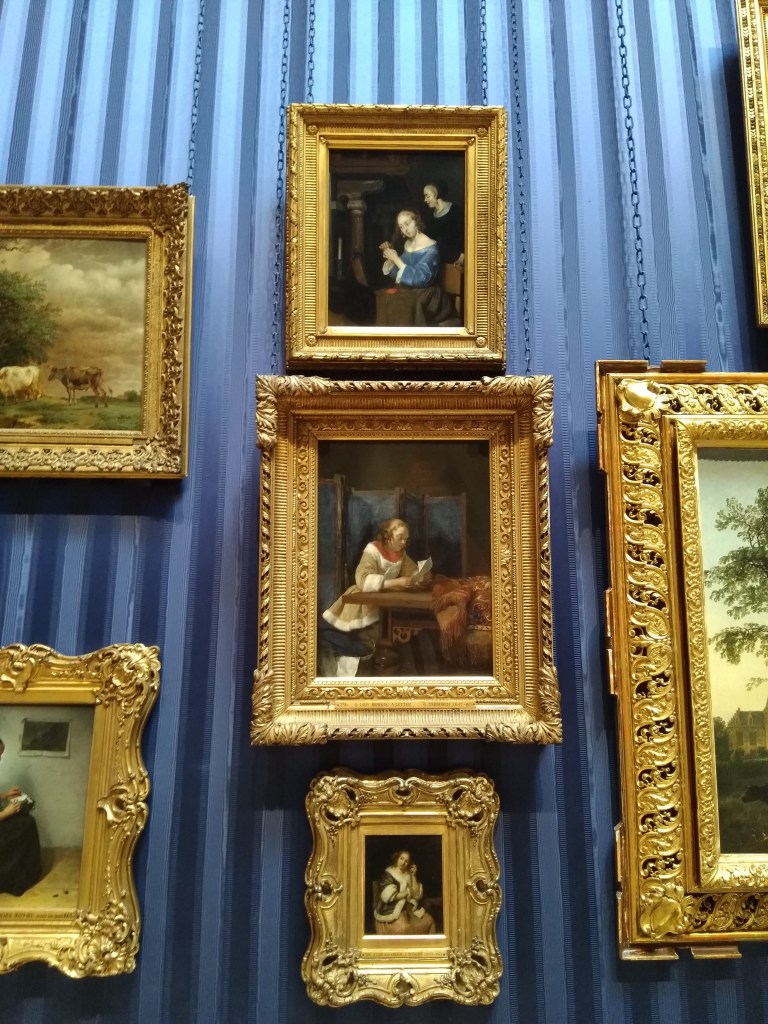
Last week, along with hanging out with my family I also went to a gallery for the first time in six months. After trawling the internet and realising most places in London had been booked out long before by far better-organised art lovers, I managed to get a midday slot at the Wallace Collection, one of my favourite places to see art, as well as admire luxurious furnishing (and pretend I’m part of eighteenth century aristocracy). I would probably go to see the silk wall hangings alone.

Blue wall silks and golden frames in a dense salon hang

I was so happy to have a slot, but despite really friendly staff and the safety measures that had been introduced, it wasn’t the most relaxing experience. It was a pressing reminder that we’re all still working through the anxieties this pandemic has produced. That the new normal isn’t going to be as good as the old normal for quite a while.

A one way system was in place and there were capacity limits on all of the rooms on the route, which created the slightly unpleasant feeling of being on a conveyor belt. Somewhat obliged to wait for those in front without pressuring them, but not wanting to take too long, disrupt the flow or be left behind, stuck in a swirling eddy without being able to rejoin the main current of my fellow gallery-goers. Not the best atmosphere for being absorbed by and for absorbing art.

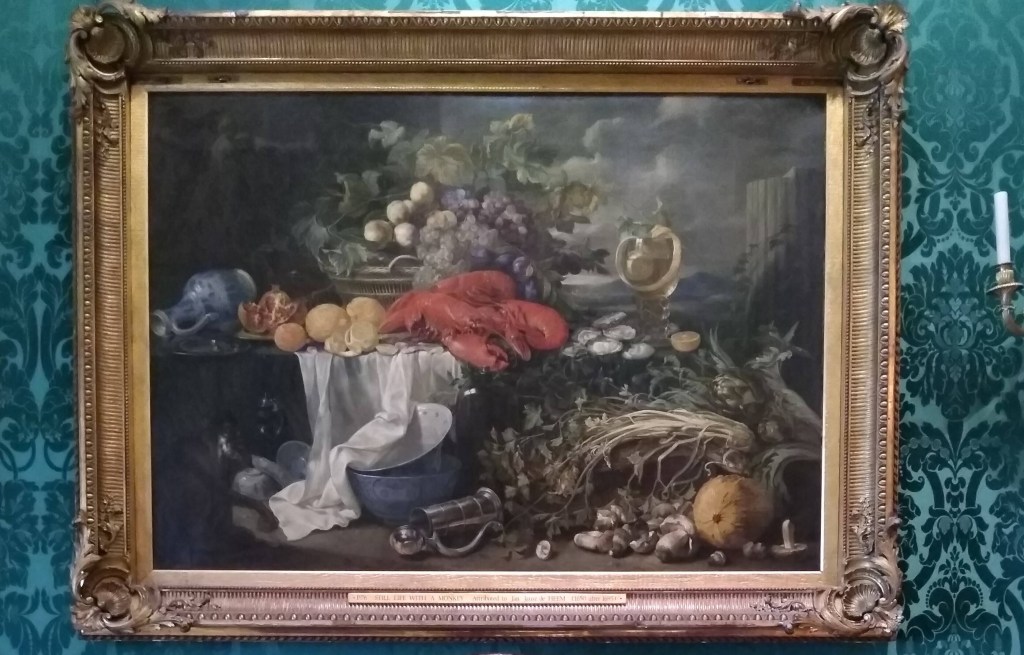
I spent the first part of my visit worrying about the choreography of my movements between my fellow observers, concerned I was getting too close, getting mildly annoyed with pushy people behind me. But then I saw an oil painting, Still Life With A Monkey, attributed to Jan Jansz de Heem (c.1670-95), that made me stop in my tracks. I thought about my nephew, how much he would love looking at the cornucopia of riches in the painting and examining all the elements, individually interrogating their form and purpose. I stepped off the conveyor belt and just looked.

Still Life With A Monkey, attributed to Jan Jansz de Heem (1670-95)

The spiral of lemon peel, the oysters, the mushrooms scattered on the table, the oozing pomegranate, the jug on its side, the tankard on its side, the bright white cloth, the monkey?! This kind of artwork demands your time, forces your eye to wander. We understand that still life paintings are often laced with double or even triple meanings (broken column = transitory nature of human life), but just looking at the surface level composition of what is there, without any further knowledge of iconography or semantics, is a pleasure in itself. The brightness of the lobster, the chaos and excess of it all, the way the food packs 7/8ths of the entire canvas, the needlessly dramatic sky behind. The above is my photo taken on the day, but there’s a brighter, slightly yellowy version of the painting here if you want to look more closely at the details.

Much of what drives my blog and my Instagram is a need and a wish to celebrate the everyday, to encourage others to read the notes in the margins, to slow down and enjoy colours and contrasts, patterns, eccentricities, particularly of city life. We can apply this attitude to great paintings in grand houses too. We think we know still life paintings. I imagine they’re the paintings most readily walked past without so much as a second glance because they are rarely super-famous showstoppers — but let’s take this opportunity to recognise how very bizarre and beautiful they are.

When we return to art galleries, they might not be the same as they were. But if we remember to approach art with curiosity, to take time, and notice the details, even if we haven’t got the brain space to work out what they mean, they can bring us both joy and a little peace. As from now, I’ll be adopting the “Who’s dat?” philosophy of close looking. That’s how I want to return to engaging with art as lockdown lifts. I’ll encourage you to do the same, but if you’re not feeling ready just yet, you can always start with The Gruffalo.

Art in lockdown: The Hermitage, St Petersburg

Each week for the past month, I’ve been going to Russia. To the State Hermitage Museum in St Petersburg, specifically. A close friend and I have been watching something we wouldn’t have considered engaging with before lockdown: a five-hour iPhone 11 advert, which explores the museum in an extraordinary way.

Even in lockdown, five hours is a bit too long. It’s far longer than I would be able to spend in a museum before fatigue, overwhelm and “museum back” set in. So we watched it in bite-size chunks. It became a little ritual. Every Tuesday at 9pm we would call each other, and press play at the same time to experience the tour together. It sounds bizarre, but it’s one of my favourite ways I’ve experienced art in lockdown.

The tour is meticulously curated. It is in one take, but isn’t a film that simply drifts past the museum’s many artworks (there are three million objects in the collection, including paintings, sculptures, textiles, porcelain, jewels, armour, coins, etc., so we only see a snapshot). This is a focussed journey that pays attention to the architecture and the interiors of the building. Dancers, actors and musicians all feature. They activate the space in vast corridors and lavish rooms, enliven the collection, and act as ciphers for our own bodies which, in normal circumstances, could be travelling through the rooms, pacing the floors, gazing at the ceilings.

I’ve long enjoyed watching people engaging with art: imagining what they’re thinking, and wondering why certain artworks speak to some people but not to others. My friend and I were now observing a false version of this in private and at a distance. We discussed the characters’ hair and clothes, speculated about their relationships with each other, puzzled over what the experience of making a film in an otherwise empty national museum, on the precipice of a global pandemic might have been like.

Gossiping with my friend, analysing what we were seeing together, was one of the best parts of the experience, making the surreal normal, as if we were actually touring a museum together. The mutuality of it, my friend watching in London and me in Edinburgh, spurred us on, and time slipped away quickly. Sometimes, the film became the backdrop to our conservation, sometimes we just watched and our words left us.

The physicality of the camera moving through rooms, doubling back, going in circles, helped make the experience lifelike. We commented on different works we liked, we discussed the merits of the decor (she hated the white curtains), I tried to show off some biblical knowledge to help interpret some of the Christian paintings, to varying degrees of success. There were moments when I craved a few clues about the paintings’ narratives, who made them, their titles – without explanation or context, lots of artworks are VERY weird and tricky to interpret – but providing additional information on screen would have made it too educational. The experience was more about wonder than learning.

The Garden of Earthly Delights prior to ultra zoom

The entire film is shot on iPhone 11, which is where the advert side comes in. The detail it captures is really extraordinary. The ultra zoom is one of my favourite digital tools through which we can experience art differently. Our capacity to see intricate close-ups of paintings is mind-blowing, and something to be celebrated. Zooming in on The Garden of Earthly Delights by a follower of Hieronymus Bosch (1556-1568?) – the original is in the Prado in Madrid – we could see more clearly than had we been standing before it. There are people cavorting on/with animals, giant birds, bodies inside clam shells, people with flowers sprouting from their bums, fruit the size of humans. If you want to pick three minutes of the whole thing to watch, this carnival of a painting features from 1:09-1:12.

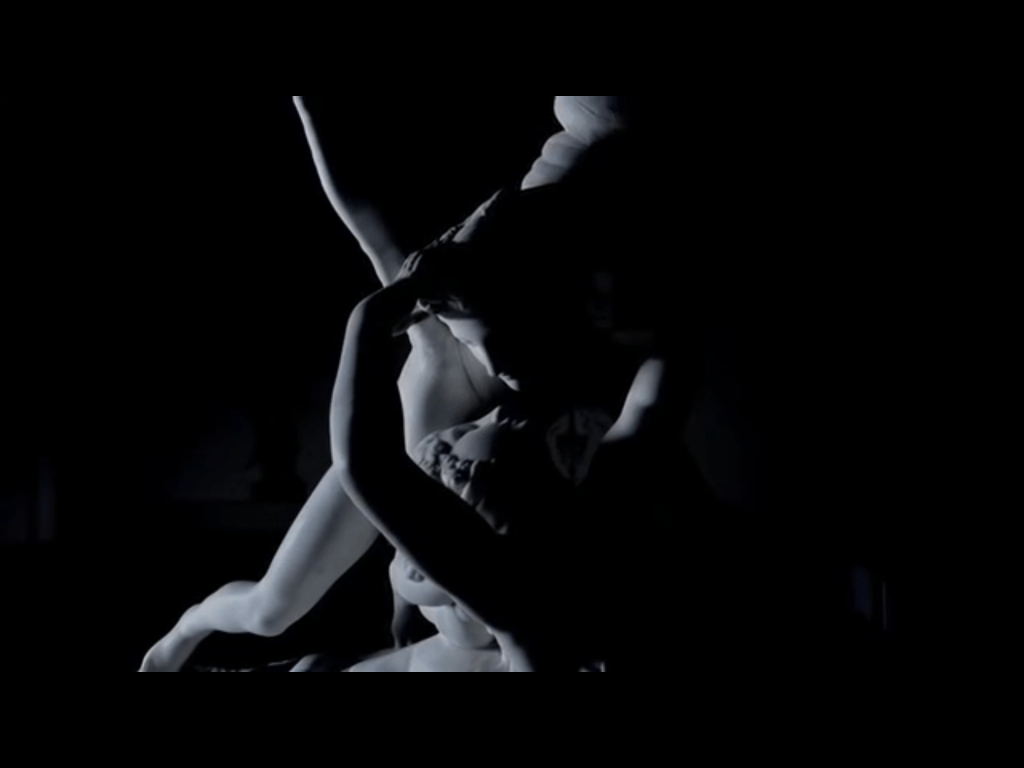
The Hermitage film played with light in interesting ways which warped time, creating uncertainty over whether it was day or night. Towards the end the use of a white torch light on white marble sculptures plunged everything else into darkness, and we were floating in a monochrome world.

Marble sculptures floating in a monochrome world

The museum at night is a creepy, exciting prospect, and one the film makes use of. There were several allusions to the presence of history, and the ghosts that live within its very walls. After all, it is a building which began as a private palace, its first collections were amassed by Catherine the Great in the 18th century. It has ridden the waves of Russian/Soviet/global history since then: wars, revolutions, political regimes, the Siege of Leningrad, and this pandemic. That it is still here today, for us to enjoy, even only as digital ghosts from a distance, is something we can all take comfort in.