Yesterday I went to see Janet, an exhibition of paintings by Caroline Walker. This was my first Edinburgh gallery visit since March, and it felt great to be back.
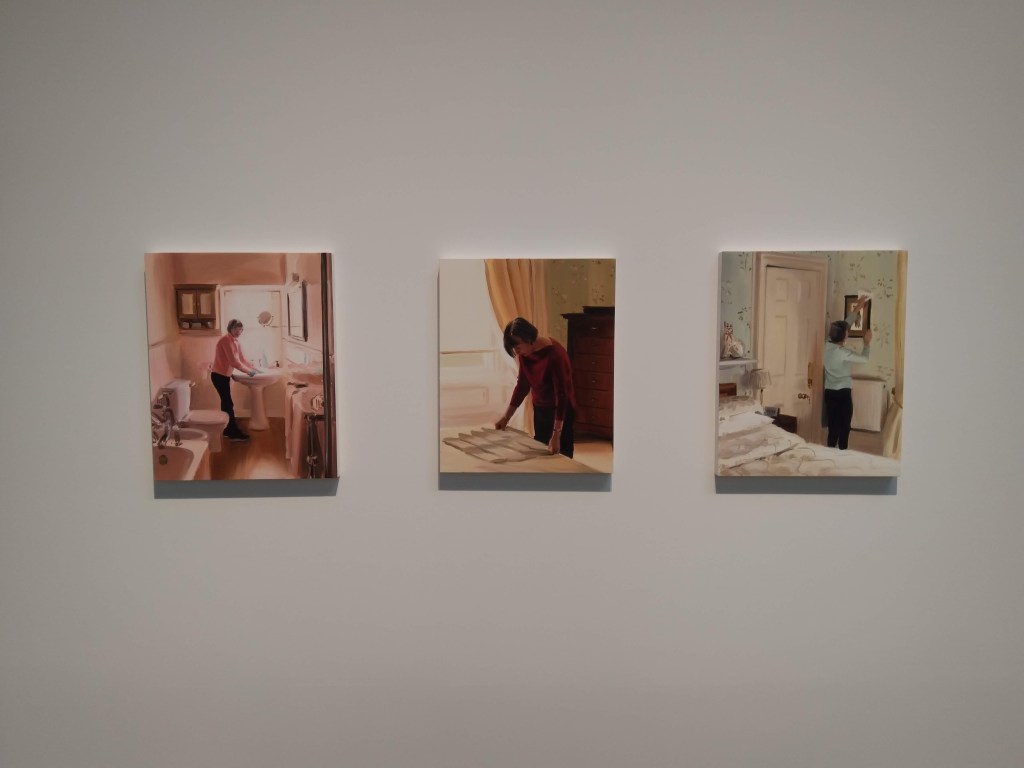
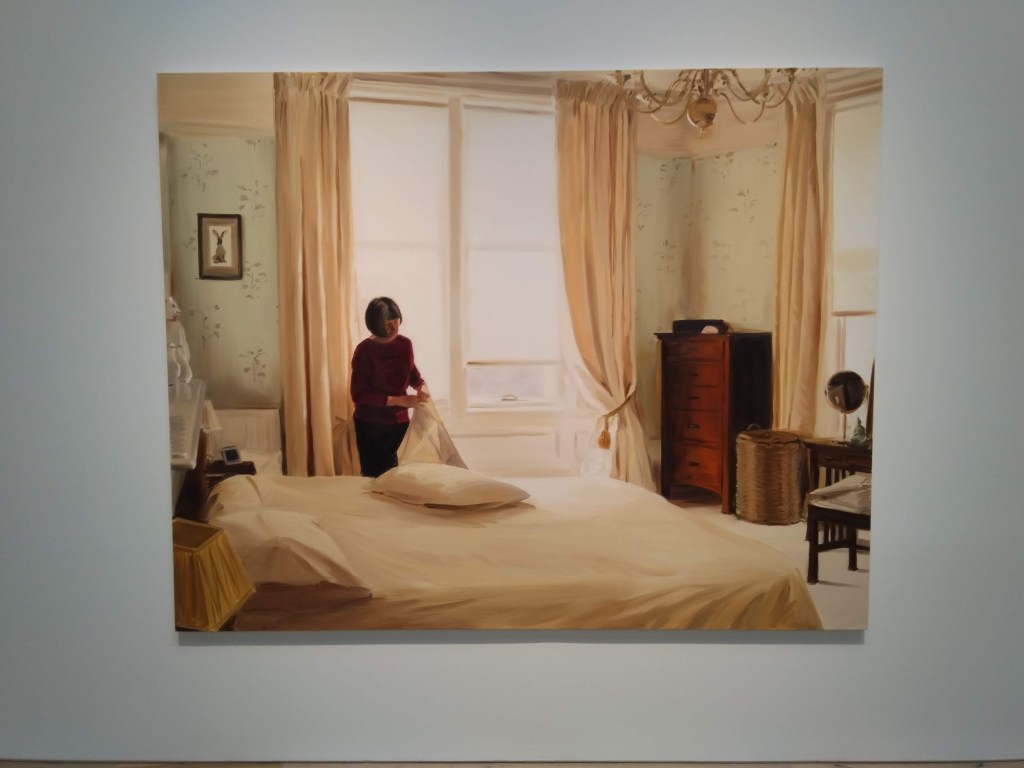
Caroline Walker, (born Dunfermline, Scotland), has created a series of works focusing on her mother, Janet, based entirely in her home. They document her mother moving from room to room, like the evidence of a childhood game. Caroline seemingly goes unnoticed, she spies on her mother, following her as she carries out chores: cleaning, gardening, cooking, dusting. We too, the viewers, spy, follow and peer in unnoticed, and it’s almost surprising when on one canvas, Janet looks straight back at us.
From left to right: ‘Bathroom Sink Cleaning, Mid Morning, March’, (2019), ‘Sizing Pillowcases‘, (2020) and ‘Dusting Pictures, Late Morning, March’, (2019)
These domestic activities are elevated, not dismissed, by the artist. The images are snapshots which combine immediacy of photography with the grandiose detachment of oil paintings. These daily moments are purposeful, meaningful, considered, deliberate.
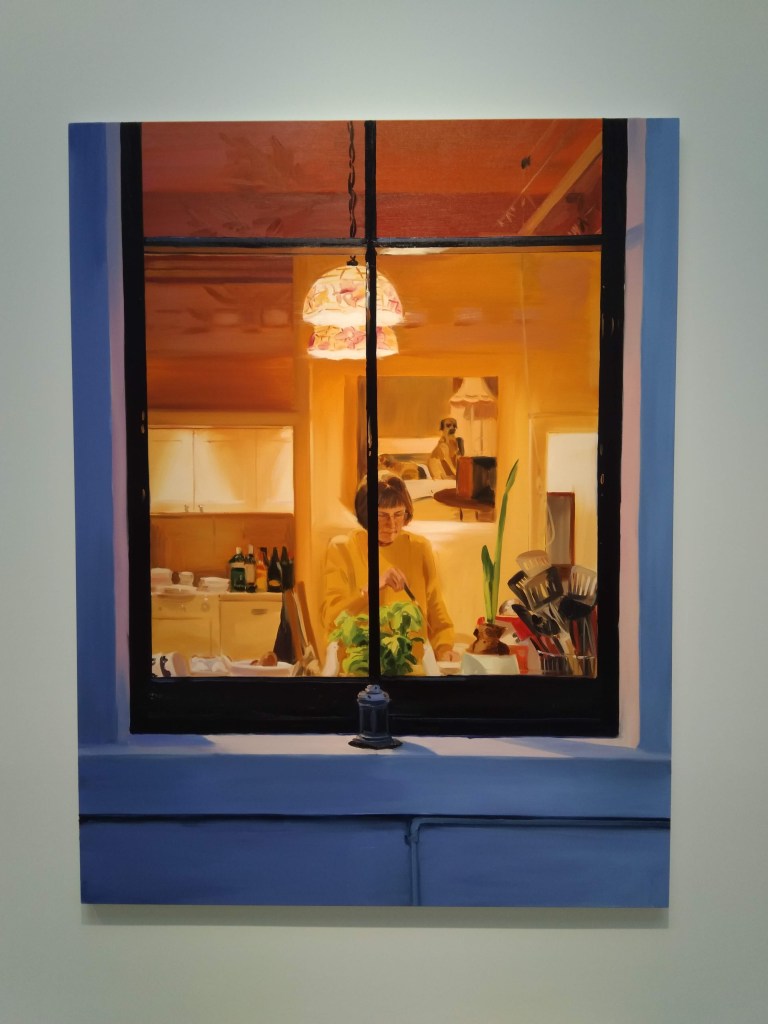
Yet they are also intimate. They capture the feeling of when you’re walking past houses in the winter when it’s dark outside, when you’re thrilled and somehow comforted by the warm glow within, even though you’re outside of that warmth. That feeling is especially captured by the jewel-like light in Making Fishcakes, Late Afternoon, December (2019), and Tucking In, Late Evening, March (2020). I loved looking in, indulging my curiosity. You can tell a lot about someone by what they surround themselves with. Janet likes animals. Janet seemingly also collects egg flips.
‘MakingFishcakes, Late Afternoon, December‘, (2019)
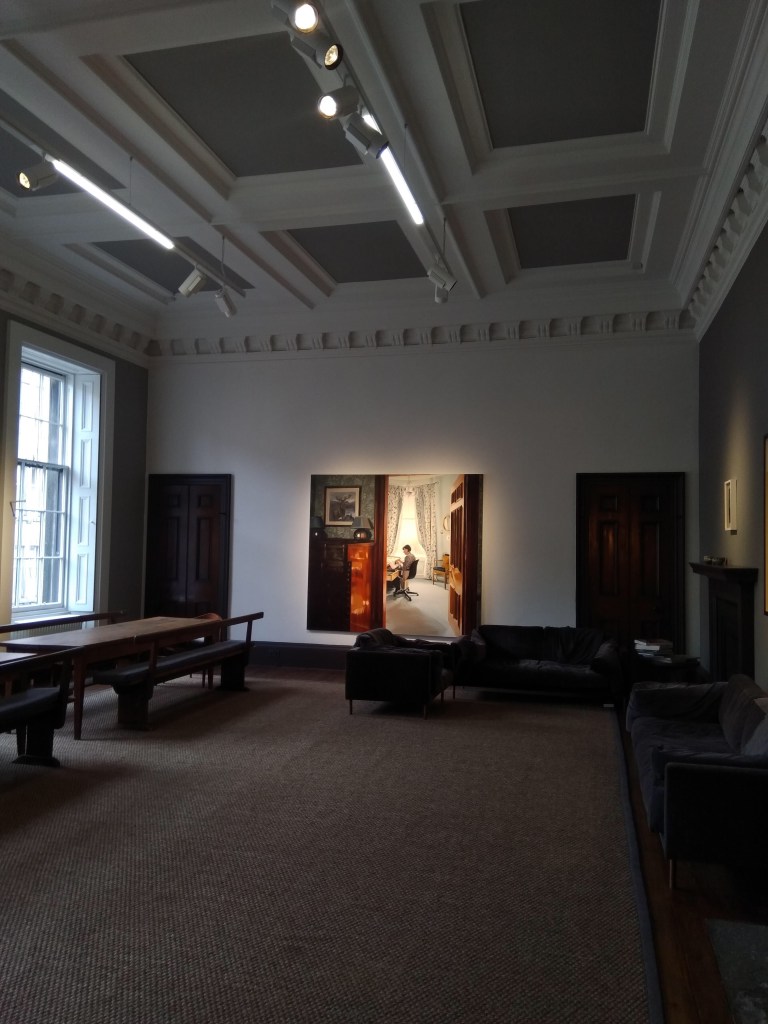
At Ingleby Gallery, the main exhibition space is on the ground floor, but upstairs in the Feast Room there are works by other artists the gallery represents. It’s like a special extra helping of art you didn’t know you were going to get, and was here where I found my favourite work by Walker, Hemming Pyjamas, Late Morning, December (2020). The darker palette of the room around the painting, the fact that the room itself is more domestic (with sofas and a dining table, albeit very grand), the placement of seeing it from afar as you come up the stairs makes it so utterly convincing and beautiful. Even though Walker paints on linen, which gives an overall matte effect, the warm light shines from the room, reflecting off the chest of drawers, beckoning you in.
‘Hemming Pyjamas, Late Morning, December’, (2020)
This is a wonderful show about light, home, warmth, the intimacy of people doing normal things. It’s what we want our homes to be, there’s a serenity about these paintings, a peace I’d like to carry with me into the next few months of winter at home.
Janet by Caroline Walker is on at Ingleby Gallery until 19th December, they are open Wednesday-Saturday, 11am-5pm. The exhibition is free but you need to book a timed slot via the website.
This is my first post since the Coronavirus outbreak hit Europe. Not for a lack of time – like all of us, I’ve had more time at home than ever before in my adult life. It’s not even for a lack of having things to write about. Rather, it’s because I haven’t had the will, or the inclination to sit down and focus. I often have vague waves of guilt around this – but then I remind myself that this is a pandemic, not a sabbatical. Having free time doesn’t automatically make this an opportune moment to hone my art writing, and that’s ok.
There are a million and one distractions (some would say excuses) that have prevented me from writing, or doing other productive things. The same is also true of engaging with art, the activity I love most. Galleries and museums have been closed for weeks, and they have scrabbled, been inventive and tried their best not to let years of work bringing exhibitions together go to waste. Switching projects to the digital realm successfully is not easy, and I would be interested to see the stats on reach and engagement for online content. I would hazard a guess that for the majority of us, while digital outputs are appreciated, quantity is overwhelming and we still don’t really want to go online to “visit” an exhibition. Even the idea of it brings to mind my least favourite gallery online content of all – photographs of exhibition previews where influential art people drink champagne and look thoughtful. No matter the quality of the exhibition, the virtual tour doesn’t sound appealing. It is more screen time that could be spent looking at things that are created for screens in the first place: telly, films, games. Even “doom-scrolling” through reams of information about the virus, though stress-including, is addictive and sometimes even mentally easier than engaging with something that doesn’t concern the virus at all.
Art can be engaged with online. Some of the artworks I have studied in depth I have only ever seen via a screen. But there is a social and physical element to visiting exhibitions that is a necessary side-effect of the experience. Why else would the National Gallery have worked through years of negotiations to bring Titian’s poesie together into the same room? We could have googled them individually and seen them together that way if we wanted. But it’s not the same. The best exhibitions have a strength of narrative that enables us to enter a state of meditative curiosity which really absorbs us. That is simply not possible at this moment, and especially on a device, where we are accustomed to enjoying art in Instagram-sized chunks. There are too many other distractions, including our own boredom, to compete with. I doubt that a physical exhibition transported online could recreate that effect – though maybe I will be pleasantly surprised. My sister and I are going to tour the Royal Academy’s Picasso and Papervirtually later this week – will report back…
Despite the circumstances, against all the odds, people have been creative and productive. Far more relevant and fun than an online exhibition, is seeing the results of people making and imitating art themselves. The hashtag #tussenkunstenquarantaine reminds us that with a bit of inventiveness and improvisation, some of the best-loved artworks can be recreated at home. I am biased, but my former colleagues have done a fantastic Twitter thread recreating some of their favourite works in the collection. The results are totally heartwarming, and that’s what we need now.
Projects like the weekly creative challenge run by OG Education (the learning branch of the October Gallery) provide a bit more freedom than creating an exact copy of an artwork – taking their artists’ work as a starting point for inspiration. Defying gravity, the theme inspired by artist Benji Reid, produced some daft and wonderful homemade results.
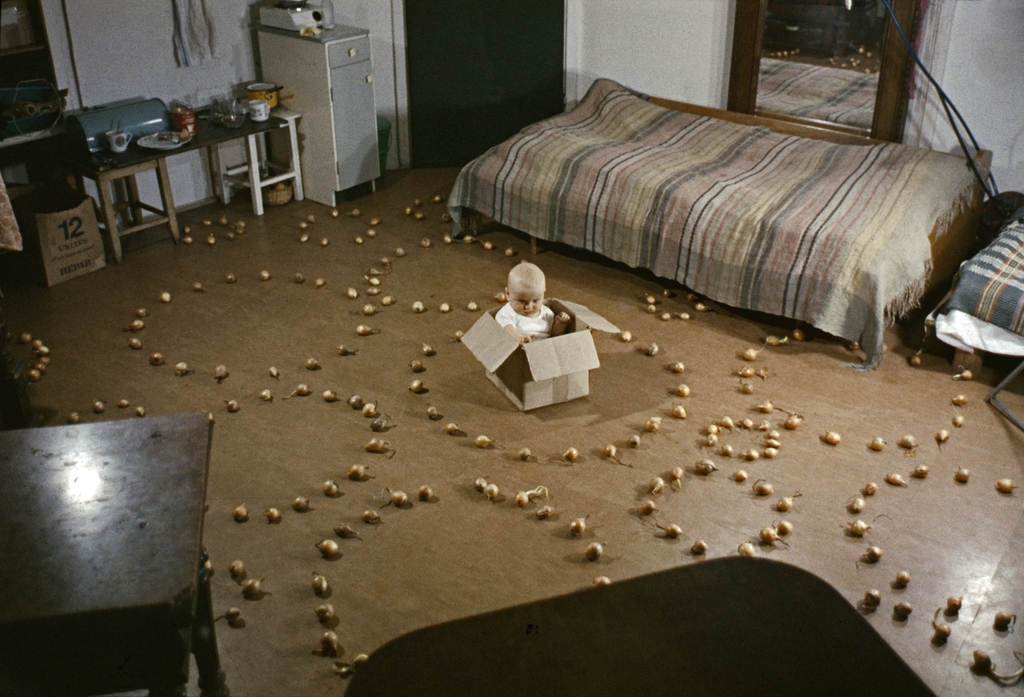
The idea of creating artworks at home is of course, not especially new. The foremost example I can think of is Activities with Dobromierz, created by the Polish artist duo KwieKulik in the early 1970s. Having experienced issues with publicly showing their work, they made the decision to produce and exhibit art in their flat, working with objects they found. Their home, which they renamed Studio of Activities, Documentation and Propagation (PDDiU) became the site for art that blurred the boundaries of the personal and political.
KwieKulik, Activities with Dobromierz, (1972-74)
We see the couple’s baby, Dobromierz, arranged in multiple surreal scenarios, surrounded by the miscellanea of domestic life. At the centre of a circle of onions, he is a cherub surrounded by stars, or a sacrificial offering in the midst of an occult ceremony. You can see more examples of this fascinating artwork here. There’s an absurdist symmetry and playfulness to these images which I find enchanting – if you can overlook the slightly dubious ethics around it (is it ok to make art by making your child the subject and placing him in a toilet? – I’ll leave that one to the psychoanalysts.)
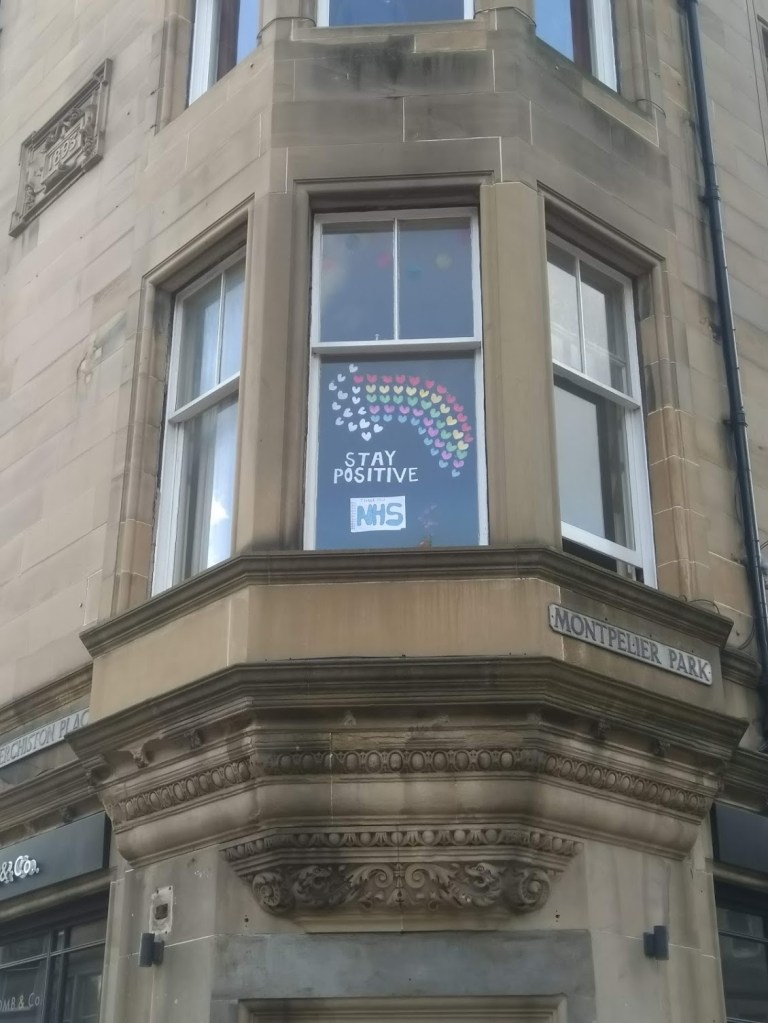
On my daily walks I am reminded of how much inspiration we really can derive from visual symbols and art marks left by other people. The name of this blog is inspired by my belief that art can (and must) be encountered in the everyday. Graffiti is, as always, the site for debate, discussion and seat-of-the-pants creativity. Seeing rainbows stuck against windows does give me hope. People are amazing, creative and inventive, and in the case of an iconic image of a sign spotted in Glasgow which reads “this is shite”, they are astutely acerbic. It is shite. There is as much truth and validity in that as there is in a rainbow.
Rainbows of all shapes and sizes adorn our streets now
We are all dealing with this situation differently: some things that appeal to you as a way to spend your time might not be fathomable to others. Some will create art, others will chuckle at their creations. There will be time to do life admin, and time to sit on the sofa. All are ok.
As we enter another week of lockdown, I miss the outside world. From the privileged perspective of someone who likes to write about art, I miss the solace of visiting exhibitions, learning new things, seeing weird and wonderful objects “in the flesh” and of course, sharing those experiences with others. But the restrictions on our movement have shown us that the democratisation of artwork is possible. Celebrating the joy of art is necessary. Humour and a spirit of accessible creativity are two tools with which we can counter the cultural shock of this pandemic. The challenge now is to bottle that spirit and carry it with us into the post-COVID 19 art world. We are going to need it.
 encounters_art