Francis Alÿs: Ricochets

Some exhibitions have an unofficial soundtrack in my mind. Francis Alÿs’ Ricochets at the Barbican, which closed a couple of weeks ago, has had Whitney Houston’s The Greatest Love of All bouncing around in my head. The song starts with a gentle falling scale on the synth, and then Whitney comes in with the words: “I believe that children are our future/ teach them well and let them lead the way… let the children’s laughter remind us how we used to be.”

I’m a woman and I’m 32. That means that I am almost daily drawn into discussions of children. People ask me why I don’t have them, or if I’m wanting to have them. I’m an auntie and a guideparent. Some of my closest friends have babies, toddlers, kids in primary school. Some are wanting babies and it isn’t happening for them at the moment, some have had miscarriages and lost unborn children. I kind of knew the phase would come, when this would be the main topic of conversation dominating my life, but I had never expected an art exhibition to bring me back to it once again.

I’m with Whitney, I do believe children are our future. I think that artist Francis Alÿs does too, which is why he has spent years and travelled the globe collecting and documenting children’s games, which have been compiled together in beautiful, moving, sensory-overload-inducing multi-screen installations for his exhibition at the Barbican. The photos I took weren’t great, but the most wonderful thing about the project is that all of the Children’s Games videos are available online. You can explore the whole roster here and I’ve linked to specific ones in this post. 

I loved immersing myself in the worlds of these children, as they raced perilously down hilly streets on makeshift go-carts, as they played “Doctor Doctor!” in a yard by a cold-looking lake, as they raced snails on concrete or flew kites, skipped and skimmed stones. They enliven and brighten and spark joy wherever these games take place. Even in war zones, places decimated by wars now over, in refugee camps, their flame and zest for life burns so brightly. The sensitive curation at the Barbican brought this home: when children play in barren wastelands, they are no longer barren. It kindles a moment of hope.
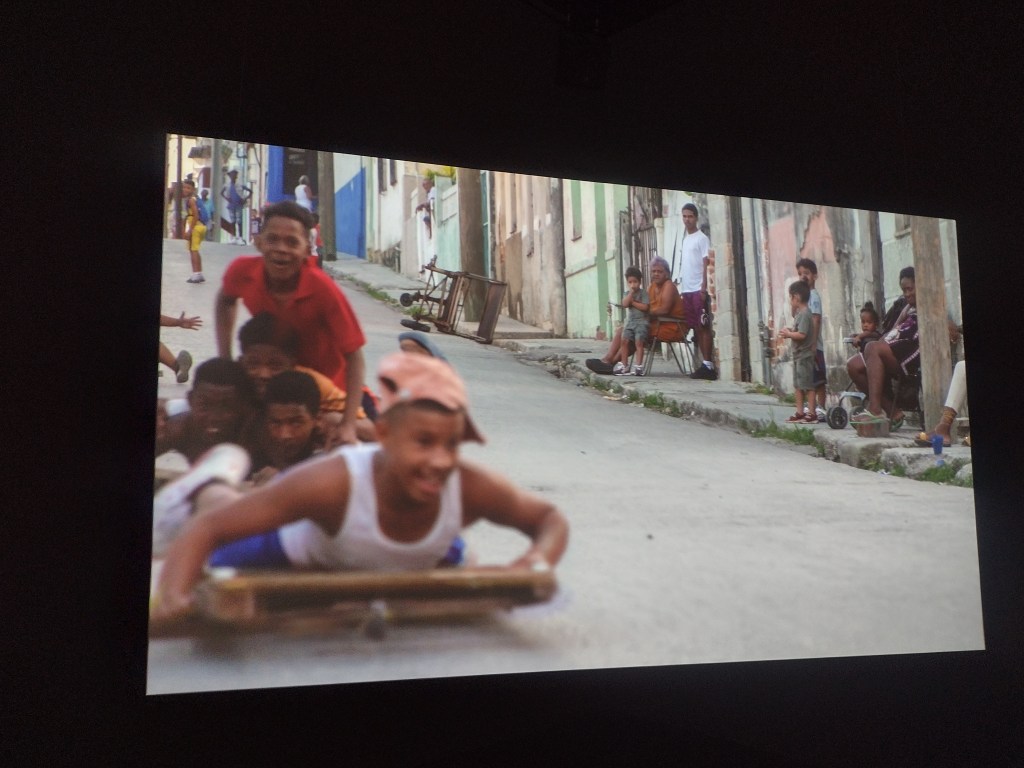
Children’s Game #40: Chivichanas
La Habana, Cuba, 2023

In one of the exhibition’s longer videos, Parol, three Ukranian pre-teen boys are dressed in khaki and have wooden rifles, daubed in yellow and blue, slung over their shoulders. As the accompanying text explains (beautifully written for each game by Lorna Scott Fox), the boys “act out a grown-up duty: to uncover Russian spies… Cars are flagged down, IDs requested, trunks inspected. A password is demanded: “Palyanitsya”, the name of a traditional Ukrainian bread, and a word that Russians can’t pronounce right.” While the drivers of the passing cars appear to be cheered by their interactions with the children, it’s a perilously pertinent reminder that in a few years, these boys won’t be playing anymore. They’ll be on the front line. The existence of innocence always implies the loss of it.
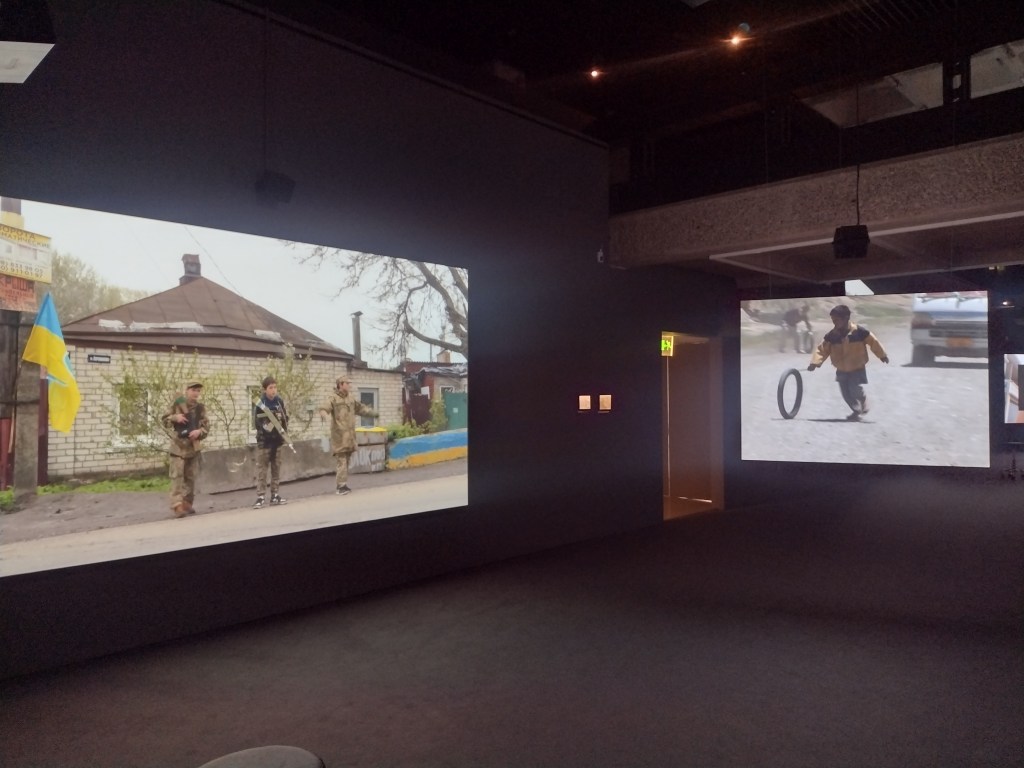
Children’s Game #39: Parol
Kharkiv, Ukraine, 2023

In Haram Football, a group of lads between 8-15 years old gather in the streets of Mosul, Iraq, to play a game of collective imagining inspired by ‘the beautiful game’. Haram means ‘forbidden’, and football was forbidden under the rule of Islamic State. In the shadow of that regime, these boys perfected their craft of playing football without a ball, a collective pretending, all in agreement where the ball bounces, rolls and flies through the air. They shake hands and once the game starts, they jostle, dribble and leap for headers. All around them there’s rubble and collapsing buildings, the sun is setting. At one point, a tank drives straight over their makeshift goalpost, the boys just rebuild it and carry on. They disperse into the rubble and the shadows at the sound of an explosion or gunfire, but return at the end under the cover of darkness, to announce their names paired with their favourite clubs.
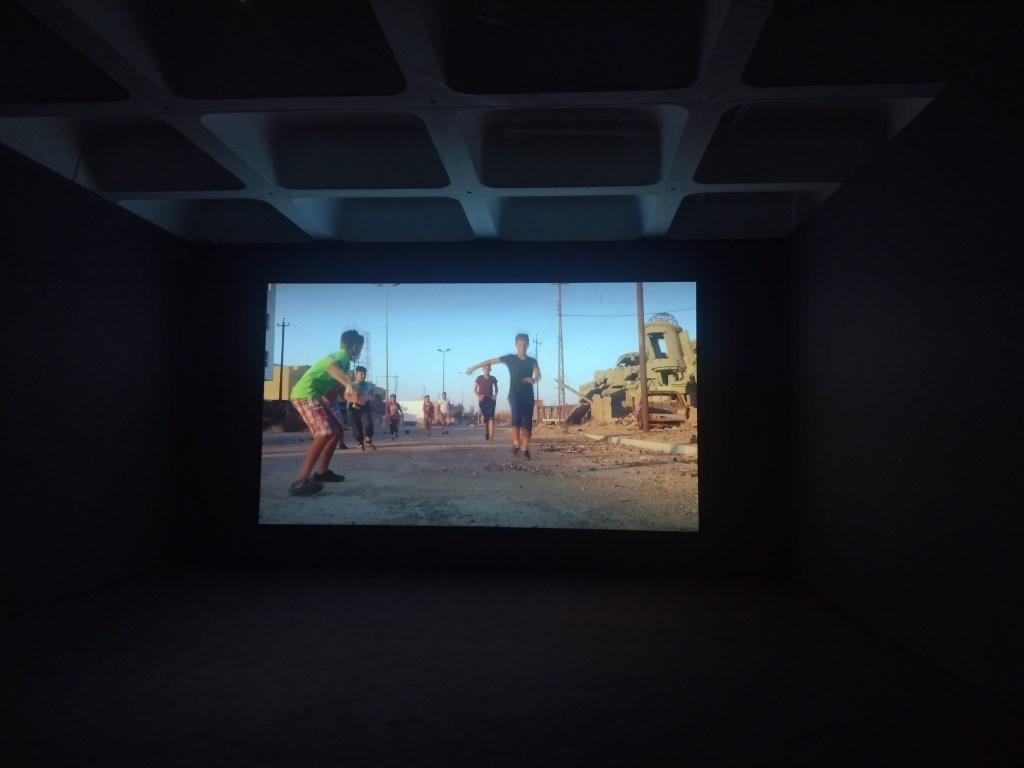
Children’s Game #19: Haram Football
Mosul, Iraq, 2017

It is utterly impossible not to think of Gaza. Back in May, Unicef estimated that 14,000 children had been killed in Gaza, with 17,000 of them unaccompanied or separated. Obviously that number just keeps on going up. While I’m sure that Alÿs will be visiting Gaza to document children creating games and hope from within whatever rubble is left, it is brutal and sickening to know that the children who do survive there will inherit decades of trauma, no matter how strong their resilience is, no matter how skilled they are at continuing to create joy even among the horror. I’m reminded of Greta Thunberg’s speech to the UN in 2019: “you come to us young people for hope? How dare you.” Yet we keep on turning back to children to kindle hope in the despair and darkness, to create something better than we have. They have so much resting on their small shoulders.

If hoping is a radical act, then having children surely must be the most radical act of hope. For me, in my head, I’m still the girl in the blue summer dress weaving through the cityscape and avoiding stepping on the lines, not one of the earthbound, onlooking adults. That is the magic of Alÿs’ project. It reminds us of the beauty and fragility of youth but also presents the language of play as the universal one, the one that connects us all, if we can only hear their laughter, to ‘remind us how we used to be’.

Children’s Game #23: Step on a Crack
Hong Kong, 2020

‘Florilegium: A Gathering of Flowers’ at the Royal Botanic Garden, Edinburgh

There’s a new, free exhibition in town, at the Botanics. Ever a beautiful place to relieve your Covid-19 cabin fever, to feel the peace of looking at plants and be made to feel small by impossibly tall trees, now you can supplement it with a visit to Florilegium: A Gathering of Flowers. The first exhibition since the RBGE started its Climate House initiative, the exhibition marries what seem to be two very different ways of looking at flowers. 

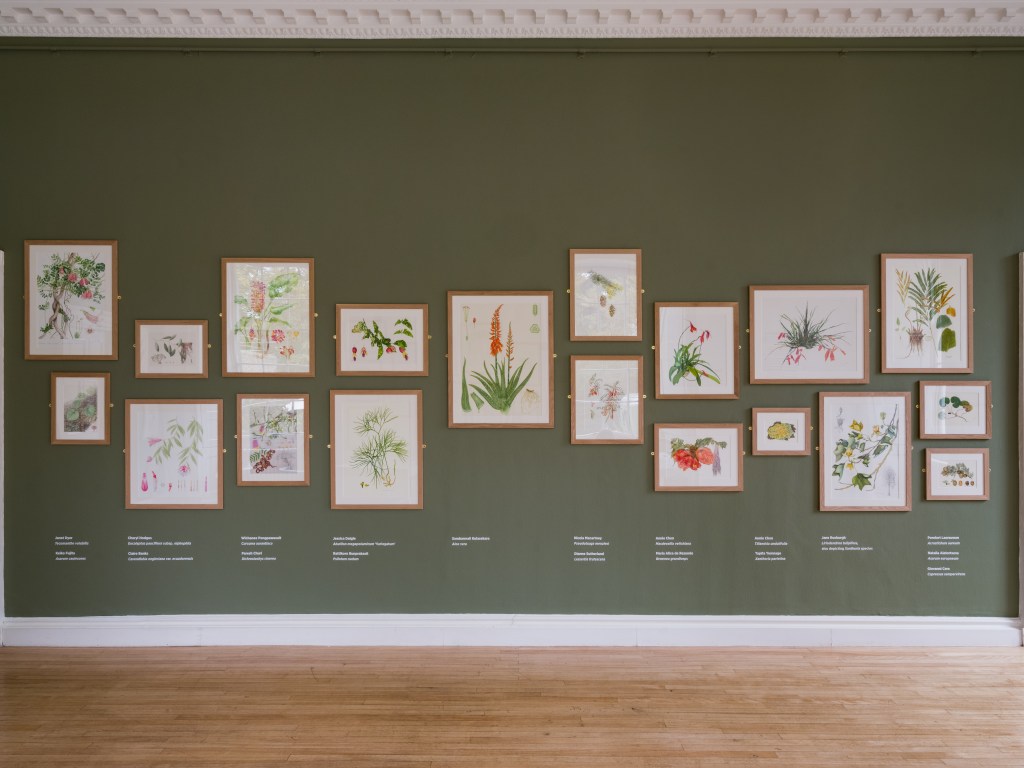
The first is factual, scientific, research-based. Packed into the first room are depictions of flowers from the Garden’s collections, submitted by botanical illustrators from around the world. I love their precision, the sense that these drawings have been set to view in HD. Glancing at these densely stacked images, their uniform wooden frames fitting perfectly with the olive green of the wall, I’m convinced there would be enough detail here alone to make an entire exhibition. Enhanced by the ikebana style floral displays, it’s what visitors might expect, might hope to see. It’s beautiful, classy, and it’s about flowers. Tick.

Florilegium: a gathering of flowers, installation view. Photo by Tom Nolan

Up the stairs, we’re taken into a somewhat different realm by four contemporary artists, Wendy McMurdo, Lee Mingwei, Annalee Davis and Lyndsay Mann. While the immensely skilled botanical illustrators are concerned with depicting the flower exactly, and in some cases, the pollinators too, the artists upstairs are more concerned with what we cannot see. The emotions and meanings we as humans attach to plants, their embroilment in our colonial past, and the metaphor of life and death a flower provides so effortlessly, are all explored here.

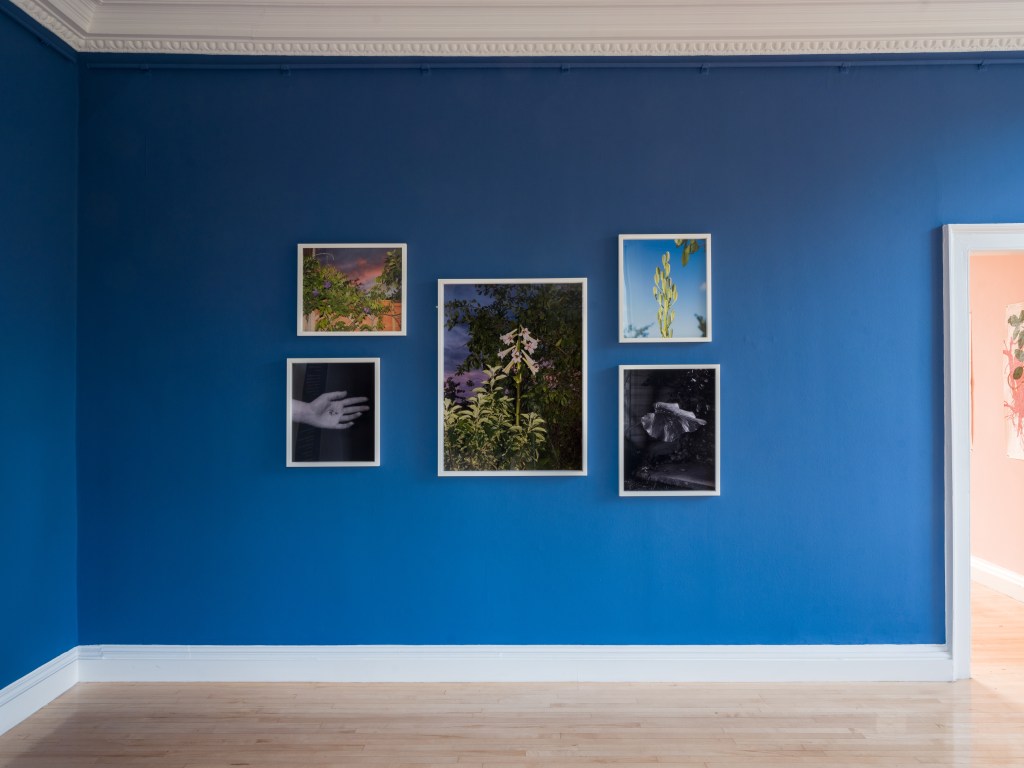
Wendy McMurdo’s photographs from the Indeterminate Objects series from 2019 use gaming software to collapse the blooming/withering lifecycle of a single flower in one vase, an eye-catching narrative that makes you look twice. Her Night Garden series (2020), reflects on how her mother’s ill health and recent death was combined and synchronised with blossoming of a large, mystery, tropical-looking plant in her suburban garden. I loved the uncanny photo of seeds resting in the palm of her hand, which looked to me like the hand itself was punctured, decaying: a wound between the states of hurt and healing.

Wendy McMurdo, ‘Night Garden’, 2020, installation view, photo by Tom Nolan

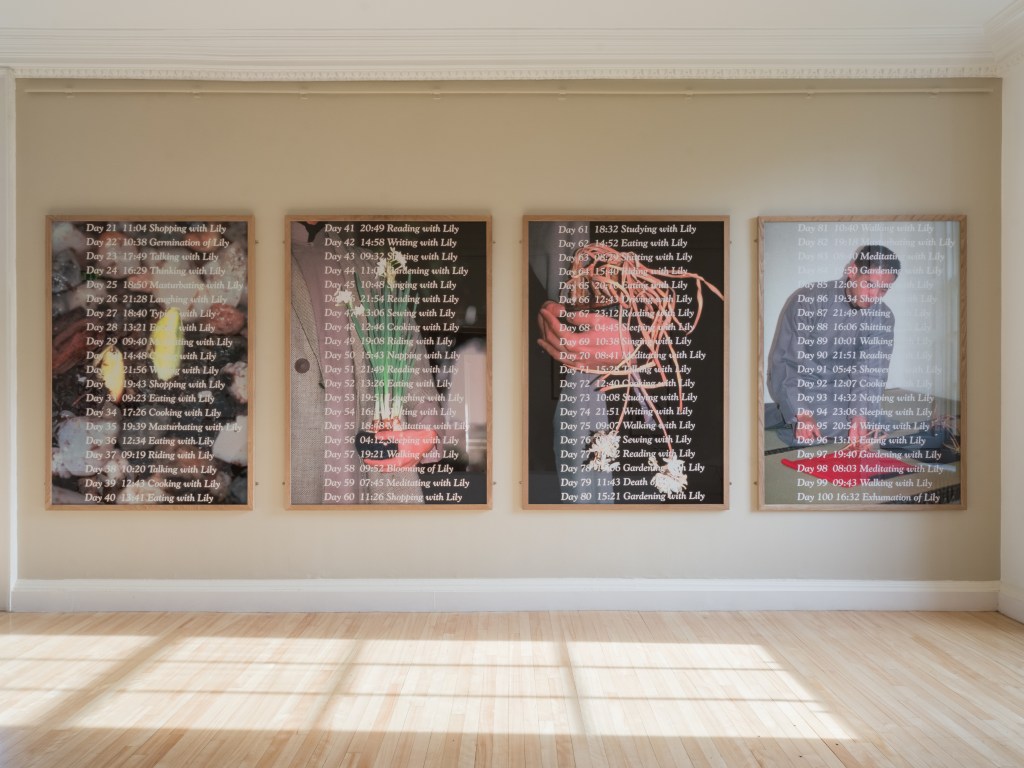
There’s a pleasant chiming here with the work 100 Days with Lily by Lee Mingwei, which documents a performance created back in 1995. His grandmother died, and in mourning he lived with this plant for 100 days, carrying it everywhere. He projects his own grief on to lifecycle of this plant, but the presence of the banal activities of daily life (Eating with Lily, Sleeping with Lily, Shitting with Lily) overwrite and undermine this strange, solemn ritual. For Florilegium, Mingwei has planned a new work called Invitation for Dawn, where opera singers will perform directly to the recipient via live video call. It sounds weird, experimental and intimate, but in a great way. You can participate between 16 November and 11 December, email creativeprogrammes@rbge.co.uk for more details on how to get your ‘gift of song’.

Lee Mingwei, 100 Days With Lily, installation view (photo by Tom Nolan)

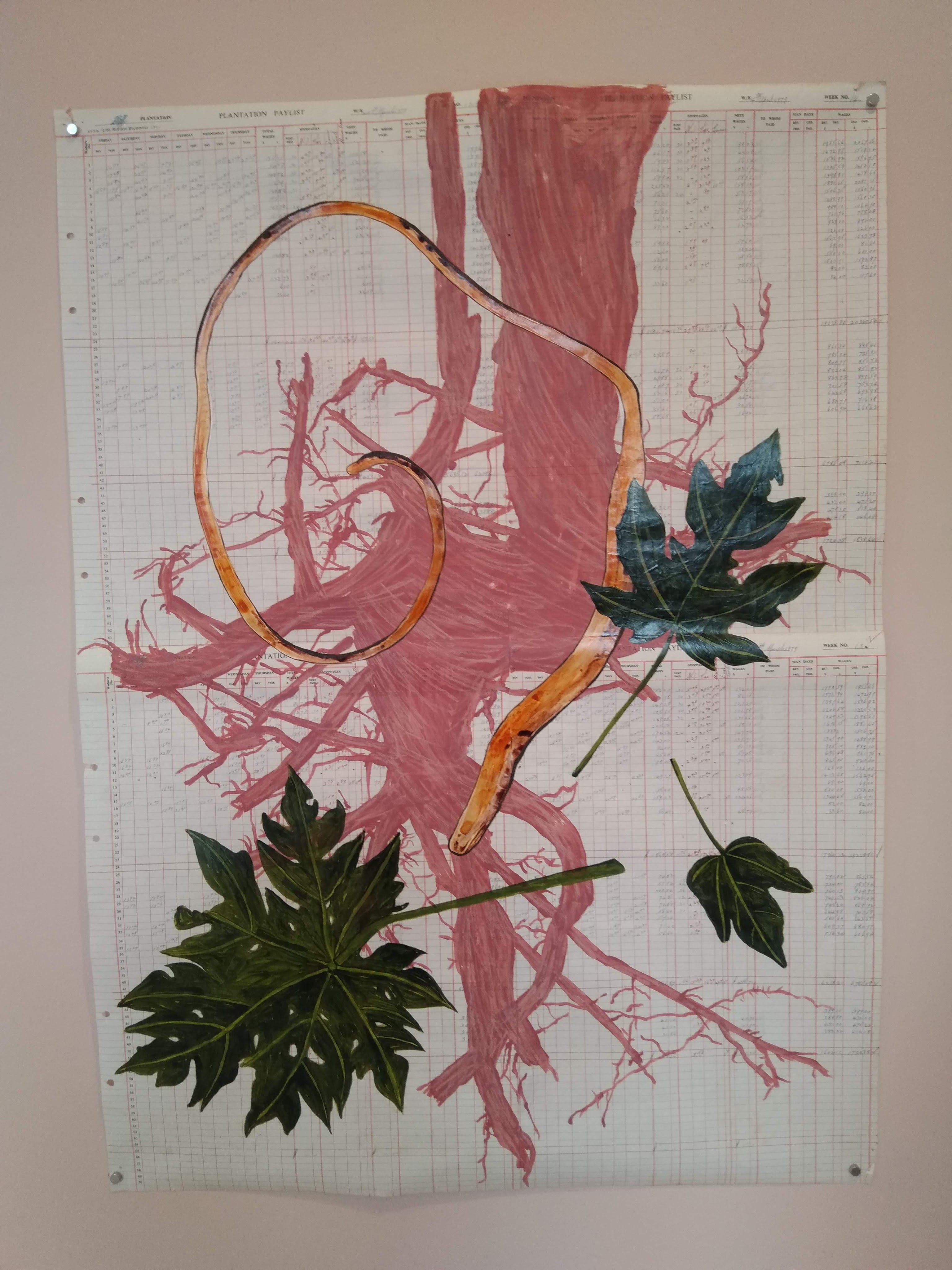
The work of both Annalee Davis and Lyndsay Mann anchors the exhibition in something deeper, bringing the role of the Botanic Garden, the collection of plants, the colonial ecosystem at the heart of RBGE’s existence, into view. Annalee Davis is a Barbadian artist whose studio is situated on what used to be a sugar plantation. Her practice investigates the history of that land, examining the power structures that have been tilled into the soil. Here, her series As If the Entanglements of Our Lives Did Not Matter (2019-20), is casually pinned up on the wall, unframed, unglazed. It immediately felt visceral and direct, denying the formality, poise and stiffness of Inverleith House. Pink, flesh-like depictions of messy clumps of roots are daubed over old payment ledgers from the plantation, which are intriguing, loaded documents in their own right. In a haunting portrait, she places two of her ancestors side by side, who though blood relatives, would have never lived together in reality, separated as they are by race and class. 

Annalee Davis, ‘As if the Entanglements of Our Lives Did Not Matter’ (2019-20), detail

Davis’ art works in dialogue with Lyndsay Mann’s A Desire for Organic Order (2016), a mesmerising film of 55 minutes which explores the RBGE’s Herbarium, where species of preserved plants are kept for study and research. Although most visitors won’t have time watch the film from start to finish, it’s a fascinating piece, which shines a light on the strangeness of it all: the meticulously categorised, catalogued, classified plants, sitting in row upon row of filing cabinets and box files, the collection expanding over the centuries as new species are found and brought to the RBGE, their final resting place. 

The violence surrounding these collections is examined at a distance, with the narrator’s voice dispassionately implying but never quite explaining what we know now, that far more care was given to these foreign plants than to the humans who lived alongside them. If you do have the chance to sit here a while, I’m sure it will make you see the exhibition, and the whole RBGE endeavour, in a slightly different light. You may not think you need this part of your world to be challenged, that you just want to enjoy the Botanics and not think too much about the difficult history and context. But it’s the ability of artists to show things you thought you knew in a new way, that is what makes them so vital to how we think about our past, present and future. That’s why we need the upper floor of the exhibition. We can’t just have a “gathering of flowers”, we need someone to tell us what they mean.

Flower displays at ‘Florilegium: a gathering of flowers’

Art in lockdown: The Hermitage, St Petersburg

Each week for the past month, I’ve been going to Russia. To the State Hermitage Museum in St Petersburg, specifically. A close friend and I have been watching something we wouldn’t have considered engaging with before lockdown: a five-hour iPhone 11 advert, which explores the museum in an extraordinary way.

Even in lockdown, five hours is a bit too long. It’s far longer than I would be able to spend in a museum before fatigue, overwhelm and “museum back” set in. So we watched it in bite-size chunks. It became a little ritual. Every Tuesday at 9pm we would call each other, and press play at the same time to experience the tour together. It sounds bizarre, but it’s one of my favourite ways I’ve experienced art in lockdown.

The tour is meticulously curated. It is in one take, but isn’t a film that simply drifts past the museum’s many artworks (there are three million objects in the collection, including paintings, sculptures, textiles, porcelain, jewels, armour, coins, etc., so we only see a snapshot). This is a focussed journey that pays attention to the architecture and the interiors of the building. Dancers, actors and musicians all feature. They activate the space in vast corridors and lavish rooms, enliven the collection, and act as ciphers for our own bodies which, in normal circumstances, could be travelling through the rooms, pacing the floors, gazing at the ceilings.

I’ve long enjoyed watching people engaging with art: imagining what they’re thinking, and wondering why certain artworks speak to some people but not to others. My friend and I were now observing a false version of this in private and at a distance. We discussed the characters’ hair and clothes, speculated about their relationships with each other, puzzled over what the experience of making a film in an otherwise empty national museum, on the precipice of a global pandemic might have been like.

Gossiping with my friend, analysing what we were seeing together, was one of the best parts of the experience, making the surreal normal, as if we were actually touring a museum together. The mutuality of it, my friend watching in London and me in Edinburgh, spurred us on, and time slipped away quickly. Sometimes, the film became the backdrop to our conservation, sometimes we just watched and our words left us.

The physicality of the camera moving through rooms, doubling back, going in circles, helped make the experience lifelike. We commented on different works we liked, we discussed the merits of the decor (she hated the white curtains), I tried to show off some biblical knowledge to help interpret some of the Christian paintings, to varying degrees of success. There were moments when I craved a few clues about the paintings’ narratives, who made them, their titles – without explanation or context, lots of artworks are VERY weird and tricky to interpret – but providing additional information on screen would have made it too educational. The experience was more about wonder than learning.

The Garden of Earthly Delights prior to ultra zoom

The entire film is shot on iPhone 11, which is where the advert side comes in. The detail it captures is really extraordinary. The ultra zoom is one of my favourite digital tools through which we can experience art differently. Our capacity to see intricate close-ups of paintings is mind-blowing, and something to be celebrated. Zooming in on The Garden of Earthly Delights by a follower of Hieronymus Bosch (1556-1568?) – the original is in the Prado in Madrid – we could see more clearly than had we been standing before it. There are people cavorting on/with animals, giant birds, bodies inside clam shells, people with flowers sprouting from their bums, fruit the size of humans. If you want to pick three minutes of the whole thing to watch, this carnival of a painting features from 1:09-1:12.

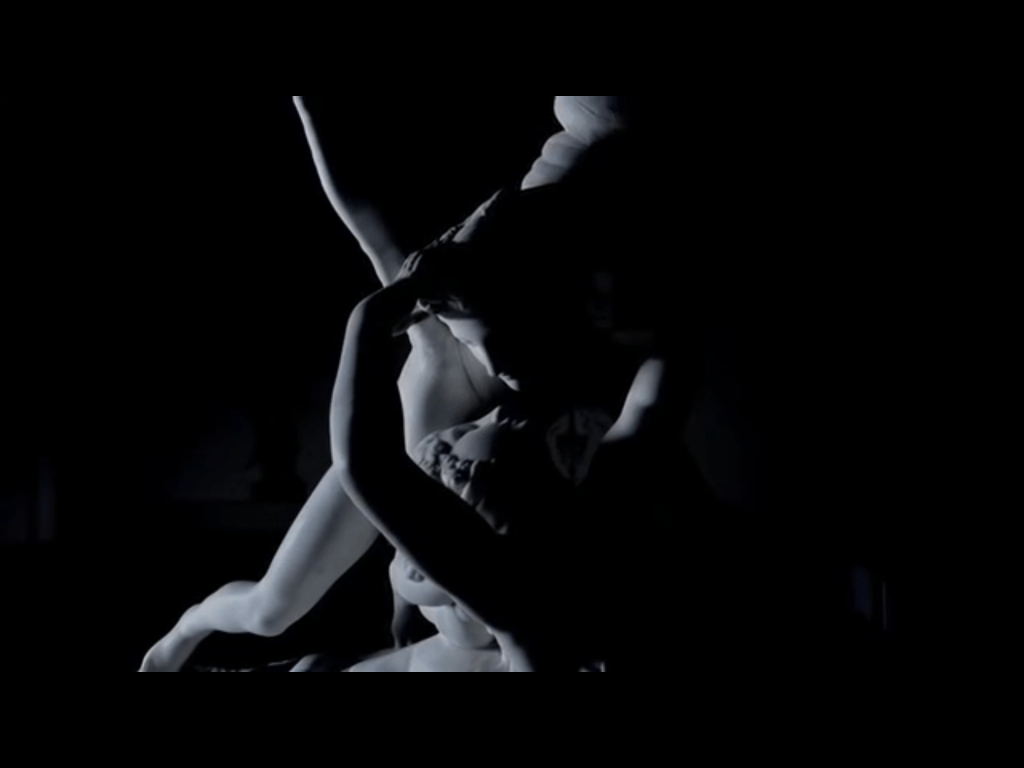
The Hermitage film played with light in interesting ways which warped time, creating uncertainty over whether it was day or night. Towards the end the use of a white torch light on white marble sculptures plunged everything else into darkness, and we were floating in a monochrome world.

Marble sculptures floating in a monochrome world

The museum at night is a creepy, exciting prospect, and one the film makes use of. There were several allusions to the presence of history, and the ghosts that live within its very walls. After all, it is a building which began as a private palace, its first collections were amassed by Catherine the Great in the 18th century. It has ridden the waves of Russian/Soviet/global history since then: wars, revolutions, political regimes, the Siege of Leningrad, and this pandemic. That it is still here today, for us to enjoy, even only as digital ghosts from a distance, is something we can all take comfort in.

Glasgow International part 2: Alberta Whittle

It is often said that the two prime events that modern Britain’s identity is founded upon are victory in the Second World War in 1945, and the founding of the National Health Service in 1948. With the 75th anniversary of VE day on Friday, and the ongoing coronavirus pandemic, I’ve been thinking these things through lately in the context of British identity. 

I’ve been helped on with these thoughts by a film by Alberta Whittle, presented as part of Glasgow International’s Digital Programme. The film is called business as usual: hostile environment (2020), and it was made especially by Whittle for the Digital Programme, adapted from a longer commission she had been working on.

Firstly I need to tell you, that if you want to watch the film you have to do so now, because today is the last day of Gi’s Digital Programme (though hopefully Whittle’s work will be added to her website soon afterwards). I wrote about two other Gi works in the previous blog post, but I needed to sit with this one for longer, because it’s more political, and therefore by nature it is harder to write about.

This is art as activism. It encompasses huge issues, from the treatment of immigrants and the hostile environment, to the Windrush scandal, to the lack of PPE available for frontline staff because of the government’s sluggish reaction and mismanagement of the unfolding COVID-19 crisis. I’ve read it as a reflection on British identity, and the holes in the narrative of that identity. That’s a lot to fit into one artwork, a 16-minute film which pieces together archival footage, news reports, computer generated images and home-movie style footage of a family’s day out on a boat. 

Despite the difficult issues broached, its juxtapositions are delicately balanced, so the imagery is not overtly violent or traumatising to watch. Painful subjects are contrasted with some beautiful footage of couples dancing from the archives of an early 1950s Britain, which then sit side by side with brief snapshots of racists marching, and National Front graffiti covering a bridge. Whittle makes use of the split screen to heighten these contrasts: a very grey-looking Britain is paired with what we assume is the clear, beautiful Caribbean sea. Towards the end, a long duet with vocals and drums raises the tension and serves to make the viewer feel uncomfortable. That’s ok though: art doesn’t exist for pleasure alone.

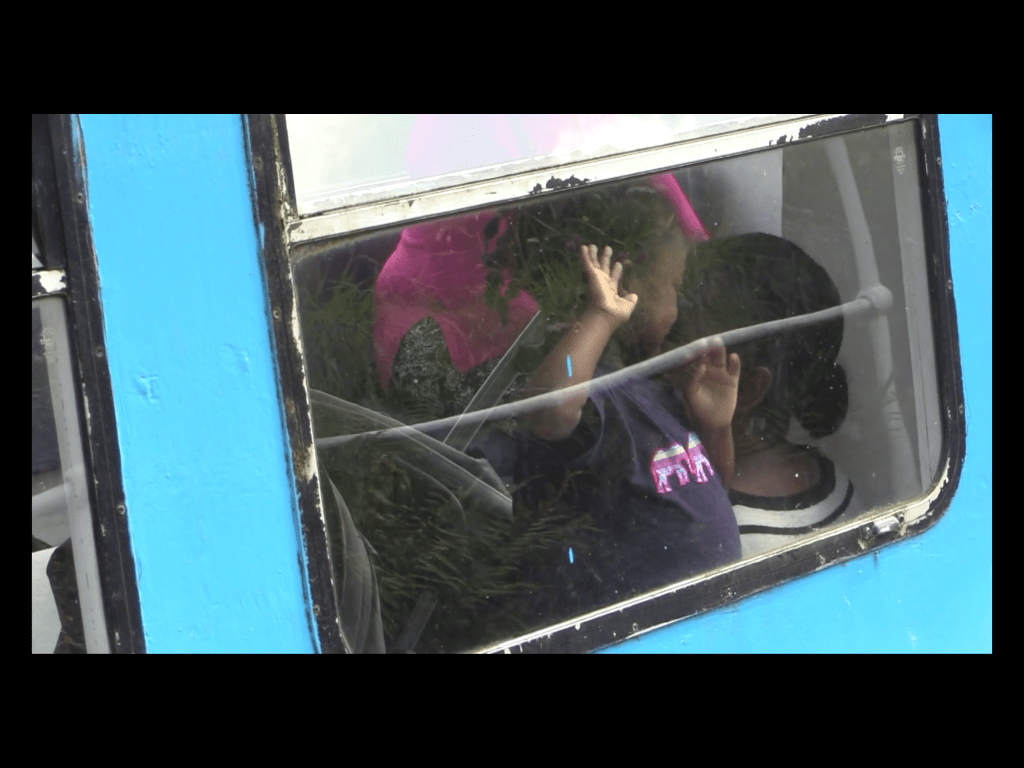
The film persistently subverts the romantic ideas around the images presented. It is partly a response to Visit Scotland’s theme for 2020, Coasts and Waters. What we (and Visit Scotland) might expect from that theme are artworks that respond to and promote Scotland’s amazing coastlines, images of peaceful landscapes with lochs reflecting mountainous scenery. In contrast, Whittle’s work looks at the role water, specifically the Glasgow Forth and the Clyde Canal, have played in the movement of people. There is one image that captures the cleverness and poignance of the film for me. A young black girl is having fun on a canal boat, smiling and knocking on the window, but a passing reflection makes it look for a moment like the window is barred, that she is imprisoned. That sent chills down my spine because of the other images I know of black people incarcerated on ships. It is the unsaid aspect which hovers over the film, including the hopeful images documenting the arrival of Empire Windrush in 1948.

A still from Alberta Whittle’s ‘business as usual: hostile environment’ (2020)

There’s a lot that can be achieved by subverting, questioning and exploring the ideas that nationhood is based upon. Frankie Boyle’s Tour of Scotland, broadcast on the BBC earlier this year, is another example of digging beneath the surface of ideas of who we are. It’s no longer available on iPlayer but clips are online. The section where he talks to Councillor Graham Campbell about Glasgow’s ties to the slave trade was fascinating and, like Alberta Whittle’s business as usual: the hostile environment, works toward educating us about aspects of our past that are often swept under the rug – an ignorance that has allowed for the hostile environment to develop and the Windrush scandal to happen.

Multiple commentators have pointed out that the British government have tried to tie modern Britain’s founding ideas together with its approach to this crisis. Coronavirus has been likened to an enemy, using the language of combat, which isn’t always appropriate, effective or clear when it comes to responding to a medical emergency. The semantics of sacrifice and loyalty are invoked to try and bring us together – though clearly the extent of lives lost could have been limited, had the situation been better handled. Whittle’s film is a reminder that no amount of metaphor should be allowed to submerge that truth.

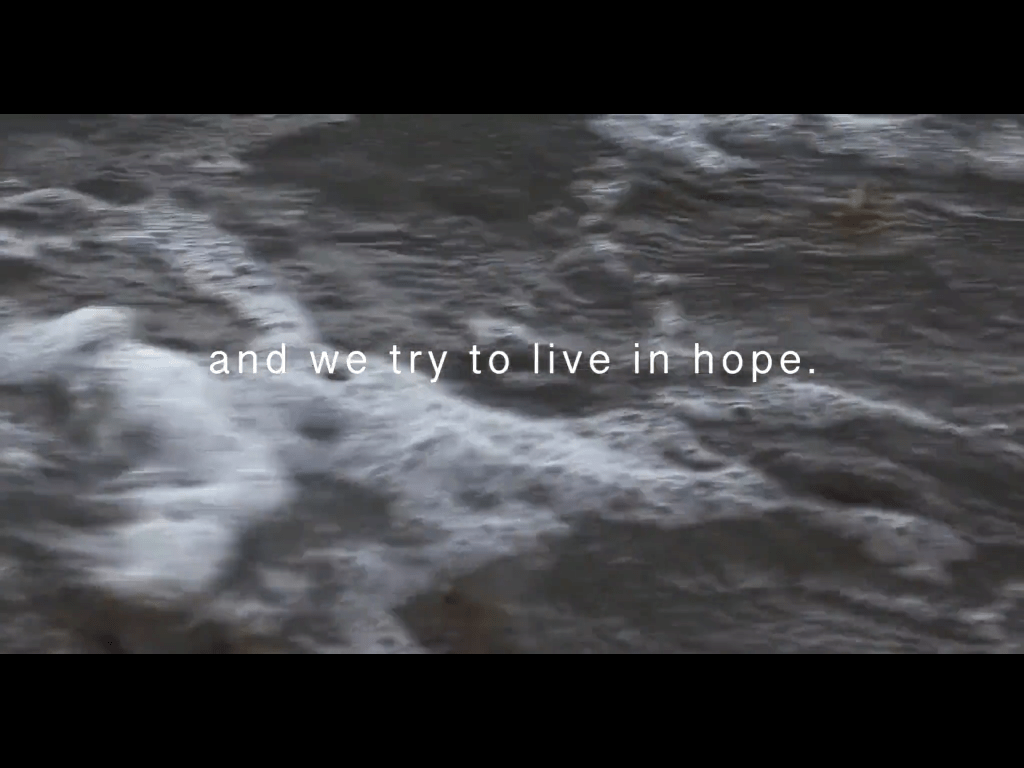
This work made me think again about how grateful I am to the artists, writers, comedians and journalists who encourage us to look deeper. The ones who question the myths, probe the difficult areas, who remind us to ‘stay alert’ to the situation unfolding around us, to the ideas and the language used to mobilise us. This has been a time of reflection and introspection for many of us, and there are some beautiful, human stories of solidarity that we can take pride in. But after it’s all over, we need a new consciousness to emerge and I want art to be at the forefront of imagining that to be possible as, to quote Whittle, “we try to live in hope” for a better future.

A still from Alberta Whittle’s ‘business as usual: hostile environment’ (2020)

Glasgow International is happening online, right now

The art festival Glasgow International (Gi) had to cancel and has curated a set of seven different artworks available online for the duration of the festival (until 10th May). Some are special commissions, some works were made long before the pandemic hit, but all artists would have been taking part in the festival itself, and the works represent a taster of what would have been available to see. While I understand that Gi want to mark the period when the festival would have taken place, it feels needlessly restrictive to have made this very interesting set of works available only to take them down after two and a half weeks. Time seems arbitrary now. I barely know what day it is, let alone the date. Why not leave them up until the end of lockdown or the end of May at least?

I was a bit late to the party but I’ve just finished watching/listening to them all and wanted to highlight two that resonated with me.

The first is Yuko Mohri’s Everything Flows – distance, 2020. Mohri has taken Yasujirō Ozu’s 1953 silent film Tokyo Story (which I haven’t seen), and has spliced together scenes devoid of human presence. What we are left with is a ghostly compilation of images which suggest humans through their absence. The city continues to function, ships move through water with purpose, but seem to be operated by remote control. Robotic railway station signs indicate platforms and train times to no one. Clothes on washing lines blow in the breeze and shadows on the walls of cramped interiors hint at human life, but each time, the film cuts out just before the figure comes into frame. It’s a tantalising series of almost-moments, which chimes well with having experienced a quiet, deserted central Edinburgh over the last month or so. There’s a strong sense of people watching the goings on from the high viewpoints over the city. Lanterns look like eyes. A moth bashes against a light, a fragile reflection on the futility of existence in this silent world.

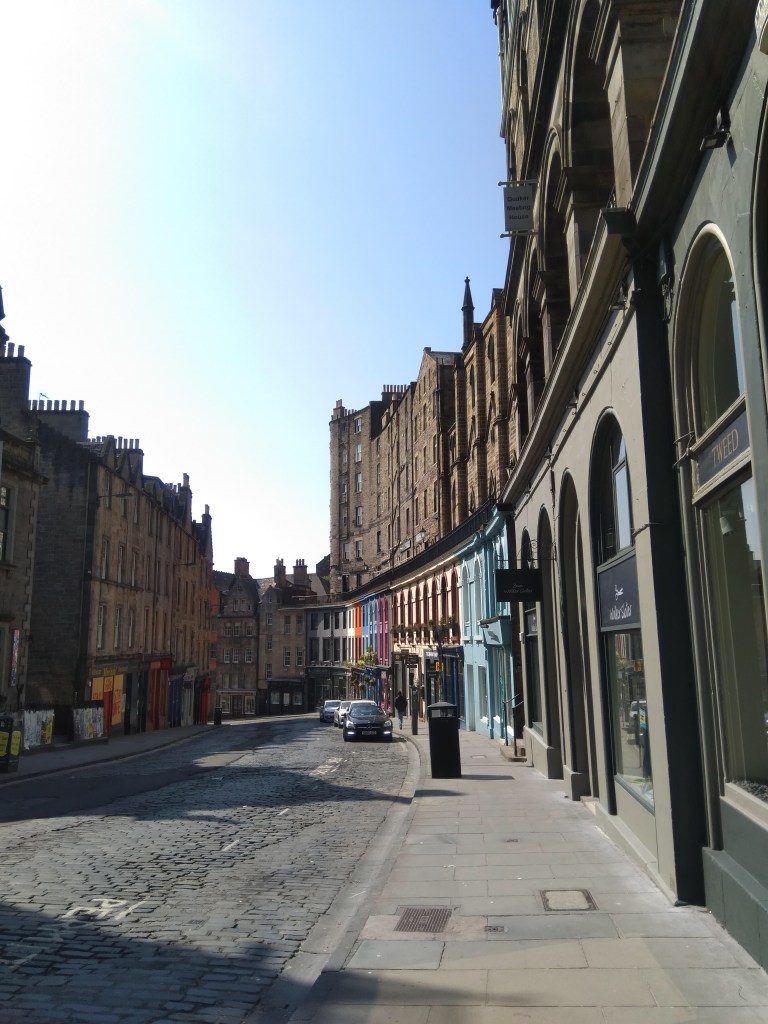
Victoria St, Edinburgh looking empty on 25 April 2020

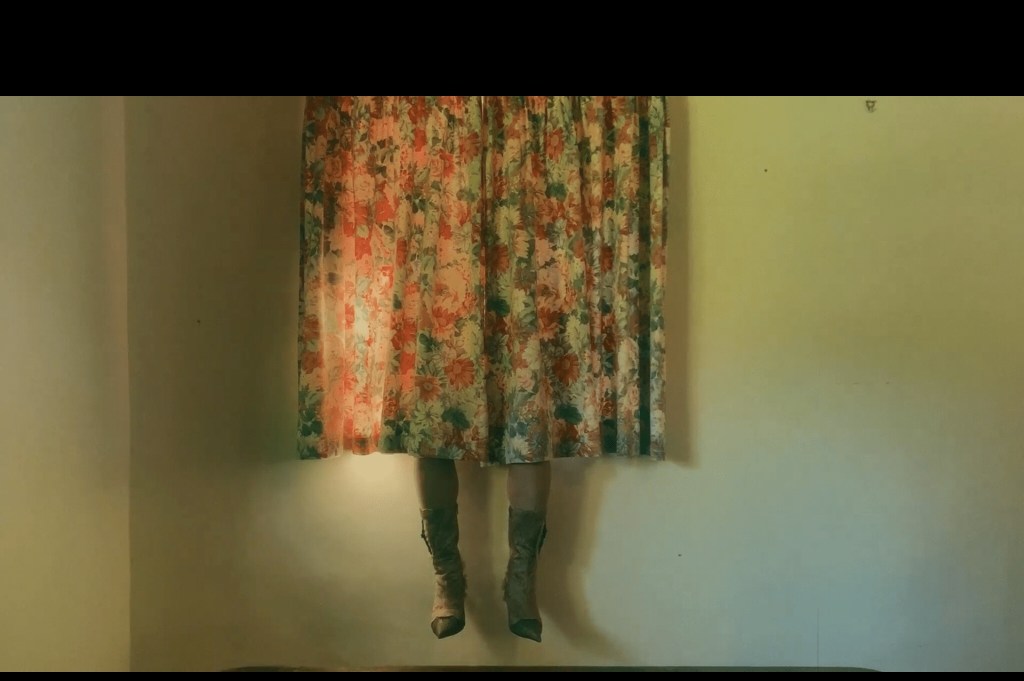
Urara Tsuchiya’s Give us a Meow, 2019, is my other pick of the bunch. This one surprised me – from the cover image and the title I didn’t think I would like it. But the 9 minute film is captivating. It tells a fragmented story, set in the rural idyll of a cottage and the countryside around it. We follow the escapades of a glamorous Asian woman who dons an impressive range of sexy outfits including animal print catsuits, fluffy negligee, powder blue and baby pink fur coats. The costumes are all made by Tsuchiya and are highly influenced by drag, adding to the fascinating confusion around the identity of our protagonist. She dances, applies makeup, takes selfies and does the ironing. It’s a surreal and humorous mash-up of the extremes of femininity, typified by one excellent shot which briefly flashes up, showing a pair of legs clad in high-heeled boots, sticking out from behind twee floral curtains. I took a screenshot which is probably not allowed, but who knows the rules of a digital art festival. Maybe this is part of a process of the democratisation of image-making, taken to a new level.

Still from Urara Tsuchiya’s ‘Give us a Meow’, 2019

For me, in a time of lockdown, it seems as though the character in Give us a Meow is attempting to recreate the experience of being in a nightclub within a completely incompatible setting of ‘home’. She dances like no one’s watching. She even has a little cry in the bathroom, picks herself back up and heads out again, an experience I’m sure we can all relate to. Seeing her vulnerability when navigating a cattle grid in heels is beautiful and moving and funny.

There’s also a fascinating, sinister aspect reflecting on the voyeurism of the film. She appears to be alone, but is not – she breaks the fourth wall repeatedly to interact with us, casting glances directly at the camera, creepily/seductively waving at us from the toilet seat. In the moments filmed outside, with her dancing by the side of the road, the film is shot from the perspective of someone watching from a car window. We are there, but it feels like someone else is there too. This also resonates particularly now – we rely on our cameras more than ever for interaction and attention, but constant rumours circulating about hackers in Zoom calls and sessions on Houseparty make us paranoid about who else might be watching. Tsuchiya created the work last year, but it feels more relevant than ever now.

So, that’s my take. I know there’s so much content out there at the moment, it can be overwhelming. I know that digital art events don’t appeal in the same way as the ones in ‘real life’, which can take you to different corners of your city and have a physicality to them that can’t be recreated on screen. But these artists have created something really interesting. What worked for me may not work for you – see what you think and let me know in the comments, or DM me on Instagram @encounters_art. I’m always here for a conversation about art!

Layers of a life

There are some artworks that become wedged in your heart. You carry them with you, and mostly they lay dormant. Then occasionally they will surface from nowhere, reminding you of something you saw, read, felt years ago. For me, one of those objects is something I saw at Found, an exhibition curated by Cornelia Parker at The Foundling Museum in 2016. I must have loved it at the time, because I bought the catalogue, and that hardly ever happens.

The piece in question is by John Smith and is unassuming and profound in equal measure. As someone who believes in the necessity of encountering art in the everyday, it’s exactly the kind of work that chimes with me.

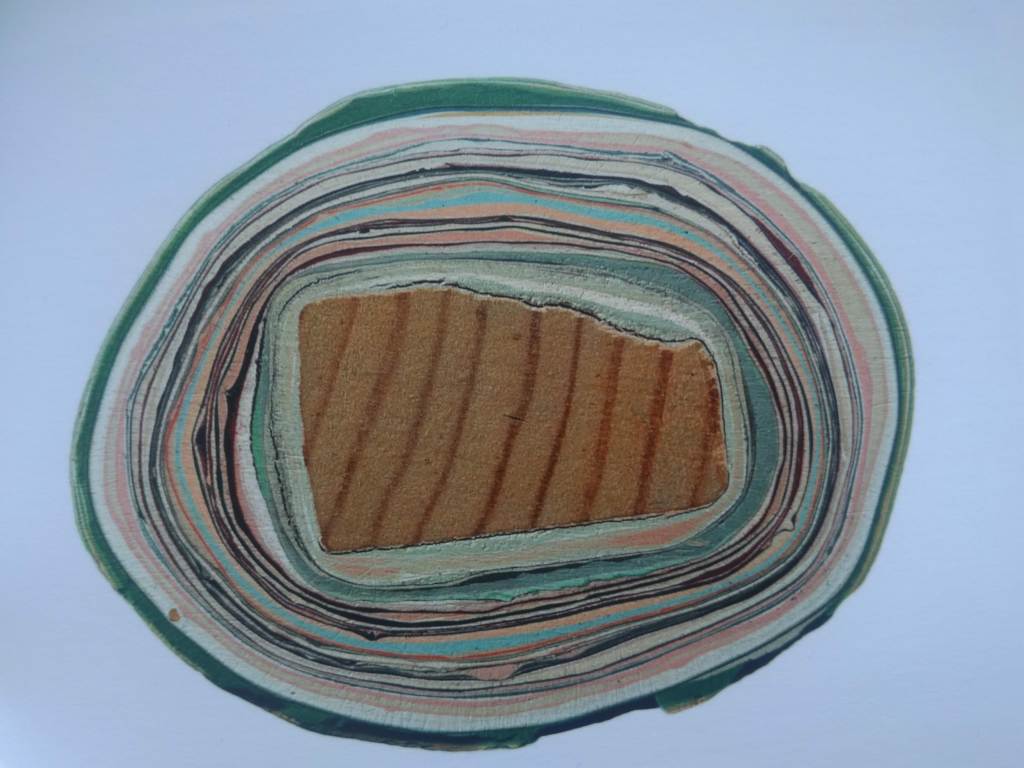
John Smith, Dad’s Stick, c.1950-2007, wood and paint, 23 x 2.7cm

It’s difficult to know how to describe Dad’s Stick – it hovers part way between art piece, art object, tool, item, artefact. This stick belonged to the artist’s father and was used to stir paint pots for around six decades. Then, towards the end of his life, Smith’s father cut through the stick. This act revealed a cross-section of multiple layers of paint, each covering over the other, like the concentric rings of a tree. It’s a wonderful thing: documenting changes in taste, memories of rooms, snapshots of different projects, a humble memorial preserving a life story, or multiple stories. In the Found catalogue, Smith reflects that looking at the colours of the stick took him back to his childhood, “the greyish green of our 1950s kitchen cupboards and the bright orange that covered the walls of our hallway in the 1960s.” (p.122). Smith created a film to accompany the object which was also shown in the exhibition. You can see an extract of it here.

Perhaps this object resonated with me because my own childhood home had this layering too. My mum, a good seamstress with an eye for interior design, made our own curtains, and as I grew up, she covered over the childish Alice in Wonderland fabric in my bedroom with a more teenager-appropriate material. My parents don’t live there anymore, but I wonder if the current inhabitants ever puzzle over the faint colours and shapes they can see through the fabric in certain types of light. Or they may have got rid of the curtains entirely – I’ll never know.

The flip side of Dad’s Stick is the rooms themselves. Most houses have multiple layers of paint, wallpaper, and questionable decor that exists below our current surroundings. Buildings have stories, and ghosts, in their very walls. Their history is a layered patchwork of the different lives played out in their rooms.

This feels more prevalent than ever while we are all confined to our homes. I live in an Edinburgh tenement flat, part of an old stone block with one side facing the street and the other overlooking an enclosed courtyard at the back. Muffled voices through walls, the frenzy of a washing machine from the flat next door, the occasional footsteps in the hallway are all part of the daily routine. They were always there, but noticing them, and their closeness, is unavoidable now. I see people smoking out of their windows, they see me moving from room to room, chasing the sun as it graces different parts of the flat throughout the day, we watch people hanging out their washing and cats prowling in the overgrown backyard. 

Being at home all the time has reminded me of these layers of lives and histories we live alongside and we contribute towards. Artworks like this one can help us process these situations, reminding us we are all part of the layering process, reassuring us that people lived here before, and they will again once we move on.