Year 3, Steve McQueen

Yesterday ArtAngel ran a live Q&A with artist and director Steve McQueen, following their most recent collaboration for his vast work, Year 3. For this artwork, McQueen arranged for 76,146 kids, from 3,128 Year 3 classes (ages 7–8) to be photographed in the timeless, traditional, and I would even say iconic format of the class photo. It’s something most of us can relate to. Bodies arranged in rows, taller kids standing, some sitting on plastic chairs or old wooden gym benches, and others cross-legged on the floor. What has emerged is a rich tapestry, a beautiful, huge patchwork quilt of thousands of photographs that document the present and, as McQueen emphasised in the talk, the future of London. What an incredible concept for a piece of art. I’ve heard it described as a giant portrait. But it feels far more dynamic, participatory and meaningful than that word implies.

I knew that the work was being exhibited at Tate Britain (I was due to visit in April, and am gutted that now I’m unlikely to see it at all), but from photos the installation looks impressive. The messy brightness of 1,504 schools packed into the grandiose space of the Duveen Galleries would always create a delicious juxtaposition. I hadn’t realised that for the ArtAngel side of the work, some 600 of the photos were created into billboards, situated across all 33 London boroughs, in November 2019. An ephemeral facet of a monumental artwork. It’s the stuff Encounters Art was made to write about – my only regret is to not have seen and documented them myself. In some ways that’s the beauty of these pop up artworks though. They aren’t supposed to be sought out, they mix and mingle with the everyday and you don’t know it’s there until you stumble upon it. If you did see a billboard in London back in November then I would love to hear your thoughts – leave a comment or DM me @encounters_art.

Installation view on Camden Road

Subverting a space that is usually used for adverts by filling it with a school photograph which is simultaneously strange (because we don’t know these children) and familiar (because we’ve all been children) is such a strong, engaging idea. One of the best moments I’ve come across by searching online for #year3project is a BT advert on Camden Road announcing “Technology will save us”. It is a timelapse video of BT’s billboard being surmounted with a photo of smiling kids in bright red cardigans and summer dresses in an old school hall. Here the children aren’t being prepped and presented as the consumers of the future. They are the future. They will save us. (Though I suppose ironically I owe my thanks to technology for preserving this moment for me to find months later.)

I love seeing these images interwoven into the London landscape. In tube stations, framed by carriage windows, this array of smiling young faces must have cheered up and intrigued countless commuters. Even in the gallery display, away from the urban fabric, it feels like a very London-based artwork, because it celebrates the city’s amazing diversity. McQueen chose Year 3 because for him, that is the moment we start to gain perception of our identities. Our classroom becomes a window on society and a crucible of the nuances of race, class, privilege and opportunity, all of which are explored in the work.
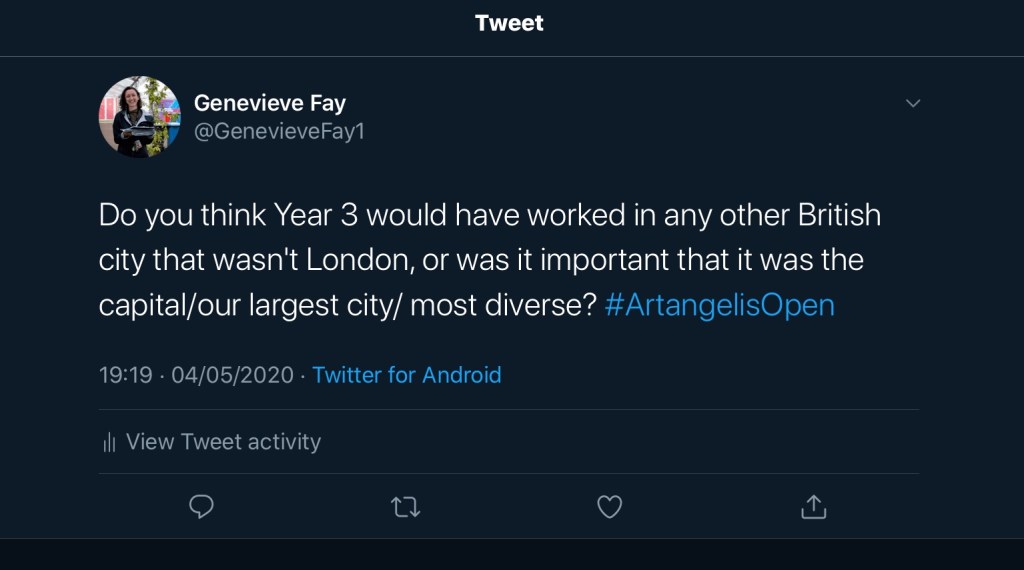
I found the London aspect particularly intriguing so I decided to ask a question using the hashtag #artangelisopen and I couldn’t believe it when it was picked for McQueen to answer. I was so excited, cheering and jumping up and down that I almost forgot to listen to his response. He said that for him, London was the clear choice, but it didn’t have to be limited to that – it could be carried out anywhere – and he seemed to be encouraging people to take up the project and move it on elsewhere. I would love to see that, particularly somewhere like Nottinghamshire (where I grew up) where there are rural and urban childhoods playing out. I wonder if it would click in the same way the original project does.

Installation view at Tate Britain Duveen Galleries

Listening to McQueen, the work was also understandably rooted in London because that was his experience – despite its scale, there is a highly personal context to the artwork which draws on his own boyhood engagement with art: a primary school outing to Tate Britain was the start of his journey. But it’s also about visibility. According to TIME magazine, Steve McQueen is one of the 100 most influential people in the world. For Twelve Years A Slave he won an Academy Award for Best Picture, and became the first black filmmaker to do so.

By creating this work, displayed in the gallery he visited as a child, he has come full circle. What an amazing thing, to provide an opportunity for the children in Year 3 be able to visit that same space, and see themselves, and others who look like them, on the walls. It fills me with hope that the project will be the spark that ignites countless artistic explorations and adventures. I can’t wait to see what they create when they’re fully grown.
Performance Live: The Way Out review

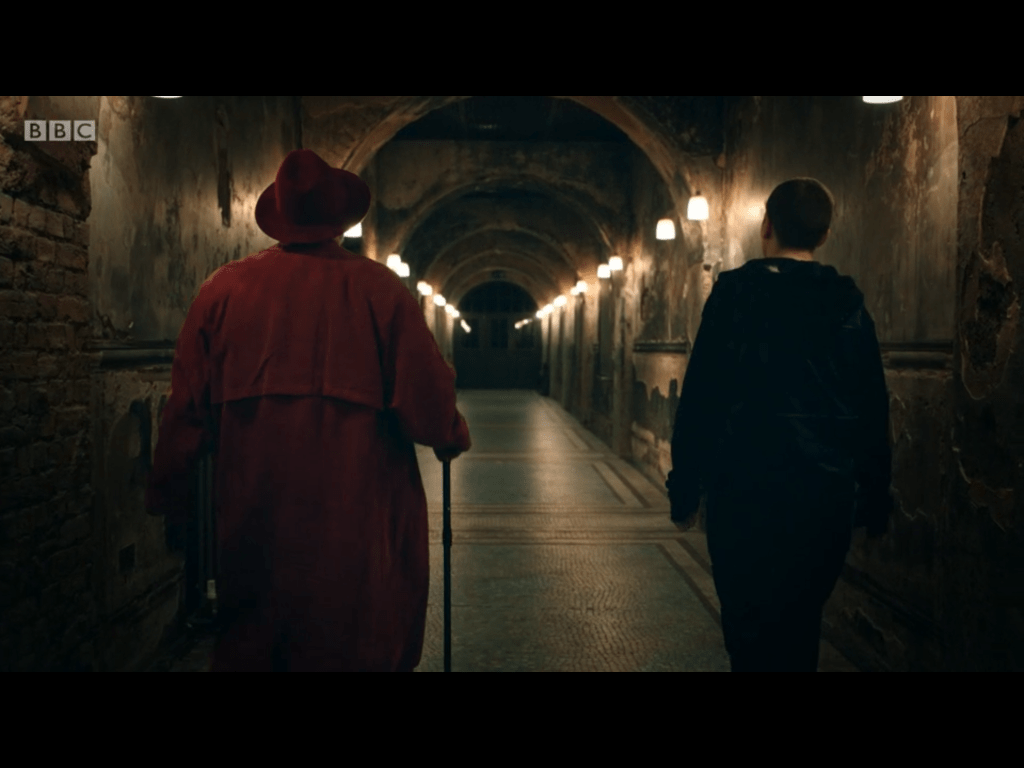
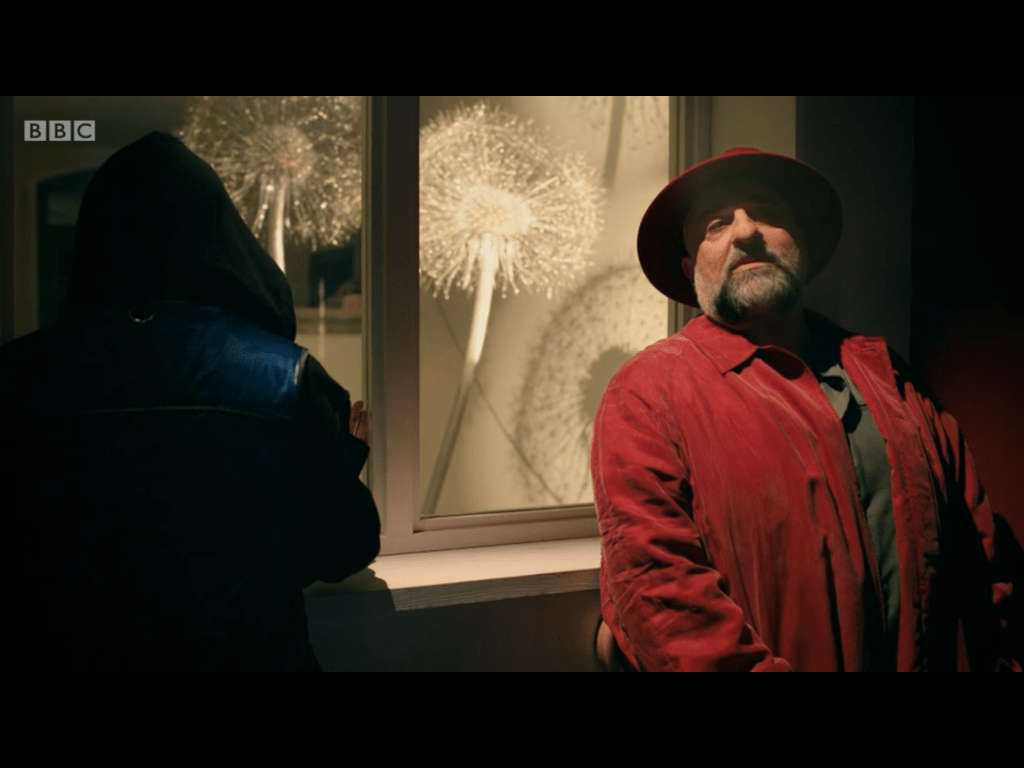
It’s raining heavily outside, and a soaked through, frightened, hooded figure stumbles upon a grand pair of wooden doors. They open automatically, and seem to offer an alternative to the storm, and whatever else is lurking outside that troubles our protagonist. This is how The Way Out, Battersea Arts Centre’s offering for BBC Culture in Quarantine, begins. I promise you that if you like imaginative, surreal adventures and need an escape from this covid-consumed world (as I did yesterday) you will fall down this creative rabbit hole and not look back.

There are a number of references to Lewis Carroll’s Alice’s Adventures in Wonderland, and in many ways this is a modern retelling, one that celebrates the talent that Battersea Arts Centre has to offer as well as the transformative power of creativity. But before we make our way to experience the performances, we first encounter the enigmatic Omid Djalili, our guide and master of ceremonies. His existential musings on pathways, growth, entrances and exits hover between philosophy and riddle. As our journey through this old town hall with crumbling walls and labyrinthine corridors continues, he is increasingly likeable and intriguing.

The work incorporates some of BAC’s art installations, such as Hope, by Caroline Russell (2019)

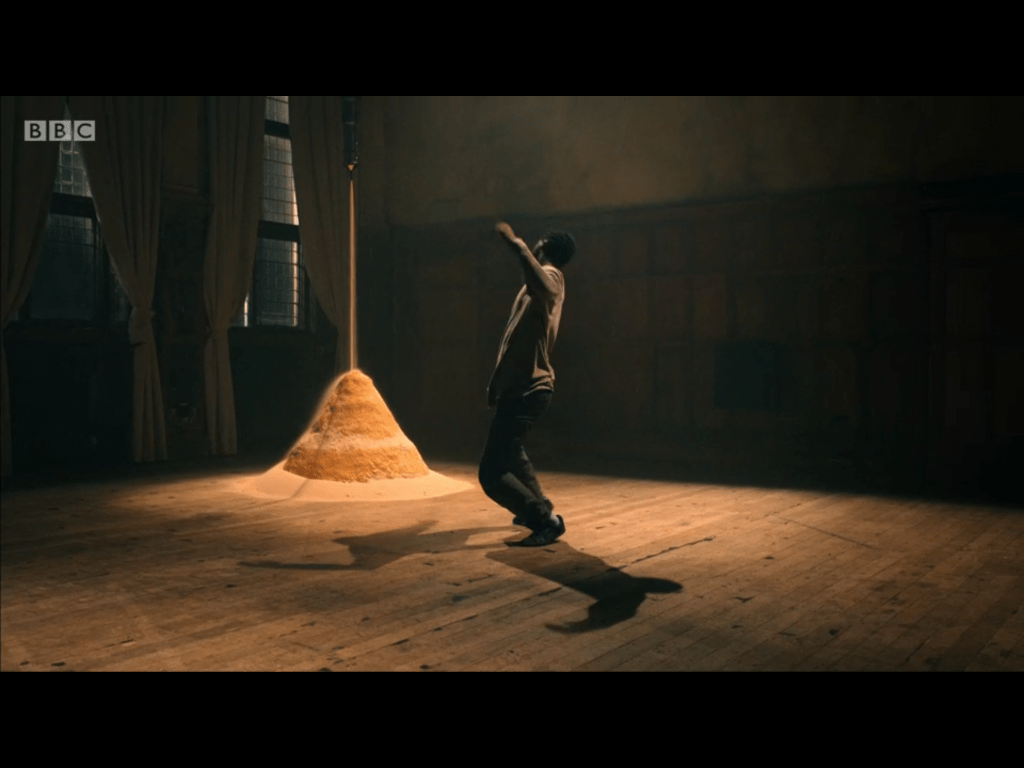
We begin as curious but detached observers, audience members, pondering how it is possible for a body to become fluid in the way that Botis Seva’s does in his performance of Quick Sand, performed alongside what seems to be a broken hourglass, its sediments hardened to the floor. As we venture further into the warren, we enter different worlds, a deep sea chamber where drag artist and opera performer Le Gateau Chocolat reigns supreme, singing a lonely siren song to the luscious, pulsating backdrop of a string trio. As the journey continues, its sinister edge, probably imagined by our own suspicions and scepticism, slowly gives way lightness and joy. We enter the cabaret world of the Cocoa Butter Club and we realise we are now participants in the show. There’s a performance of “Young Hearts Run Free”, one of my favourite disco classics which is poignant and joyful in equal measure. It’s a party and a crazy one at that, the kind of night when time warps and you don’t realise how late or early it is, or how it got to be light outside?

Botis Seva working magic with his movements in Quick Sand

The building is in many ways my favourite part of the show. It transported me, kindling memories of similar places I’ve been or known – art venues like Summerhall in Edinburgh (which is currently crowdfunding), nightclubs, the backstages of theatres, the burlesque house from The Simpsons, Shangri-la at Glastonbury, and even certain dark, decrepit corridors of my Midlands secondary school. The film is about 40 minutes long and is taken in a single shot from around head height, making it as close to immersive theatre as TV can get. You are the one journeying through the maze. And wow, it feels good to be traveling through and exploring a hive of creativity and weirdness. While watching I vow to myself not to take these experiences for granted again.

Come As You Are is a heartfelt poem written and performed by Sanah Ahsan, resplendent in a bright yellow suit and standing in centre of what seems to be a yellow brick road. It’s a nod to another memorable, psychedelic adventure into another land – except it is made from flowers and not bricks. A road made of flowers sums up the paradoxes of this wonderful piece of theatre, this story. It’s bizarre, fun and seems impossible and yet it works because of all the paradoxes woven into it. It is a beautiful escape, so perfect and so utterly needed for these times that it’s hard to believe that it wasn’t planned for a quarantined world (it was filmed in January). 

This flight of fantasy took me out of myself for a moment. Hopefully, on the other side of this stationary journey we are all undergoing, we can emerge, like the character from The Way Out, with our hoods thrown back, ready to embrace the world, each other and ourselves.

Through the labyrinth

Myriam Lefkowitz / Walk, Hands, Eyes (Edinburgh)

I have been wanting to write a piece about this for a long time. I regret I’ve been behind on my blog posts lately, but February is the month I’m going to write regularly. As my friend Kate put it, ‘perfectionism is taking a hit’. She is drawing every day, and I’m trying to do the written equivalent, whether on here, in my journal or on Instagram (@encounters_art).

What does it mean to meet a stranger, and within minutes, be expected to rely upon them for everything? To trust them to be your eyes, to guide you through the complex labyrinths of city streets, buildings, traffic, and other people? This is the question that lies at the heart of Myriam Lefkowitz’s extraordinary work ‘Walk, Hands, Eyes (Edinburgh)’, which was organised and performed by Talbot Rice Gallery, one of the city’s best places for engaging with contemporary art (art that is being made now, or has been very recently).

The work is a 45-minute 1-1 walk where the performer takes you by the hand and leads you through the city, with your eyes closed throughout. It is a silent experience, except for the occasional, whispered command by your performer “one step down… and another”. It was as intense as it sounds, and most people I have discussed the piece with have recoiled in horror, and asked me why anyone would voluntarily put themselves through that kind of thing. Was it even “art” if there wasn’t a object or thing you could look at as part of it?

Yet, I would go so far as to say it was one of the best art pieces I’ve experienced. Yes, it was intense, but in all the best ways. The childlike, gentle way the performer took my hand, and the way my body responded with utter trust (even though my mind fluctuated between embarrassment, confusion and hilarity) was a fascinating experience. It’s a simple concept when you boil it down, but for me as participant, it was and emotional and sensory rollercoaster.

People have always told me that when a person loses one sense, the others become sharper, super-senses. Temporarily ‘losing’ my sight for around an hour (I just about managed without peeking) demonstrated how accurate this is. I became aware of so much more in a way that was genuinely exhilarating: the frosty blades of grass crunching under my feet, the snippets of conversations, and even the atmosphere or feeling that you sense when entering a place. I did the walk on 12 December, and certain rooms we passed through vibrated with intense festiveness. In other moments I could sense we were in the deserted crevices of Edinburgh: alleys and corners where the sun barely ever reaches, the very quality of the air a telltale sign of pervasive damp.

There was an almost embarrassing sense of intimacy to it. As a rule, we only ever hold hands with people we know really well, who we feel affection for, who we know will not judge us if our hands are clammy or our skin rough. I found myself thinking about the performer (who was fast becoming my spirit guide through this new sensory world). I worried that her hand was cold: that prolonged connection with a stranger, though artificially created through an artistic concept, became a strong bond through a shared surreal experience. I had to trust her, because I had no choice otherwise. I also had to trust the other people we encountered in the streets not to hurt me, to take advantage of my vulnerability, my acute sense of which was counteracted with relief when nothing did go wrong. (On a side note, I have new respect for those who navigate landscapes with limited sight, by using a white stick or a guide dog. It really brought home the element of trust and bravery involved in that).

Experiential art, or art that functions through making us interact or participate with it in some way, is a big business. In our free time more and more we seek “experiences”, moments we can document on social media that boost our social capital in the process. Unfortunately, this can often lead to art experiences that are packed with gimmicks, but art vacuous at their core. By contrast, this simple action of two people walking together, with the city as their backdrop, felt minimalist and radical. Lefkowitz’s ‘Walk, Hands, Eyes (Edinburgh)’ reminded me that to make this kind of art successfully, you don’t need lights, big budget shows, music, bells and whistles.

For me, the best art can makes us as viewers/listeners/participants feel, perceive, experience and enjoy both reality and artifice in a way we hadn’t before, that stays with us. You can tell from the lack of images on this post that there were no visual tokens or takeaways from the experience, nothing to prove I was there. That’s because the best part of the work came from something intangible, from what I experienced within.

Gormley and Eliasson: perception and perspective

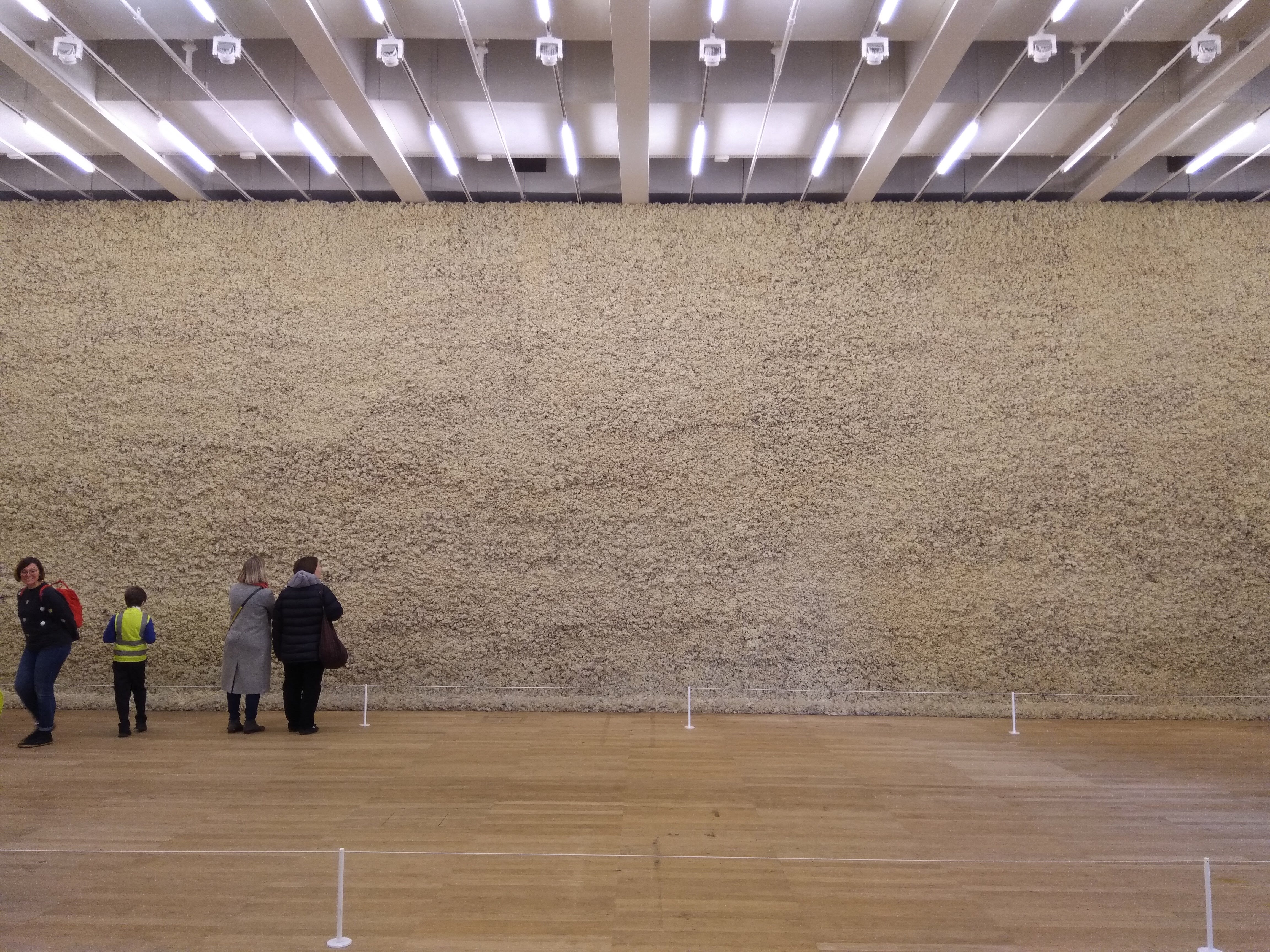
At first glance, it might not seem that there is much that connects the art of Anthony Gormley and Olafur Eliasson. Two weeks ago I would have summarised Gormley’s work as largely figurative, heavy, often made using metal and other industrial materials, and sombre in tone, while I tended to think of Eliasson’s as abstract, colourful and using a range of substances, natural and artificial, to playful effect.

Eliasson’s Moss Wall (1994)

Before visiting their recent exhibitions in London two weeks ago, the only thing that connected them in my mind was the fact that both shows were exceedingly busy and popular. This was based on the huge volume of posts I’d seen on Instagram, combined with an article in the Guardian in which gallery-goers expressed their chagrin that other people were getting in their way of enjoying art (more on that later).

Both exhibitions surprised me, starting with the Gormley. Although I’ve always enjoyed his work when I’ve come across it, I’ve often thought of it as fairly repetitive (frequently based on his own body) and ubiquitous. His sculptures are scattered across the country, in high-profile installations from Gateshead to Merseyside. In Edinburgh there are six Gormleys standing in a short stretch of the Water of Leith. But the Royal Academy show demonstrated how his artwork is much broader and more varied than the ‘universal’ self portraits we are frequently exposed to in his public art. His best works challenge how we perceive space, and how we perceive ourselves and each other through art.

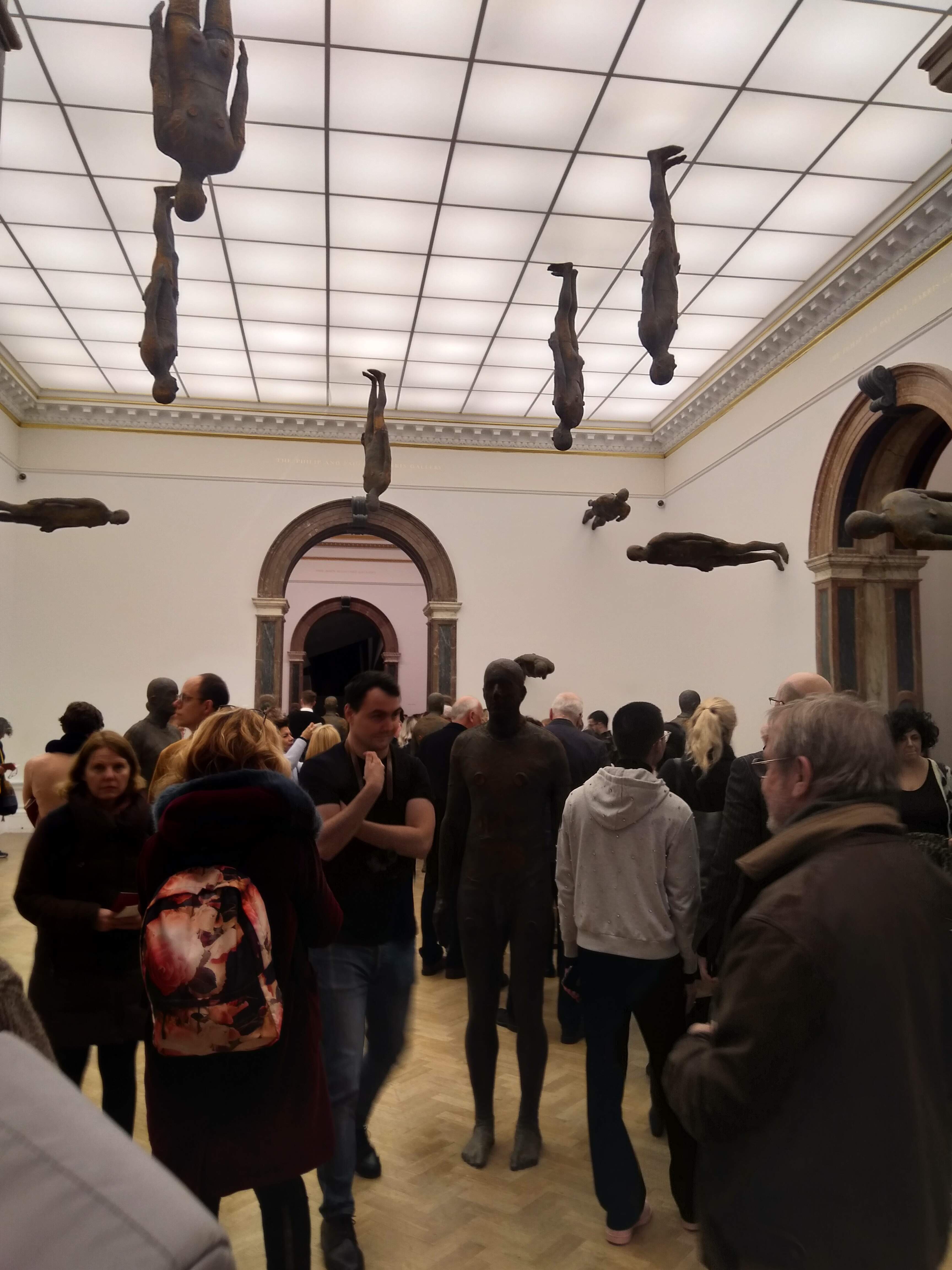
For instance, his Lost Horizon (2008), presents us with a familiar sight, multiple forms of Gormley’s body in cast iron, but in a different way. Bodies jut out at all angles and surround us, defying gravity and playing with our senses. The work isn’t ponderous, it’s fun. Seeing the exhibition on the last day meant that the room was packed with people, making it difficult to tell the sculptures from the live bodies that surrounded them.

Art and life intermingle in Lost Horizon I (2008)

Some of you might look at that photo and recoil at the number of people in the room. Yes, both exhibitions were busy. But part of experiencing art is noticing how others experience it: seeing other people react to and interact with art is one of the things I find most interesting about it. This aspect was what really made me see the connections between the two artists’ work. Humans play a major part in activating these artworks and making them resonate.

Visiting the Eliasson exhibition mid-week and during the day, I experienced it alongside a large school group of teenagers. Their interactions with Your Uncertain Shadow (colour) (2010), brought the work to life for me: they danced, flicked their hair, and had fun with it. One criticism that has been levelled at the show is that it’s a little gimmicky, but it is indisputable that this very quality makes it a good entry point for young people. And in turn, they remind us that we don’t have to be so serious all the time when it comes to art.

My fellow guests brought Your Uncertain Shadow (colour) to life

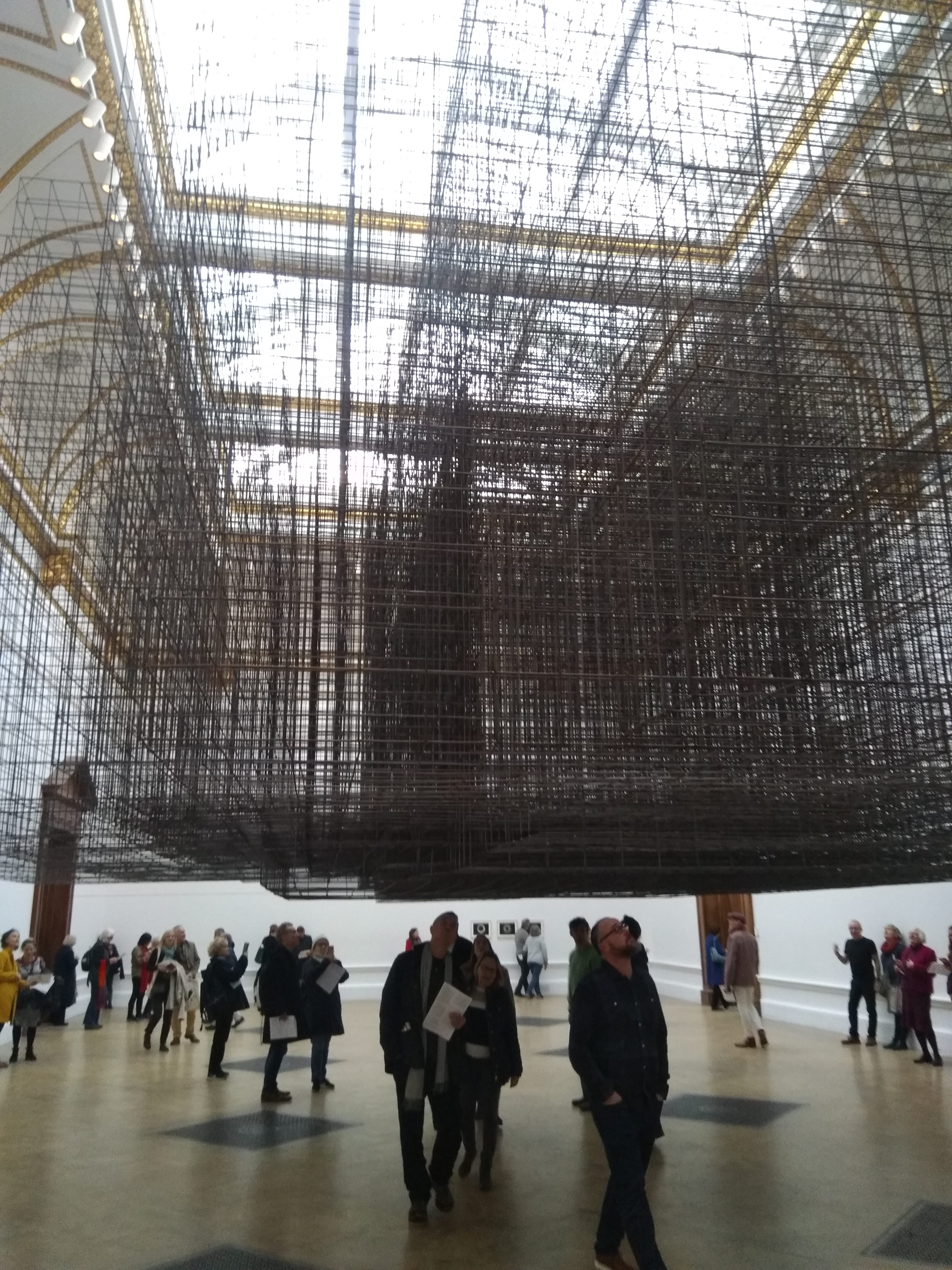
As well as having moments of levity and playfulness though, both exhibitions experimented with their visitors’ senses of fear and disorientation. Walking, sitting and lying beneath the Gormley’s colossal Matrix III (2019), 21 intersecting weighty steel mesh cages that contrasted satisfyingly with the Academy’s gilt cornices, felt genuinely daring. Cautiously making my way through the 39-metre fog tunnel of Eliasson’s Din blinde Passager (Your blind passenger) (2010), I wondered whether this immersive journey through colour and light would ever end (is this what they speak about when they say you see a white light when you die?!) Both were enormous, immersive, visceral and tinged with danger.

Walking underneath Matrix III – not for the faint-hearted

Alongside the colossal, statement-making art of these two big budget shows, there is also an exploration of vulnerability which makes them more than a bombastic celebration of these highly successful artists’ achievements.

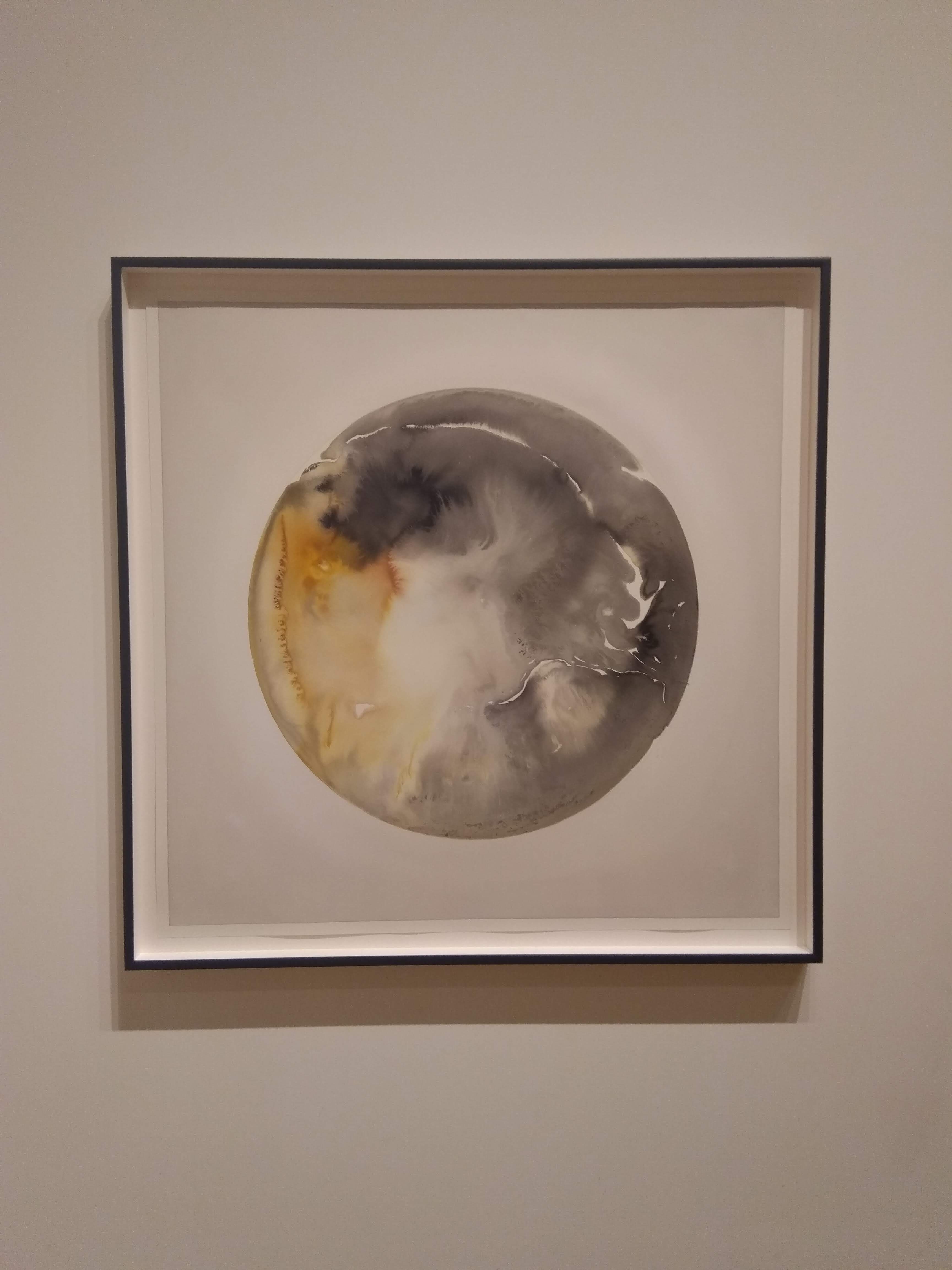
Eliasson’s work is centred around the environment, focusing on absence as well as presence, and soberly examines the loss of elements of our natural world in an era of climate crisis. Installations remind the viewer of the magic of the everyday: rain trickling down a window in Regenfenster (1999), the different effects that occur when light and water meet are made manifest in Beauty (1993) and Big Bang Fountain (2014). The ghostly imprints left by glacial ice melting into thin washes of colour in the Glacial currents series (2018) were almost haunting.

Glacial currents (yellow, sienna), 2018

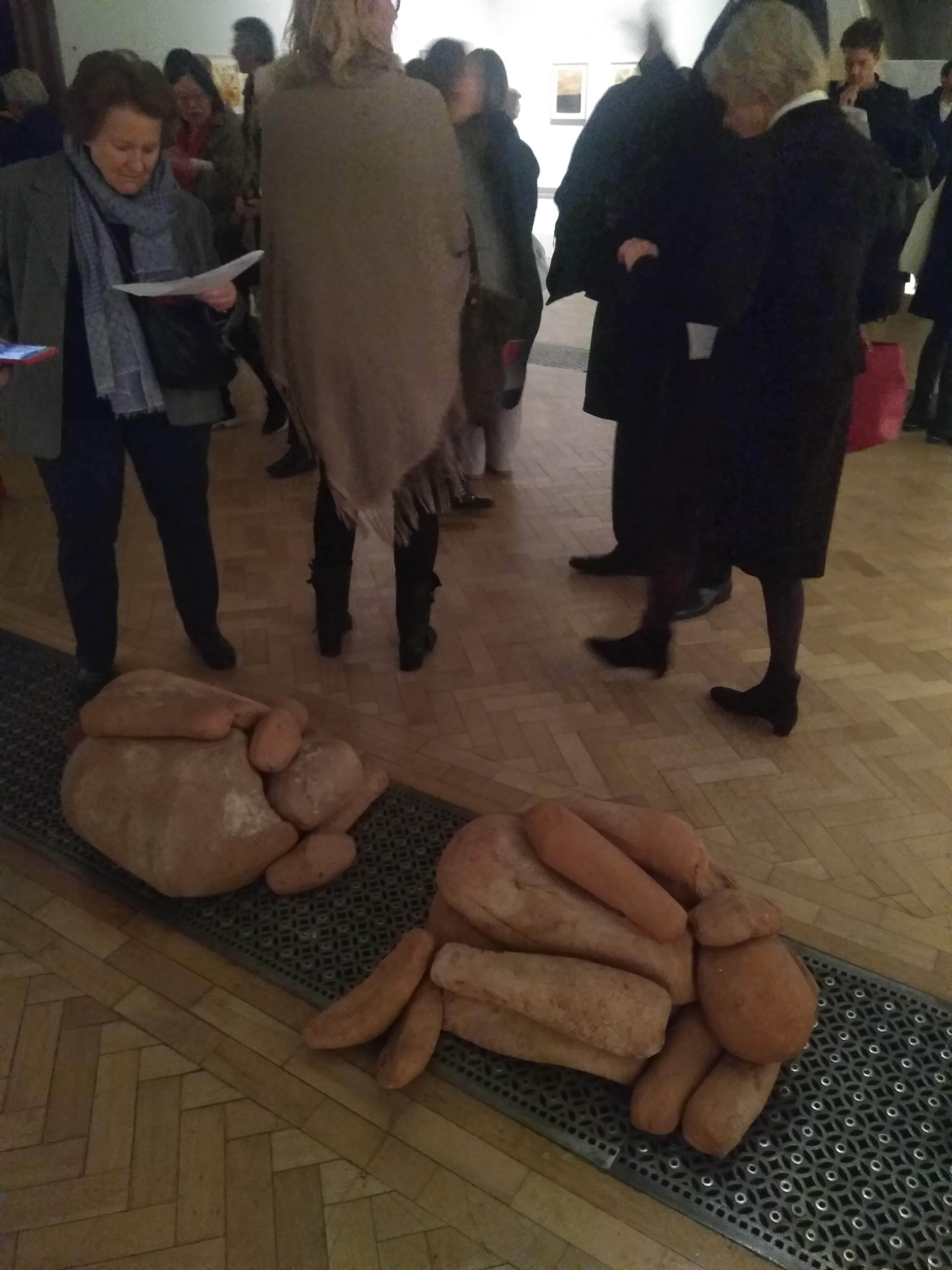
While Eliasson’s work focusses on the vulnerability of the planet, Gormley takes us back to ourselves once again. Starting the journey in the courtyard with Iron Baby (1999), at the end of the show we encounter ourselves once more, in Pile I (2017) and Pile II (2018). Stacks of simple, earth-coloured clay, huddled on the floor and without a plinth to protect them from the metal grates beneath, these small works are the hardest hitting of all in their unassuming fragility. We contemplate ourselves, our earthliness and our mortality.

Full circle: we encounter ourselves again as huddled lumps of clay

In very different ways, both artists are helping us to make sense of ourselves, our present, and heightening our awareness of our surroundings. That kind of lesson is worth braving a crowded exhibition for – and who knows – you might even feel inspired by those you have been thrown together with on your journey of discovery.