Goodwood Art Foundation

The corner of West Sussex where my Dad lives, you are never far from a large country estate. Brown National Trust signs proliferate (Petworth; Uppark), and there are also estates that are still going, that still belong to some of the country’s richest families. You can tell this even by the architecture. In the villages surrounding Midhurst, many of the houses windowframes are painted in a bright saffron yellow, the colour of corn-fed chicken’s egg yolks. To a casual passerby, this might just be a jolly colour scheme collectively chosen by the locals, but in reality they are a territorial marker, showing that they belong to the Cowdray Estate (a 16,000-acre estate owned by Michael Pearson, aka the 4th Viscount Cowdray). 

The Viscount’s neighbour is Charles Gordon-Lennox, 11th Duke of Richmond. His estate, Goodwood, is about 10 miles south of Cowdray. He is the owner of the the Goodwood Art Foundation, a beautiful new sculpture park and exhibition space tucked amongst the rolling hills of the South Downs. From 1992-2020, it was the site of the Cass Sculpture Foundation but it has been expanded and reopened. As it’s just a stone’s throw away from my Dad’s, I was keen to get there. Especially when I found out their first headline exhibition is by Rachel Whiteread, an artist I researched as part of my Master’s in 2019.
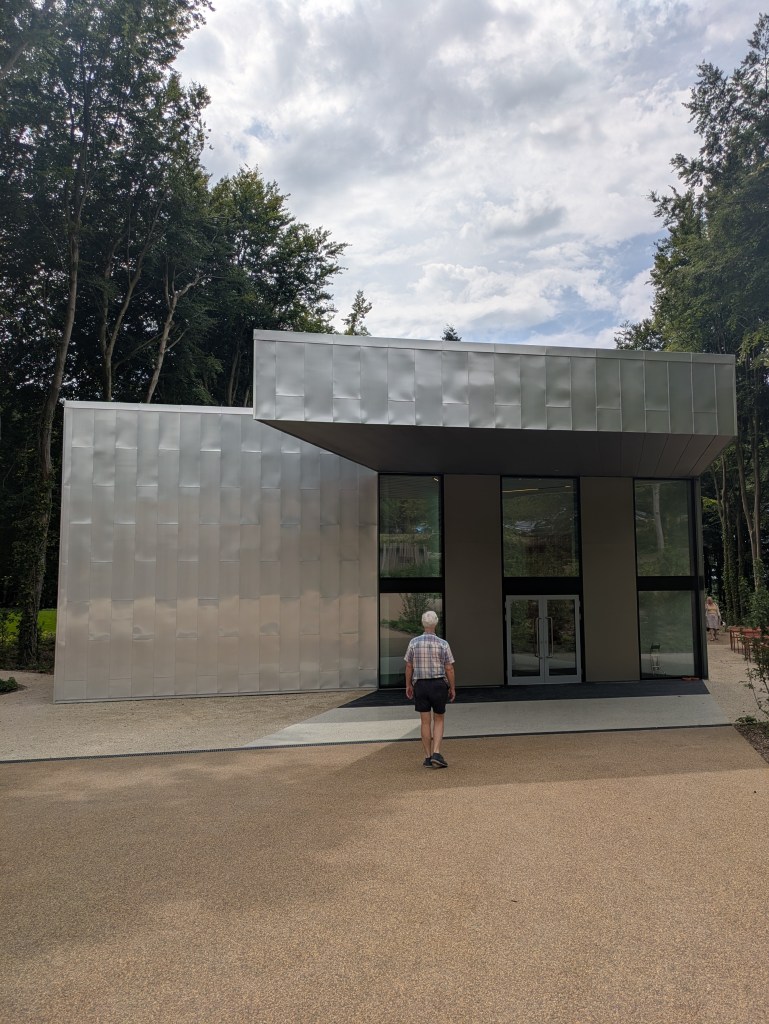
The Restaurant at Goodwood Art Foundation with my Dad for scale

My first impression is one of taste: everything looks new and clean and swanky. Like it cost a lot. There’s a striking black and silver and asymmetrical building, and for a second, it feels like I’m back at the Louisiana museum on the far reaches of Copenhagen. But the landscape around here is undeniably English: the rolling hills, the ancient woodlands, and the mighty oak trees dotted in the fields. It’s a fascinating, jarring almost, setting for Rachel Whiteread’s work, which has always struck me as unfailingly urban. Her use of concrete is what defines much of her sculpture, with her most famous work, House (1993) filling up an east London townhouse from the inside out, then its cast left behind, standing as a lonely monument to demolition and faded domesticity. 

This season, Whiteread is the main focus of the larger gallery, one of two indoor art spaces at the Foundation. In the centre, the space is dominated by her work Doppelgänger (2020-21), a bright white ghost of a tumbledown corrugated iron shack, trees poking through the building’s seams. However, I was drawn to the photos on display, the first substantial showing of her photography. Her photos, like most people’s, were largely taken on her phone and capture landscapes, interesting shapes, everyday encounters with the traces of human presence, or as she says “eccentric features” that interest her. Whiteread views photographs as a form of notetaking, a sentiment which strongly chimes with me. Part of the reason for starting this blog came from a desire to capture those artistic ‘encounters’ that one meets within the city. So in Whiteread’s photos, we see fragments of colour against brown and grey of signs and posts, and the pleasing, satisfying textures of tiles, pictured side by side with dried, fragmented earth. The wall labels tells us the locations for these images: France, Rome, California, Essex, Tuscany.
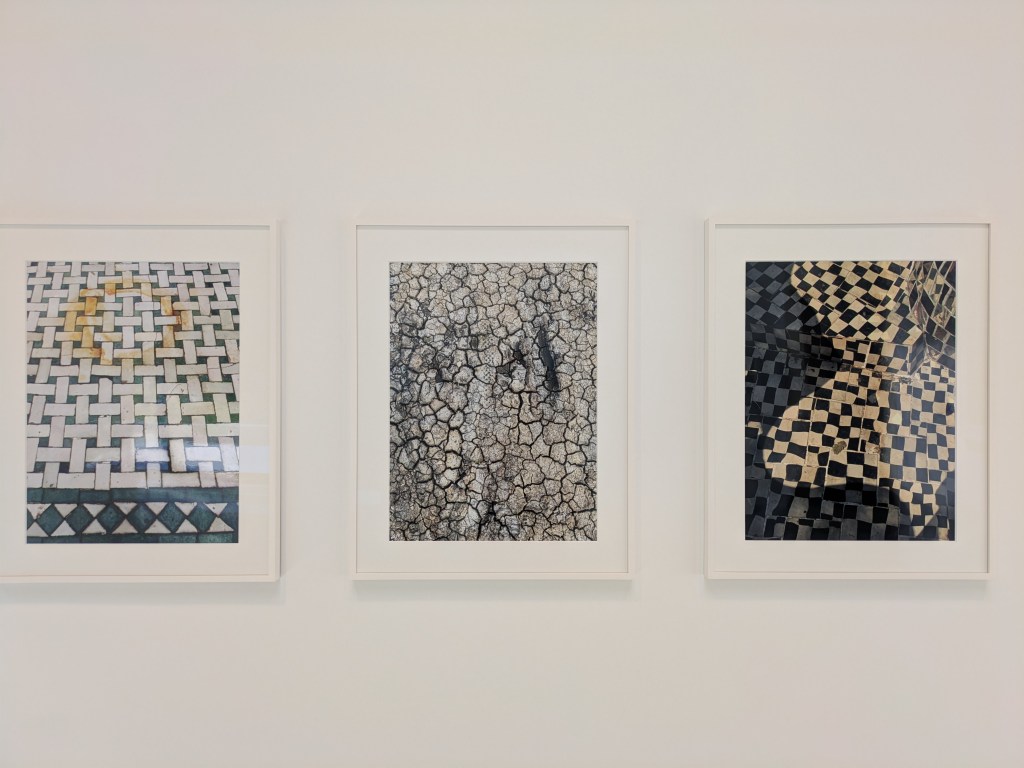
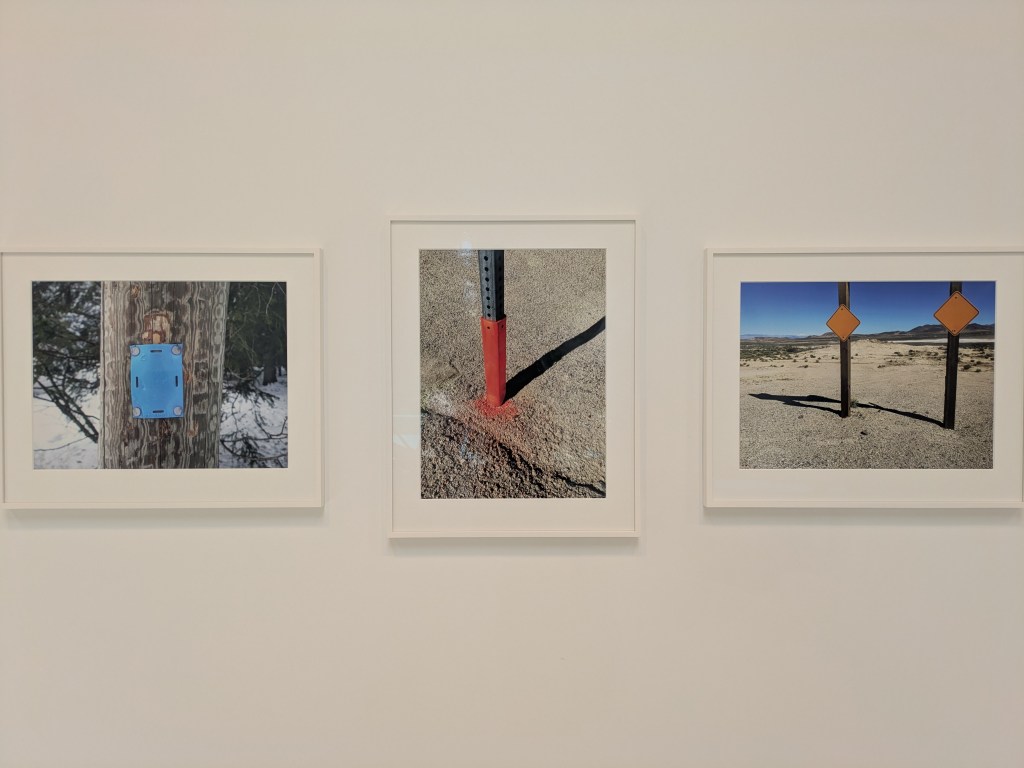
Whiteread’s photographs

Back outside, my Dad and I strolled around at an easy pace, enjoying the vistas through the woods and occasionally playing a game of “is it an artwork or is it a nicely arranged pile of wood?” The landscape gardener, Dan Pearson, clearly has a nuanced understanding of the playful boundary between them. I enjoyed the exploration of materials and fragility in Veronica Ryan’s Magnolia Blossoms (2025) a circle of fallen petals and buds made from bronze. Rose Wylie’s Pale-Pink Pineapple/Bomb (2025) isn’t my type of thing, but looked pleasantly incongruous in the landscape. Unfortunately, Hélcio Oiticica’s Magic Square #3 (1978) was not yet open for exploration, but I’ll go back.
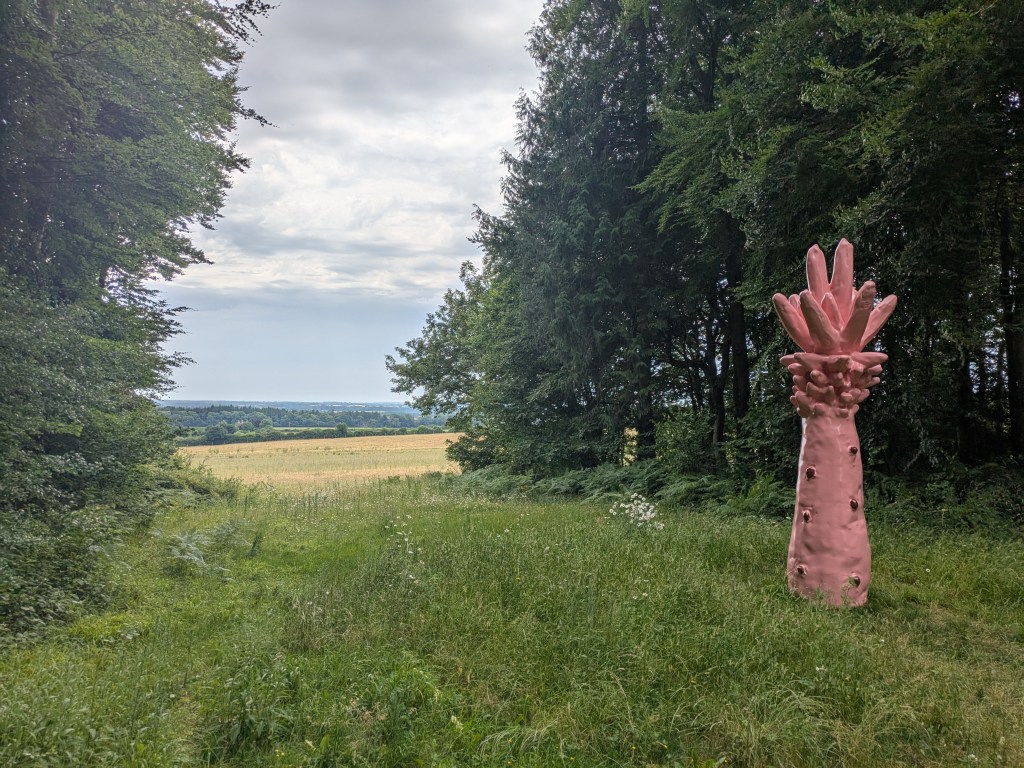
Rose Wylie’s Pale-Pink Pineapple/Bomb (2025)

When we came upon Susan Phillipsz’ work As Many As Will (2015), it took a few moments of listening to the silence (actually the birds and the wind in the trees) before being startled by a lone signing voice, soon joined by others. This beautiful ‘in the round’ song, which Phillipsz sings herself with her soft Scottish accent, about refuge and Robin Hood moved me, but I couldn’t quite say why I had tears in my eyes and a strange catch in my throat. Something about feeling lucky and sad at the same time. How did I get to stroll through this beautiful landscape, stumbling upon art, when there is so much horror unfolding before our very eyes on our phones from morning ‘til night. Why is the world like this.

Whiteread’s unmistakable footprints appear again across the wildflower meadow, her signature concrete casting process back with Down and Up (2024-25), a staircase flung in the wide field like a strange fragment of a disappeared home. The free guide booklet contained an interview with Whiteread, where she refers to this sculptural staircase as  “universal memory of a commonplace architectural form”. I cannot think of her work without feeling it is haunted, these casts of buildings capture a ghostly suggestion of a structure that once was and now isn’t there any more. It is no wonder her art is associated with memorials: her Memorial to the 65,000 Austrian Jews who were Murdered in the Shoah in the Judenplatz in Vienna is an unforgettable work. Seeing this staircase then, one cannot help but think of ruined buildings of Gaza, of destruction and war. It is inescapable.
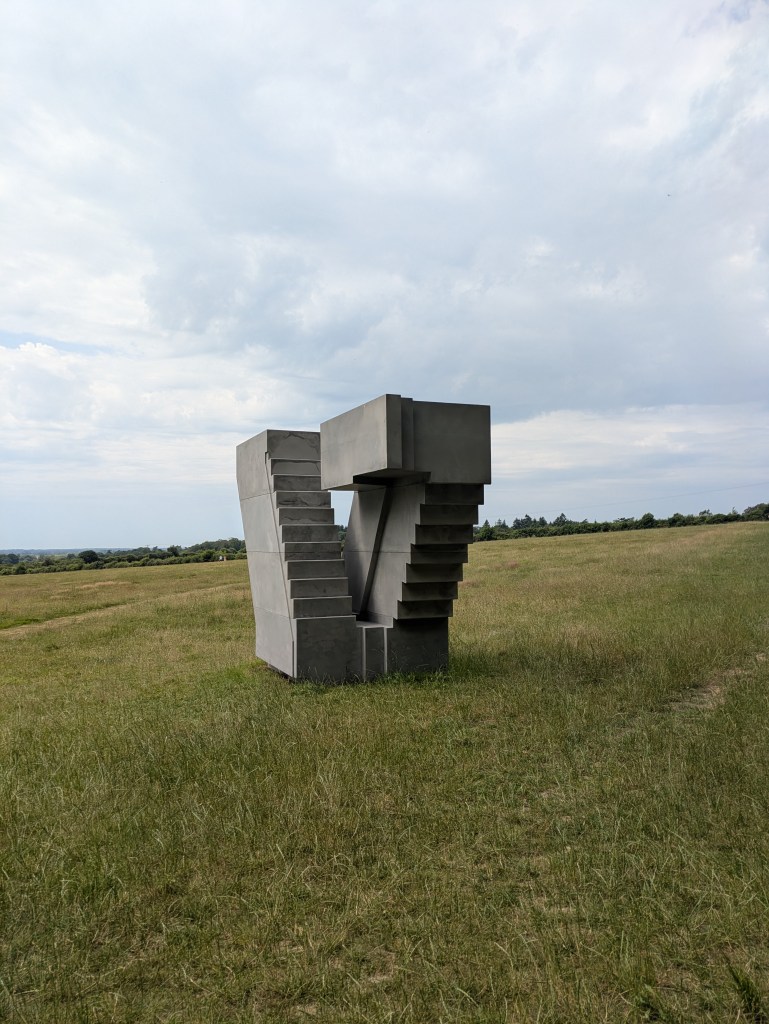
Whiteread, Down and Up (2024-25)

The smaller gallery space housed Amie Siegel’s Bloodlines (2022). I don’t normally engage video art for long, I’m naturally impatient. Here though, in the shade and darkness I was completely captivated by the luxurious interiors of Seigel’s film. Unnarrated, the camera drifts eerily along magnificently decorated hallways and into rooms with ticking clocks, marble pillars and strange taxidermied animal collections. We see an ‘insider’ view of huge stately homes, that are choc-full of artworks. It felt very apt that Bloodlines, which traces the movement of artworks by George Stubbs between private collections and public museums but really explores wealth, history, the legacies of ownership, class, and the strange power dynamics of who owns art and who can look at, and on whose terms that is, felt an important nod to where we were: the art collection of an actual Duke, (because yes, they’re still around), in the middle of a field in England.
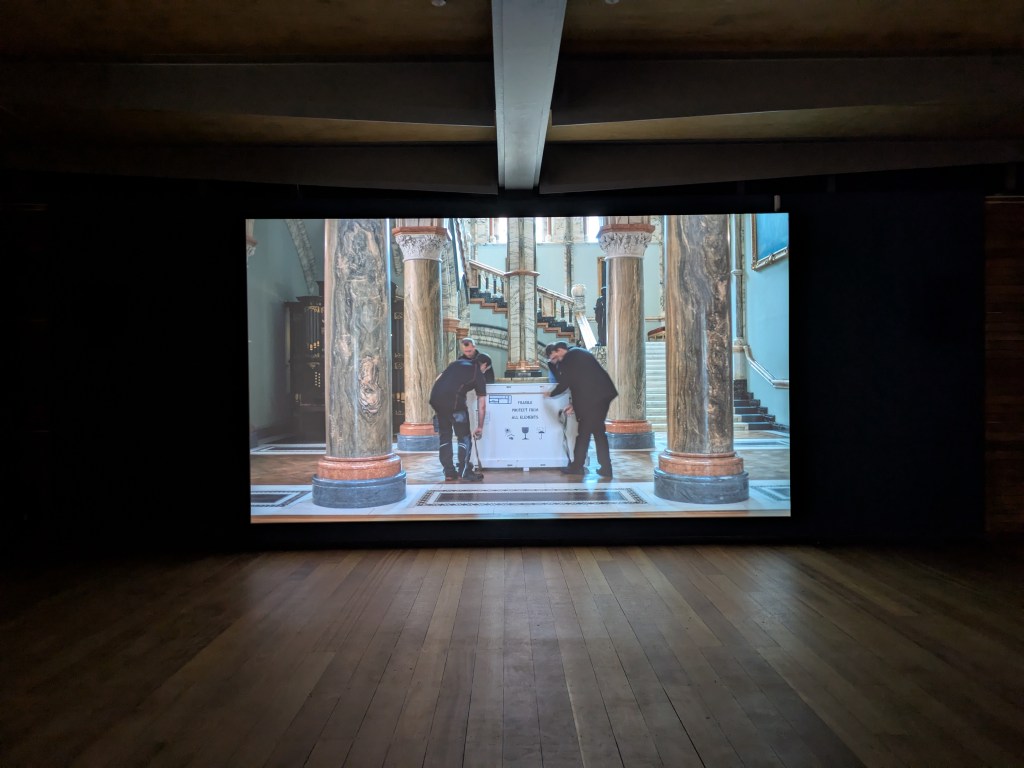
Film still from Amie Siegel’s Bloodlines (2022)

Mark your diaries! My must-see art for this year.

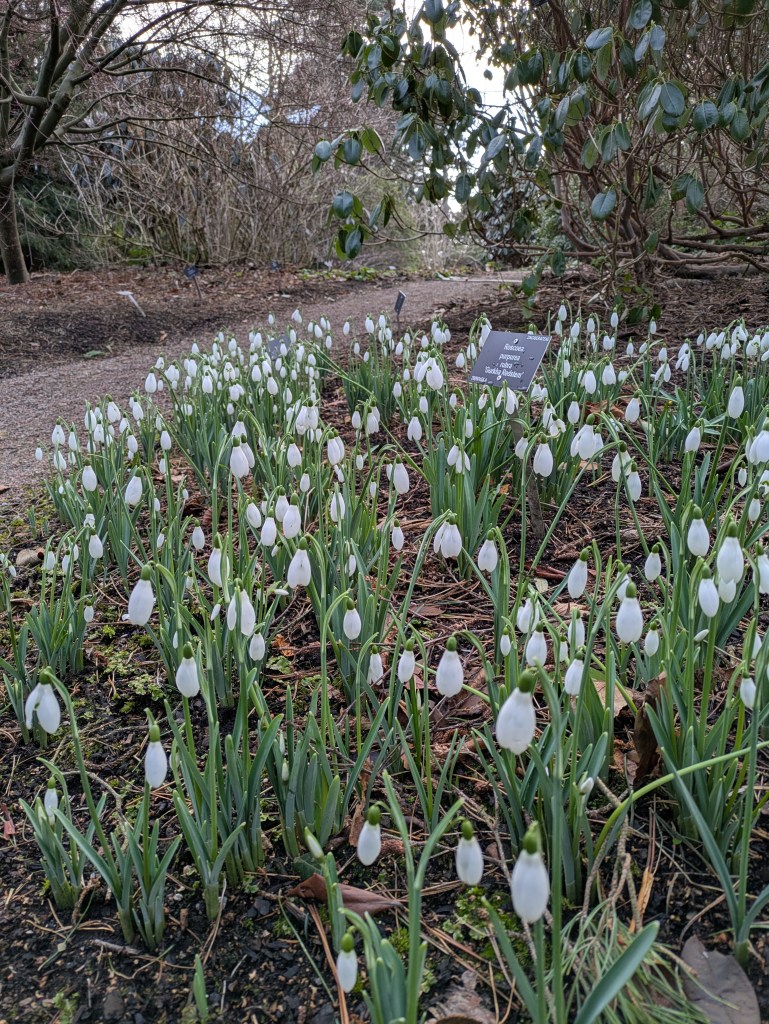
Steadily, tentatively, light is creeping back. The snowdrops have been sighted at the Botanic Gardens. There are still a few dregs of colour in the sky after the work day is done. Slowly we begin to emerge from hibernation, and what better way to celebrate this than by letting you know about some of the art exhibitions I’m most looking forward to this year.

Over my years of writing about art (Encounters Art is four years old in May this year!) there are a few things I’ve learnt. Unfortunately, you have to be organised. If you see something you like the look of, make sure you go to see it close to the start of the run. Otherwise, you just won’t get round to it. I have learnt this the hard way far too many times. Even with shows that will be on until 2026, it’s better to strike while the iron’s hot. So, let’s all get our diaries out and get these dates marked! Exhibitions are listed in chronological order.

Snowdrops sighted at the Botanics

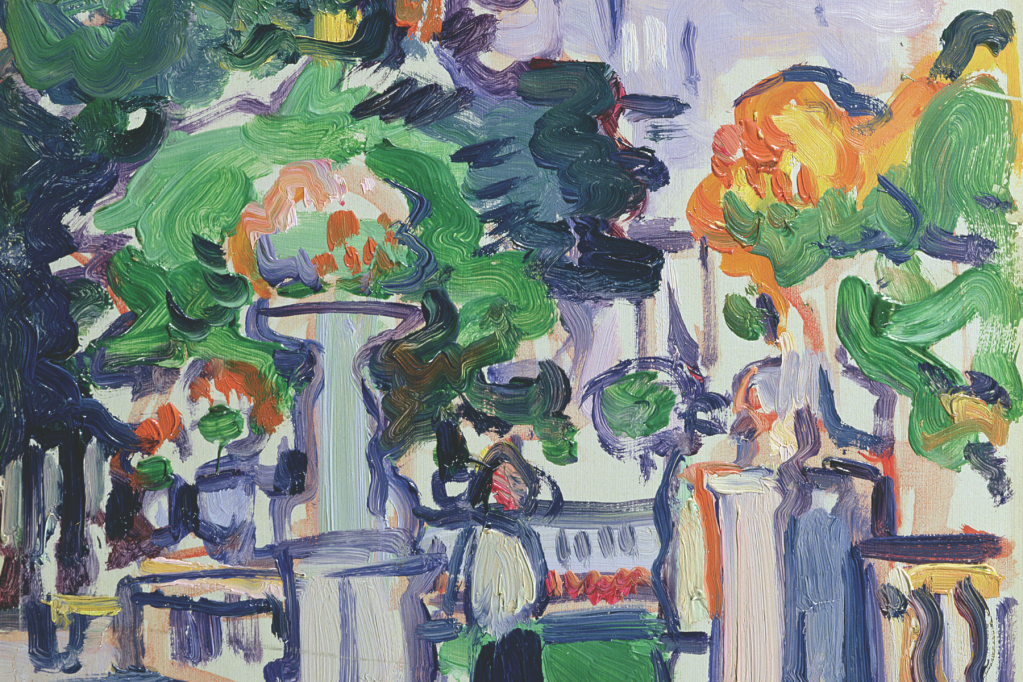
The Scottish Colourists – Radical Perspectives at Dovecote Studios

Friday 7 February to Saturday 28 June

This looks like a fascinating show, hosted by Dovecot Studios – one of the most underrated places to see art in Edinburgh. The Scottish colourists were a group of four painters around in the early 20th century, who were influenced by the time they spent in France. This exhibition shows their work alongside Matisse and Derain, as well as Vanessa Bell and Duncan Grant from the Bloomsbury Group. I LOVE this era of painting but don’t know much about this much beloved group of Scottish artists, so I’m looking forward to learning more. General Admission tickets are £12.

Luxembourg Gardens by SJ Peploe, c.1910 from the Flemming Collection

Jerwood Survey III at Collective

Friday 28 February to Sunday 4 May (Wednesdays – Sundays)

Collective, perched high atop Calton Hill, is an art space I feel I have neglected. I think I’ve seen a few shows there that didn’t quite land with me, which have made me lazy about climbing that hill. However, I intend to rectify that this year. Their first show of the year is the Jerwood Survey III. This initiative brings together ten emerging, early career artists who have been recognised and selected by leading artists for the outstanding work they are creating. Collective is the final stop on this exhibition’s tour, it has been to London, Cardiff and Sheffield. I love the concept of a touring exhibition – several feature in this list. Themes addressed by the artists include colonialism, climate change, healing, gender, sexuality, folklore and spirituality. So this is one to visit when you’ve got brain space and energy for art that can challenge, provoke and make you encounter the big topics. Entry is free, though a £5 donation is suggested. Please donate if you can afford to do so: these are trying times for the arts in Scotland and exhibitions are expensive to run. Collective is open Wednesday-Sunday.

Acts of Creation: On Art and Motherhood at Dundee Contemporary Arts

Saturday 19 April to Sunday 13 July

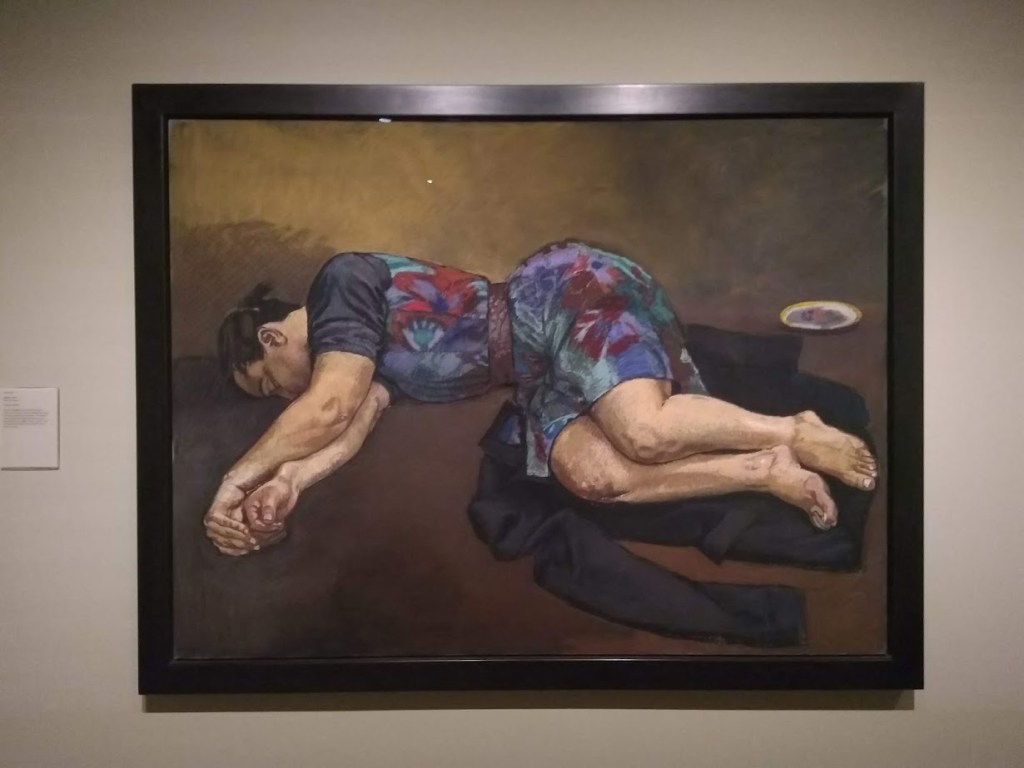
I love Dundee Contemporary Arts. If I lived in Dundee I’d be there all the time at their cinema which seems to only show interesting movies (I just checked, it’s also showing Mad About the Boy, which is fine with me). The Acts of Creation exhibition has been on my radar for a while. Hettie Judah, the curator, has done an amazing job of advocating for artists who are also mothers. She uses her Instagram as a platform for artist-mothers work and I love the idea of an exhibition that interrogates motherhood in all its complexity. Featuring some pretty big hitters of the art world, including Tracey Emin, Paula Rego and Chantelle Joffe, I’m so glad this is finally coming to Scotland – it began at the Hayward Gallery in London and has also been at the Millenium Gallery in Sheffield. I think tickets are free, can’t see anything to suggest otherwise. The gallery is open Wednesday-Sunday.

Sleeper by Paula Rego, 1994
Photographed at the ‘Obedience and Defiance’ show at Scottish National Gallery of Modern Art, 2019

The murals at Mansfield Traquair

This is another one on the “I’ve been meaning to go for years but never got round to it” list. The Mansfield Traquair Centre is referred to by some as ‘Edinburgh’s Sistine Chapel’, which is a pretty big claim. Originally it was a Catholic Apolostolic Church, completed in 1895. The building’s most famous feature is its murals, painted by the renowned Phoebe Anna Traquair in the 1890s. The space is currently used for weddings, parties and corporate events, but they host open days and tours usually on the second Sunday afternoon the month, with more dates added during the Fringe. Free – more info on tours and dates here.

Linder: Danger Came Smiling at Inverleith House, Royal Botanical Gardens

Friday 23 May to Sunday 19 October

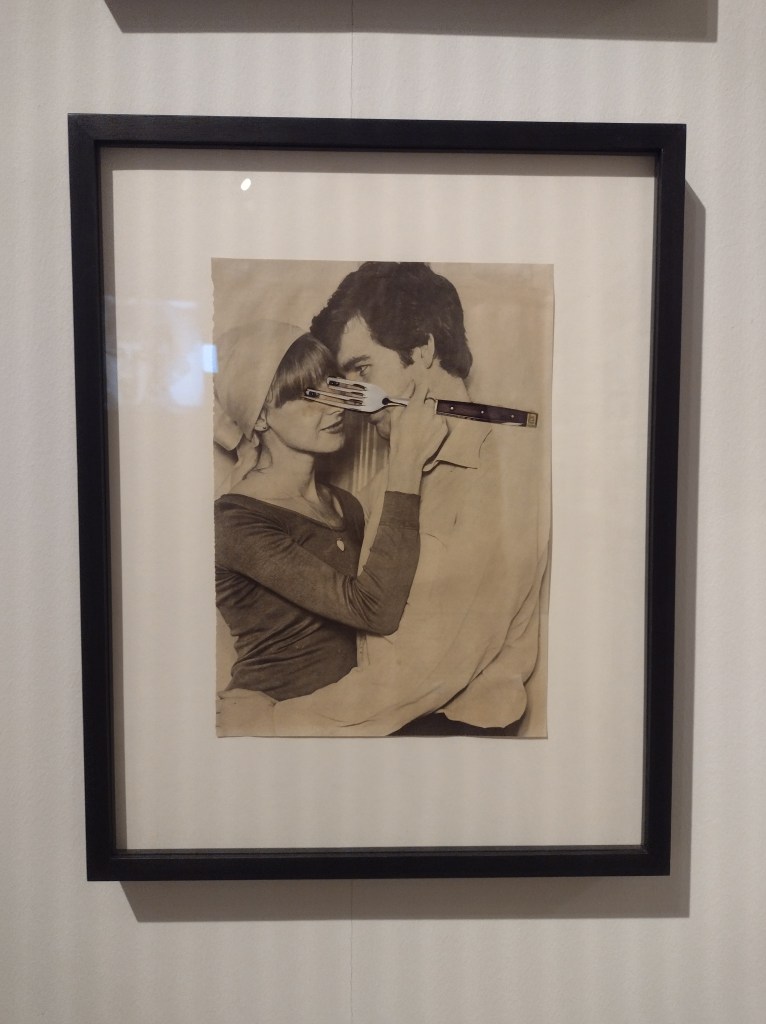
I was really excited hearing about this show and was trying to figure out when I could get down to London to see it at the Hayward Gallery when, lo and behold I find out it’s coming to Inverleith House! This will be a remarkable show – a retrospective of feminist icon Linder’s work in the year she turns 70. This weekend in the Guardian there was a long and fascinating interview on how she uses trauma and porn to inform her art, and I definitely think she’s going to ruffle a few feathers of people visiting the Botanics! She’s a very cool punk artist who does incredible collages. This one, of a woman seemingly in a picture of domestic bliss, is gouging her eyes out with a fork (I saw it at the Women in Revolt exhibition at the National Galleries of Scotland earlier this year). I can’t wait to see more of her provocative and radical work. Not sure on ticket details and pricing yet – watch this space.

Untitled collage by Linder (1976)

Mike Nelson at Fruitmarket

Friday 20 June to Sunday 28 September

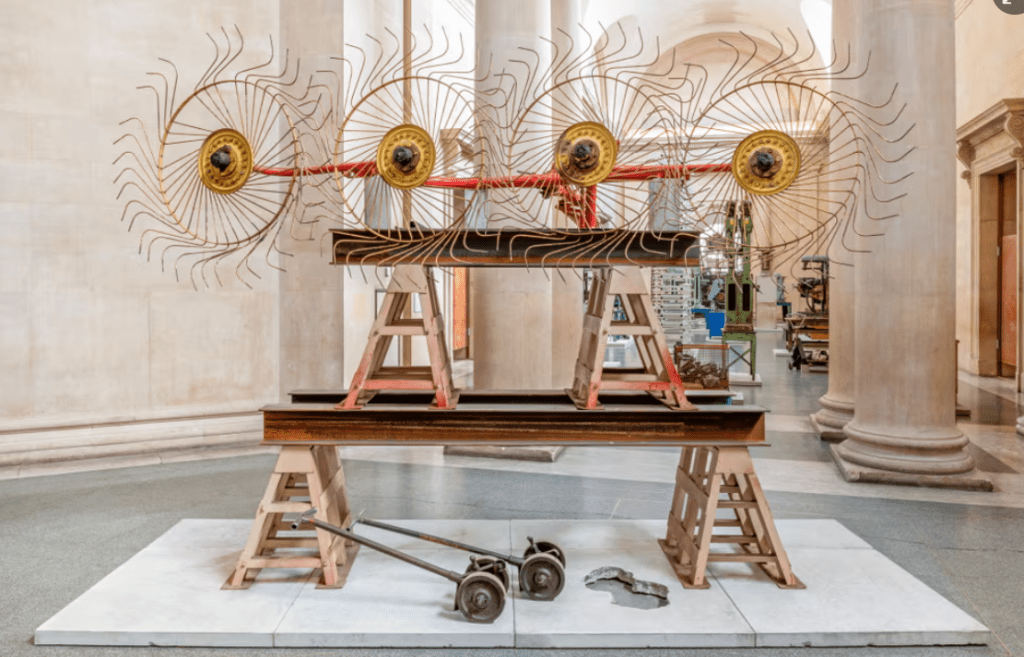
I first came across Mike Nelson’s work at a huge exhibition at Tate Britain in 2019, which art critic Laura Cumming referred to as his ‘all time masterpiece’. I’ll be interested to see where he goes from there. His work features huge installations, often formed from scrap metal and defunct machinery. For this exhibition, Nelson will be using Fruitmarket’s bare Warehouse as a studio in the weeks preceding the exhibition, and I think his work will marry well in that space, where the art has to take on an industrial scale. Fruitmarket exhibitions are free.

A detail from Mike Nelson’s The Asset Strippers at Tate Britain, 2019

Andy Goldsworthy – Fifty Years at the Royal Scottish Academy

Saturday 26 July – Sunday 2 November

You have probably seen an Andy Goldsworthy artist without having even realised it. Last week at the Botanic Gardens a slate structure that looked like an old cairn caught my eye, and it turned out to be a large sculpture by him. His work, Coppice Wood, at Jupiter Artland is probably my favourite there. He uses nature and the natural elements of our world to craft artwork that is simultaneously vast in scale and understated in tone. The exhibition brings together more than 200 works including photographs, sculptures and expansive new installations built in-situ and specially created for this exhibition. Unlike some of the other shows on this list, it’s only being exhibited in Edinburgh – part of Edinburgh Art Festival – but one to visit before the Fringe crowds arrive, if you can. Full price tickets are £19. Read to the end for my tip on getting cheaper tickets.

Stone Coppice by Andy Goldsworthy (2009) at Jupiter Artland

Jupiter Rising x EAF

Date TBC

Those of you who’ve been reading the blog for a while know I’m a big fan of both Jupiter Artland and Edinburgh Art Festival. But I’ve never made it to their big collaborative summer party/festival, Jupiter Rising x EAF. This time, I’m determined to be there. It brings together experimental music, performance, poetry and art. Essentially it sounds like a big fun queer art party. Does anyone want to give me a lift?

Pittenweem Arts Festival

Saturday 2 to Saturday 9 August

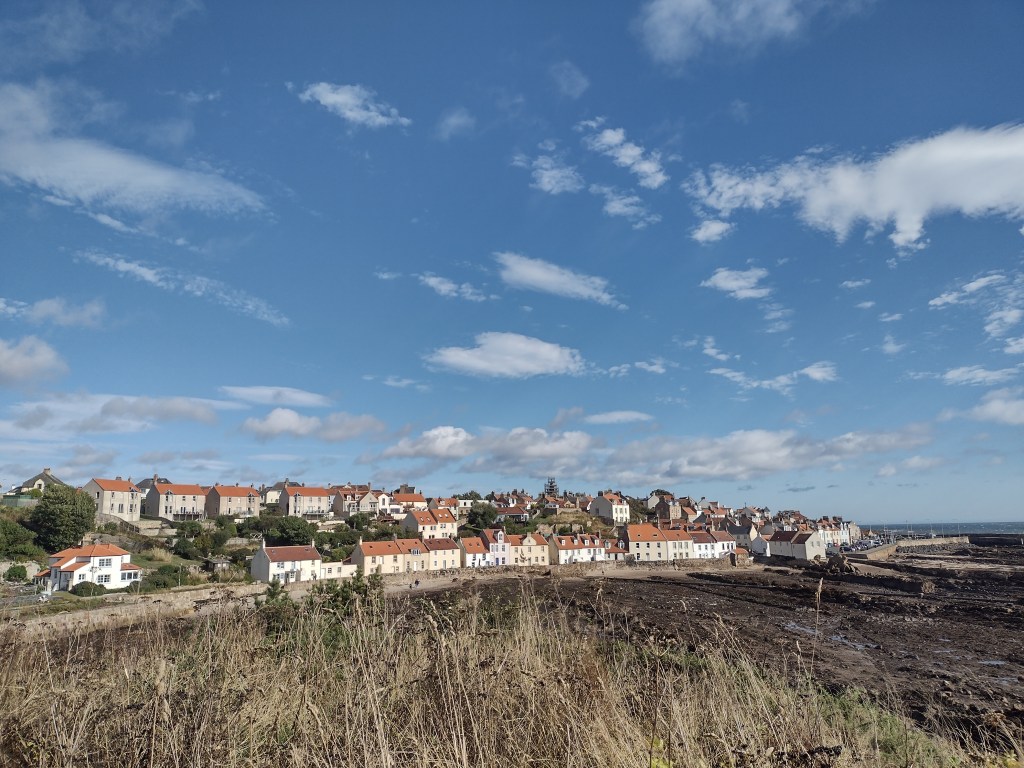
This is an event I’ve been meaning to go to for a while, and it’s in one of my favourite corners of Scotland. Pittenweem is one of the prettiest coastal villages in the East Neuk of Fife. The annual art festival brings the joy of art to everyday spaces – homes, garages and sheds. I think it sounds like a lovely way to spend a day, wandering along the Fife Coastal Path (hot chocolate at the Cocoa Tree Cafe, lunch at the East Pier Smokehouse) then browsing some art, and chatting to artists, maybe purchasing something new for your home too.

Pittenweem looking pretty

Art Walk Porty

6 to 14 September 2025

OK I am biased with this one as I’m on the Board of the organisation, but Art Walk Porty is always one of the highlights of the art calendar in my year. It brings together artist residencies, with events, workshops, and the art houses, where people open up their homes to exhibit their art. While the programme is yet to be announced, this year marks 10 years since the organisation began, so it’s bound to be a packed and celebratory week. I am always in awe of how much the Art Walk team manage to deliver, and they recently managed to secure multi-year funding from Creative Scotland for the first time. Watch this space as more details of the programme emerge.

Rolled over from last year, I still want to visit Mount Stewart House in Bute and the Italian Chapel, Orkney. You can read more about my 2024 bucket list in last year’s blog post here.

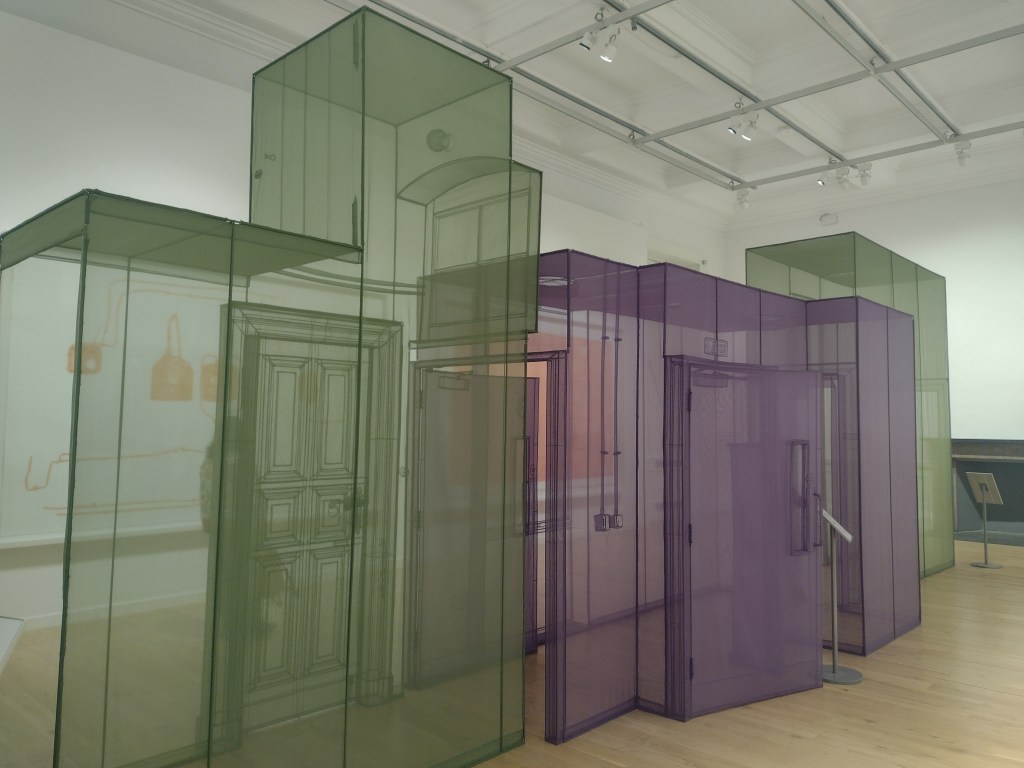
Finally, I feel the list wouldn’t be quite complete without a nod to two exhibitions I am intending to see in London. Firstly, Kiefer/Van Gogh at the Royal Academy London (28 June – 26 October) which is sure to be astounding. My Masters’ Dissertation was on Anselm Kiefer and his retrospective at the Royal Academy in 2014 was one of my favourite shows I’ve ever seen. At Tate Modern, I’m hoping to see Do Ho Suh: Walk the House (1 May – 19 October). This is after encountering his work for the first time at the one of my favourite exhibitions of the 2024 at the National Galleries of Scotland. I’m very keen to see more.

Do Ho Shu installation view at Tracing Time exhibition, National Galleries Scotland

Top tip: if you’re seeing lots of art this year, I’d recommend looking into buying a National Art Pass from the Art Fund, which currently costs £62.35 by direct debit. Almost every charging exhibition gives you a discount if you have the card, you get a cute quarterly magazine with interesting article and art news, and most importantly, you’re supporting the arts.

I’d love to hear what you’re looking forward to, and perhaps any major moments I’ve missed from my list! Feel free to get in touch using the comments, and don’t forget to follow me on Instagram to see if I make good on all these art ambitions for 2025.

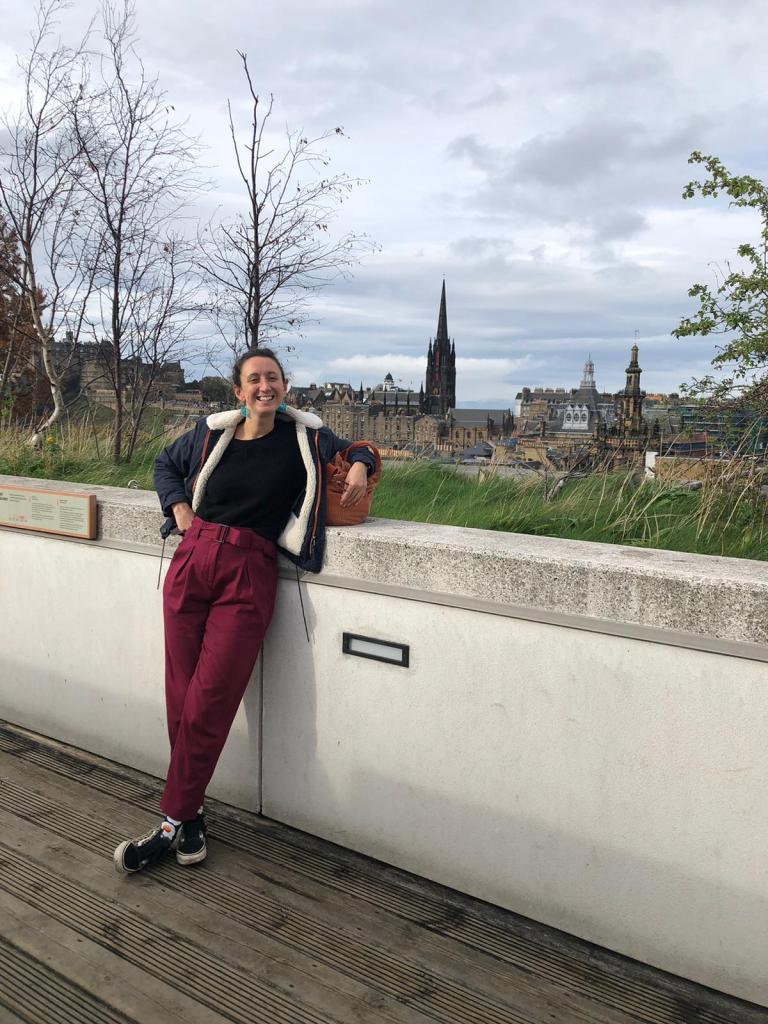
On the roof of National Museum of Scotland

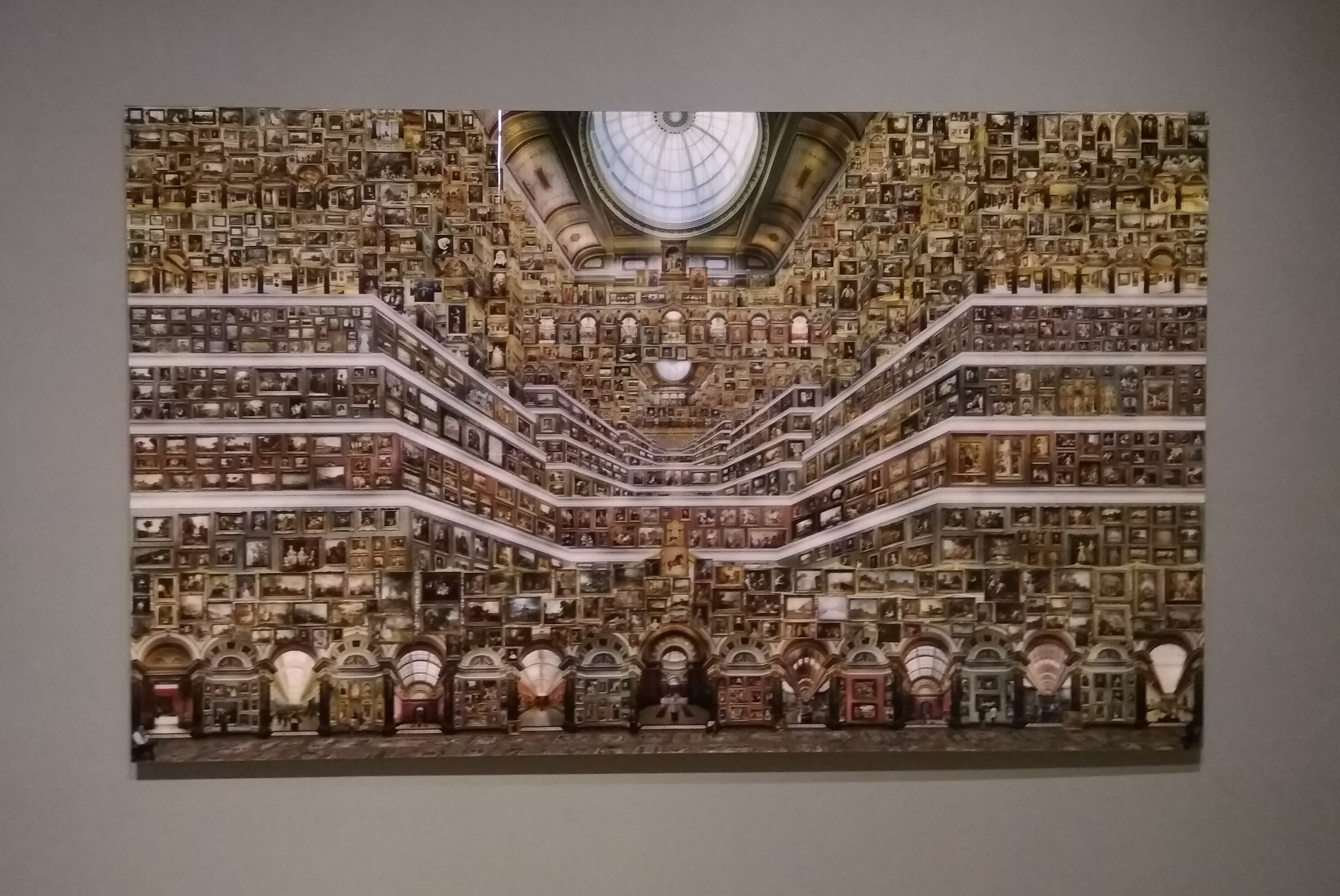
‘National Gallery, London’, by Jean-François Rauzier (2018)

I keep on thinking about a remarkable work I saw as part of Cut and Paste: 400 Years of Collage at the Modern last week, which I didn’t include in my review. The work was made in 2018 by Jean-Francois Rauzier (b.1952) and is called National Gallery, London.

At this stage I will admit that I may have been predisposed to think favourably of the piece. I worked at National Gallery for around four years, and the bonds I form with places dear to me don’t tend to fade away casually. This work recreates some of the place’s grandeur, its abundance, then mashes it up and reimagines it in the most striking way.

Familiar architecture, reimagined

The composition is made up of thousands of different photos of the National Gallery, with around 3000 works from the collection digitally stitched together (hence being part of the ‘Cut and Paste’ narrative). The National Gallery’s architecture has been futuristically transposed, its famous long vistas and arches lined up across the base of the work, while the broad white borders that cut horizontally across the centre give the impression of a multi-storey building, packed to the rafters with paintings in a dizzying salon hang.

National Gallery, London is one of Rauzier’s “Hyperphotos”, which he began creating in 2002 and which combine the feeling of a panorama with microscopic detail. While it may not be evident from my own photographs of the work, snapped during an exhibition visit, each painting is reproduced with pinpoint accuracy, astounding detail and clarity. Getting up close to the work, the viewer can pick out any number of famous, recognisable and well-loved paintings. For me, finding some of my old favourites was like searching for the faces of long lost friends in a crowd.

I found George Stubbs’ Whistlejacket (1762), a painting I loved as a child, taking pride of place in the centre.

One of the special things about the National Gallery is that in the action of walking through its rooms, the visitor goes on a pretty comprehensive journey through the history of Western European painting from c.1250-c.1930. Within that broad narrative, each painting tells an individual story, and captures something of its own historical moment. With the help of wall texts, written by curators and educators, we as viewers use clues to decipher that story, such as the subject matter, the style in which it is painted, the life of the artist, or through the artwork’s history as an object itself (who it was painted for, who has owned it throughout the centuries).

Even though I am lucky enough to be familiar with some of the works photographed by Rauzier, I felt as though I needed hours, if not days, to look properly at this artwork and the paintings contained within it, just as when you visit an art gallery you know it won’t be possible to absorb everything before what a friend of mine calls “museum back” kicks in and you need to sit down in the cafe.

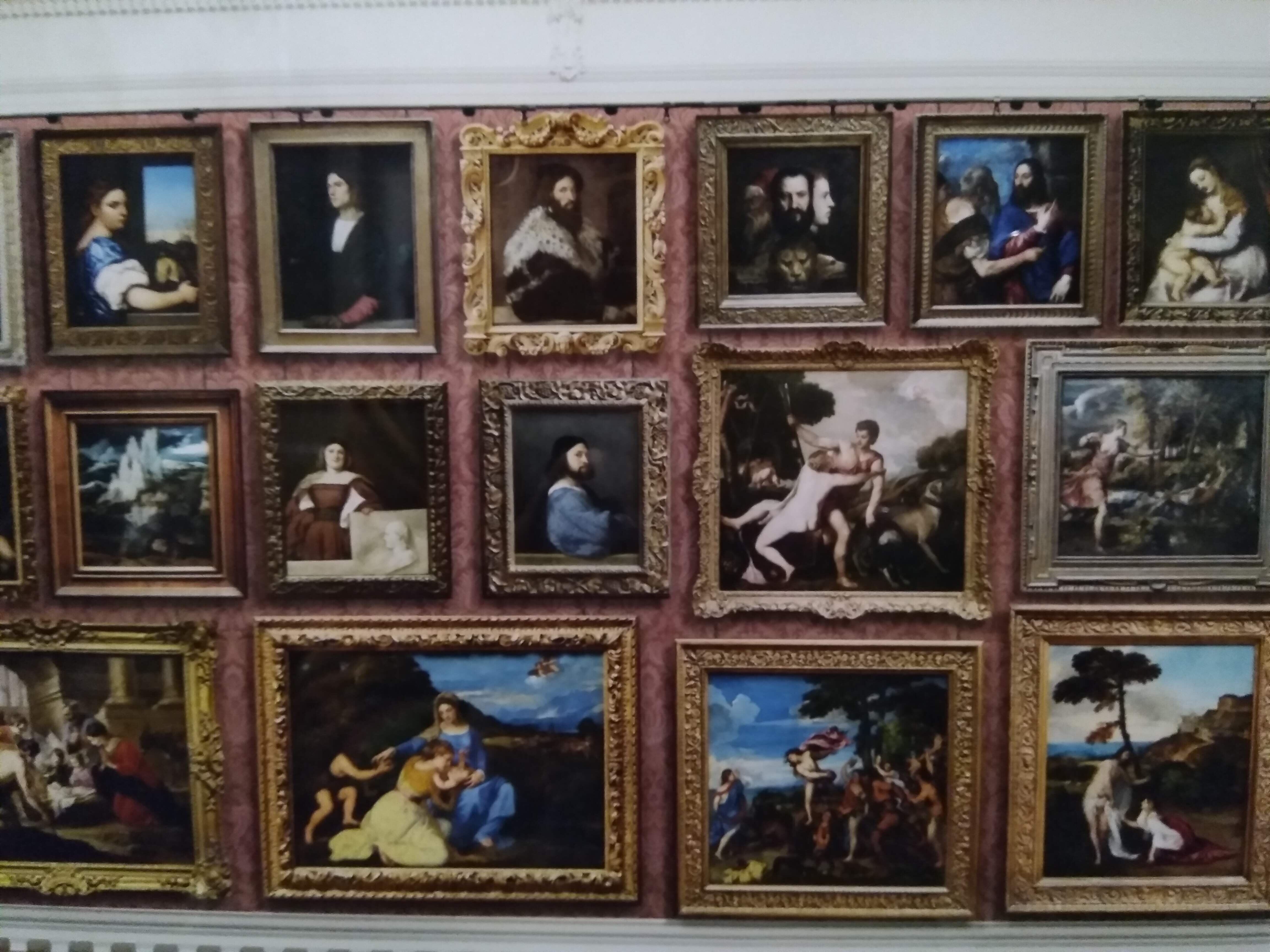
A wall of paintings by Titian (1490-1576). What’s not to love?

There is so much life packed into every single artwork, and the more you learn about the history of art, the more remarkable it is that here, Rauzier has piled a major chunk of that sumptuous and fascinating history into one single work, exercising his own curatorial and architectural choices along the way. He tells the story in way that would almost be legible in one glance, were it not for the sheer weight of all that’s packed into it.

As individuals, we create and take our own meanings from artworks, and our experience of art is informed by our own stories, which is certainly one of the reasons why I found this work by Rauzier so fascinating, and why I know I’ll keep finding things to say about it even after I’ve hit the ‘publish’ button for this blog post. Whether or not you are interested in art history, it is impossible to deny that Rauzier’s futuristic retelling of it is a visual feast, albeit an overwhelming one that is impossible to finish in one sitting.

Ivon Hitchens, Pallant House Gallery, Chichester

I’ve been meaning for a while now to write about a lovely, focused exhibition I saw at the Pallant House Gallery in Chichester last week. I’d never been to the gallery before, and unfortunately I didn’t have enough time to explore its permanent collection, which is based around modern and contemporary British art – I’m looking forward to exploring that the next time I go.

So many important creative people of the twentieth century, including members of the Bloomsbury Group, the poet Edward Thomas and visual artists like Eric Ravilious, seem to have been drawn to spend time in Sussex at some point in their lives, so it makes sense that this Sussex gallery represents some of the most important artistic developments of the last century. While Ivon Hitchens (who I hadn’t heard of before seeing the show) isn’t someone who rewrote the rulebook of modern art, his work shows a talent for noticing and capturing the remarkable detail within the big picture, the abstract patterns he experimented with in his early career continuing playing a major part in the landscapes he is primarily known for today.

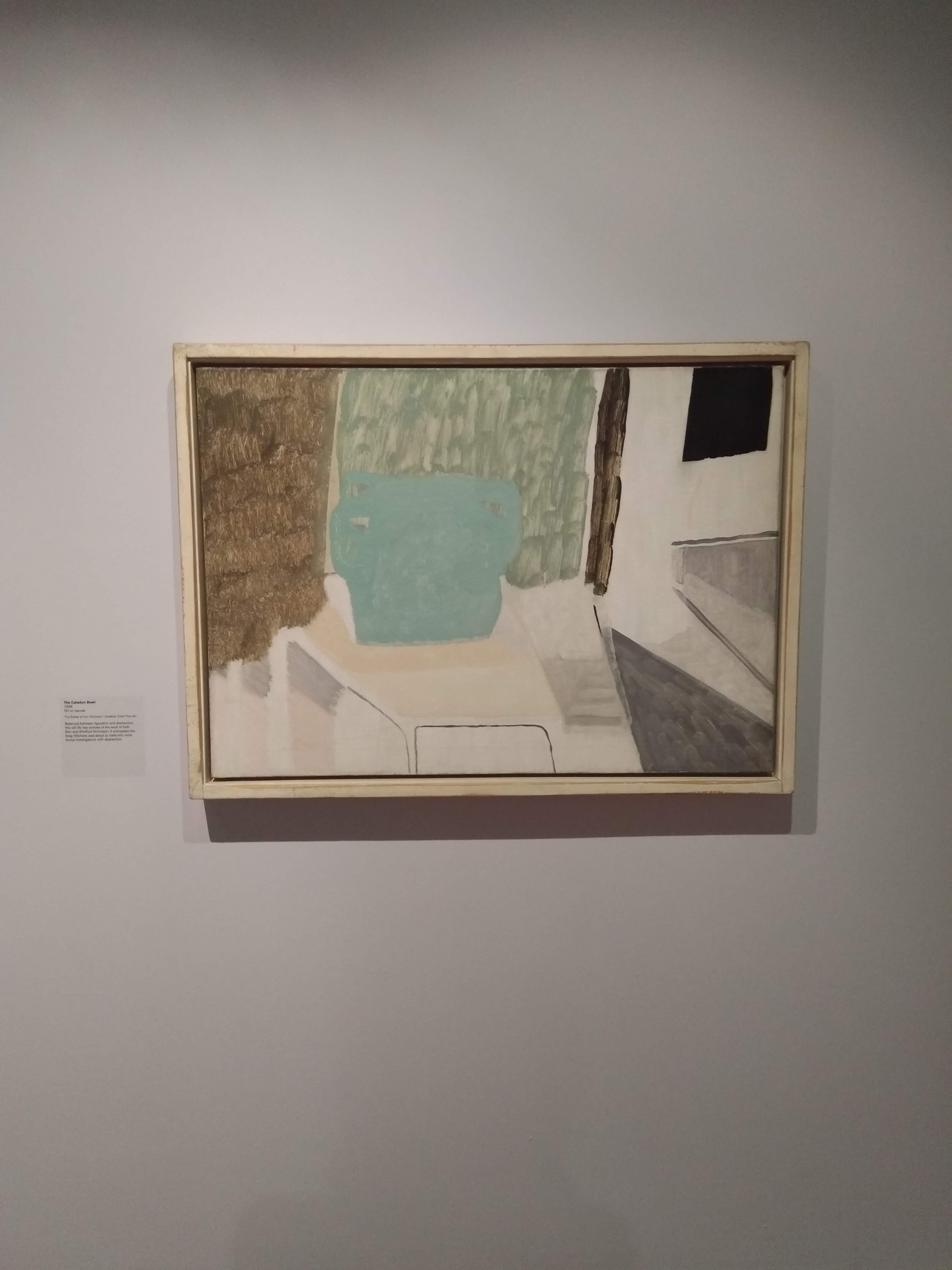
The Celadon Bowl (1936)

Some of my favourite of his works were early ones like The Celadon Bowl (1936), in the way that it delicately treads the line between abstraction and figuration, the scrubby brushstrokes of the teal and khaki squares in the backdrop adding texture to the plain white canvas. In a sketchbook annotation, he wrote “don’t try to find a picture. Find a place you like and discover the picture in that”, which is true of every setting he painted, interior and exterior.

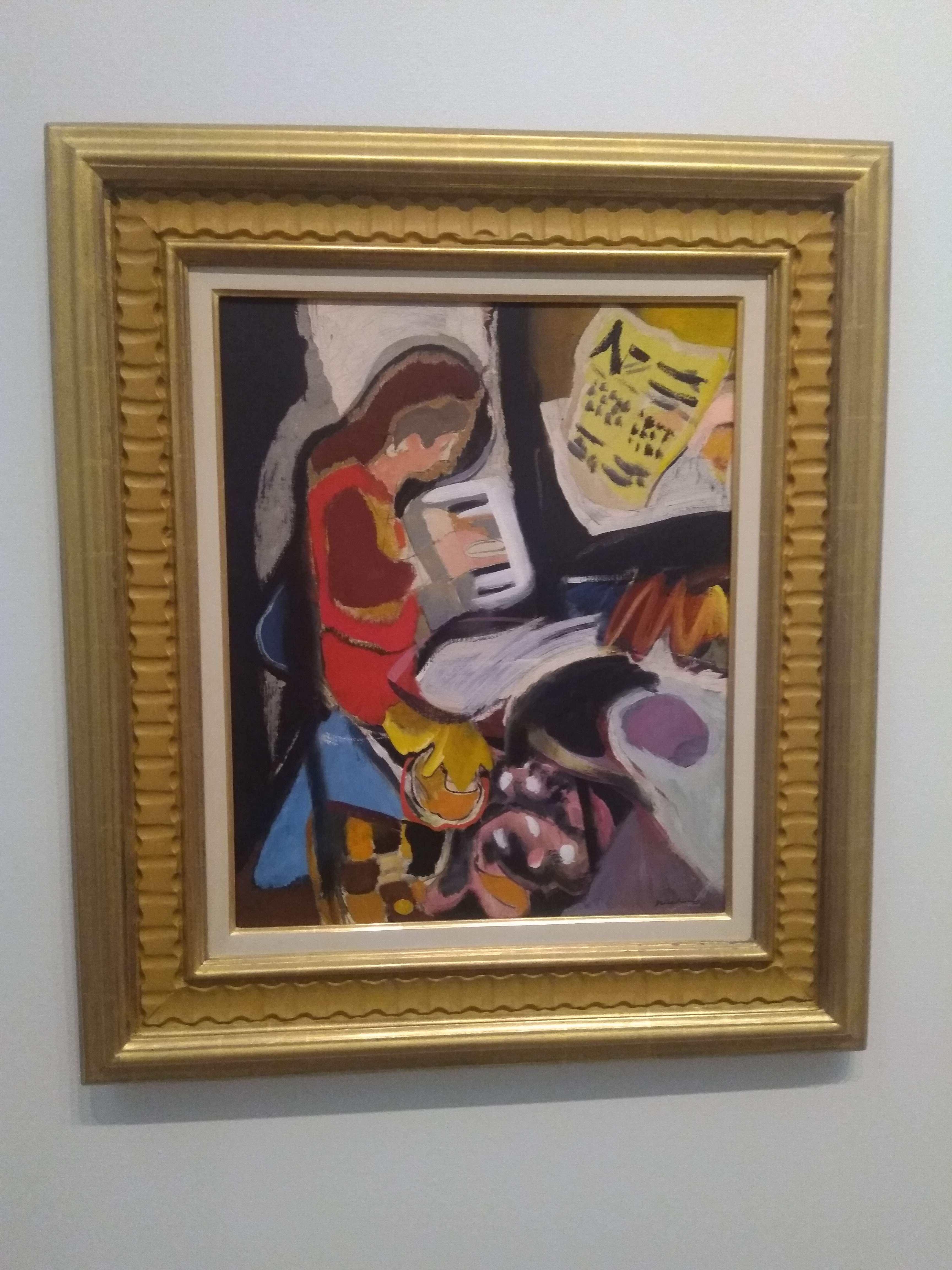
Woman playing the piano, c.(1942)

He left London during the war, and lived in a caravan called Greenleaves with his wife and their baby, set in a forest clearing. Living in the heart of the countryside clearly gave Hitchens more than enough subject matter for his art, and he set about painting the landscape, not focusing on grand vistas, but on his favourite spots that he visited repeatedly, capturing the view in different seasons and at times of day.

I love the Sussex countryside and have enjoyed walking on the South Downs, in the woods and by the rivers that Hitchens lived alongside, and so I may be biased, but I found his landscapes very evocative and able to capture the magic of the place. Perhaps there’s something in the water that makes it special.

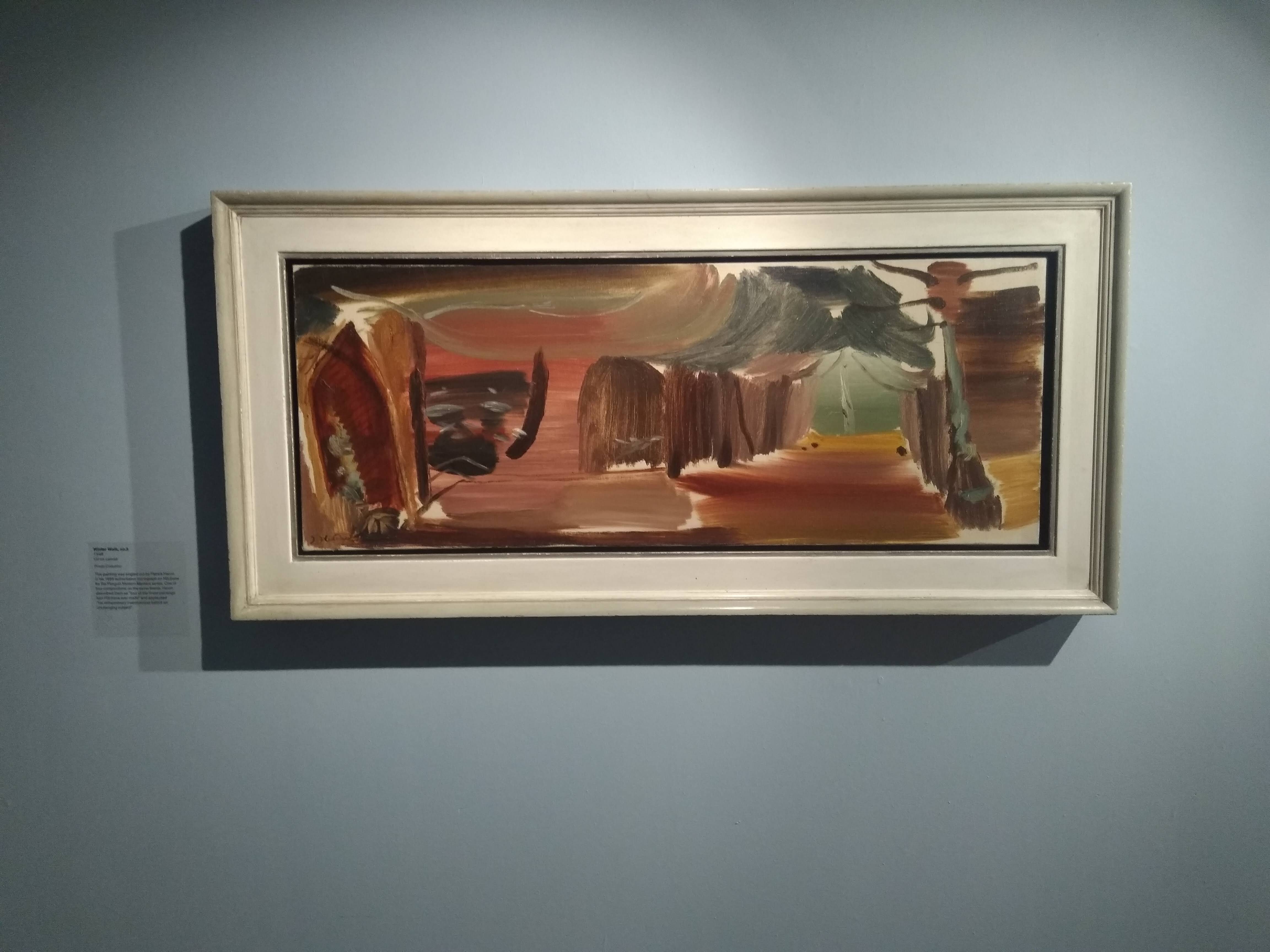
Winter Walk, no.3 (1948)

Winter Walk no.3 (1948), really captured me. The earthy brown and scratchy red tones, mixed with the evergreen of the avenue of pine trees towards the right of the picture perfectly sum up the colours of winter which are beautiful too, in their muted way.

The theme of the exhibition, how artists use their works as an exploration of their surroundings and of place more generally, was underpinned by the audio element of Simon Roberts’ Inscapes exhibition, which were dotted throughout Hitchens show. Roberts is an artist-photographer whose work focuses on identity and people’s connections with the landscape around them, and as part of the exhibition was invited to revisit the settings that so fascinated Hitchens. His soundscapes of the countryside (cattle lowing, brooks babbling, branches creaking in the wind) brought Hitchens’ landscapes to life in new ways, and the pairing of the two artists’ work brought out the best in both of them.

The Long Look, Scottish National Portrait Gallery

The Long Look at the Scottish National Portrait Gallery is a small but focused show that turns portraiture on its head in a conceptually intriguing and visually satisfying way. The exhibition is the result of a two-year project in which Norman McBeath (photographer, printmaker) sat for painter Audrey Grant as she created two portraits of him in charcoal.

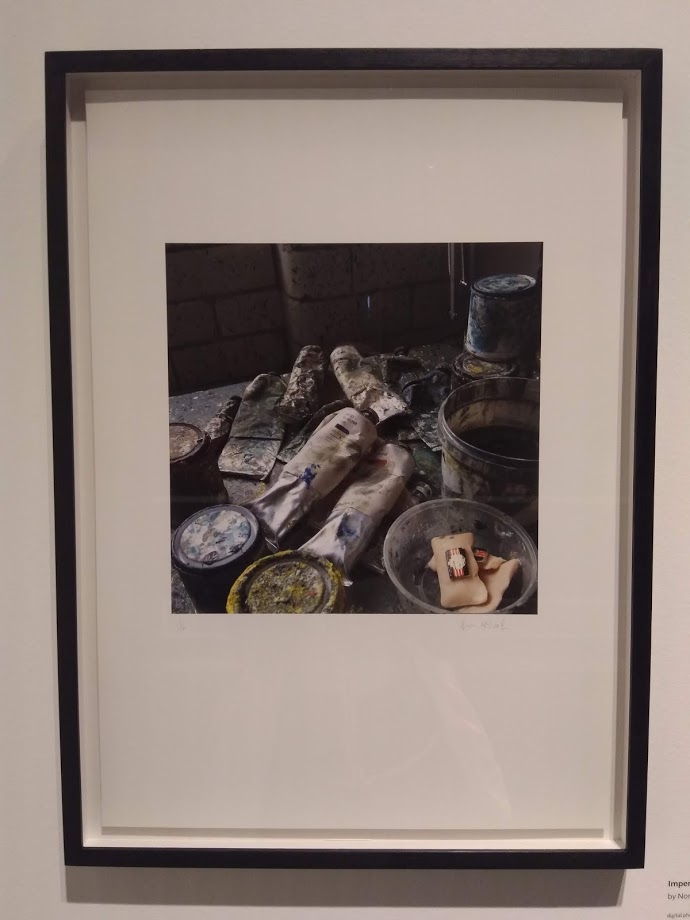
The portraits of McBeath do feature, but they are really only a side story to this show. The main body of work is by McBeath: his photographic impressions of Grant’s studio, documenting her presence by the trails of creative detritus she leaves in her wake. These ‘portraits’ show the traces of Grant everywhere: fingerprints in the paint that has dried on the back on her easel; highly detailed close-ups of her charcoal-blackened apron that seem transformed into vast monochrome sand dunes; the bars of soap on the counter, misshapen by the hands they help to clean after every session.

Hands series, a sequence of close up and super-high-definition photographs is at the centre of the display. Each minute detail is made more striking by the charcoal dust embedded in the creases of Grant’s skin. We rarely get much of a glimpse of the artist in standard portraiture, a genre that can feel fairly prosaic and transactional. Here, the photographs by McBeath document her creative space, the studio, and present its contents as a lens through which we ‘see’ the artist.

Imperial Leather by Norman McBeath

It seems that the sense of fascination with the artist’s studio now seems more prevalent than ever. The most unique and (the more I reflect on it) bizarre example I encountered was at Dublin City Gallery, The Hugh Lane. There, in the centre of the gallery, is Francis Bacon’s studio. Its contents – even the dust – painstakingly reassembled having been documented and meticulously transferred from London to Dublin in 1998. Though it is undeniably a fascinating sight, and totally worth visiting, there is something voyeuristic about the practice of preserving and reassembling the artist’s studio within the Gallery space (closer to home, Paolozzi’s studio is on display at the Scottish National Gallery of Modern Art until next year). These kind of displays continue to assert the narratives of the ‘artist genius’, elevating and shrouding his or her workplace in magic and mystique, ways of thinking that contemporary art history has sought to move away from.

The Long Look, though it has elements of this tendency to give the artist’s studio too much auratic power (including the unnecessary inclusion of the chair that McBeath sat in while his portrait was created) for the most part manages to circumvent these more troubling tendencies of artist/studio worship. Particularly when presented in the context of a national collection of portraiture, where wall labels normally the list the sitter’s name and details of their life far more prominently than the artist’s, this reversal of the gaze subverts the traditions of portraiture in a refreshing way.

Hands series by Norman McBeath

For me, the examination of the psychological intensity of two people observing one another over time, and the resulting sense of intimacy between McBeath and Grant was one of the other most successful outcomes of the show. For this reason, I would argue that the inclusion of two portraits of Val McDermind were a kind of ‘third wheel’, an unnecessary curatorial appendage to an otherwise tightly-focused exhibition.

Through the simple switch between observer/observed, The Long Look empowers the usually passive sitter with the gift of re-observation, and extends this to the observer in a way that offers a fresh perspective. When encountering subsequent portraits, we might ask ourselves: how did it look from the other side?