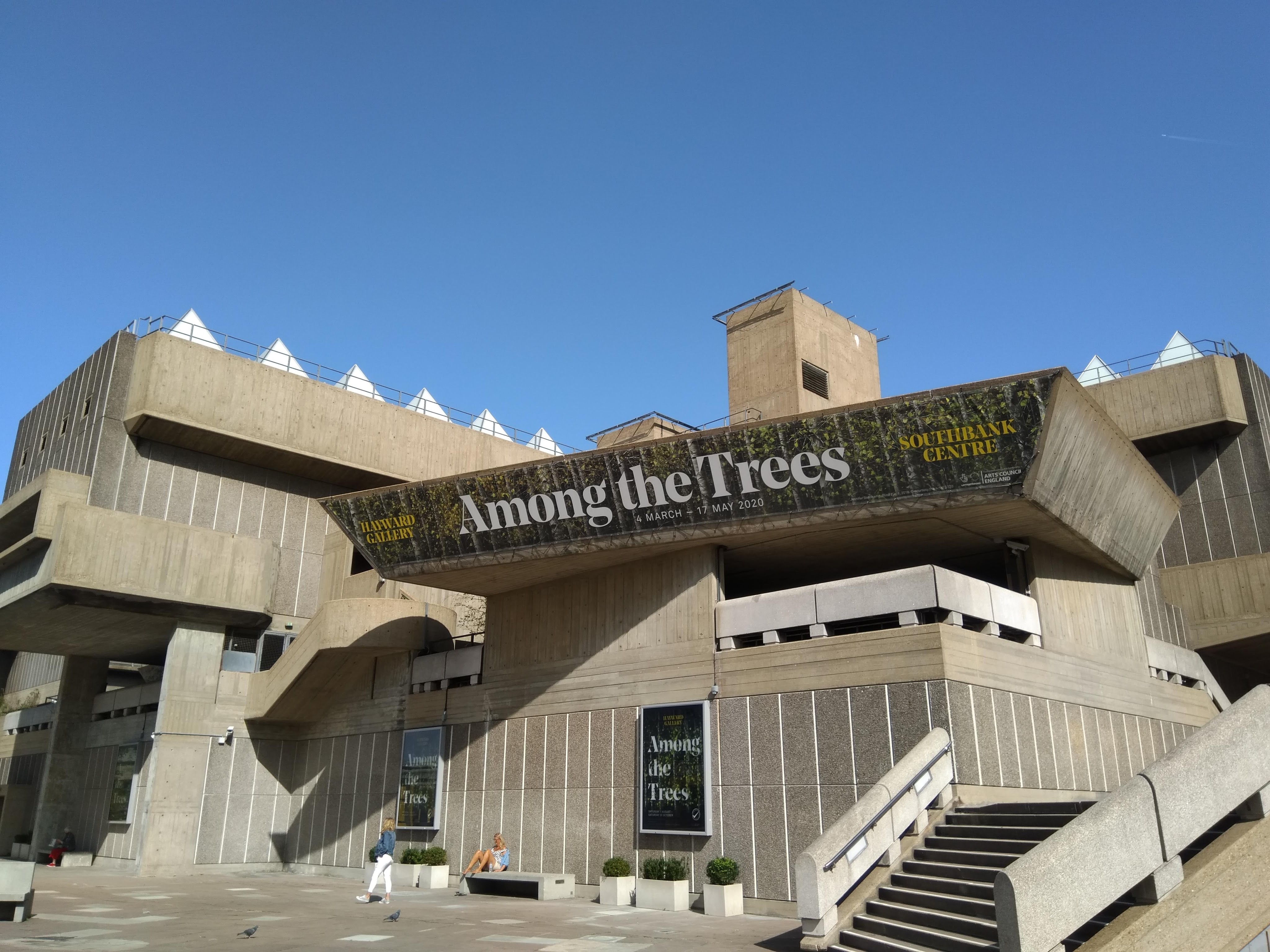
What does it mean to come to a place like the Hayward Gallery, the most concrete of concrete buildings in the heart of the UK’s largest city, to immerse oneself in images of trees? This isn’t a museum, a science hub, or a university, so it’s not a place dedicated to learning about trees, but for looking at them. It’s impossible not to hear strains of Big Yellow Taxi as you see the hoardings around the Hayward Gallery: “They took all the trees, put them in a tree museum/ and charged the people a dollar and a half just to see em”. The irony was particularly present for me, as I headed straight to a dark exhibition space to look at nature, having just arrived from the actual countryside (full of actual trees).
In the first room, I began by wondering whether this was going to be a contemporary echoing of Romanticism. There were seemingly no signs of human life, except for the artists of course. The ghostly, delicate Untitled (2008) by Toba Khedoori, and Robert Longo’s Untitled (Sleepy Hollow) (2014) exposed what we forget in the height of summer, the intricacies of tangled branches. I wondered then whether the show was going to be boiled down to a central message: escapism through beauty. With Covid-19, Brexit, government incompetency, economic collapse and the US election for context, we crave escape more than ever, and nature can seem to offer some sort of way out of it all. That’s also what the Romantics thought too: the fewer humans in their landscapes, the better! But we know that’s not a true representation of landscapes. They are, and now always will be, shaped by humans – for better and for worse. In that context, what does it mean to imagine landscapes without humans? Is it eco-fascism, or just an overly simplistic, narrative of nature = good, humans = bad? The artists and artworks in Among the Trees put this idea under a microscope, reminding us that art can do both – be visually pleasing and profound.
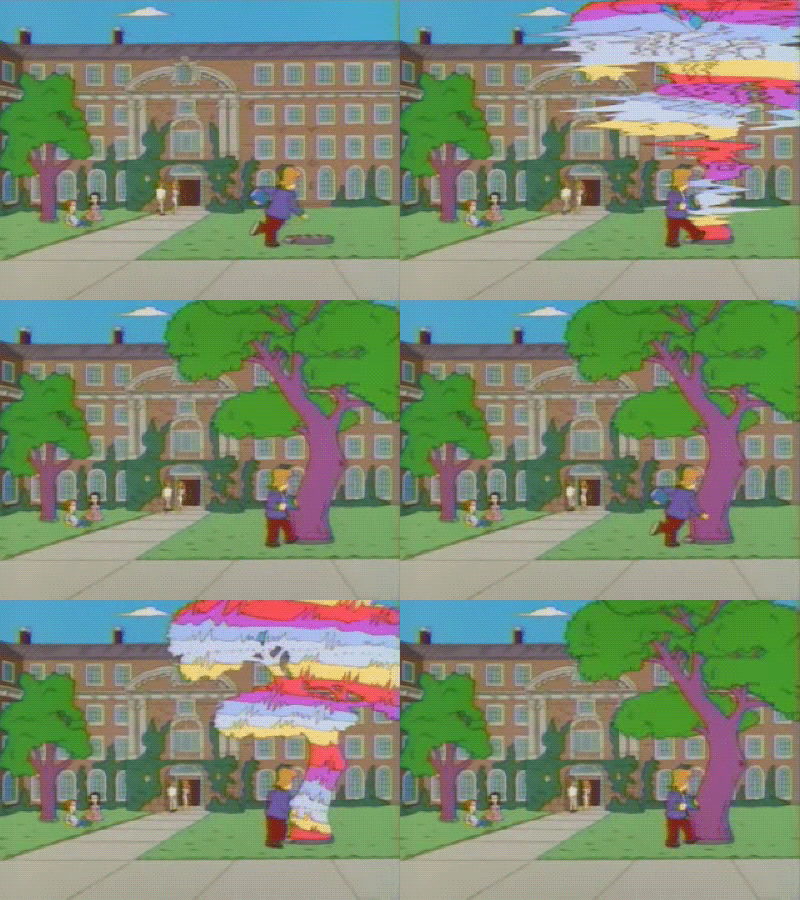
Remember the iconic Simpsons episode where Lisa has her fortune told? It’s full of painfully ironic, insightful vignettes of how the near future might pan out. In a college campus quad, a plaque reads “In memory of a real tree”, but the tree is flickering like a static TV screen. An electrical malfunction exposes this simulacrum for what it is – until a passer-by boots it back into functionality, into looking natural again. That’s the image I couldn’t get out of my mind while at this exhibition. I was looking at a monument to something we are knowingly destroying; the monument was artificial.
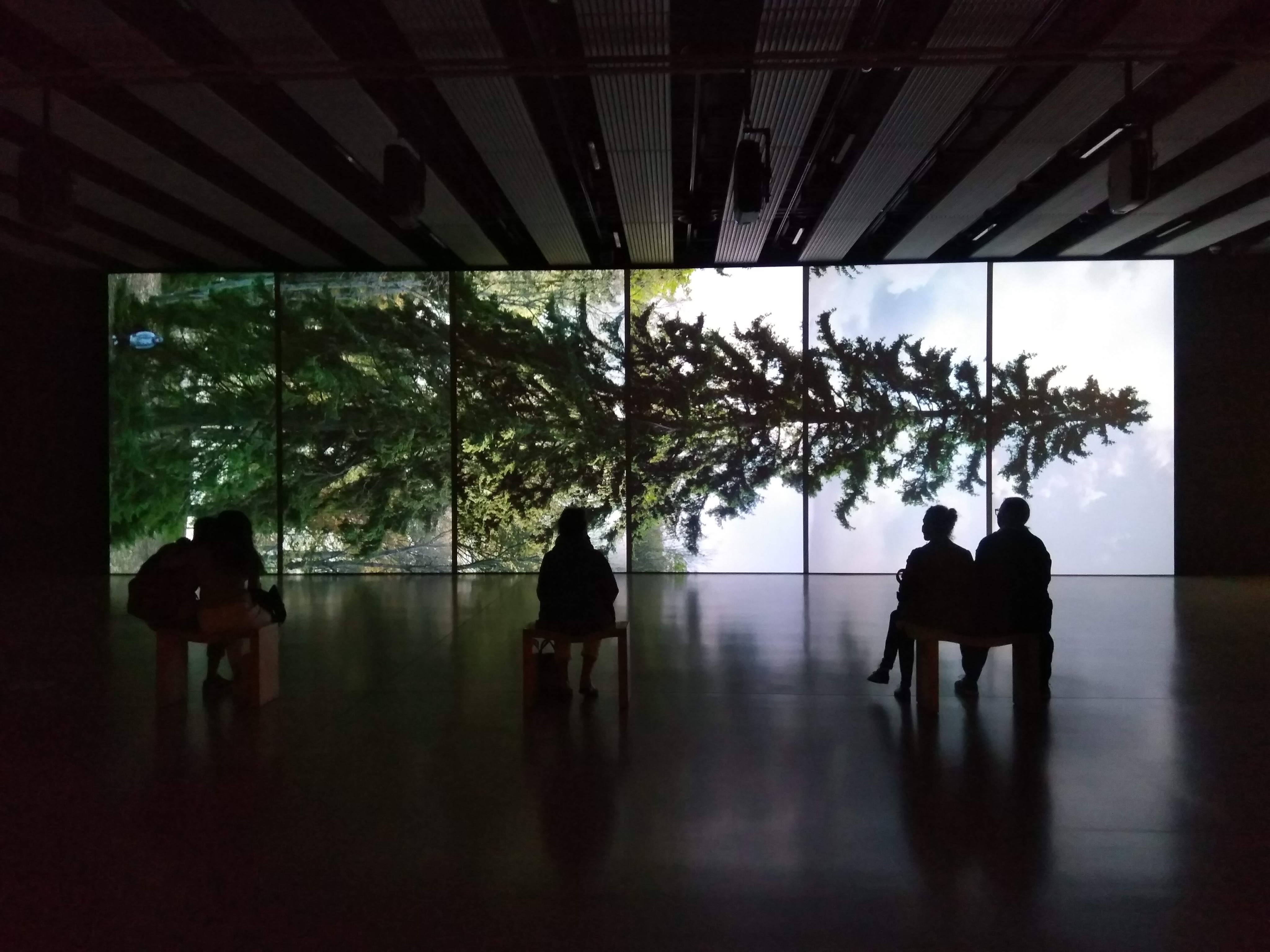
Yet the highly effective use of artifice in conjuring the natural is what I found most interesting about Among the Trees. One of the first spaces is dominated by a huge video projection across the back wall, the work that is on all the posters. This is Horizontal – Vaakasuora (2011) by Eija-Liisa Ahtila, depicting a huge native Finnish spruce in five video panels, each slightly out of sync. It’s mesmerising. We hear the wind in the branches, bird song, and watch the spindly, yet strong and flexible, living tree, dancing, creaking and swaying in on itself. There’s a kind of discombobulation that comes from seeing something this tall lying on its side. You’re not supposed to see the tops of these trees close up. There’s a feeling of privilege in looking without having to crane your neck, but also a foreboding in the position. Trees lie this way when they are felled.
The other large-scale video work is Jennifer Steinkamp’s Blind Eye 1 (2018). It is wholly artificial, using animated computer technology to show a fake birch tree forest move through the cycle of all four seasons in a cool 2 minutes 47 seconds. I’ve always loved the visual effect of technology speeding up the forces of nature in a way that reveals how utterly miraculous they already are – time-lapse videos of plants growing impossibly quickly, sprouting leaves, buds, flowers, seeds and withering and dying all in a few moments. It’s all so heart-wrenching and magical.
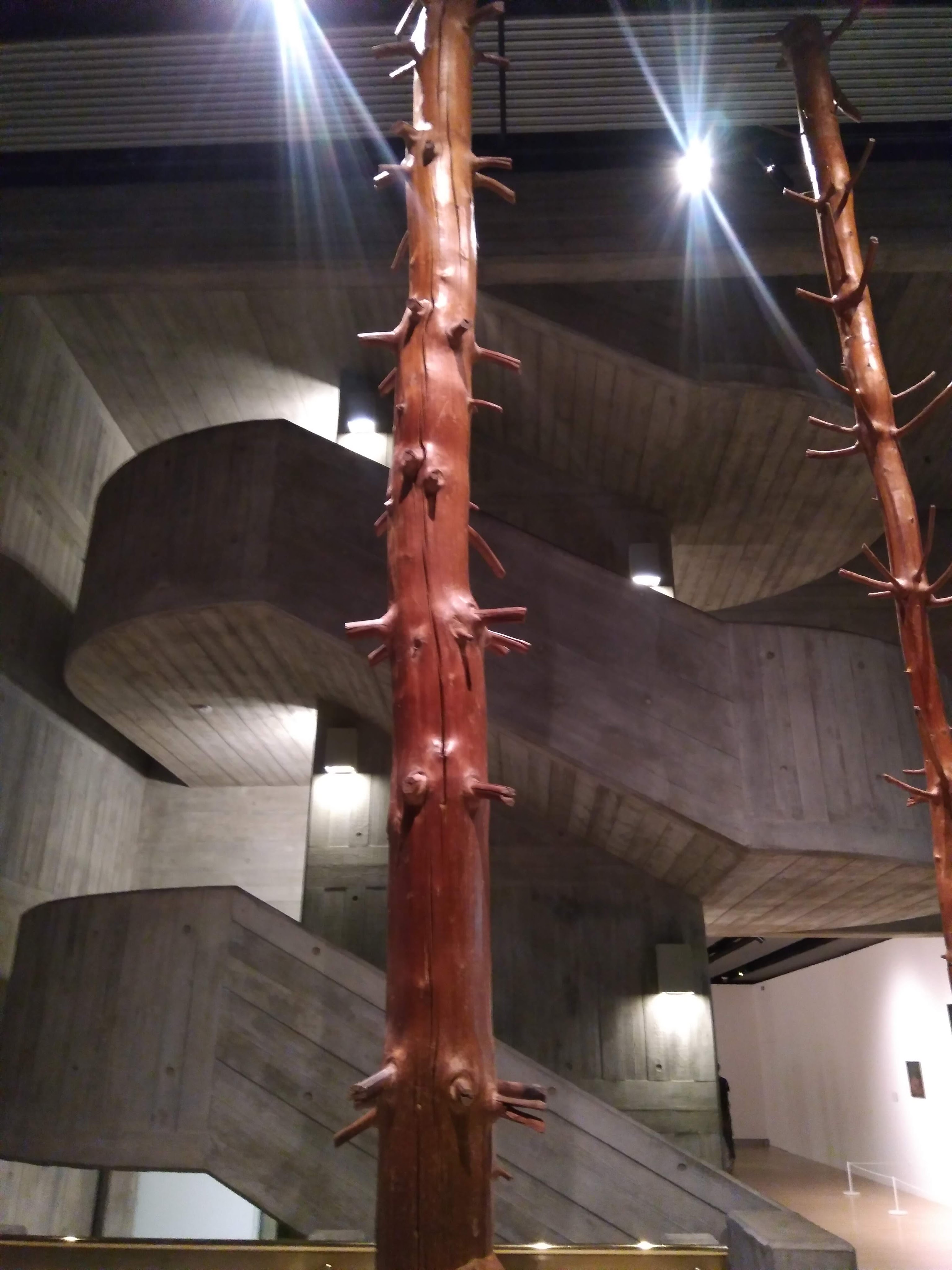
Revealing what is already there is at the heart of Giuseppe Penone’s work with trees. His Tree of 12 Metres (1980-82) is the most ‘natural’ of all works in the first room: a very tall tree has seemingly been divided in two, stuck into plinths and carted into an art gallery, it’s warm earthy tones juxtaposing with the smooth, cold concrete staircase behind. But this tree is actually a sculpture, fashioned from an industrially planed piece of timber that Penone painstakingly scraped away, in a reverse Frankenstein fashion, following the knots, lines and ridges in the wood, unlocking how the tree would have looked long before it was felled. He takes it back in time, back to nature, back to life.
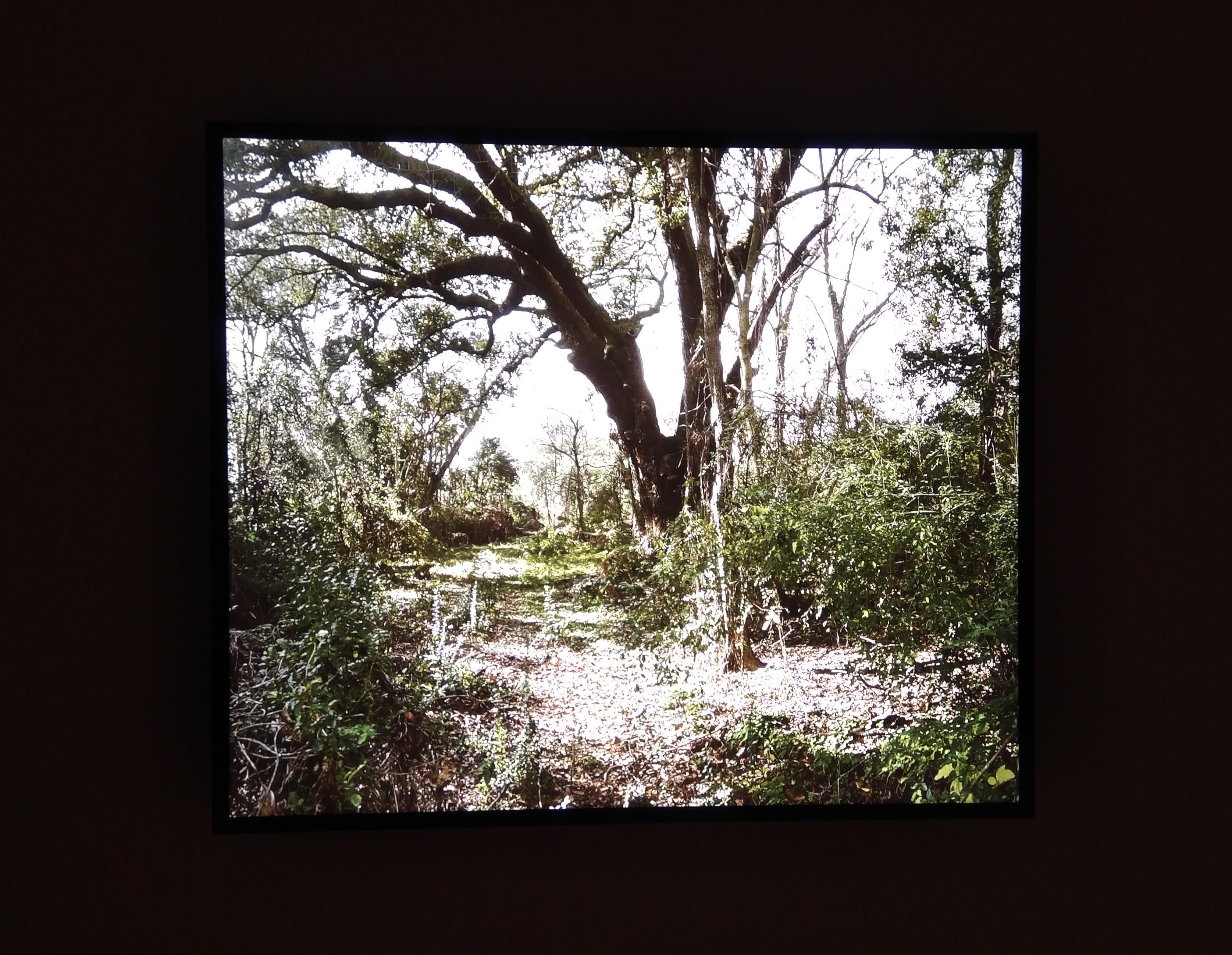
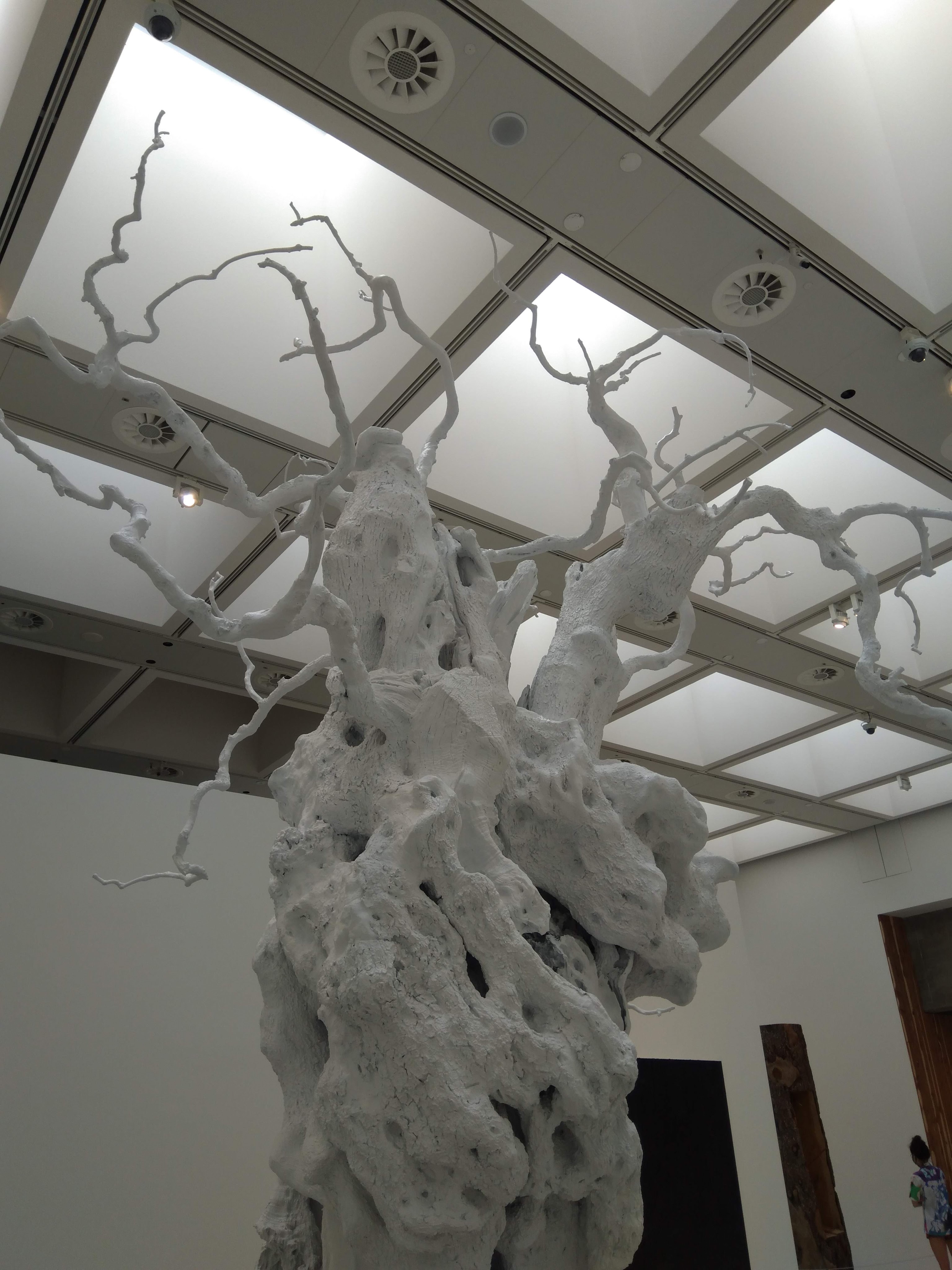
Death and life are here in abundance. Because trees can span many human lifetimes, they are presented as witnesses, as memento mori. Ugo Rondinone’s cold moon (2011) is a cast of an ancient olive tree in southern Italy, its hulking, twisted, wizened form reminiscent of the White Tree of Gondor, as well as calling to mind the Ancient Mariner, an old man sitting in a corner of a dark city pub, a man who has *seen things*. Steve McQueen’s Lynching Tree documents where countless African-American bodies were lynched, a site encountered while filming 12 Years A Slave. It is a tree that has, in its very shape, borne witness to and memorialised the worst of us.
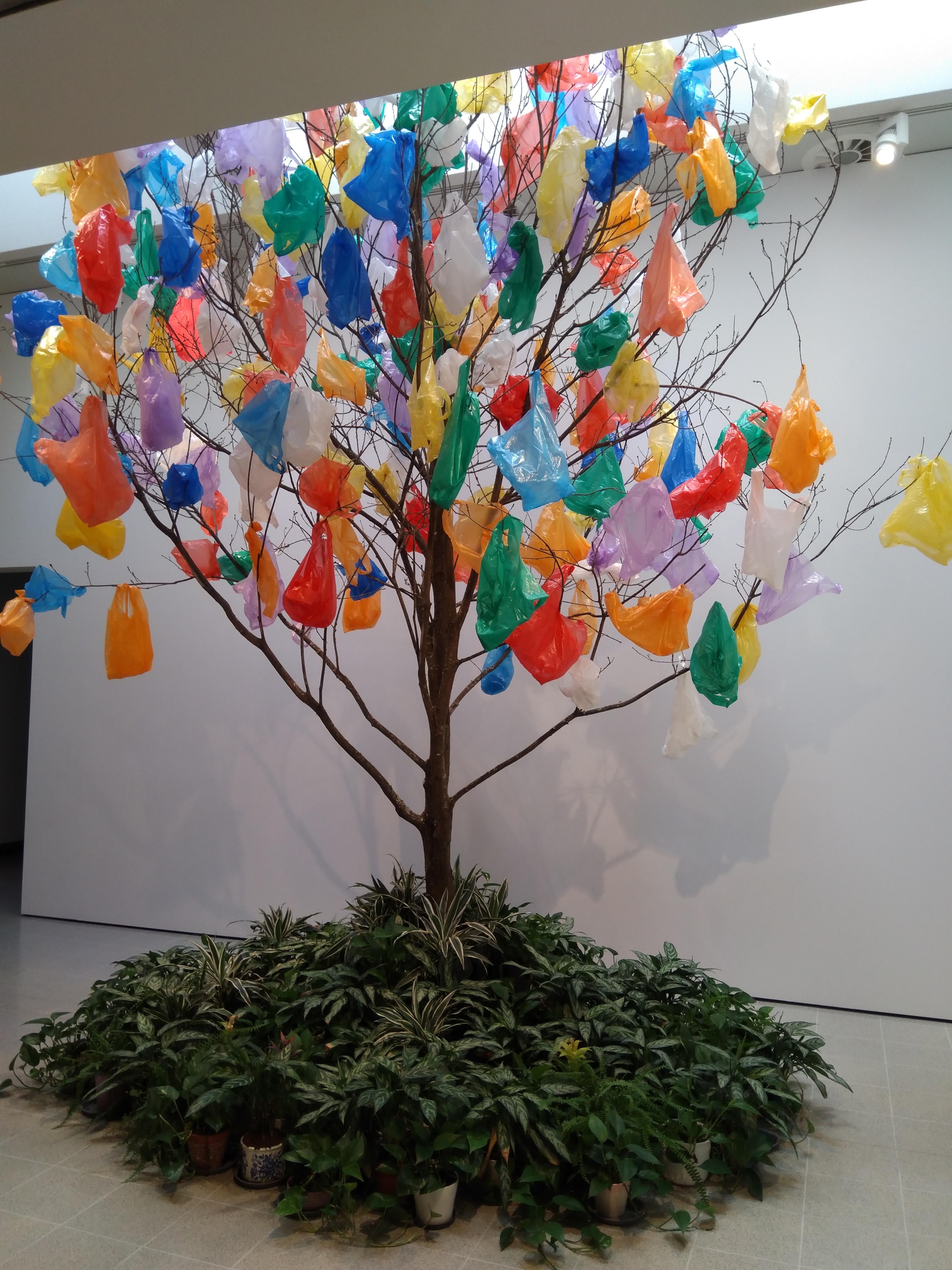
Alongside this, you can see Plastic Tree B, created this year by Pascale Marthine Tayou, where plastic bags have become the bright, somehow beautiful blossoms of an Instagram-worthy sculptural tree. Simplistic idea perhaps, but still visually striking, and reminding us of how damn precious it all is, and how much it is slipping through our fingers because we are, by and large, terrible custodians. You can’t even walk down a street without seeing hundreds of disposed plastic masks on the ground, like scattered flags of surrender to the coronavirus age. The show could probably have pressed more on the climate crisis message. But I was reminded in a talk by Olivia Laing recently, that in the face of politics, art won’t make the change itself, but it’s a way of “galvanising, and grouping a response”. In other words, art can’t do the work for us.
The woodland I was walking in just hours before my trip to London is full of signs of human life. On a nearby bench, “Trump Out” is scratched into the surface, reminding us that our human politics infiltrate every part of our world, no matter how much we might wish to escape them. We have to acknowledge that, and not lose ourselves in the mesmerising beauty of nature and of art. That is appreciation, and it might give us space to become mindful, but that is only the first step. A moment of escapism is acceptable, but only if we emerge from it refreshed to re-engage, to take meaningful steps to do some damage limitation, to avoid the climate crisis that is unfolding before our very eyes. Otherwise we might find ourselves, in forty years, frustrated that our tree memorial isn’t convincing enough, wishing we had acted before it was too late.
 encounters_art