The art festival Glasgow International (Gi) had to cancel and has curated a set of seven different artworks available online for the duration of the festival (until 10th May). Some are special commissions, some works were made long before the pandemic hit, but all artists would have been taking part in the festival itself, and the works represent a taster of what would have been available to see. While I understand that Gi want to mark the period when the festival would have taken place, it feels needlessly restrictive to have made this very interesting set of works available only to take them down after two and a half weeks. Time seems arbitrary now. I barely know what day it is, let alone the date. Why not leave them up until the end of lockdown or the end of May at least?
I was a bit late to the party but I’ve just finished watching/listening to them all and wanted to highlight two that resonated with me.
The first is Yuko Mohri’s Everything Flows – distance, 2020. Mohri has taken Yasujirō Ozu’s 1953 silent film Tokyo Story (which I haven’t seen), and has spliced together scenes devoid of human presence. What we are left with is a ghostly compilation of images which suggest humans through their absence. The city continues to function, ships move through water with purpose, but seem to be operated by remote control. Robotic railway station signs indicate platforms and train times to no one. Clothes on washing lines blow in the breeze and shadows on the walls of cramped interiors hint at human life, but each time, the film cuts out just before the figure comes into frame. It’s a tantalising series of almost-moments, which chimes well with having experienced a quiet, deserted central Edinburgh over the last month or so. There’s a strong sense of people watching the goings on from the high viewpoints over the city. Lanterns look like eyes. A moth bashes against a light, a fragile reflection on the futility of existence in this silent world.
Urara Tsuchiya’s Give us a Meow, 2019, is my other pick of the bunch. This one surprised me – from the cover image and the title I didn’t think I would like it. But the 9 minute film is captivating. It tells a fragmented story, set in the rural idyll of a cottage and the countryside around it. We follow the escapades of a glamorous Asian woman who dons an impressive range of sexy outfits including animal print catsuits, fluffy negligee, powder blue and baby pink fur coats. The costumes are all made by Tsuchiya and are highly influenced by drag, adding to the fascinating confusion around the identity of our protagonist. She dances, applies makeup, takes selfies and does the ironing. It’s a surreal and humorous mash-up of the extremes of femininity, typified by one excellent shot which briefly flashes up, showing a pair of legs clad in high-heeled boots, sticking out from behind twee floral curtains. I took a screenshot which is probably not allowed, but who knows the rules of a digital art festival. Maybe this is part of a process of the democratisation of image-making, taken to a new level.
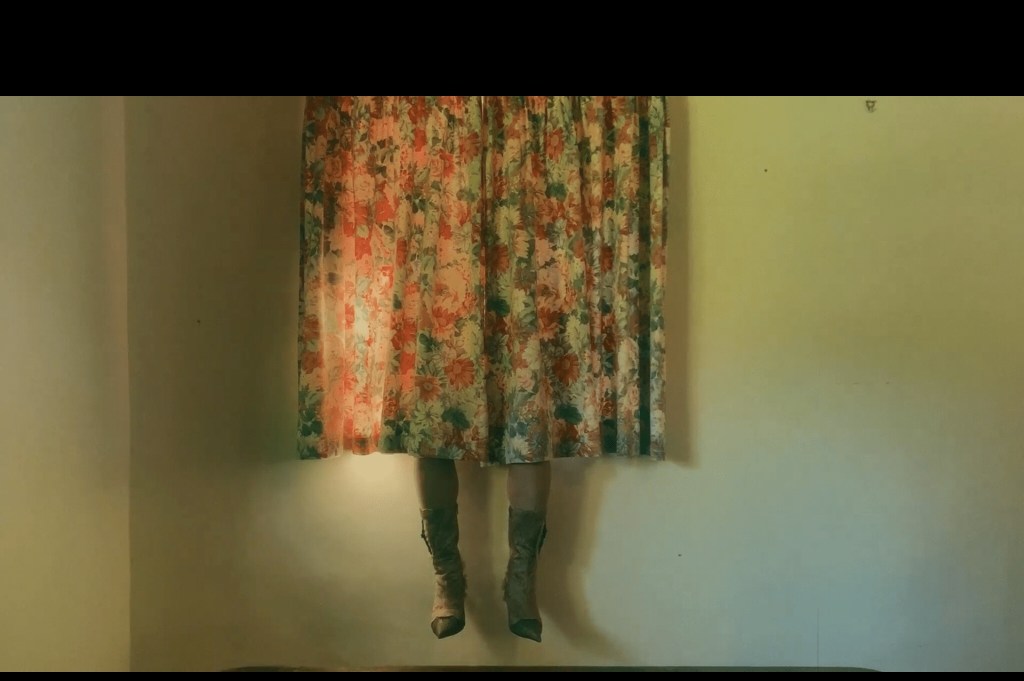
For me, in a time of lockdown, it seems as though the character in Give us a Meow is attempting to recreate the experience of being in a nightclub within a completely incompatible setting of ‘home’. She dances like no one’s watching. She even has a little cry in the bathroom, picks herself back up and heads out again, an experience I’m sure we can all relate to. Seeing her vulnerability when navigating a cattle grid in heels is beautiful and moving and funny.
There’s also a fascinating, sinister aspect reflecting on the voyeurism of the film. She appears to be alone, but is not – she breaks the fourth wall repeatedly to interact with us, casting glances directly at the camera, creepily/seductively waving at us from the toilet seat. In the moments filmed outside, with her dancing by the side of the road, the film is shot from the perspective of someone watching from a car window. We are there, but it feels like someone else is there too. This also resonates particularly now – we rely on our cameras more than ever for interaction and attention, but constant rumours circulating about hackers in Zoom calls and sessions on Houseparty make us paranoid about who else might be watching. Tsuchiya created the work last year, but it feels more relevant than ever now.
So, that’s my take. I know there’s so much content out there at the moment, it can be overwhelming. I know that digital art events don’t appeal in the same way as the ones in ‘real life’, which can take you to different corners of your city and have a physicality to them that can’t be recreated on screen. But these artists have created something really interesting. What worked for me may not work for you – see what you think and let me know in the comments, or DM me on Instagram @encounters_art. I’m always here for a conversation about art!


 encounters_art