Top ten art moments of 2020

This year, it is needless to say that we’ve not had the art experiences we might have been hoping for. With travel restrictions, exhibitions cancelled, rescheduled and put online, the art world landscape has changed significantly, perhaps forever. I have just had pre-Christmas visits to see Artemisia and Titian’s Poesie at the National Gallery cancelled, as London crashes into Tier Three. I’ve been longing to see these once-in-a-lifetime exhibitions for years, since I first heard they were going ahead. So I began writing this with a sad heart.

Yet despite and because of what 2020 has thrown at us, the need for art and culture is stronger than ever, as a way to escape, to heal, to reflect on what is happening. Many people have used 2020 to have a go at making art themselves, with countless organisations sending out art packs for people to unleash creativity at home. What I’m now calling Self Portrait with Haribo was born of boredom and childishness (yes I’m 29 and I still buy Haribo), but looking back at it now, it captures a particularly cabin fever-ridden moment of lockdown. Marking moments like this is a good way of acknowledging time passing, in a year that has felt interminable but with very little to show for it.
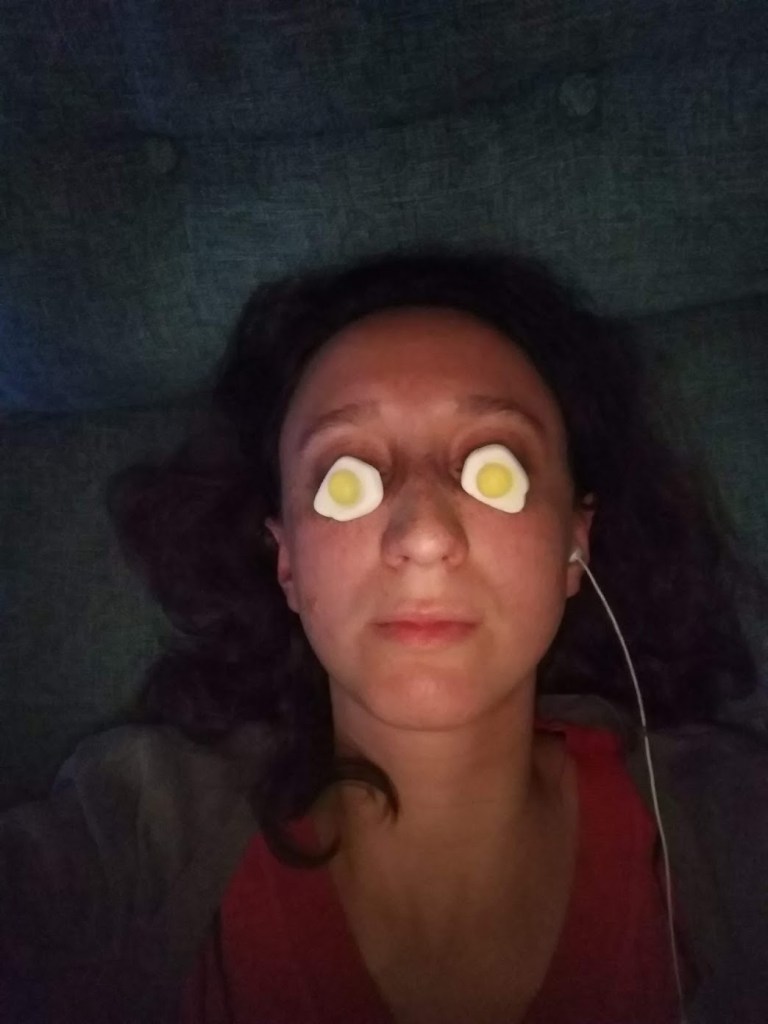
‘Self portrait with Haribo’

You’ll be relieved to hear, this blog post isn’t about my own personal creative output. Rather, it’s a moment of reflection and reassurance, to look back at 2020 and realise it hasn’t been a total creative wasteland. As by now you may have guessed, my concept of what art is is very broad, and that attitude has helped me this year.  It helps me notice my surroundings, and to not feel culturally deprived, even when museums and galleries have been largely closed.

Art hasn’t gone away this year, we’ve just experienced it differently. So consider this an invitation for you to get out your phone, scroll through 2020’s photos and consider the past twelve months in a new light: there will be evidence of things you’ve seen that connect us, that have made life more interesting, that have enabled you to see or understand something differently. To me, that is the purpose of art.

10) “Please do not remove” sign, Fountainbridge

This comes under the category of ‘weird things I take photos of in the streets of Edinburgh’. I first noticed this sign in Fountainbridge in January. It was still there in June. I love random signs, posters and stickers that are woven into the fabric of our cities. Once you start noticing them, you’ll never be able to stop: there are whole debates played out on bus stops, sign posts, bins and streetlights. I like this one because it shows how people did what the sign said by leaving it there. Either the people Edinburgh are very law abiding, or, possibly more likely, it went unnoticed.
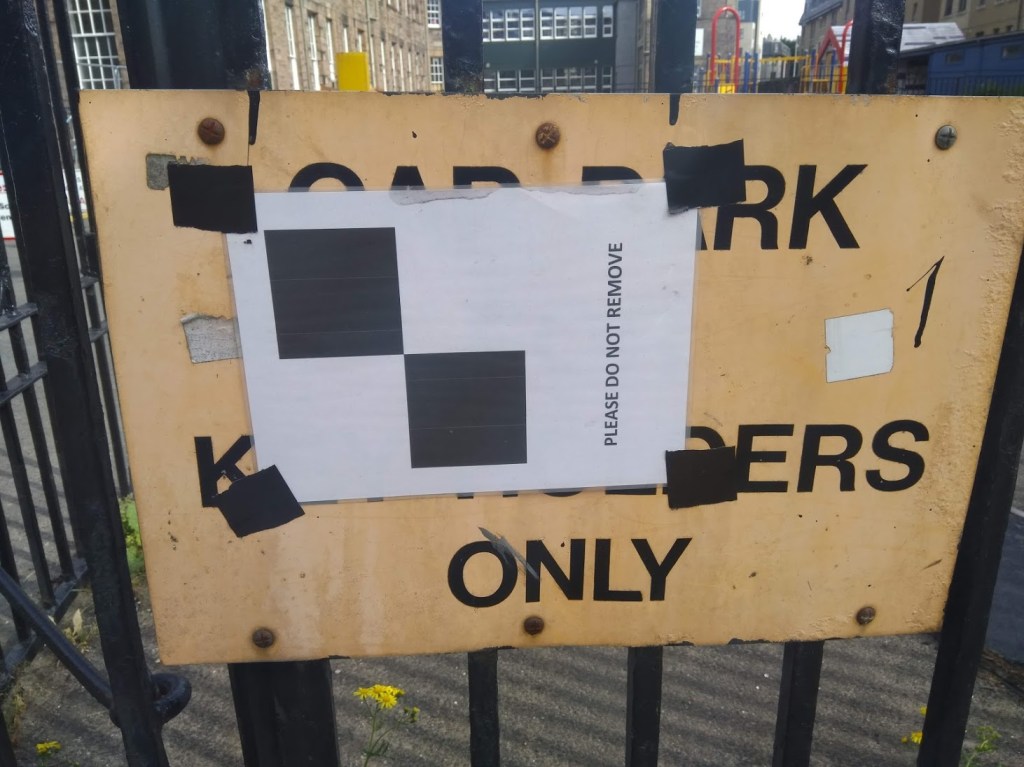
‘Please do not remove’, Fountainbridge, June 2020

9) A visit to Petworth House

When infection rates were low, I visited Petworth House for the first time this year. I’d known that the house had lots of art connections, having seen it in the film Mr Turner, but I hadn’t realised how many treasures are packed into just a few rooms. The National Trust’s webpage says that it is one of the finest art collections in their care. It includes The Adoration of the Magi by Hieronymous Bosch, a bust of Aphrodite attributed to Praxiteles which is over 2,300 years old, and The Molyneux Globe, the earliest English-made globe in existence, made in 1592. My favourite moment was seeing the beautiful marble sculpture of Saint Michael overcoming Satan by Jonathan Flaxman, created 1817-1826. When I was studying at UCL, the full-scale plaster model that Flaxman made in preparation for this piece was on display in the main library, so seeing the final result felt like the artwork had come full circle for me.
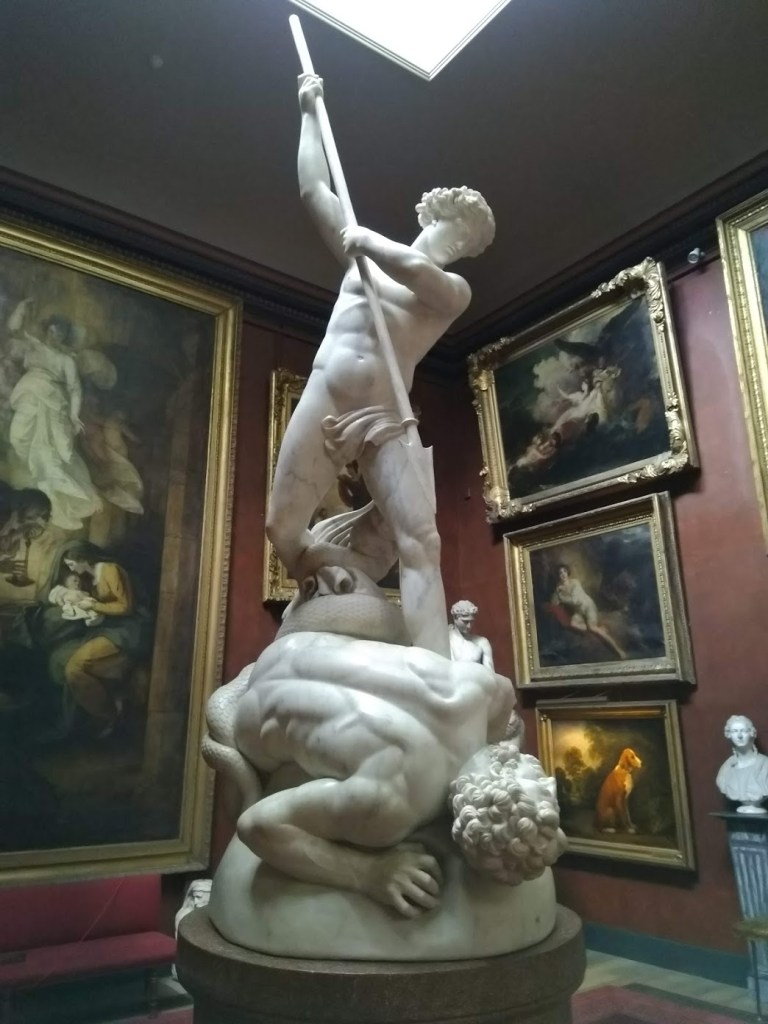
‘Saint Michael overcoming Satan’, Jonathan Flaxman

8) Apple’s iPhone X advert at The Hermitage

Ah, who knew an advert would play such an important part in my year. I actually am one of those people who enjoy TV adverts: the ludicrous fantasies of high-end perfume, the terrible, expensive sofas at DFS. An oven chip advert about family made me cry once. Yet this advert was not your usual one. It was five hours long, a slow-paced art house film with minimal dialogue, all shot on iPhone X, filmed in The Hermitage in St Petersburg. Each Tuesday in the spring, my friend Jane and I sat down, started a phone call and pressed play on YouTube together as we watched an installment. We discussed the paintings, the dancers, the architecture, the narratives, and sometimes, we just talked over the film about life. It was as close as I came to the real experience of trawling through a major museum while on holiday and I looked forward to it every Tuesday for over a month. I’ve written a longer piece which has a link to the advert here.

7) A specific frame in The Wallace Collection

From my trip to The Wallace Collection in the summer, one object is thoroughly wedged in my mind: the frame of Ary Scheffer’s Francesca da Rimini (1835). The painting itself is very dramatic, it depicts a scene from Dante’s Inferno, with the tragic figures of Francesca and her lover Paolo condemned with the souls of the lustful to the second circle of hell. The frame completely wowed me, I think it’s one of the largest frames I’ve ever seen. You can see a book in the bottom right corner, there are doves, chains, oak leaves and a scroll which incorporates elements of Dante’s text. It was created by a certain Félicie de Faveau for the painting’s third owner, Anatole Demidoff, Prince of San Donato, who owned the painting from 1853-70.

Ary Scheffer’s ‘Francesca da Rimini’ in the Wallace Collection

6) Graveyards of Edinburgh

Edinburgh is one of the greenest cities in the UK and I recognise my privilege in experiencing lockdown here for that very reason. Exploring the city’s open spaces has led me to encounter several of Edinburgh’s old graveyards for the first time this year. Being a fan of the Romantics, the more dilapidated and ivy-covered the angels, skulls and crossbones and shrouded urns, the better. Perhaps it seems morbid, but I’ve always found these places peaceful and interesting, and as someone who doesn’t believe in life after death, seeing nature flourish in these places has always been reassuring. Warriston Cemetery, Greyfriars Kirkyard, Dean Cemetery and Dalry Cemetery are some places I’ve found solace this year, as well a place to appreciate the art and symbolism in the carvings, sculptures and iconography.

A grave with ivy, Warriston Cemetery

5) Andy Goldsworthy’s Stone Coppice at Jupiter Artland

Jupiter Artland – I visited at last! Cycling with my sister out to Wilkieston on the canal path, this was one of the most perfect art afternoons of the year. We walked around the whole thing slowly, soaking it all up, and got a seat in the café just as the rain came down. I love so many of the artworks here, but my top one for this list is Stone Coppice by Andy Goldsworthy. You stumble upon this artwork in one of the more unkempt pockets of the sculpture park, you might not even know it was there at first. It’s the perfect balancing act: the way the trees delicately hold the rocks, how some seem composed in a tender embrace, how others seem crushed by the branches or vice versa. The artist’s positioning of the natural matter, which is then left to its own devices to grow and unfold over the years, is poetic.
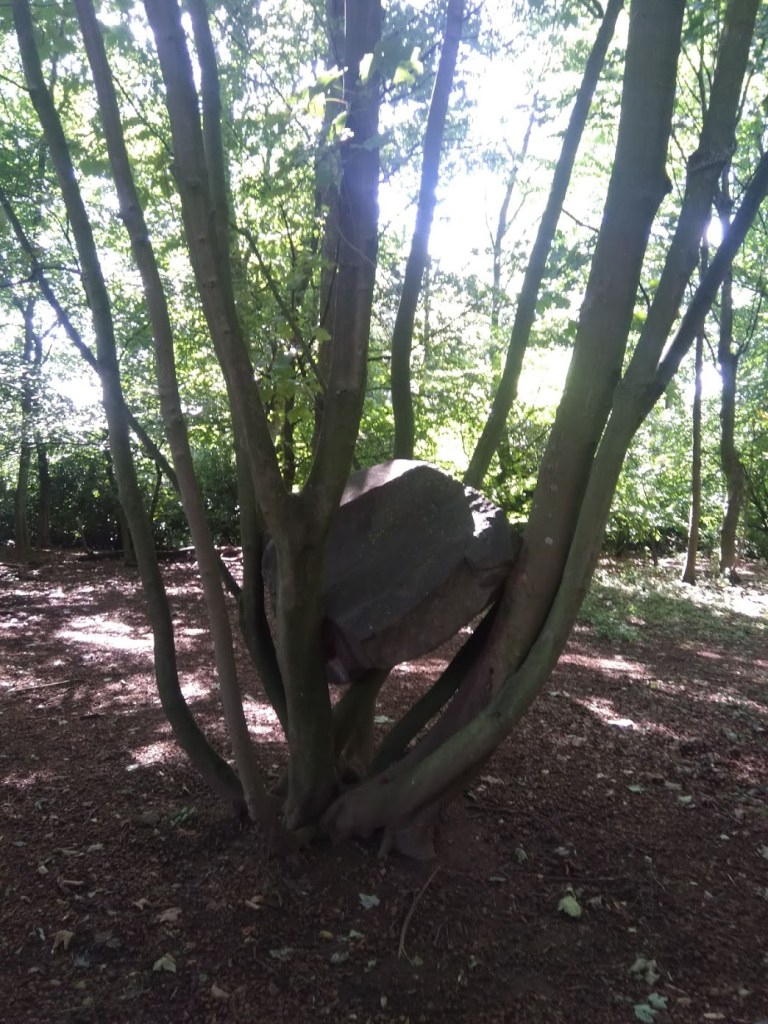
‘Stone Coppice’, by Andy Goldsworthy, at Jupiter Artland

4) Rainbows – Colinton Tunnel

The cynical among you will perhaps raise your eyebrows at this… rainbows in windows everywhere were sweet at first, but as the grim reality and longevity of the pandemic set in, they started creating a backlash, with one of my favourite tweets of the year capturing a perfect counterpoint – a sign in Glasgow that simply said “This is shite”. But this huge rainbow, arching over me as I cycled through Colinton Tunnel stopped me in my tracks. Street art and bike rides have both helped me through the year.
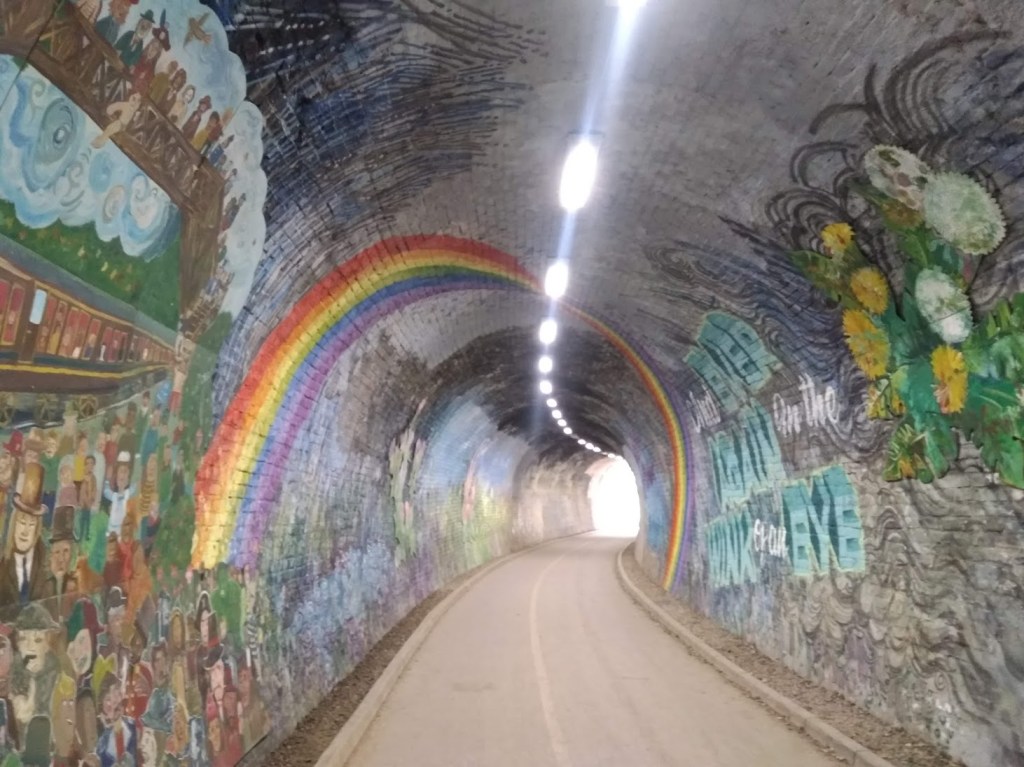
Colinton Tunnel

3) Rediscovering Black Portraiture by Peter Brathwaite

Peter Brathwaite has taught me so much this year. His project to recreate artworks at home was born out of a light-hearted DIY art challenge started by the Getty Art Museum. But Peter’s project took on huge significance as he made it his mission to shine a light on Black portraiture specifically, and used objects in his home to explore his own ancestry and past. In the context of the Black Lives Matter protest movement this year, this exercise in sharing these portraits of Black people with the world was so important, reminding us that these figures do exist in art and history, we just haven’t seen them, we haven’t named then. The whole project showed how the personal is political. How art is a mirror that reflects history and society, flaws and all, and critical engagement with it can help us understand the world and ourselves. Scroll through Peter’s Instagram to have your mind expanded, or take a deep dive into five of his recreations as part of The Essay on Radio 3 – highly recommended listening.

2) Violet Chachki’s ‘fall reveal’ runway look on Ru Paul’s Drag Race

Though I was a fan of Ru Paul’s Drag Race before 2020, the antics of the queens, their talent, their silliness, their mental strength and their artistry has meant the show has been my constant companion through lockdown. Yes, one of the reasons I love the show is that it satisfies my craving for gossip and drama, which has been so utterly lacking in real life this year. But despite its highly formulaic reality TV structure, the show has done so much to expose mainstream heterosexual audiences like me to the art of drag. And what an art it is! It’s difficult for me to pinpoint an exact moment, but I think we can all appreciate that the two-in-one catwalk outfit Violet Chachki burst on the scene with, in the very first mini-challenge of season 7, is the most delicious balance between high fashion and performance art.

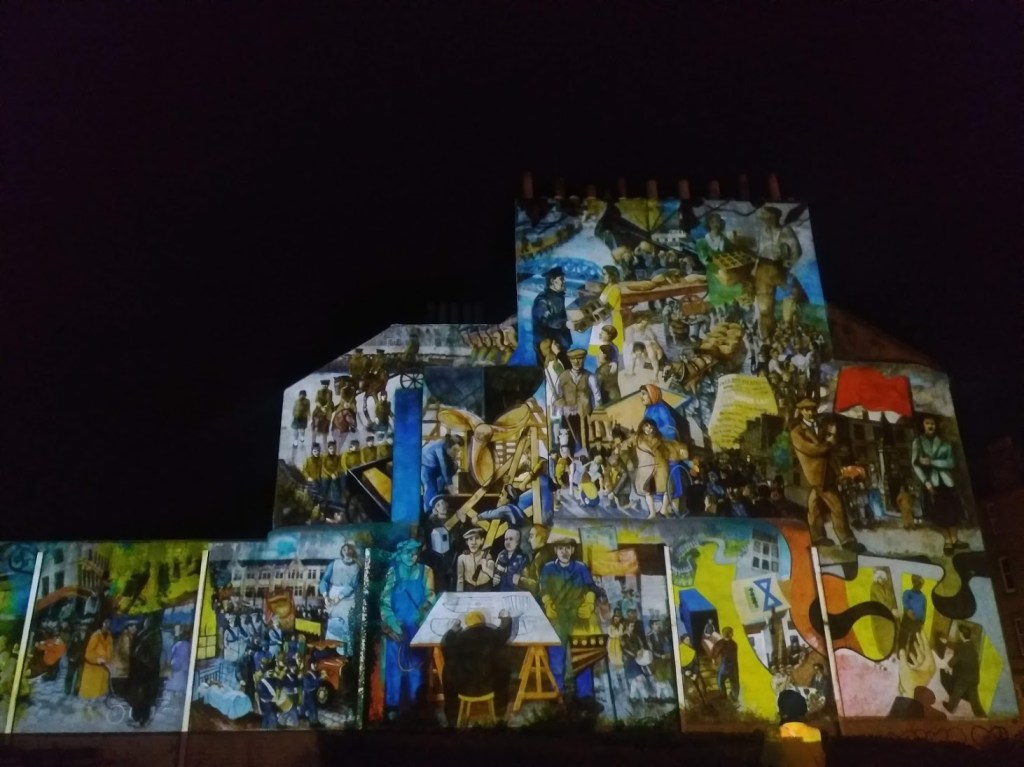
1) Leith’s historic mural, brought to life by Double Take Projections

There are some artworks that seem a little like magic and this is one of those. If you’ve ever seen Leith’s historic mural near Leith Theatre, you’ll know it’s not in the best state of repair. The colours have faded, the edges are eroding, it’s difficult to decipher. I wouldn’t necessarily want to change that, fading is part of a mural’s cycle of existence. Plus I’ve heard that the artists Paul Grime and Tim Chalk, who created the mural in collaboration with local residents in 1985-6, have resisted suggestions of the mural being restored. This decision then, to use projections, sound effects and music to bring different parts of the mural to life, is inspired. With the projection focusing on particular characters and animating different parts, we see a ship’s rudder gently rotating, children playing and soldiers marching. We notice the mural’s complex layers, and the installation restores what is a special piece of street art and local history in the city’s collective memory.
There you have it, my top ten art moments of 2020 so far. What have yours been? I would love to hear from you, so feel free to leave me a comment or DM me on Instagram or Twitter.
The Clearing by Samantha Clark

I am a visual person. I work at a book festival. These two things marry in a particular way which means that I frequently judge books by their covers. It’s impossible not to, and the more you learn about the bookselling industry, the more you realise how important the cover is. Different visual tropes are used depending on the genre (think big, clunky font and capital letters for crime writing). I think most experienced booksellers and librarians would be able to shelve a book based on seeing the cover from 20 metres away. 

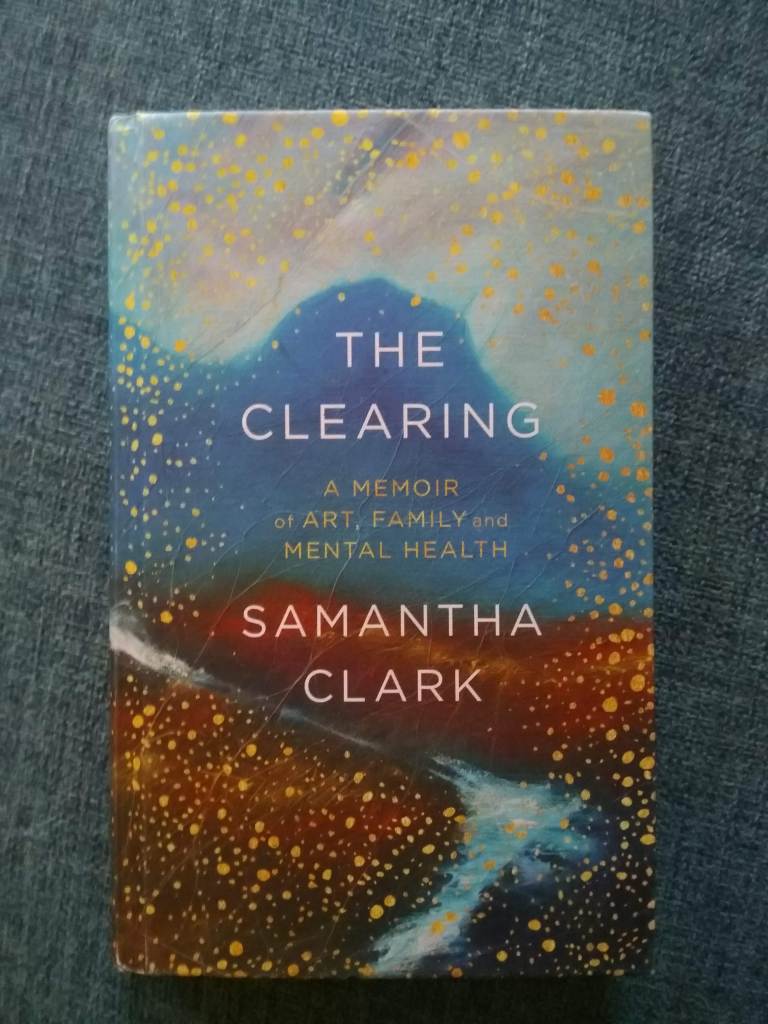
Naturally then, when I saw The Clearing by Samantha Clark, a blurry landscape speckled with flecks of gold, I was drawn to it, as I have been drawn to her art ever since. If you aren’t following her on Instagram I firmly suggest you amend that now. Her work is delicate, intricate, pleasingly detailed and you will also be treated to snapshots of her surroundings (she lives on Orkney so they happen to be sparsely beautiful).

The cover of ‘The Clearing’ by Samantha Clark

The book broadly follows the process of Clark clearing her parents’ house of a lifetime worth of belongings after their deaths. The clearing is twofold of course, because it’s also about memory, and in Clark’s case, dealing with the legacy and repercussions of her mother’s mental illness. As she wrote in a Instagram post on World Mental Health Day, ‘this is something that doesn’t just affect those who are ill, but everyone who loves and relies on them too’. It’s a memoir about some of the tough aspects of emotional life, but it’s not brutal or grim in the way you might fear a book about this could be. It is actually hopeful and there’s a calm quality to it that makes it easy to read and digest.

Reading the acknowledgements – I start with the acknowledgements, because I’m desperately nosey and I want to know about the writer whose world I’m about to immerse myself in – it was interesting to find out that the book didn’t start as a memoir. It was meant to primarily be about ‘the spaces between things’, meditations on philosophy and science that are part of Clark’s art practice.

The writings on art take a backseat to reflections on life and family, but the style is undoubtedly formed and informed by the piercingly observant eyes of an artist, one deeply connected to place and sensitive to the meaning of everyday things: ‘Memory is not just in the mind. It lives in actual places, in actual things. It sits in empty chairs and in worn carpets and smudged walls and light switches. I stand close to the wall and rest my own fingertips against the mark my father’s touch had left, a final intimacy, the closest I will ever get to his physical presence again.’

Clark writes about a worn mark near the light switch in her father’s workroom with precision and poignancy. This writing, this deep attention paid to surroundings, reminds me again how glad I am that artists and writers do all this observing, capturing, distilling. That they share it with me, the reader-observer, so I can be led to notice more, so I can get more out of the ‘stuff of life’, is why I love art. It makes me feel so privileged that I can be on the receiving end of all this work.

When I come to the end of a book, I tend to go back and write down the parts that resonate in my notebook. I read The Clearing back in January, in those pre-pandemic days, but looking in my notebook now, so much remains so utterly relevant to the present. Clark’s reflections on noticing the details, particularly of city life, have stuck with me. This passage helped remind and reassure me of a presence of hope, and I want it to do the same for you.

‘Perhaps every age feels like the end times. May be there is nothing new in this feeling that reality is full of pain and suffering, injustice and degradation, gathering pace, so much, too much to feel it all, so we make ourselves numb. But reality is also and at the same time full of startling beauty. The spinning feather catching the sunlight above the rush hour traffic. The starling on the rooftop signing a song of car alarms and squealing bus brakes. It feels like a small and necessary act of resistance, to pause to listen to the the urban starling’s city song, to attend to the careful washing of a cabbage leaf, to the uncountable blades of grass in my local park, each slender blade performing its own Indian rope trick as it lifts itself miraculously towards the spring sunlight.’

Page 164, The Clearing

These small and necessary acts of resistance are how we will get through this winter. Thank you, Samantha Clark, for reminding us.

‘Florilegium: A Gathering of Flowers’ at the Royal Botanic Garden, Edinburgh

There’s a new, free exhibition in town, at the Botanics. Ever a beautiful place to relieve your Covid-19 cabin fever, to feel the peace of looking at plants and be made to feel small by impossibly tall trees, now you can supplement it with a visit to Florilegium: A Gathering of Flowers. The first exhibition since the RBGE started its Climate House initiative, the exhibition marries what seem to be two very different ways of looking at flowers. 

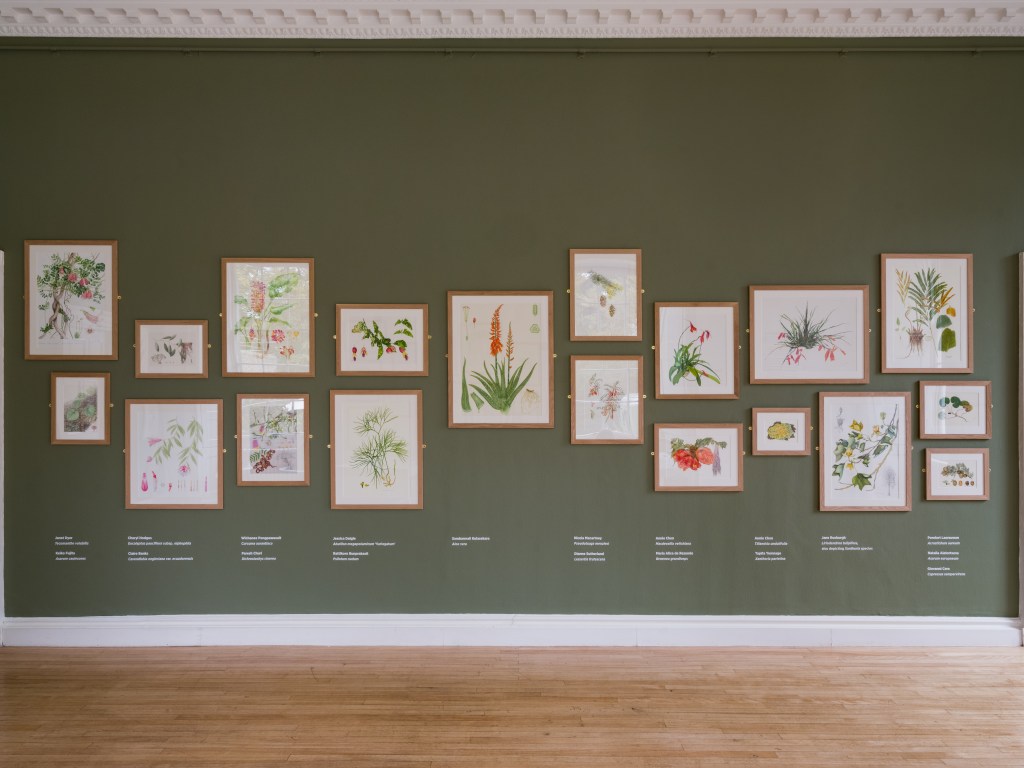
The first is factual, scientific, research-based. Packed into the first room are depictions of flowers from the Garden’s collections, submitted by botanical illustrators from around the world. I love their precision, the sense that these drawings have been set to view in HD. Glancing at these densely stacked images, their uniform wooden frames fitting perfectly with the olive green of the wall, I’m convinced there would be enough detail here alone to make an entire exhibition. Enhanced by the ikebana style floral displays, it’s what visitors might expect, might hope to see. It’s beautiful, classy, and it’s about flowers. Tick.

Florilegium: a gathering of flowers, installation view. Photo by Tom Nolan

Up the stairs, we’re taken into a somewhat different realm by four contemporary artists, Wendy McMurdo, Lee Mingwei, Annalee Davis and Lyndsay Mann. While the immensely skilled botanical illustrators are concerned with depicting the flower exactly, and in some cases, the pollinators too, the artists upstairs are more concerned with what we cannot see. The emotions and meanings we as humans attach to plants, their embroilment in our colonial past, and the metaphor of life and death a flower provides so effortlessly, are all explored here.

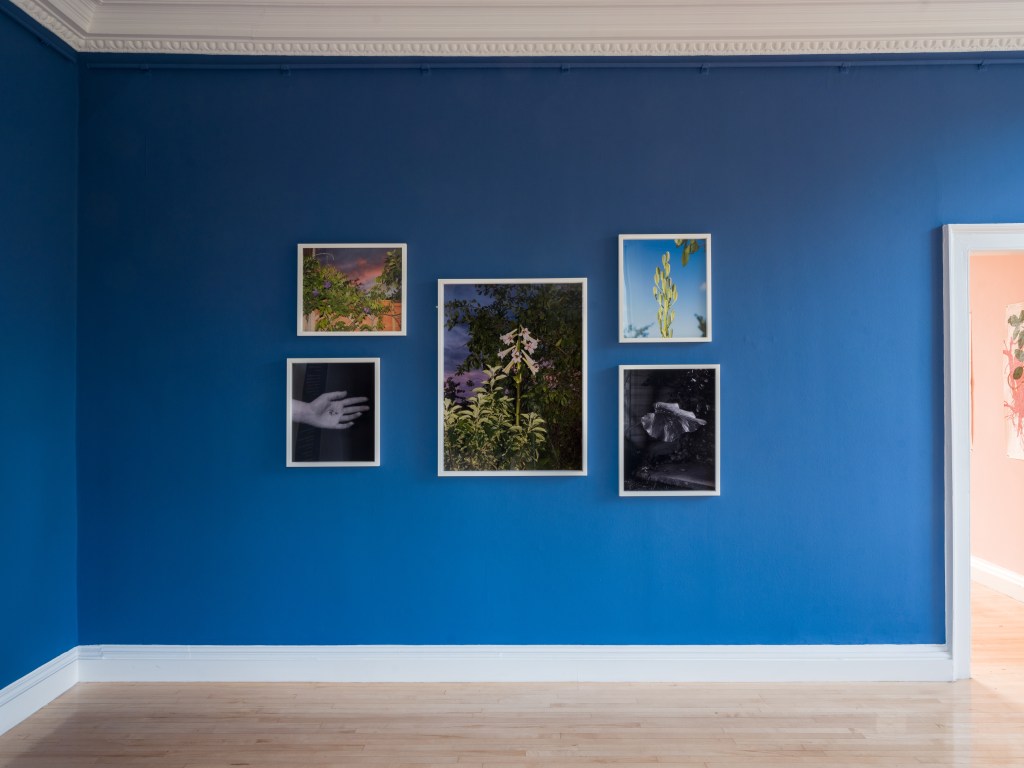
Wendy McMurdo’s photographs from the Indeterminate Objects series from 2019 use gaming software to collapse the blooming/withering lifecycle of a single flower in one vase, an eye-catching narrative that makes you look twice. Her Night Garden series (2020), reflects on how her mother’s ill health and recent death was combined and synchronised with blossoming of a large, mystery, tropical-looking plant in her suburban garden. I loved the uncanny photo of seeds resting in the palm of her hand, which looked to me like the hand itself was punctured, decaying: a wound between the states of hurt and healing.

Wendy McMurdo, ‘Night Garden’, 2020, installation view, photo by Tom Nolan

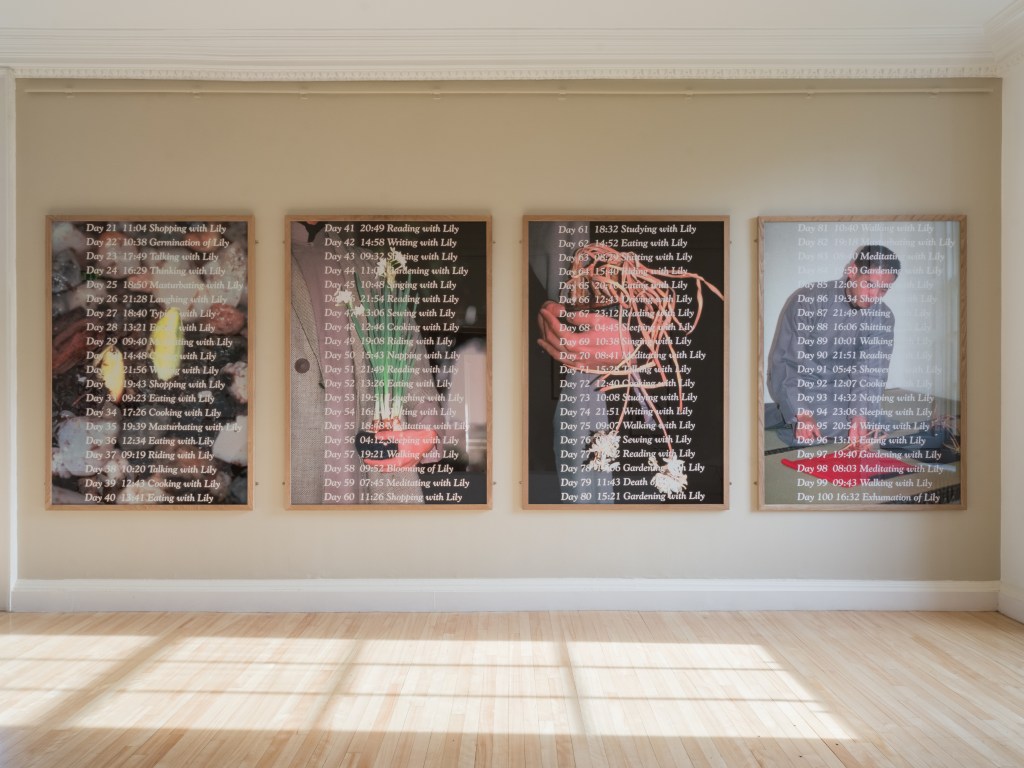
There’s a pleasant chiming here with the work 100 Days with Lily by Lee Mingwei, which documents a performance created back in 1995. His grandmother died, and in mourning he lived with this plant for 100 days, carrying it everywhere. He projects his own grief on to lifecycle of this plant, but the presence of the banal activities of daily life (Eating with Lily, Sleeping with Lily, Shitting with Lily) overwrite and undermine this strange, solemn ritual. For Florilegium, Mingwei has planned a new work called Invitation for Dawn, where opera singers will perform directly to the recipient via live video call. It sounds weird, experimental and intimate, but in a great way. You can participate between 16 November and 11 December, email creativeprogrammes@rbge.co.uk for more details on how to get your ‘gift of song’.

Lee Mingwei, 100 Days With Lily, installation view (photo by Tom Nolan)

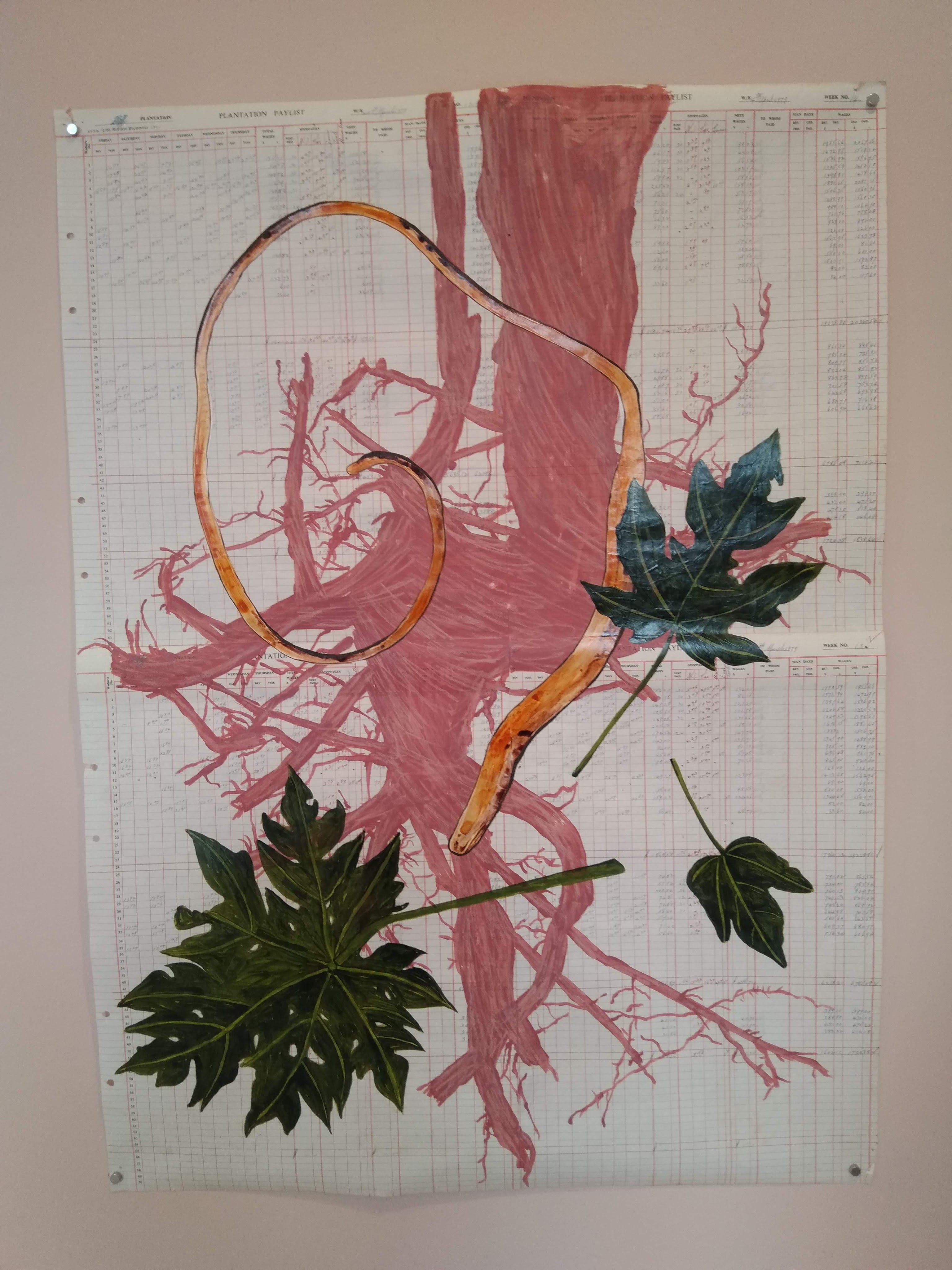
The work of both Annalee Davis and Lyndsay Mann anchors the exhibition in something deeper, bringing the role of the Botanic Garden, the collection of plants, the colonial ecosystem at the heart of RBGE’s existence, into view. Annalee Davis is a Barbadian artist whose studio is situated on what used to be a sugar plantation. Her practice investigates the history of that land, examining the power structures that have been tilled into the soil. Here, her series As If the Entanglements of Our Lives Did Not Matter (2019-20), is casually pinned up on the wall, unframed, unglazed. It immediately felt visceral and direct, denying the formality, poise and stiffness of Inverleith House. Pink, flesh-like depictions of messy clumps of roots are daubed over old payment ledgers from the plantation, which are intriguing, loaded documents in their own right. In a haunting portrait, she places two of her ancestors side by side, who though blood relatives, would have never lived together in reality, separated as they are by race and class. 

Annalee Davis, ‘As if the Entanglements of Our Lives Did Not Matter’ (2019-20), detail

Davis’ art works in dialogue with Lyndsay Mann’s A Desire for Organic Order (2016), a mesmerising film of 55 minutes which explores the RBGE’s Herbarium, where species of preserved plants are kept for study and research. Although most visitors won’t have time watch the film from start to finish, it’s a fascinating piece, which shines a light on the strangeness of it all: the meticulously categorised, catalogued, classified plants, sitting in row upon row of filing cabinets and box files, the collection expanding over the centuries as new species are found and brought to the RBGE, their final resting place. 

The violence surrounding these collections is examined at a distance, with the narrator’s voice dispassionately implying but never quite explaining what we know now, that far more care was given to these foreign plants than to the humans who lived alongside them. If you do have the chance to sit here a while, I’m sure it will make you see the exhibition, and the whole RBGE endeavour, in a slightly different light. You may not think you need this part of your world to be challenged, that you just want to enjoy the Botanics and not think too much about the difficult history and context. But it’s the ability of artists to show things you thought you knew in a new way, that is what makes them so vital to how we think about our past, present and future. That’s why we need the upper floor of the exhibition. We can’t just have a “gathering of flowers”, we need someone to tell us what they mean.

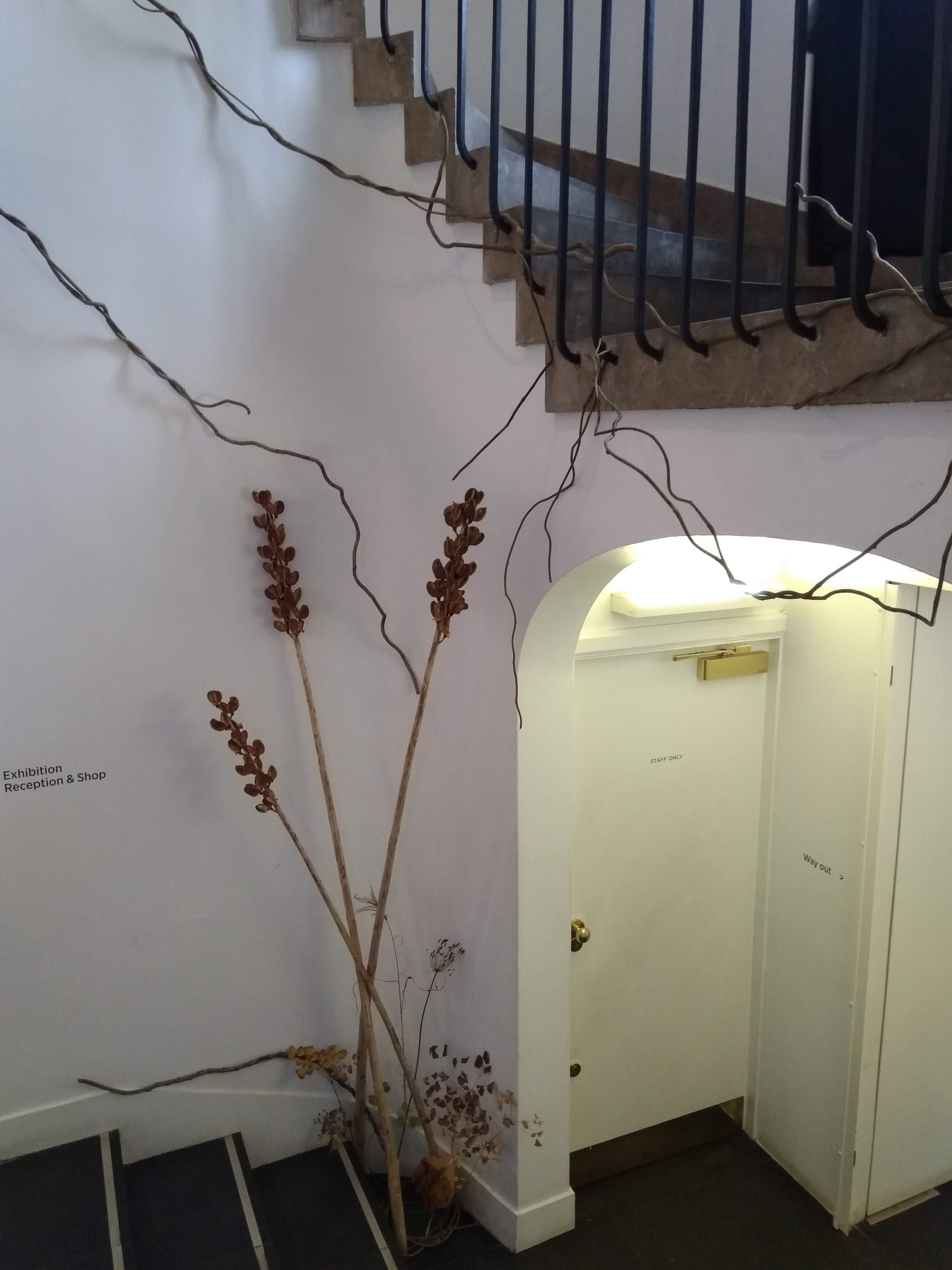
Flower displays at ‘Florilegium: a gathering of flowers’

Among the Trees review

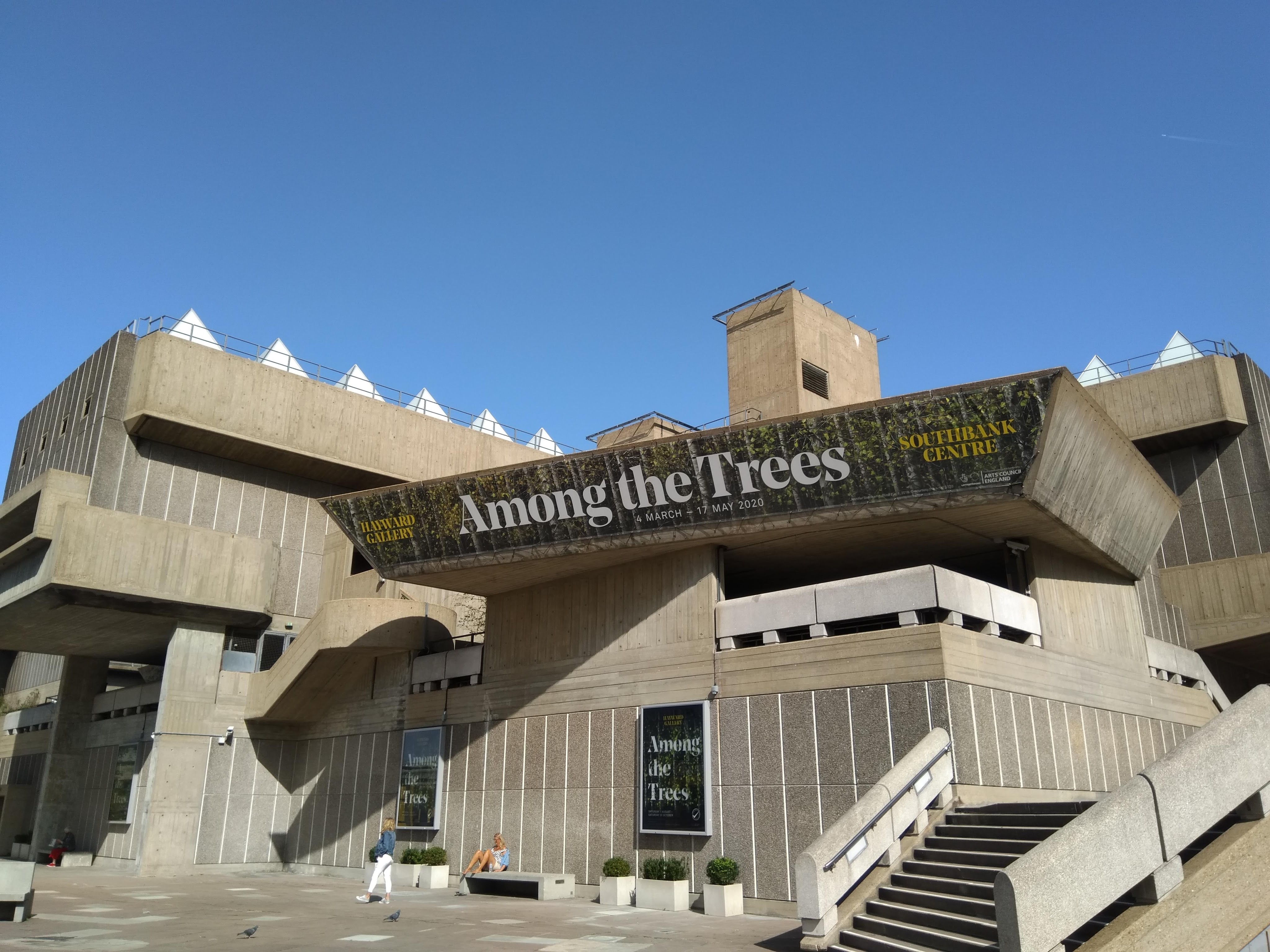
What does it mean to come to a place like the Hayward Gallery, the most concrete of concrete buildings in the heart of the UK’s largest city, to immerse oneself in images of trees? This isn’t a museum, a science hub, or a university, so it’s not a place dedicated to learning about trees, but for looking at them. It’s impossible not to hear strains of Big Yellow Taxi as you see the hoardings around the Hayward Gallery: “They took all the trees, put them in a tree museum/ and charged the people a dollar and a half just to see em”. The irony was particularly present for me, as I headed straight to a dark exhibition space to look at nature, having just arrived from the actual countryside (full of actual trees).

The outside view

In the first room, I began by wondering whether this was going to be a contemporary echoing of Romanticism. There were seemingly no signs of human life, except for the artists of course. The ghostly, delicate Untitled (2008) by Toba Khedoori, and Robert Longo’s Untitled (Sleepy Hollow) (2014) exposed what we forget in the height of summer, the intricacies of tangled branches. I wondered then whether the show was going to be boiled down to a central message: escapism through beauty. With Covid-19, Brexit, government incompetency, economic collapse and the US election for context, we crave escape more than ever, and nature can seem to offer some sort of way out of it all. That’s also what the Romantics thought too: the fewer humans in their landscapes, the better! But we know that’s not a true representation of landscapes. They are, and now always will be, shaped by humans – for better and for worse. In that context, what does it mean to imagine landscapes without humans? Is it eco-fascism, or just an overly simplistic, narrative of nature = good, humans = bad? The artists and artworks in Among the Trees put this idea under a microscope, reminding us that art can do both – be visually pleasing and profound.

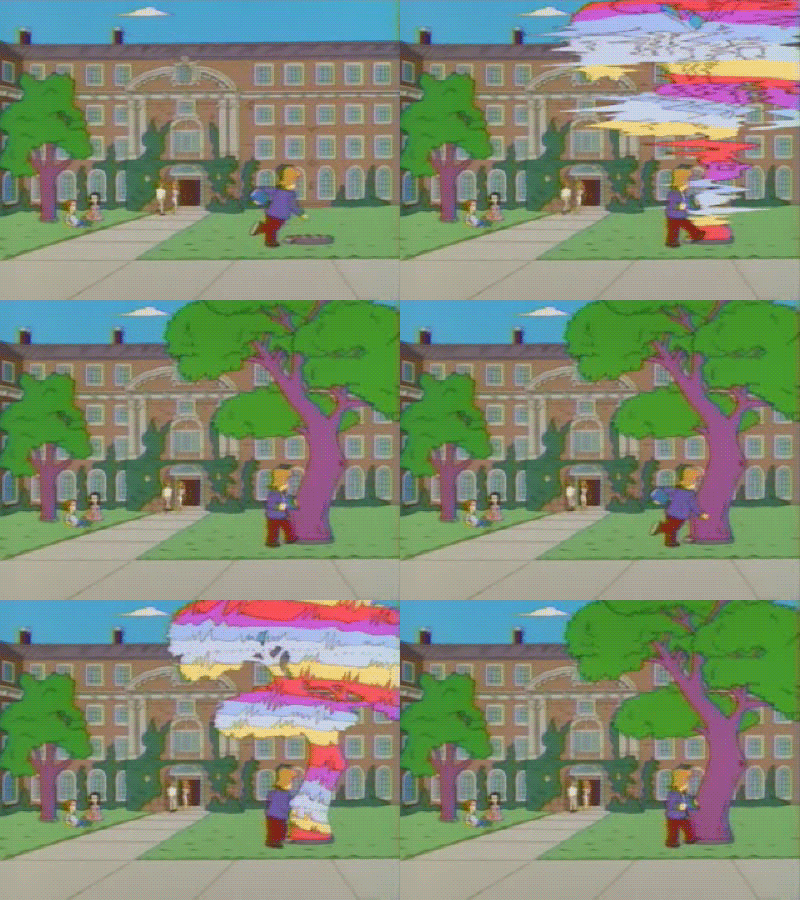
Remember the iconic Simpsons episode where Lisa has her fortune told? It’s full of painfully ironic, insightful vignettes of how the near future might pan out. In a college campus quad, a plaque reads “In memory of a real tree”, but the tree is flickering like a static TV screen. An electrical malfunction exposes this simulacrum for what it is – until a passer-by boots it back into functionality, into looking natural again. That’s the image I couldn’t get out of my mind while at this exhibition. I was looking at a monument to something we are knowingly destroying; the monument was artificial.

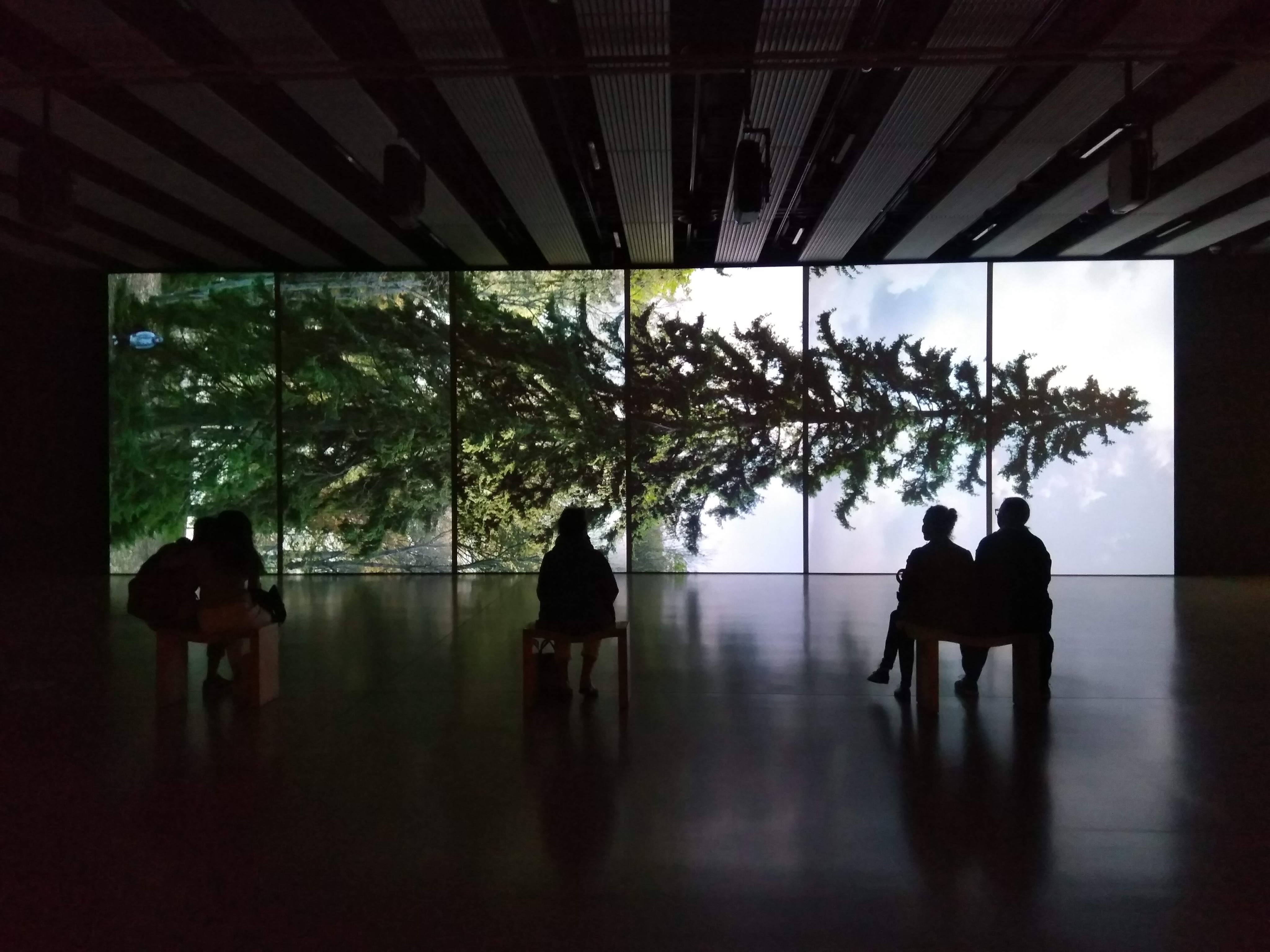
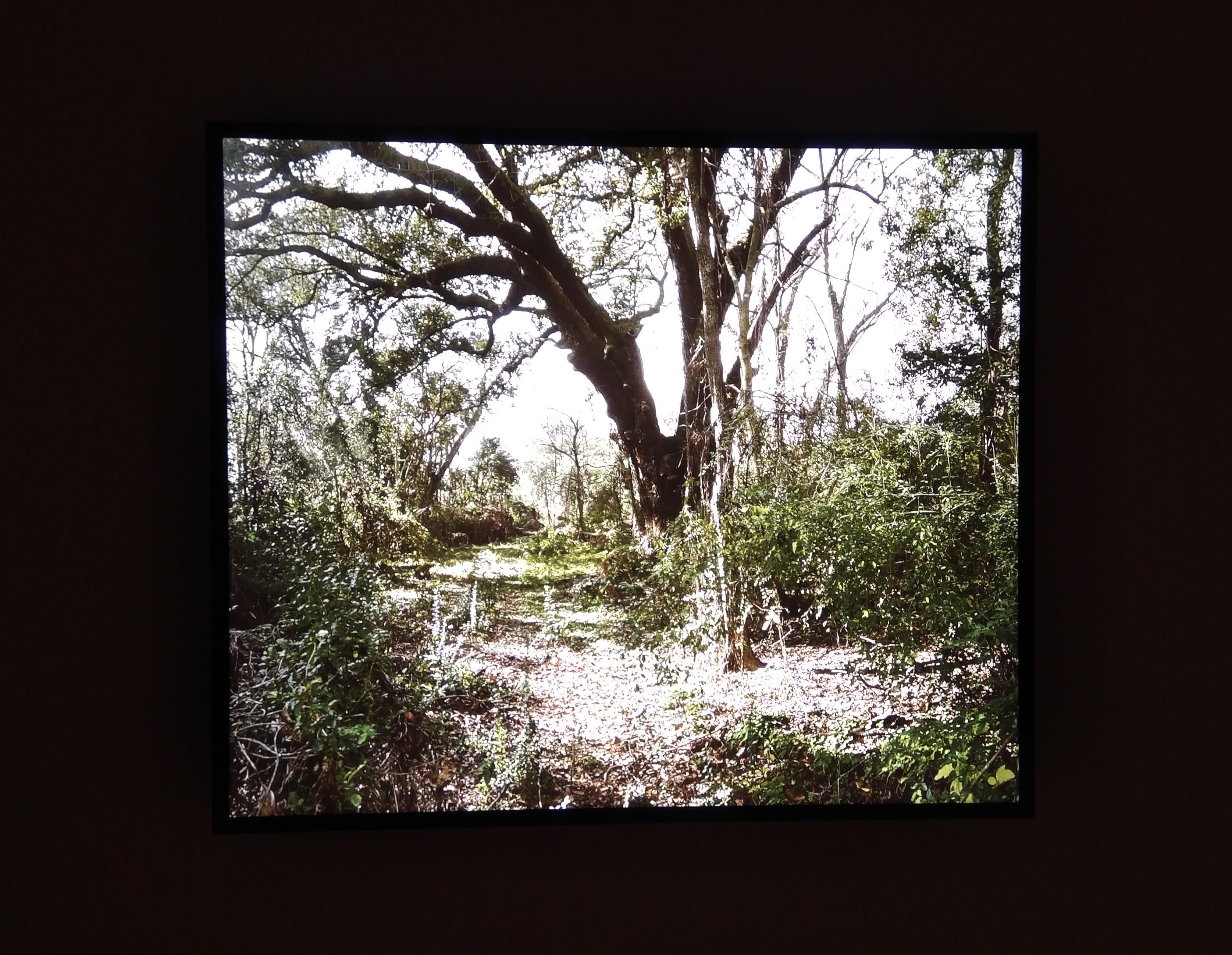
Yet the highly effective use of artifice in conjuring the natural is what I found most interesting about Among the Trees. One of the first spaces is dominated by a huge video projection across the back wall, the work that is on all the posters. This is Horizontal Vaakasuora (2011) by Eija-Liisa Ahtila, depicting a huge native Finnish spruce in five video panels, each slightly out of sync. It’s mesmerising. We hear the wind in the branches, bird song, and watch the spindly, yet strong and flexible, living tree, dancing, creaking and swaying in on itself. There’s a kind of discombobulation that comes from seeing something this tall lying on its side. You’re not supposed to see the tops of these trees close up. There’s a feeling of privilege in looking without having to crane your neck, but also a foreboding in the position. Trees lie this way when they are felled.

Eija-Liisa Ahtila, ‘Horizontal – Vaakasuora’, 2011

The other large-scale video work is Jennifer Steinkamp’s Blind Eye 1 (2018). It is wholly artificial, using animated computer technology to show a fake birch tree forest move through the cycle of all four seasons in a cool 2 minutes 47 seconds. I’ve always loved the visual effect of technology speeding up the forces of nature in a way that reveals how utterly miraculous they already are – time-lapse videos of plants growing impossibly quickly, sprouting leaves, buds, flowers, seeds and withering and dying all in a few moments. It’s all so heart-wrenching and magical.

Jennifer Steinkamp, ‘Blind Eye 1’, 2018

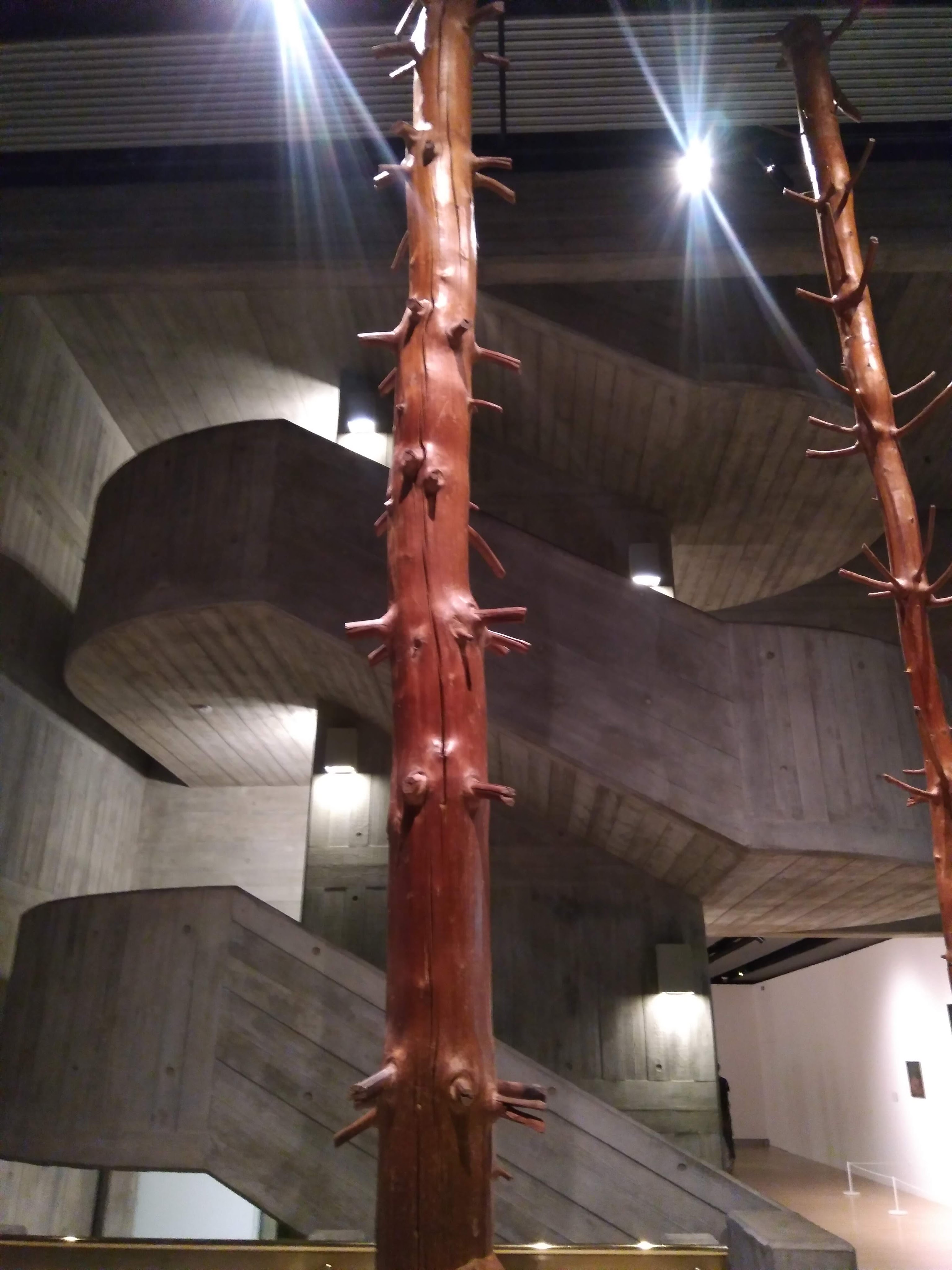
Revealing what is already there is at the heart of Giuseppe Penone’s work with trees. His Tree of 12 Metres (1980-82) is the most ‘natural’ of all works in the first room: a very tall tree has seemingly been divided in two, stuck into plinths and carted into an art gallery, it’s warm earthy tones juxtaposing with the smooth, cold concrete staircase behind. But this tree is actually a sculpture, fashioned from an industrially planed piece of timber that Penone painstakingly scraped away, in a reverse Frankenstein fashion, following the knots, lines and ridges in the wood, unlocking how the tree would have looked long before it was felled. He takes it back in time, back to nature, back to life.

Giuseppe Penone, ‘Tree of 12 Metres’, 1980

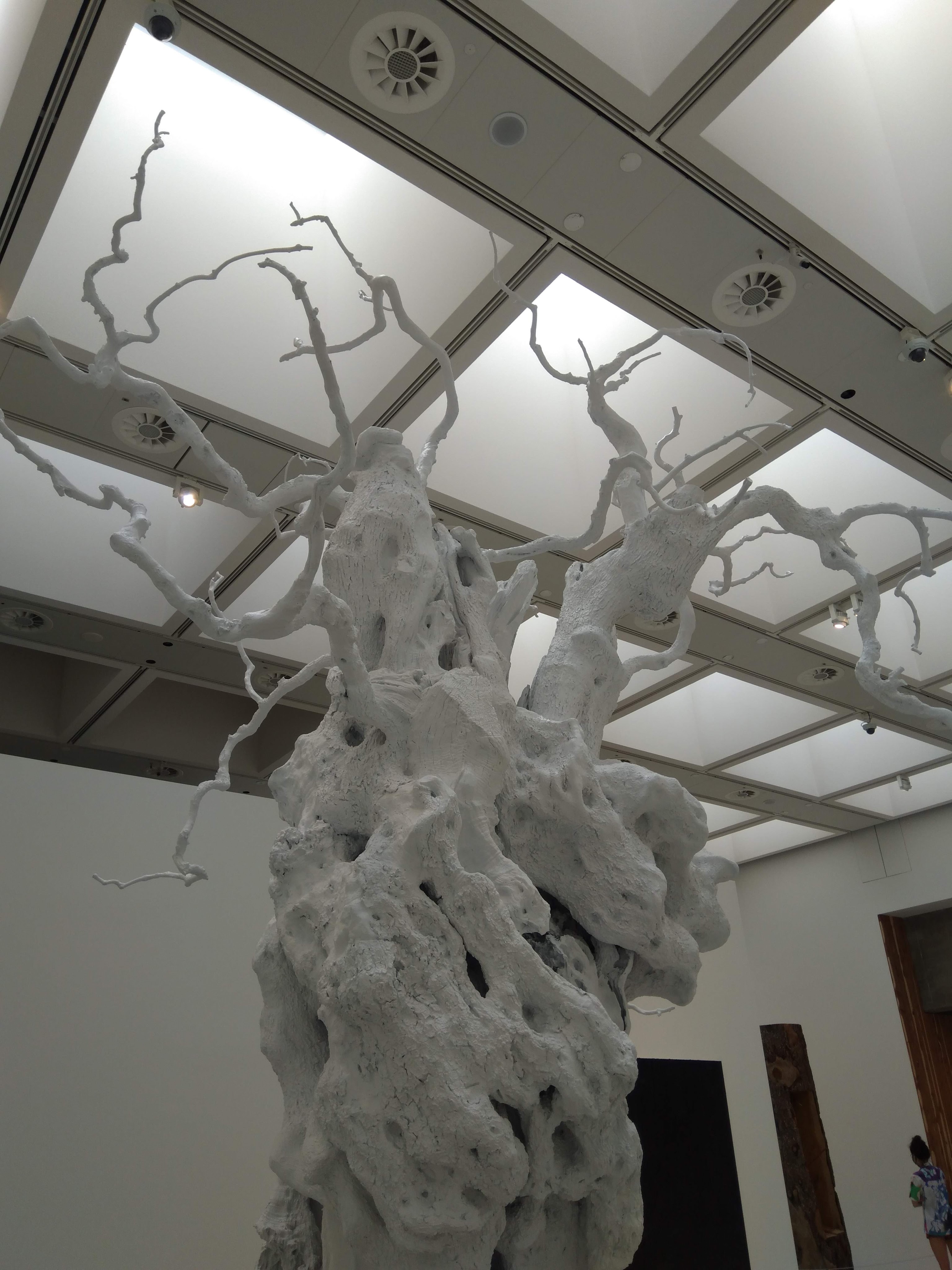
Death and life are here in abundance. Because trees can span many human lifetimes, they are presented as witnesses, as memento mori. Ugo Rondinone’s cold moon (2011) is a cast of an ancient olive tree in southern Italy, its hulking, twisted, wizened form reminiscent of the White Tree of Gondor, as well as calling to mind the Ancient Mariner, an old man sitting in a corner of a dark city pub, a man who has *seen things*. Steve McQueen’s Lynching Tree documents where countless African-American bodies were lynched, a site encountered while filming 12 Years A Slave. It is a tree that has, in its very shape, borne witness to and memorialised the worst of us.

Steve McQueen, ‘Lynching Tree’, 2013

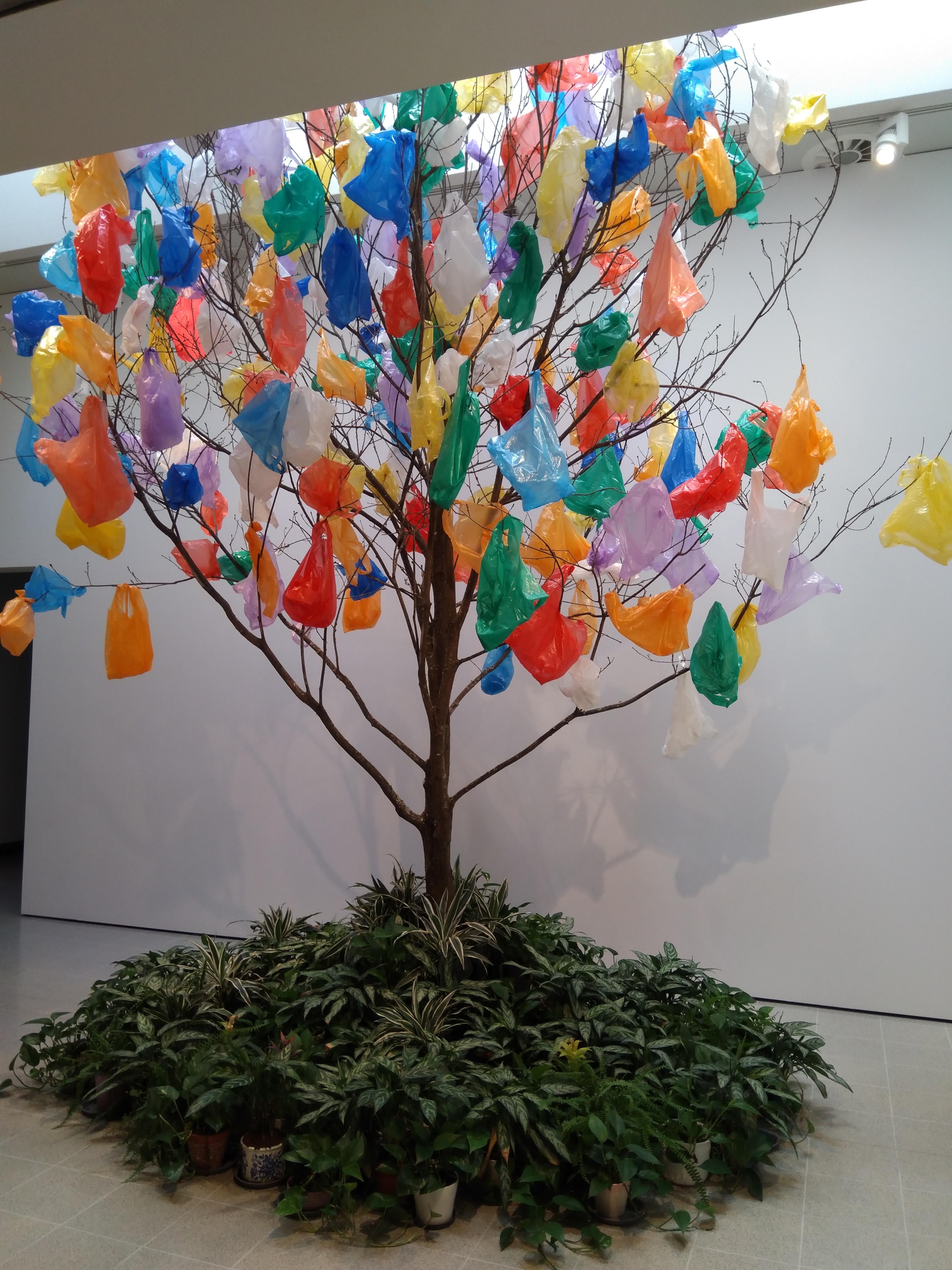
Alongside this, you can see Plastic Tree B, created this year by Pascale Marthine Tayou, where plastic bags have become the bright, somehow beautiful blossoms of an Instagram-worthy sculptural tree. Simplistic idea perhaps, but still visually striking, and reminding us of how damn precious it all is, and how much it is slipping through our fingers because we are, by and large, terrible custodians. You can’t even walk down a street without seeing hundreds of disposed plastic masks on the ground, like scattered flags of surrender to the coronavirus age. The show could probably have pressed more on the climate crisis message. But I was reminded in a talk by Olivia Laing recently, that in the face of politics, art won’t make the change itself, but it’s a way of “galvanising, and grouping a response”. In other words, art can’t do the work for us.

Pascale Marthine Tayou, ‘Plastic Tree B’, 2020

The woodland I was walking in just hours before my trip to London is full of signs of human life. On a nearby bench, “Trump Out” is scratched into the surface, reminding us that our human politics infiltrate every part of our world, no matter how much we might wish to escape them. We have to acknowledge that, and not lose ourselves in the mesmerising beauty of nature and of art. That is appreciation, and it might give us space to become mindful, but that is only the first step. A moment of escapism is acceptable, but only if we emerge from it refreshed to re-engage, to take meaningful steps to do some damage limitation, to avoid the climate crisis that is unfolding before our very eyes. Otherwise we might find ourselves, in forty years, frustrated that our tree memorial isn’t convincing enough, wishing we had acted before it was too late.

Ugo Rondinone, ‘cold moon’, 2011