Edinburgh Printmakers

Edinburgh Printmakers has moved to my side of town. Which is great news for me, and I think it will be for them too. They now have a lot more space and are in a beautifully renovated old factory which used to make rubber and rubber products, (wellies, hot water bottles, etc.). 

The new building is stunning, and the current exhibition in the main front room is really worth seeing: a new commission by German artist Thomas Kilpper called The Politics of Hertiage vs. The Heritage of Politics. The floor is a giant rubber carving that acts as a linocut plate, the ceiling and walls are imprints of the plate. There’s a wonderful tactility in being able to walk right over the plate, to reach down and feel the different grooves where the ink hasn’t quite reached. Within the room, there are images all around and above you, demonstrating the reversible and mirror-image effect of printmaking and completely immersing the visitor in the artwork.
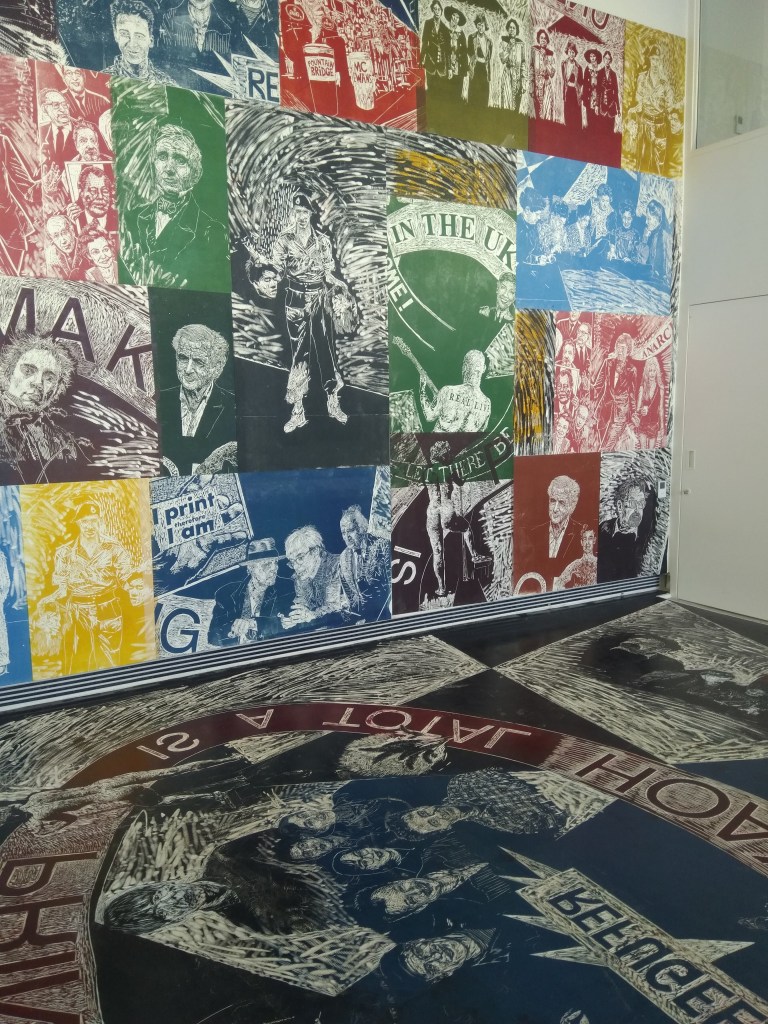
The image itself is a vast roll call of different characters, some of whom are local to Fountainbridge, others are national political or cultural figures. It has that special quality of being site specific, and rooted in history but also very much of our times, with references to recent occurrences in the media (complete with Theresa May dancing – the awkwardness is perfectly captured and still cringeworthy). Yet there’s also a humorous note to it that slightly plays with history, mixing fact, fiction, fake news and narrative. A banner unfurls from Donald Trump’s mouth declaring: ‘Printmaking is a hoax invented by the Chinese’ – paraphrasing his statements on climate change and wryly nodding to the actual origins of printmaking, in China.

It’s an artwork you need time to appreciate, and I’ve visited twice already to take more time to discover the different members of the cast (the leaflet in the corner is really helpful for this). I got talking to a couple who have lived in Edinburgh for most of their lives, who told me that Sean Connery, who features in the nude as he apparently used to do life modelling for students at Edinburgh College of Art, used to do the milk round in Fountainbridge when he was a boy. We talked about the area, how it has changed, and they mentioned more local characters they had known over the years. This is one of the things I love about good art – it can encourage encounters with strangers, and spark dialogue that can enhance your experience of a place, adding more elements to your own patchwork quilt of knowledge, much like the one Kilpper has created for this space.

However, it’s such a dominant artwork that it won’t be there for long. The exhibition is up until 13 July, after which it will travel to Germany. It would be so amazing if this artwork could stay in Edinburgh: it’s site specific and mainly informed by local history, after all. Perhaps it could be acquired by the NGS for their collection? Or maybe a wealthy local could purchase it for the Edinburgh Printmakers, so they could keep it in their beautiful new home. Sean Connery, are you listening?
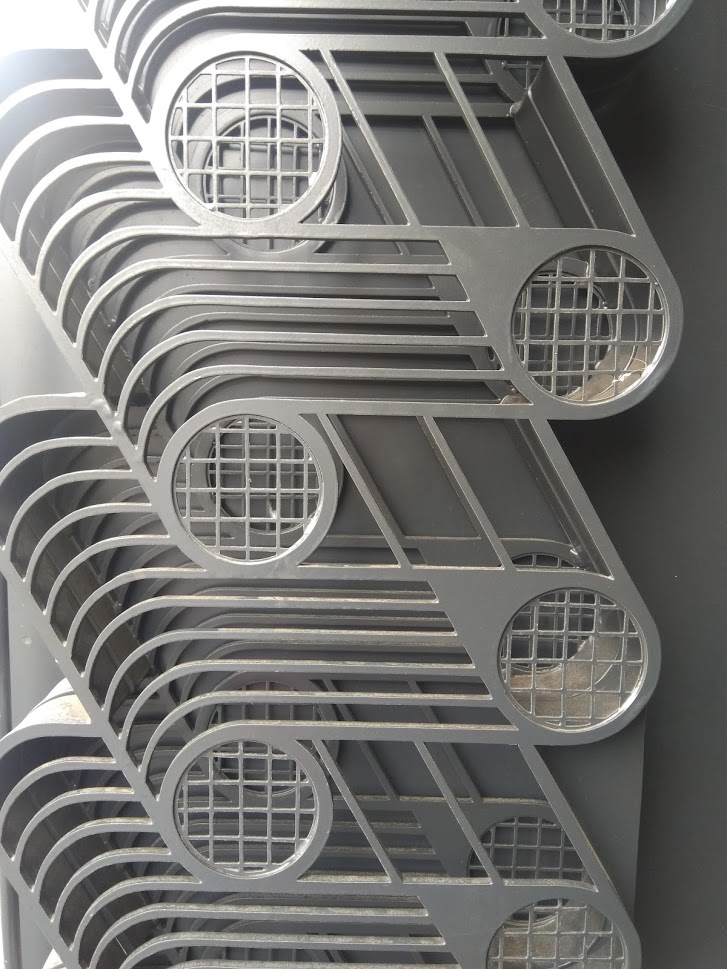
The gates of the Printmakers were a special commission by Rachel Duckhouse

Senga Nengudi, Fruitmarket Gallery

Walking into the Senga Nengudi exhibition at Fruitmarket Gallery, I was struck again by how weird art is. Immediately visible were two pieces that looked so utterly different, you would never think they were by the same artist. One was a large section of the gallery floor covered in sand, with what looked like little mole hills spattered with colour. The other was like three giant ice pops that had melted in their plastic sheaths, with bubbles that had formed where the garish colours met the surface of the clear plastic. This work was wholly artificial where the other was primarily natural. My first urge was to reach out and touch these kitsch water features, to poke the plastic and watch the bubbles move and see the tube take a different shape. However, being a natural rule-abider, I didn’t. Didn’t want to be told off.

I often feel that by being a postgrad History of Art student, I ought to know what’s happening with ALL artworks. What are they about? Could I explain them to someone else, who maybe wasn’t as keen on art as I am? But at this stage of the exhibition, I was quite lost and I couldn’t really get my head around the artist’s aesthetic choices. Perhaps the invigilator noticed I looked baffled and handed me the Gallery guide, which was helpful. This has happened to me a couple of times at the Fruitmarket and I always think how great it is that the invigilators are encouraged to interact with the public.

The guide explained that the giant melted ice pops were part of a series of early works known as Untitled Water Compositions.

“When they were first made and shown for short periods of time, they were designed to be activated by the audience, to be pliable and responsive to touch as flesh might be, challenging the static, intransigent nature of much minimalist sculpture of the 1960s. The works we are showing have been recreated for this exhibition. We ask you not to touch them as they become extremely fragile over the longer time of the exhibition.”

This really irks me. What’s the point of something which was conceived by the artist as kinetic, which is now static? The meaning and substance of the work is completely altered. For artists like Nengudi who work with performance, the fragility of the piece is surely essential to its conception? Plus, on a practical note, these aren’t even the ‘original’ pieces, so that plastic can’t be that fragile. It is sometimes difficult to know who makes these decisions. Is it the host gallery, the external curator, the gallery representing the artist, or the artist herself? The whole thing reminded me, in a bad way, of one of my most frustrating exhibition experiences at the Alexander Calder exhibition at Tate. There was a key piece of sculpture which took up an entire room. The conceit of the work was a pendulum that swung and hit the different objects in its path, thus creating different patterns of sounds and a unique journey through the space each time it was set off. The sculpture was not permitted to move because the estate of Alexander Calder didn’t want it to be damaged: the ultimate example of how monetary value can totally eraticate the aesthetic value of a work.

I made my way upstairs feeling a bit pissed off about the whole thing. But the upstairs was where the exhibition really started to come together, the R.S.V.P sculptures Nengudi has created with tights/stockings having the biggest impact. These were first created in the mid-1970s, way before Sarah Lucas created her tortured forms using stockings (I’m thinking of Tate’s Pauline Bunny, 1997). The tension between the stretched nylon and the stones/sandbags weighing them down was palpable. Particularly striking and important was the use of dark brown tights, depicting black skin. It brought to mind the difficulties women of colour can face when trying to do a simple thing like buying tights: “flesh coloured” is a loaded term, and many beauty products still haven’t caught up. These seemingly simple works allude to absent female bodies which are simultaneously weak and fragile, powerful and tenacious, able to withstand their own tortured forms. They say a lot even though their forms are simple, their materials part of the everyday. That was the part of the exhibition that will stay with me and helped me to better understand the other works I had almost dismissed.