Inspired by Ben Street’s recent article in Apollo magazine about the meaning of art postcards, I’ve decided to have a root around in my own collection, and share five of them with you.
How art postcards collections come into being is a curious matter. We buy them as mementos from favourite exhibitions, or while visiting new places on holiday (remember those?). Some, we are sent by friends and family, not all of which we would’ve chosen ourselves. When I was looking through my own stash, I came across blank postcards of artworks I have zero memory of seeing in real life, which I don’t even like that much. Where do they come from? They seem to spawn independently in shoeboxes and desk draws.
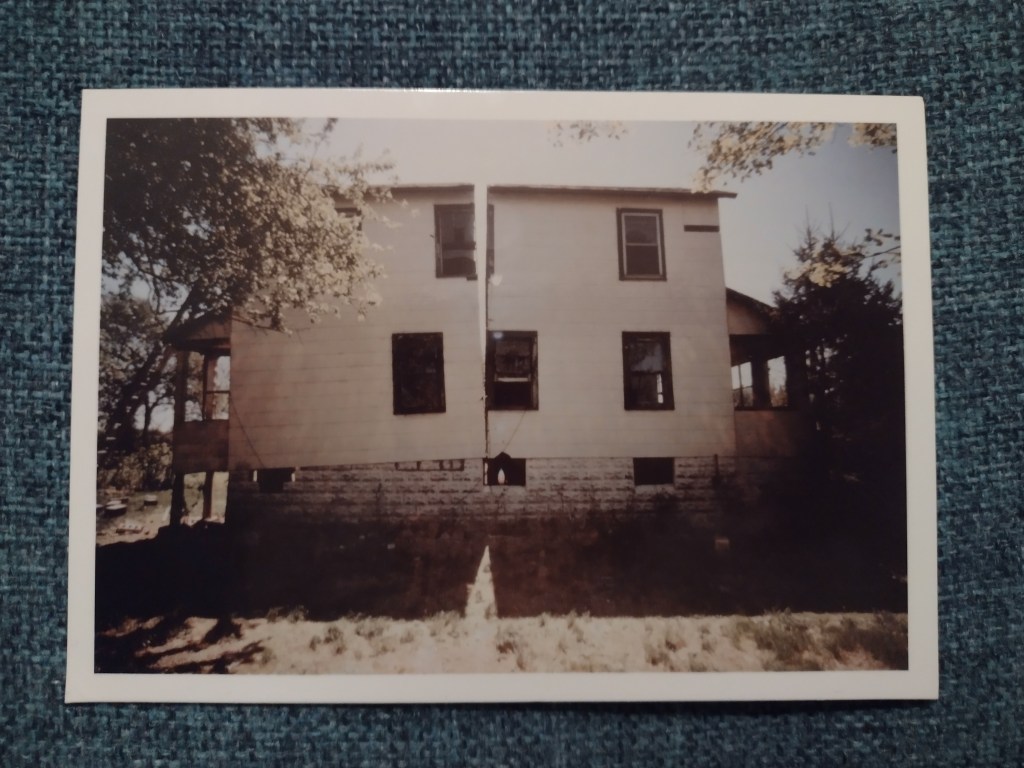
Splitting by Gordon Matta-Clark, 1974
I often end up sending my favourite art postcards to people who I know will appreciate them. But I’ve never wanted to part with this one, I love this postcard a lot. I think I bought it at an exhibition at the Barbican in 2011, long before I started writing about art. I only really remember Matta-Clark from that show. His art hovered at the edges of architecture and performance, and this documents one of his most famous works, where he bisected an entire New Jersey house. It’s unlike anything I’d seen before, an artwork on such a huge scale. Cutting up a house like that makes it useless, which makes me wonder, what’s the point of this act? Why turn something useful, valuable, a place of shelter and memories into something broken and strange? I’m still drawn to it though. It’s an arresting image, the sunshine beaming down, a big wedge missing from the house’s shadow like a slice of cake. It stops you in your tracks, makes you curious, makes you a little confused. It’s like a beautiful, surreal cartoon and for that moment you see something as simple as a house in a different way. Sometimes certain artworks chime with us and we don’t really know why. Perhaps that’s the reason I’ve held on to this postcard for so long: I’m still trying to figure it out.
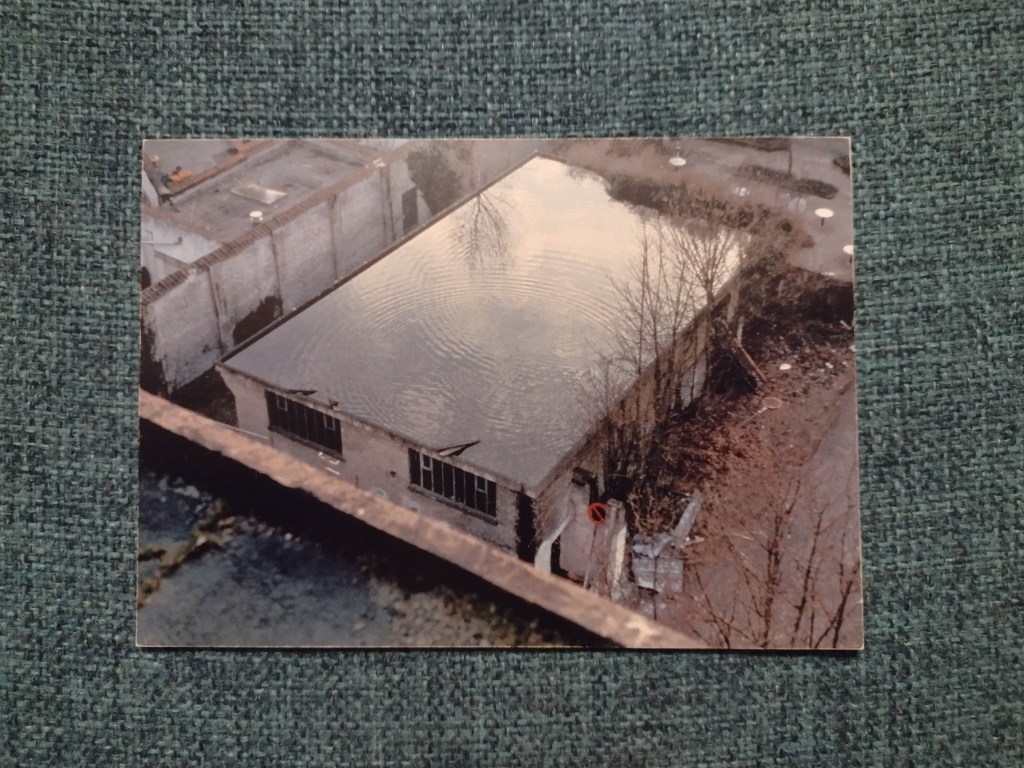
From Roof to Roof by Gabriel Orozco, 1993
The artist Gabriel Orozco notices things. His eagle eye can spot a fleeting moment of enchantment from afar the way a shark can sense a drop of blood in an ocean. I recently wrote about how visiting his retrospective exhibition at Tate Modern changed the way I saw art and the world, and it resonated with lots of other people. Why? Why does this rectangle of water captured on a flat rooftop, reflecting light, sky and trees, pinpointing a passing breeze in its ripples, make such captivating art? I think it’s because it’s about seeing the magic, or the possibility of magic, in the mundane, which is something we all can do, a radical choice we can all make. It’s empowering, to be able to take a moment and see beauty, chance, luck, favour where we might otherwise just have seen a dilapidated outhouse with a flat roof.
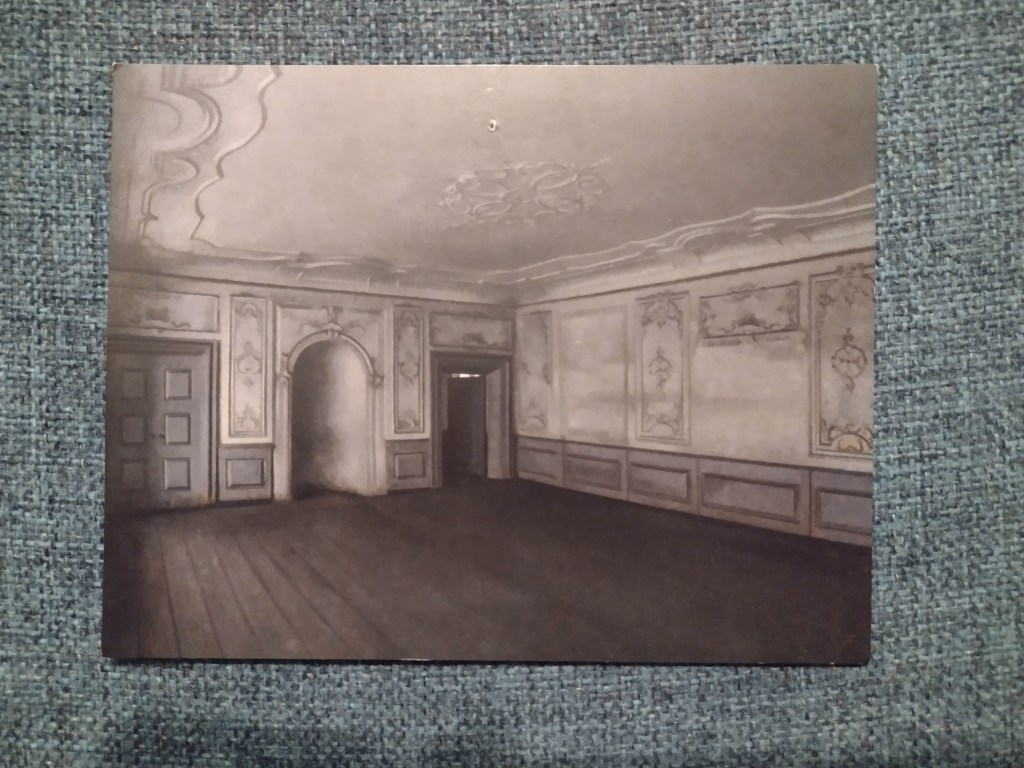
Interior of the Great Hall in Lindegaarden by Vilhelm Hammershøi, 1909
I am pretty sure I have loved every work I’ve seen by Hammershøi, though I don’t know many of them well. I think I first encountered his work at the National Gallery’s most modern rooms, and remember how the greys, and the stripped back aesthetic of his Interior, (1899) contrasted so shockingly with the bright colours of paintings by Manet and Seurat. This postcard is from a trip to Ordrupgaard, a gallery outside of Copenhagen I visited with a dear friend. The atmosphere of this ghostly, grand, empty room is so convincing, you feel like you are looking through a keyhole in a haunted house, not at a tiny postcard of a painting. I have so many questions about this room that I know will never be answered, and I’m ok with that.
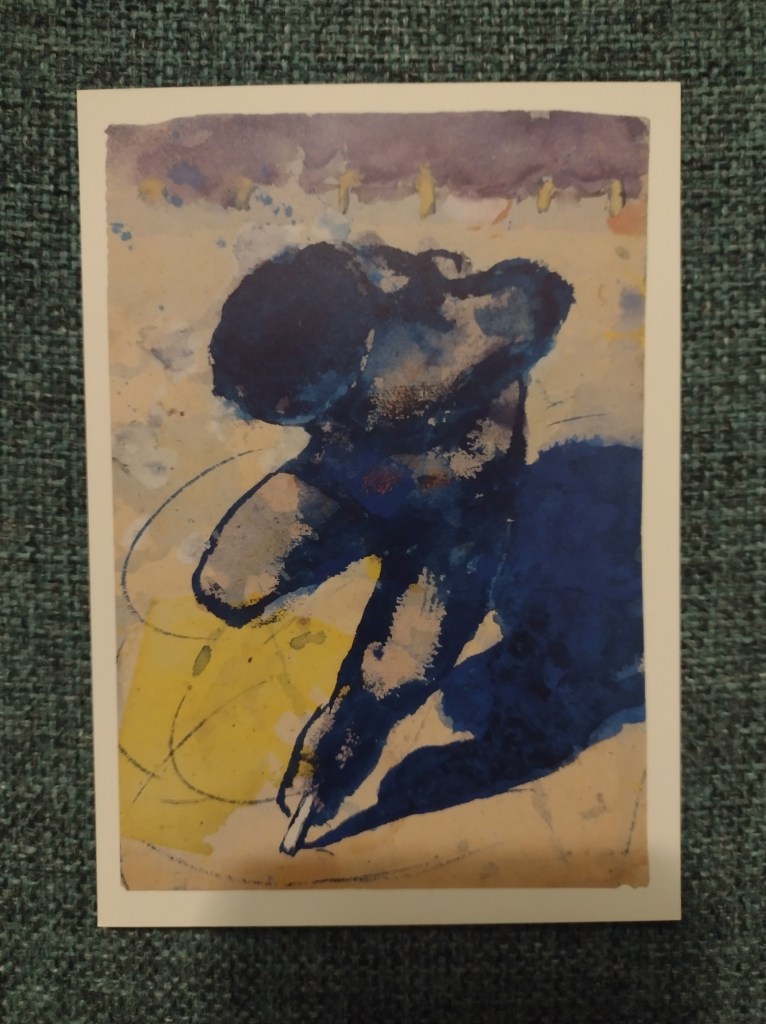
Skater by Emil Nolde, 1938-45
The reason I’ve picked this is that it’s simply one of the most beautiful prints I’ve seen. Some artworks really translate to postcards (in the same way that some really translate to Instagram) and this is just perfect. I remember buying two copies, and sending one to my sister just saying “look how beautiful this is”. The yellows and blues, the blurred splodges contrasting with the precise curved lines on the ice, the movement of the skater crouching forward, propelling into our space. I picked this postcard up at National Galleries of Scotland’s Emil Nolde: Colour is Life in 2018. Sometimes colour IS life. Looking at this picture lifts my mood in a big way. Thanks Emil.
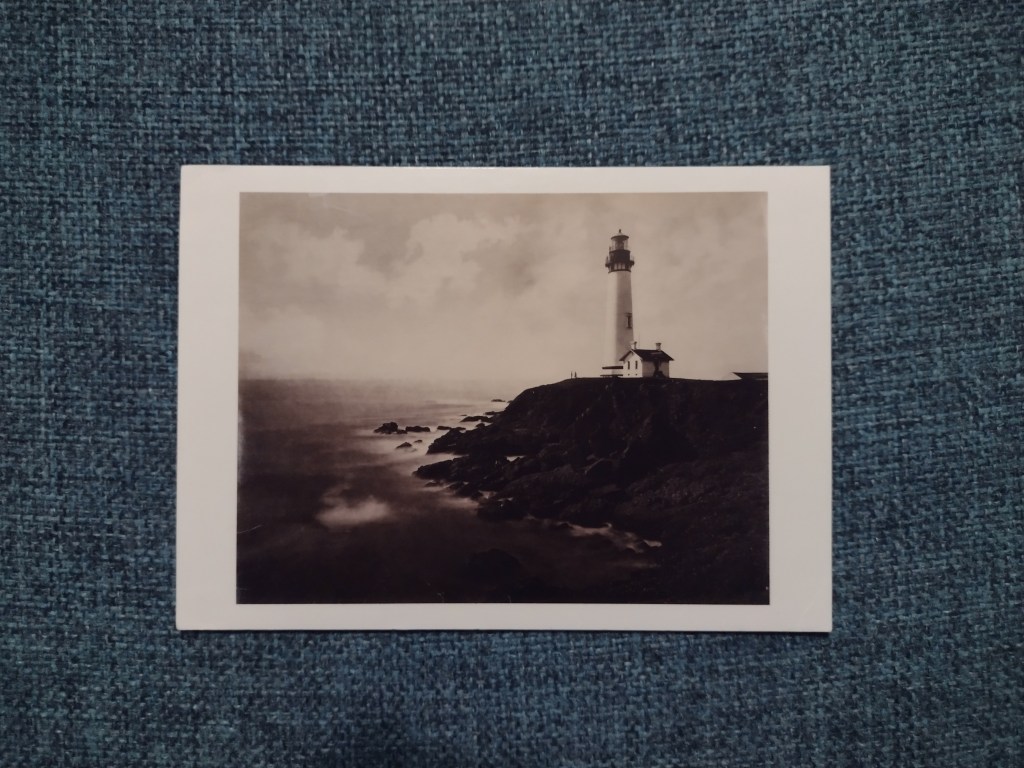
Pigeon Point Lighthouse by Eadweard Muybridge, 1873
My final choice from my collection of many, many art postcards is this one, bought at the Muybridge exhibition at Tate Britain in 2010. Lining up the dates, I must have seen this picture when I first moved to London. I would’ve been 18 or 19. I love photography, I think it has always tied into my fascination with the past – I studied history before I studied art. But I think photography might also have been a route in to contemporary art for me: it straddles past, present and future. Muybridge changed the medium of photography, the fields of art and filmmaking and with that, the way people saw the world. I look at this now and remember a visit in 2019 to a lighthouse on the most northerly point of the Isle of Lewis, where it was so windy we could barely open the car doors. That’s what’s special about these images. They are scraps of memory that live with us, they gather meanings as well as dust. They remind us of what we love about art, and sometimes tell us what we used to treasure that now doesn’t hold so much weight.
Thank you Ben for inspiring me to look through this old collection of images. I’ll be doing it more often from now on.
If you collect art postcards, I would love to know which artworks they reproduce and what they mean for you. Head to the Contact page to get in touch, or DM me on Instagram.

 encounters_art
Dear Dearest,
Excellent again!
Dad and I were sharing our pleasure in some of your sentences:
Eg ‘seem to spawn independently in shoeboxes or desk drawers.‘
‘ shark can sense a drop of blood …’
And many others! Possibly my favourite , ‘They live with us and gather meaning as well as dust’ 👏
Thank you Mishy and keep it up!
Love, Mum xx
LikeLike
I absolutely love these – it makes me want to start my own collection. I think Splitting is my favourite. Like you said, there is something in the strangeness of that image that is really quite captivating.
LikeLike
Thanks so much for the comment Lydia, I’m so pleased you enjoyed it and great to hear you want to start your own collection! 🙂
LikeLike