I am a visual person. I work at a book festival. These two things marry in a particular way which means that I frequently judge books by their covers. It’s impossible not to, and the more you learn about the bookselling industry, the more you realise how important the cover is. Different visual tropes are used depending on the genre (think big, clunky font and capital letters for crime writing). I think most experienced booksellers and librarians would be able to shelve a book based on seeing the cover from 20 metres away.
Naturally then, when I saw The Clearing by Samantha Clark, a blurry landscape speckled with flecks of gold, I was drawn to it, as I have been drawn to her art ever since. If you aren’t following her on Instagram I firmly suggest you amend that now. Her work is delicate, intricate, pleasingly detailed and you will also be treated to snapshots of her surroundings (she lives on Orkney so they happen to be sparsely beautiful).
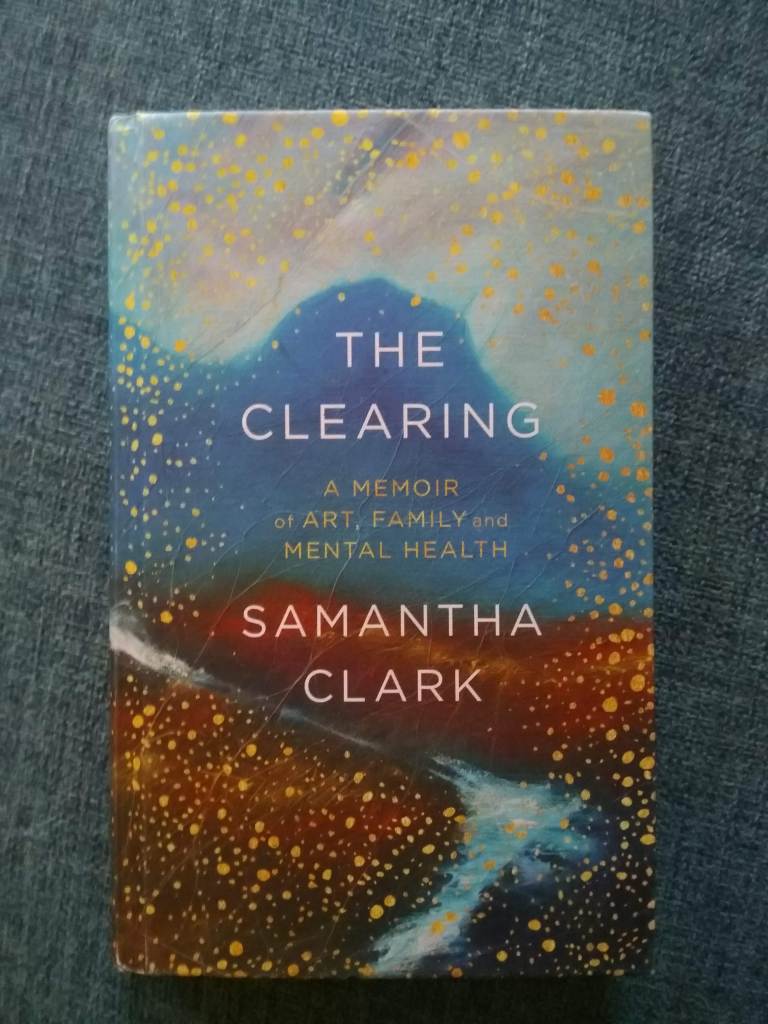
The book broadly follows the process of Clark clearing her parents’ house of a lifetime worth of belongings after their deaths. The clearing is twofold of course, because it’s also about memory, and in Clark’s case, dealing with the legacy and repercussions of her mother’s mental illness. As she wrote in a Instagram post on World Mental Health Day, ‘this is something that doesn’t just affect those who are ill, but everyone who loves and relies on them too’. It’s a memoir about some of the tough aspects of emotional life, but it’s not brutal or grim in the way you might fear a book about this could be. It is actually hopeful and there’s a calm quality to it that makes it easy to read and digest.
Reading the acknowledgements – I start with the acknowledgements, because I’m desperately nosey and I want to know about the writer whose world I’m about to immerse myself in – it was interesting to find out that the book didn’t start as a memoir. It was meant to primarily be about ‘the spaces between things’, meditations on philosophy and science that are part of Clark’s art practice.
The writings on art take a backseat to reflections on life and family, but the style is undoubtedly formed and informed by the piercingly observant eyes of an artist, one deeply connected to place and sensitive to the meaning of everyday things: ‘Memory is not just in the mind. It lives in actual places, in actual things. It sits in empty chairs and in worn carpets and smudged walls and light switches. I stand close to the wall and rest my own fingertips against the mark my father’s touch had left, a final intimacy, the closest I will ever get to his physical presence again.’
Clark writes about a worn mark near the light switch in her father’s workroom with precision and poignancy. This writing, this deep attention paid to surroundings, reminds me again how glad I am that artists and writers do all this observing, capturing, distilling. That they share it with me, the reader-observer, so I can be led to notice more, so I can get more out of the ‘stuff of life’, is why I love art. It makes me feel so privileged that I can be on the receiving end of all this work.
When I come to the end of a book, I tend to go back and write down the parts that resonate in my notebook. I read The Clearing back in January, in those pre-pandemic days, but looking in my notebook now, so much remains so utterly relevant to the present. Clark’s reflections on noticing the details, particularly of city life, have stuck with me. This passage helped remind and reassure me of a presence of hope, and I want it to do the same for you.
‘Perhaps every age feels like the end times. May be there is nothing new in this feeling that reality is full of pain and suffering, injustice and degradation, gathering pace, so much, too much to feel it all, so we make ourselves numb. But reality is also and at the same time full of startling beauty. The spinning feather catching the sunlight above the rush hour traffic. The starling on the rooftop signing a song of car alarms and squealing bus brakes. It feels like a small and necessary act of resistance, to pause to listen to the the urban starling’s city song, to attend to the careful washing of a cabbage leaf, to the uncountable blades of grass in my local park, each slender blade performing its own Indian rope trick as it lifts itself miraculously towards the spring sunlight.’
Page 164, The Clearing
These small and necessary acts of resistance are how we will get through this winter. Thank you, Samantha Clark, for reminding us.

 encounters_art
This sounds like a wonderful book, I love how she describes memory living in physical things. You started your year with it and I may have to end my year with it. Thanks for the recommendation! Bx
LikeLike
Lovely review. It’s a task with so many layers of meaning and memory. A strange mixture of contact with the person who has died, and awareness of how missing they are, how inexplicably gone from everywhere, not just from this chair or study or garden. Thank you – I’d like to read it.
LikeLike